|
| |
|

|
Ancyrean
|
|
Back to Ankara, Turkey
Feb 2003
time: 12:31
|
|
quote:
Originally posted by Ned
Ancryean, did you know that Mohammed has a statue (IIRC) at the Supreme Court? |
It cannot be Mohammed, depictions of him are strictly forbidden in Islam, so actually there's not even a popular face of Mohammed as is the case with Jesus, but I get your point, if you mean there's a statue of some Islamic figure at the Supreme Court, as a sign of impartiality towards religion.
quote:
Originally posted by Ned
No, this is not about the display of Christian symbols. It is about the removal of only Christian symbols. It is an attack by the left on Christianity. |
Actually, the dynamics of this topic is quite familiar with me, as in Turkey there are similar arguements in response to the strictly secular nature of the Turkish state, so I can make some comparisons. For example, it's a big issue in Turkey if women should be ALLOWED to wear headscarves (in many Muslim countries it's FORBIDDEN to take it off!) in public offices, as this would constitute an expression of a religious belief, and would be contrary to the commitment of the state not to be partial towards any religion...
Without distracting too much from the topic, I just want to say that I understand the arguement for the removing an object that puts down one of the basic tenets of a certain faith from public office space (as opposed to a graveyard, as it has been put in this thread), if that country is committed to being impartial with regard to religion. For the strong followers of any religion in question, it might look as an attack on the religion concerned, whereas the impartial nature of a state demands that you refrain from any displays that implies a connection to that religion. (This is different from portraits of Moses...Imagine some Quranic verses forbidding theft, for example, as opposed to some portrait of an Islamic scene from history).
So, the core of the issue here is, if you are against the secular nature of a state, you should say it so instead of trying to reason with acts stemming from a tradition of impartiality with regards to religion...If you are against the removal of the Ten Commandments from a public office of such high stature, you should question the merits of secularism and the seperation of state and religion, instead of trying to prove it doesnt violate the secular principles of the state (I assume the US to be a secular country, my arguements would be moot if I have the wrong idea about this). Otherwise, its removal is, without any doubt, what is demanded by a state governed through principles of secularism...
|
|
| |
|
|
|
Berzerker
|
 |
topeka, kansas,USA
May 1999
time: 23:31
|
|
Ancryean - quote:
Isn't it the case that if you think of those who fervently argue for keeping the monument there in the courthouse, Christianity is central in their lives?... |
I'm not a Christian or a Jew, just someone who believes in freedom, including religious freedom.
quote:
If so, I thought the US was set up as a country taking lessons from the persecutions done by registered (or official) churches in Europe, that the best safeguard for this never to happen again is never to let a particular faith even SEEM more preferential... |
You should read what the Founders wrote, they had no problem stating their religious views and several made it clear they believed God's blessing was upon this nation.
quote:
The whole arguement to keep the Commandments in the courthouse seems to me like an attempt to REGISTER Christianity as "more influental" in the US than other religions (as it has been suggested...And as an outsider, I thought that's exactly the kind of registration that the founding fathers of the US sought to prevent?... |
I'd agree with that assessment, but the 1st Amendment prohibits laws respecting an establishment of religion, not non-legislative religious acts. There is no law involved here... That is what the Framers feared, legislated religion...
Paraphrasing Thomas Jefferson, it is tyranny to compel a man to subsidise opinions he disagrees with. He was condemning the practice of tying the Church in with government where the former lives off taxes imposed by the latter...
|
|
| |
|
|
|
Berzerker
|
|
topeka, kansas,USA
May 1999
time: 23:31
|
|
Spiffor - quote:
Since congress doesn't enforce its religious preference, it doesn't infringe such a right.
But I find it very awkward that congress begins his sessions with a prayer. The religious preference of your country is clearly stated, and it looks very wrong to me.
Now, the day where a sessions will begin with a prayer for each religion present and the US (plus whatever display of atheism), I'd have no problem with it |
That's the key, whether or not a religious preference is enforced or coerced. Actually, James Madison had a problem with opening congressional sessions with prayer too. It was not so much the prayer but he opposed the notion that Congress would hire a minister to offer the prayers. That, he argued correctly, was a legislative act respecting an establishment of religion. But it appears he lost that battle...I guess he didn't want to waste political capital on fighting over it...
Ancryean - quote:
If you are against the removal of the Ten Commandments from a public office of such high stature, you should question the merits of secularism and the seperation of state and religion, instead of trying to prove it doesnt violate the secular principles of the state (I assume the US to be a secular country, my arguements would be moot if I have the wrong idea about this). Otherwise, its removal is, without any doubt, what is demanded by a state governed through principles of secularism... |
This "secularism" stems from the language of the 1st Amendment. "Congress shall make no law respecting an establishment of religion or prohibiting the free exercise thereof"... The 14th Amendment ostensibly applies this restriction on legislative power to the states...
Clearly the words "shall make no law" and "respecting an establishment of religion" are the relevant parts. While "respecting an establishment of religion" may seem ambiguous, what is not ambiguous is the stated restriction - "shall make no law". If there is no law, there can be no violation of the 1st Amendment...
|
|
| |
|
|
|
Rogan Josh
|
|
quote:
Originally posted by molly bloom
Contrary to Rogan Josh?s earlier assertion, Deuteronomy and the Bible are not the origin of English Common Law, or American Common Law.
|
I never said it was. I was objecting to the statement that American Law is Roman. It is not.
I agree that the original English law was not Christian, but since English law is based on precendent and England was a Christian country (on and off) for nearly 1000 years before the formation of the USA, Christian principles and The Bible are a primary influence. This carries over into American law too. I don't see how you can deny this with a straight face....
|
|
| |
|
|
|
Ancyrean
|
|
Back to Ankara, Turkey
Feb 2003
time: 12:31
|
|
The idea of seperation of state and religion stems from the historical experience that most religions will aspire to have control over the state machinary and thus have the sociopolitical tools to fashion the society in the image of that religion. This applies for both internal and foreign policy of the state concerned. In Europe, many wars have been fought to save policymaking from the grips of religious dogmas, and after this was achieved, religion was consigned, for all purposes, to its own sphere.
Even so, people of religious conviction every now and then think this is unfair that their belief cannot have more institutionalised a form, more so directly proportional to the conviction of a person in the "rightness" of his religion. Therefore, what develops in response to an oblivious state is to introduce religion in increments, a reference here, a monument there, a condemnation somewhere, a recommendation somewhere else, and measured over time, it amounts to religion BECOMING a factor in policy making.
Therefore, however politically correct an issue may seem under the light of freedom of expression, the issue is in fact wider than that. Religion has been more a divisive concept for mankind than a uniting one, so an expression of religion for one person may go against the grain of another, and although it seems unimportant if the issue is about a monument or even less, what's at stake is if you start making exceptions of the fundamental caveat and principle of keeping the state out of proximity to any church of belief, lest that others now or in the future, will take this as sufficient cause to divide the society.
If I can infer from the fact that the Founders were grandsons of those persectued in Europe, they should be more aware of the divisive qualities of religion, then I can assume that the US was founded on such a concern and with such a principle as described above, than the issue of the removal of the monument should be seen under the general light and is only approppriate.
Hence,
quote:
Originally posted by Berzerker
Ancryean -
I'm not a Christian or a Jew, just someone who believes in freedom, including religious freedom. |
it's more relevant whether the actions of the people who made the removal of Ten Commandments an issue stem from their religious convictions as opposed to an intellectual concurrance withreligious freedom.
quote:
Originally posted by Berzerker
You should read what the Founders wrote, they had no problem stating their religious views and several made it clear they believed God's blessing was upon this nation. |
Here again, the core issue I would like to touch upon is whether the Founders were establishing a principle as I described above. Stating your personal religious view is perfectly OK in a secular state, and so is to express the belief that God's blessing is upon America. A seperation of state and religion does not necessarily compel individuals to behave like atheists. It just keeps such expressions out of public office sphere, as it perfectly fits the case at hand, the removal of a clear expression (a monument) of religious conviction from a public office. If you consider the evolution of the US, it seems to me there was a clear preference in America to keep the state seperate from religion, regardless of the remarks of the Founders that MIGHT be taken as a wish to set up a state that favors the religion of the majority.
quote:
Originally posted by Berzerker
I'd agree with that assessment, but the 1st Amendment prohibits laws respecting an establishment of religion, not non-legislative religious acts. There is no law involved here... That is what the Framers feared, legislated religion...
Paraphrasing Thomas Jefferson, it is tyranny to compel a man to subsidise opinions he disagrees with. He was condemning the practice of tying the Church in with government where the former lives off taxes imposed by the latter... |
Non-legislative religious acts are precisely the tools employed by religious people to bring the state closer in apperance to their religion. It also has the advantage of sounding politically correct and hence making an issue of principle into an exasperatingly meticulous legalistic issue. So, if in the US the principle of the seperation of state and religion was introduced along concerns I describe here, then the removal of the Ten Commandments from an Office of Court cannot be interpreted as an act of suppression of expression. Because the place of expression is inapproppriate, and gives the exact image that the state is behind that one religion

|
|
| |
|
| |
|
|
|
Ancyrean
|
|
Back to Ankara, Turkey
Feb 2003
time: 12:31
|
|
quote:
Originally posted by Berzerker
I've explained what the 1st Amendment says, what it means, and why it is not violated by a piece of stone placed on public property even if it is a courthouse. That is how we determine if the 1st Amendment has been violated, not if the stone serves as some tool to create an appearance of endorsement. |
Granted. But don't you think this is quite a narrow interpretation, taking it quite literally? Asking from a position of trying to understand the American way of deciding on issues, has there never been an examination of the spirit of the Constitution as a complement to the letter of it? Can issues be boiled down to a study of whether there's anything very specificly forbidding something? Is this the way issues are handled? (No irony intended). When I first heard of the final decision to move the monument, I thought the opposite is obviously the case.
|
|
| |
|
|
|
Imran Siddiqui

|
 |
The Potterverse
Jan 1970
time: 00:31
|
|
quote:
The state is responsible for creating the situation. My God Imran, how can you argue a piece of stone violates the 1st Amendment when it's just a piece of stone but reverse yourself and argue that the state can "ask" little children to stand up in front of others and affirm a religious belief or face potential retaliation from students and teachers? |
Where did I reverse myself? They are two different clauses of the Constitution. The monument deals with the 'Establishment Clause' and the pledge deals with 'Free Exercise'. So the kid can face potentential retaliation for not saying "under God". That's nice. Don't see how that violates his free exercise of religion. He can always not do it. If others retaliate then that is their idiocy and the state has little to do with it, especially when it allows someone to not say the pledge at all and there are laws against battery (retaliation).
quote:
"Free" - Not imprisoned or enslaved; being at liberty.
Not controlled by obligation or the will of another. |
That is the first 2 definitions of a 17 definition term. Selective defining?
http://dictionary.reference.com/search?q=Free
I'll point you to definition 5:
Not subject to external restraint
Being able to have human sacrifices according to your religious beliefs and not have the state intervene is being 'not subject to external restraint'. It is FREE EXERCISE OF RELIGION! The key is that it deals with with the freedom of religion, not the freedom of the people in the religion.
Groups can have freedom while the individuals within those do not. For example when the Catholic Church during the Papal Revolution (Investiture Crisis) called for a 'freedom of the Church'. It called for a freedom solely for the church, not for the members in the church (that wouldn't be articulated until Luther's "Freedom for the Christian").
quote:
That's exactly what "free exercise" requires - the absence of coercion. |
Yes, the absense of coercion for the RELIGION, not the people making up the religion.
quote:
That isn't what happened with Moore, no law was passed. Even you acknowledged no "specific" law was involved... |
Doesn't matter. 'Law' in the 1st Amendment has been expanded to include official acts by members of the government.
quote:
If the Church wanted money from the peasantry, who do you think got the money? The government? I'd call that power. Why did you introduce Scandinavian churches? |
So if the Department of Labor wanted more money from the people (taxes), the fact that the Federal Government got the money means that the Department of Labor has power over the government?!
That's the kind of absurdity you are describing. The Anglican Church was as much a department of the Crown as the Department of Labor is to the US Government. I'd say the Government has power over the DepLabor, not the other way around.
I introduced the Scandinavian Churches because those would be clearly unconstitutional, since they are established churches. The Establishment Clause says nothing about coercion, it simply prohibits an establishment of religion.
quote:
They could before the 14th Amendment |
Can you show me where in the 14th Amendment it says the Bill of Rights must be incorporated into the states? That is a judicially created doctrine... the Judicial Activism you love so much  . .
|
|
| |
|
|
|
chegitz guevara
|
 |
Ft. Lauderdale, FL Communist Party of Apolyton
Jun 2000
time: 00:31
|
|
Damn, wrong thread.
Last edited by chegitz guevara on 06-11-2003 at 03:05
|
|
| |
|
|
|
lord of the mark
|
 |
FUKCOV - Former United Kingdom Colony of Virginia
Dec 2000
time: 00:31
|
|
quote:
Originally posted by Ben Kenobi
Tell me, does that citation favour Judaism, or Christianity? I think that it can be true for both religions. Therefore, the Ten Commandments do not favour one religion over another.
|
so if the state of alabama put up a sign that said that EITHER the Protestant Episcopal Church,USA was the vessell of divine truth, OR the Twelver variety of Shiite Islam, take your pick, that would be OK cause it didnt favor one religion over the other.
BTW, whether it "favours" one religion over the other is obviously irrelevant, since we dont spell that way down here. Im not trying to make a US vz Brit/canadian spelling quibble - just wondering why youre so concerned with establishment of religion issues in the States? I mean i can understand foreigners getting all concerned about Gitmo, or whatever - but seperation of church and State - thats a Yank thing, thank you very much. I mean I dont go around complaining that Queen Liz is the head of the Church of England, and all that.
|
|
| |
|
|
|
Ned
|
 |
of Aptos, CA
Oct 1999
time: 21:31
|
|
Ancryean, you make a lot of good points which I will consider. It is just that you have to consider the larger picture here in the US. There's a cultural war ongoing here in the United States between the religious right and secularist left. The religious right condemns abortion, drug use and sexual libertinism on essentially religious grounds as being immoral. The secularist left condemns all displays of Christian symbols as part and parcel of this war. For example, the Democrats in Congress had been uniformly against any judicial appointee who expresses any firm religious conviction. They have done this so much recently that they have now been called the anti-Catholic party because Catholics are especially hardline on issues of morality.
The left never attacks displays of religions other than Christianity. The displays of a Roman goddesses, Confucius, Buddha or of Islam are never a subject of controversy. Only displays that involve Christianity.
I assume that in Turkey that the problem is not Christianity but Islam. I assume there is no problem in display of Christian symbols in Turkey. Right?
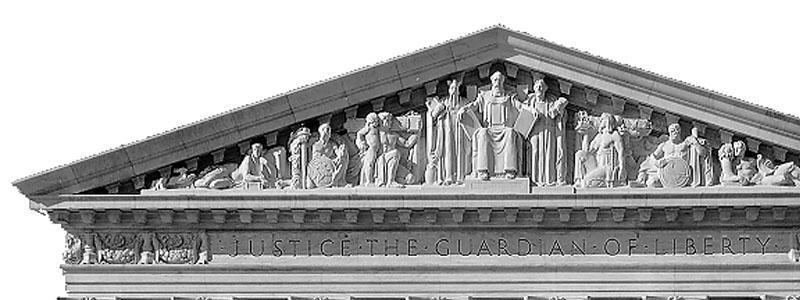
By the way, here is a picture of the East pediment on the US Supreme Court. It displays Confucius, a Chinese religious symbol, and Moses; Moses is holding the Ten Commandments. Any lawsuit filed by the ACLU for removal of the display of religious symbols from the Supreme Court building will, I submit, only involve the removal of Moses and the Ten Commandments.
The left has pushed this issue so far that it is going to become a major issue in future elections.
 Attachment: supremecourt.jpg Attachment: supremecourt.jpg
This has been downloaded 50 time(s).
|
|
| |
|
| |
|
|
|
Rufus T. Firefly
|
 |
is one way of saying it, though I prefer "mensch"
Sep 2000
time: 07:31
|
|
quote:
Originally posted by Ned
I assume that in Turkey that the problem is not Christianity but Islam. I assume there is no problem in display of Christian symbols in Turkey. Right?
|
Not so, as it happens. Turkey's founding constitution actually designates Turkey as a specifically Islamic nation; this is something Ataturk wanted to avoid, but didn't feel he had the political support to fight it. In fact, some religious instruction in the nature and history of Islam is required in the Turkish state schools, and the two big Islamic holidays -- the 3-day Sekir Bayram at the end of Ramazan and the 3-day Kurbun Bayram about 45 days later -- are both government holidays as well. Turkey only really regulates those aspects and symbols of Islam that it regards as actually Islamicist, and therefore a threat to the secular nature of the state; chief among these is the wearing of headscarves at schools or government functions.
Christianity, on the other hand, has a curious presence here. At the beginning of the Republic, when Turkey declared itself officially Islamic, the only other permitted religions became those that were "grandfathered" in by virtue of being tolerated under the Ottoman Empire. Thus, Orthodox Christianity is a legal religion here, as is Catholicism, I believe (a legacy of the Ottomans' long, close relationship with France, as well as with the city-states of Venice and Genoa). Judaism is also legal. But Protestantism, AFAIK, is illegal, and Christian missionaries are routinely harrassed for prosthetizing; the only public Protestant house of worship in Ankara is on the grounds of the British embassy, and therefore technically not in Turkey.
Turkey's one working model of how to have a secular state, but not of how to preserve freedom of religion.
|
|
| |
|
|
|
Ancyrean
|
|
Back to Ankara, Turkey
Feb 2003
time: 12:31
|
|
quote:
Originally posted by Ned
Ancryean, you make a lot of good points which I will consider. It is just that you have to consider the larger picture here in the US. There's a cultural war ongoing here in the United States between the religious right and secularist left. The religious right condemns abortion, drug use and sexual libertinism on essentially religious grounds as being immoral. The secularist left condemns all displays of Christian symbols as part and parcel of this war. For example, the Democrats in Congress had been uniformly against any judicial appointee who expresses any firm religious conviction. They have done this so much recently that they have now been called the anti-Catholic party because Catholics are especially hardline on issues of morality. |
Yep, I see the issue has a very different nature in the US. I was just comparing the concept of secularism as I understand it from my upbringing in Turkey as opposed to how it plays out in a specific issue like this one in the US.
quote:
Originally posted by Ned
The left never attacks displays of religions other than Christianity. The displays of a Roman goddesses, Confucius, Buddha or of Islam are never a subject of controversy. Only displays that involve Christianity. |
I can't say anything about the interplay of the left and right on religion in the US, but actually, the situation about displays of Christianity as you put here only makes sense, because separation of church and state is implemented most vigourously with regards to any religions that have the highest potential to be influential in state affairs. So, although the principle demands a uniformity of action in response to anything religious (public displays of ANY religion that would imply a preferential position), in practice only the religion that is dominant in the society gets the most reaction...Ten Commandments, despite their Judaic origins (gosh, I almost typed "Mosaic" there, I mean, from Moses  ) are so basic for Christianity, it transcends (or underlies) ALL brands of Christianity (correct me if I'm wrong here) so much so that it is inevitably associated with Christianity in general without the need for any reference to which particular church, and thus draws the most attention...Making a wild analogy, I would go on to say, if the Roman Gods had tens of millions of followers in the US, their display in public offices would attract quite a reaction, and thus be subject to discussions of freedom of religion (man, I hope this is making sense...I don't know, I hope you catch my drift...) Actually, the absence of any following to Roman Deities and the insignificant degree of following of Confucianism or whatnot in the US makes the symbols of them de-religionised. That's why I was talking about the principle behind the idea of secularism and not about legalistic interpretations of the relevant Amendments to the US Constitution. The principle explains what seems to be most exasparating, the issue of why Christian symbols are always the matter... ) are so basic for Christianity, it transcends (or underlies) ALL brands of Christianity (correct me if I'm wrong here) so much so that it is inevitably associated with Christianity in general without the need for any reference to which particular church, and thus draws the most attention...Making a wild analogy, I would go on to say, if the Roman Gods had tens of millions of followers in the US, their display in public offices would attract quite a reaction, and thus be subject to discussions of freedom of religion (man, I hope this is making sense...I don't know, I hope you catch my drift...) Actually, the absence of any following to Roman Deities and the insignificant degree of following of Confucianism or whatnot in the US makes the symbols of them de-religionised. That's why I was talking about the principle behind the idea of secularism and not about legalistic interpretations of the relevant Amendments to the US Constitution. The principle explains what seems to be most exasparating, the issue of why Christian symbols are always the matter...
|
|
| |
|
|
|
Berzerker
|
|
topeka, kansas,USA
May 1999
time: 23:31
|
|
Ned - quote:
There's a cultural war ongoing here in the United States between the religious right and secularist left. The religious right condemns abortion, drug use and sexual libertinism on essentially religious grounds as being immoral. |
Now this is where we have violations of the establishment clause. The "religious right" has legislated it's religious views in a number of areas and then they accuse the people who don't want these views imposed upon them of "bigotry" or being anti-Christian as if Jesus commanded his followers to run around jailing non-believers.
Imran - quote:
Where did I reverse myself? |
I just explained where.
quote:
They are two different clauses of the Constitution. The monument deals with the 'Establishment Clause' and the pledge deals with 'Free Exercise'. |
No, they both deal with the establishment clause and the pledge also deals with the free exercise clause. Regarding the pledge, the state is "asking" children to affirm a religious belief, that goes to the heart of an establishment of religion and religious freedom.
quote:
So the kid can face potentential retaliation for not saying "under God". That's nice. |
No Imran, that's coercion.
quote:
Don't see how that violates his free exercise of religion. He can always not do it. If others retaliate then that is their idiocy and the state has little to do with it, especially when it allows someone to not say the pledge at all and there are laws against battery (retaliation). |
The state created the coercive situation.
quote:
That is the first 2 definitions of a 17 definition term. Selective defining? |
You need the entire definition? Have you found an opposite meaning among those 17? If not, then what I offered is enough.
quote:
I'll point you to definition 5: |
Oh, selective defining?
quote:
Not subject to external restraint
Being able to have human sacrifices according to your religious beliefs and not have the state intervene is being 'not subject to external restraint'. It is FREE EXERCISE OF RELIGION! The key is that it deals with with the freedom of religion, not the freedom of the people in the religion. |
Imran, is murder an external restraint? Sheesh, you have a mental block.  If murder is an external restraint, then murder is not an act of freedom. And if murder is not an act of freedom, it is not an act of religious freedom and a law prohibiting murder does not constrain anyone's freedom. If murder is an external restraint, then murder is not an act of freedom. And if murder is not an act of freedom, it is not an act of religious freedom and a law prohibiting murder does not constrain anyone's freedom.
quote:
Groups can have freedom while the individuals within those do not. For example when the Catholic Church during the Papal Revolution (Investiture Crisis) called for a 'freedom of the Church'. It called for a freedom solely for the church, not for the members in the church (that wouldn't be articulated until Luther's "Freedom for the Christian"). |
And? I wish I could respond with more but you've gone from a debate about the meaning of religious freedom in the 1st Amendment to something the Catholic Church did.
quote:
Yes, the absense of coercion for the RELIGION, not the people making up the religion. |
Who do you think practices religions? There would be no religion without adherents...
quote:
Doesn't matter. 'Law' in the 1st Amendment has been expanded to include official acts by members of the government. |
It was expanded? When? What amendment re-wrote the 1st Amendment?
quote:
So if the Department of Labor wanted more money from the people (taxes), the fact that the Federal Government got the money means that the Department of Labor has power over the government?! |
The Dept of Labor is part of the government.
quote:
That's the kind of absurdity you are describing. The Anglican Church was as much a department of the Crown as the Department of Labor is to the US Government. I'd say the Government has power over the DepLabor, not the other way around. |
You didn't answer my question. If the Church of England wanted money from the peasantry, who got the money? Trying to equate the Church with a government bureaucracy won't cut it, the Church and the British government were allied but separate entities often at "war" with each other in struggles over power sharing.
quote:
I introduced the Scandinavian Churches because those would be clearly unconstitutional, since they are established churches. The Establishment Clause says nothing about coercion, it simply prohibits an establishment of religion. |
No Imran, the 1st Amendment prohibits LAWS respecting an establishment of religion. If there are no laws made respecting an establishment of religion, the 1st Amendment remains intact.
quote:
Can you show me where in the 14th Amendment it says the Bill of Rights must be incorporated into the states? That is a judicially created doctrine... the Judicial Activism you love so much . |
Section 1 - "No State shall make or enforce any law which shall abridge the privileges or immunities of citizens of the United States; nor shall any State deprive any person of life, liberty, or property, without due process of law; nor deny to any person within it's jurisdiction the equal protection of the laws."
|
|
| |
|
|
|
Ancyrean
|
|
Back to Ankara, Turkey
Feb 2003
time: 12:31
|
|
quote:
Originally posted by Rufus T. Firefly
Not so, as it happens. Turkey's founding constitution actually designates Turkey as a specifically Islamic nation; this is something Ataturk wanted to avoid, but didn't feel he had the political support to fight it. In fact, some religious instruction in the nature and history of Islam is required in the Turkish state schools, and the two big Islamic holidays -- the 3-day Sekir Bayram at the end of Ramazan and the 3-day Kurbun Bayram about 45 days later -- are both government holidays as well. Turkey only really regulates those aspects and symbols of Islam that it regards as actually Islamicist, and therefore a threat to the secular nature of the state; chief among these is the wearing of headscarves at schools or government functions.
Christianity, on the other hand, has a curious presence here. At the beginning of the Republic, when Turkey declared itself officially Islamic, the only other permitted religions became those that were "grandfathered" in by virtue of being tolerated under the Ottoman Empire. Thus, Orthodox Christianity is a legal religion here, as is Catholicism, I believe (a legacy of the Ottomans' long, close relationship with France, as well as with the city-states of Venice and Genoa). Judaism is also legal. But Protestantism, AFAIK, is illegal, and Christian missionaries are routinely harrassed for prosthetizing; the only public Protestant house of worship in Ankara is on the grounds of the British embassy, and therefore technically not in Turkey.
Turkey's one working model of how to have a secular state, but not of how to preserve freedom of religion. |
Hi Rufus . The secular nature of the state is first enshrined in the second constitution of Turkey, and the thing about the seperation of state and religion in Turkey is that in fact it's not a seperation by the full meaning of the word, it's rather state control over religion. State watches over the training and assignment of imams, and religious schools are permitted only under the aegis of the state. That's why for example, the universal nature of the Greek Orthodox Patriarch is not recognised by the state (he'd be out of state's oversight if he were a universal figure -like the Pope- so he's considered as the leader of only the Greek Orthodox Christians in Turkey, whereas the Orthodox take him as some kind of a Pope) and the Convent that trains bishops for the Patriarchate remains closed (they insist it to be an independent entity).
About Protestantism, it cannot be illegal in Turkey, as there's a Protestant Armenian church in Istanbul.
Anyway, to connect all this to the discussion at hand, it seems to me that in the US the discussion about secularism is more issue-intensive, where the topic comes up only when there's an incident inspiring reaction (mostly) from religious people. Otoh, in Turkey the more tangible nature of a potential Islamic takeover made secularism an untouchable article of faith
and issues are handled from that starting point.
Actually, it's amazing that I started to come across references to Christian fundamentalism after 9/11 more and more (maybe it was always there in US public debate and I wasn't aware, or maybe taking the clue from Islamic fundamentalism people started to talk about it more...And yes, I know, this is a highly political issue in the US )
|
|
| |
|
| |
All times are GMT. The time now is 05:31.
Apolyton Time is 00:31. |
top of page
|
| archivepost |
|
Forum Rules:
You may not post new threads
You may not post replies
You may not post attachments
You may not edit your posts
|
HTML code is ON
vB code is ON
Smilies are ON
[IMG] code is ON
|
|
|
|
|
|






 05-11-2003 13:20


 Don't you support the GOP and the drug war? Freedom is the absence of coercion or constraint on choice or action, freedom is not a "right" to remove religious expression from public life.


 |
|