|

|
LDiCesare
|
|
La Ferté sous Jouarre France
Jan 2001
time: 05:35
|
|
Just note that diagnostic output can already be found in the social.txt file. This really only about UI. I don't think a # would be of any help when representing EGs. Ethnicity should be enough to get a good view.
|
|
| |
|
|
|
manurein
|
|
Paris, France
May 1999
time: 05:35
|
|
Hi all
There is a game called Victoria, by Paradox (makers of Europa Universalis). Historical game that runs from 1836 to 1920.
Like in Clash they have EGs in their social model (strangely there really are ideas in this game that resemble concepts that have been discussed on this forum for years ...) and they have an interface that may be interesting for you.
I will try to describe it :
- they have three levels like you : nation, region/state, province.
- they have groups of population that are defined by a nationality, a religion and a social status/job (that are labourer, farmer, employee, aristocrat, slave, clergyman, business man and craftsman). those groups of population also have some political / social preferences and problems.
- at the province (tile in Clash) level you have a detailed display of each group of population with every information in text.
- at the other level you have a synthetic information with cheese graphs that show the split of population by nationality, religion and social status/job, political preferences / problems ...
- in the overall UI, there is a map (with layers) on the screen, with a panel on the right and a semi-transparent message board on the bottom. when you click on something on the map (region, province, unit ...) details are displayed on the right panel. There are also three main buttons on the top of the screen :
- a button gives acces to "empire" management : the right panel gives acces to overall information / management of budget, commerce production, politics, social management, diplomacy
- a button gives access to military management
- a button allows the user to browse the empire by region.
OK, I just thought this may give you some ideas for your UI ...
Cheers
Manu
|
|
| |
|
|
|
LDiCesare
|
|
La Ferté sous Jouarre France
Jan 2001
time: 05:35
|
|
Is Victoria UI actually ergonomic? From the screenshots I saw, that wasn't obvious. If it's actually easy to use and understand, then I will check it more.
How do you get to the intermediary (region/state, province in Clash) level of detail?
|
|
| |
|
|
|
manurein
|
|
Paris, France
May 1999
time: 05:35
|
|
Salut Laurent - Hi Laurent
Actually, given the complexity of the game itself, it's difficult to say that Victoria's UI is simple : it is complex. However it is usable.
For a good overview of the Ui with screenshots etc you can check this URL :
http://victoria.nsen.ch/interface_guide/
I'd be very happy to discuss this further with you if you feel it necessary or interesting.
Cheers
Manu
One last request to Mark : I'd be very happy to playtest the beta demo 8. Is it possible ?
|
|
| |
|
|
|
manurein
|
|
Paris, France
May 1999
time: 05:35
|
|
Answer to your question :
you have two ways to access the intermediary level :
- on the main screen (map), when you first click a place on the map you access the region level (on your territory); on the second click in the same region you access the province (tile) level
- as stated, you also can access a list of all your regions on the left panel (BTW I made a mistake : what I called the right panel is actually on the left of the screen); when you click an entry of that list you access the region you clicked.
Hope it answers your question (this may be clearer with the help of screenshots).
Manu
|
|
| |
|
|
|
LDiCesare
|
|
La Ferté sous Jouarre France
Jan 2001
time: 05:35
|
|
I checked that link. Wow, complex it is. In fact, I have started creating a pie chart widget which I want to use to display the proportions of ethnic groups and maybe social classes. Though I don't know if I want to show social classes as tehy are or the breakdown that they induce in terms of political power blocks.
For the testbench, you should ask Mark, but I think he's travelling right now. I can't send it to you either because I'm not home now and am on vacation early july, so I won't be active here before the 10th of july or so.
|
|
| |
|
|
|
manurein
|
|
Paris, France
May 1999
time: 05:35
|
|
Thx for this replyu Laurent.
Bonnes vacances.
Manu
|
|
| |
|
| |
|
|
|
LDiCesare
|
|
La Ferté sous Jouarre France
Jan 2001
time: 05:35
|
|
quote:
When I try to run the scenario itself rioting at home overpowers me almost immediately. |
Actually that's on purpose. I made it so the riots were maximised, so you have to use the ruler panel immediately. I should say so in the opening panel.
You must go the rulers panel and change policies based on what the various political power blocks want.
It's probably not obvious what the faces buttons do or mean. I'll explain it a bit in the main panel. Click the pie icon, you'll see what the political power blocks want, and if you set all policies to that level, you shouldn't have trouble, at least until you conquer Greeks and later on Persians.
As an alternative, you can use the social button which can automate this a bit.
I'll try to explain this more in the opening bulletin.
I'll see what I can do for Jericho. Maybe adding population and one or two units would let the player hold off the ai while they attack them. Or let some civs be at war with one another instead of all against Jericho.
|
|
| |
|
|
|
alms66
|
|
Louisiana
Oct 1999
time: 23:35
|
|
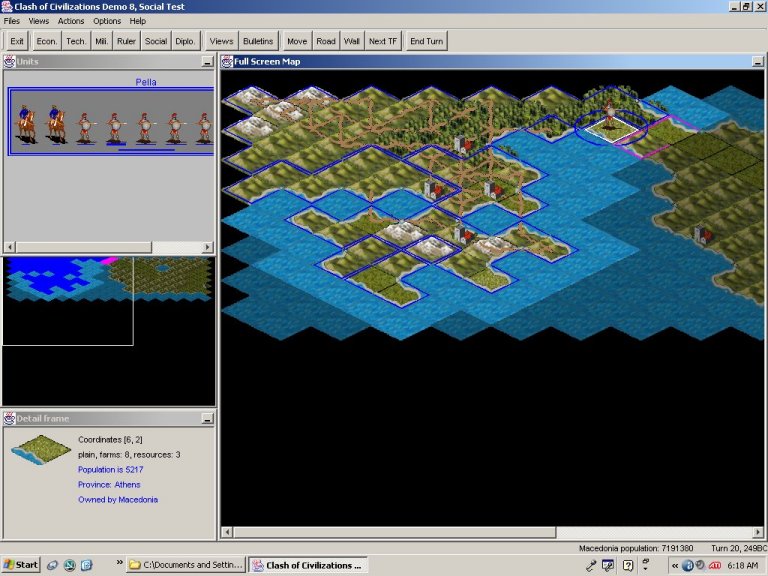
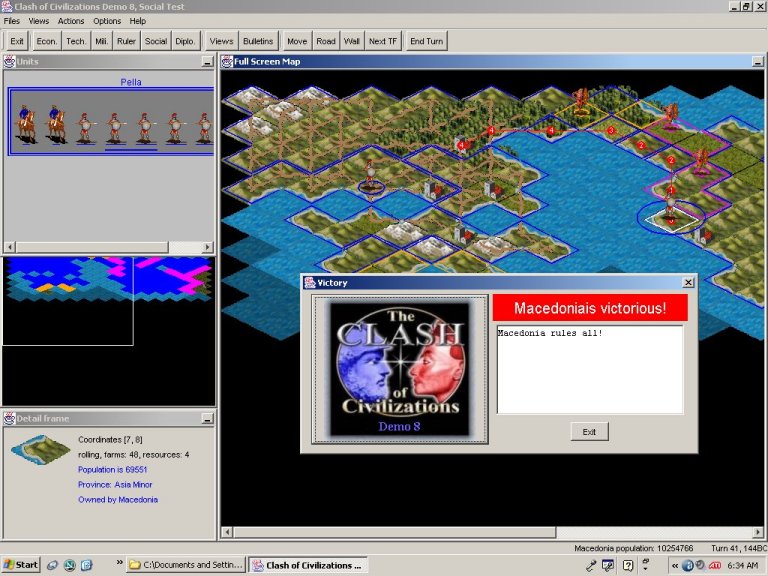
I came ridiculously close to beating the social test a few minutes ago. I figured out the perfect settings, which allow you to conquer and pacify all the Greeks, but if you take a Persian square, it's riot city. Set all policies, except the first (taxes) and the last (social policy) to 50. This should allow you to go riot-free while conquering the Greeks. I also set the ruler's power to 70 and all others except "human" and "bureaucracy" to 10, though sometimes I didn't and it seemed to have little effect.
The second key to winning this scenario is road building (I set mine at 5). You have to build roads in all your major squares in order to quickly move about your empire, fending off attacks from the Persians in the east while conquering the Greeks in the south. But, you have to build them at the perfect moments... that is, right before you need them, otherwise, the enemy uses them against you! It would take too long to describe the exact sequence, but here's a hint:
Don't build a road on the flat square adjacent to Persia. - Ever!
No matter how close I came, I couldn't beat it. This has convinced me that we need to add one of two things in to make this winnable:
1. Add a second army about 75% of the power of the current one, and adjust the current one's power down 75%.
-or-
2. Add the ability to build units. As it is now, now matter how high I set the construction input, I never get units built. Is this even intentional?
Personally, I think #2 is the better choice. If #1 were implemented, I think the scenario would be a cakewalk.
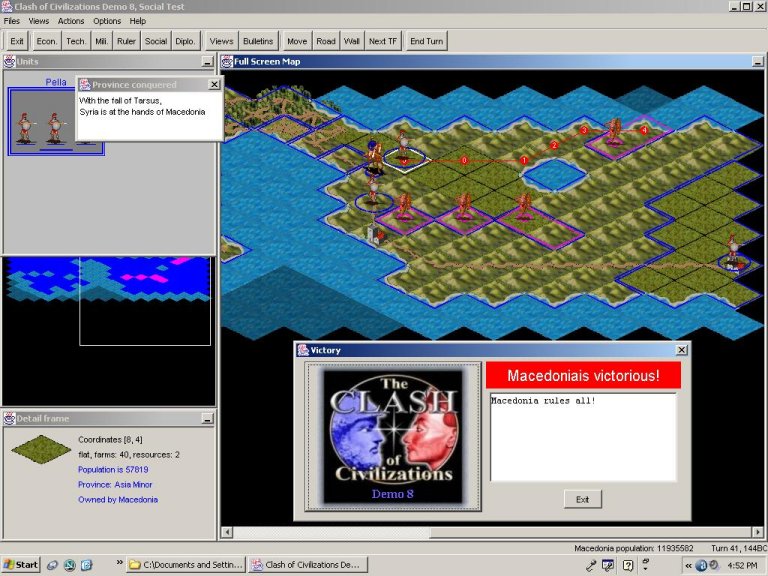
As a side note, I actually did beat it once, but I don't know how or why. I was down to 4-6 squares under my control, but still held Pella, which is why I suspect I won, after having conquered all the Greeks and having them taken away by Persia during their onslaught.
|
|
| |
|
|
|
alms66
|
|
Louisiana
Oct 1999
time: 23:35
|
|
And the second...
Here you can see just how deep into Persian territory I got!
 Attachment: social scenario screenshot2.jpg Attachment: social scenario screenshot2.jpg
This has been downloaded 44 time(s).
|
|
| |
|
|
|
Mark_Everson
|
 |
Canton, MI
Jan 1970
time: 00:35
|
|
quote:
Originally posted by alms66
The second key to winning this scenario is road building
(snip)
2. Add the ability to build units. As it is now, now matter how high I set the construction input, I never get units built. Is this even intentional?
|
I like the road building idea, that makes sense.
Not being able to build units is. I believe not a direct intention of Laurent. It is a consequence of two aspects of the scenario. The first is that very low tax rates are needed to keep people happy, and so little economic power is available for the govt. The second is that the econ model assumes that provisioning the troops always comes first, before building more units etc.
With the starting armies, supplies consumes all available resources pretty much. (a few other builds may get through if they use different resources from army supplies.) Only when you either radically increase the size of your economic base, or alternatively lose enough troops, do you get out of this regieme.
Obvious fixes are to either make the economy more productive (increase tech level seems best) or change the amt. of supplies needed for an army. Another solution is to remove the assumption that full supplies should be maintained as a first priority. I don't like that since once that auto feature is shut off the player would need to mess with the supplies regularly to stop the supply situation from going out of whack.
Fixing this problem was going to be my next step, but I don't know when it'll happen. If you want to change the tech levels by editing the scenario file, you might be able to fix it yourself!
|
|
| |
|
|
|
LDiCesare
|
|
La Ferté sous Jouarre France
Jan 2001
time: 05:35
|
|
I beat it regularly too  . I usually control the whole map by turn 50. . I usually control the whole map by turn 50.
I don't actually build roads, but it can help. Units start being built around the time when you have conquered all Greece and some of Persia. It's indeed more of a side effect than anything else, but it's nice with me. And since you said a solution could be to add an army, well, what I do is to split mine in two and send some to the northeast...
The side effects of riots are not always drastic. When you have 3 or 4% riots probability in every square, you actually have no riot, or the riotting is limited and doesn't cause rebel units creation.
The social model in this scenario is indeed hard, but it's the way I wanted it. You have very little to maneuver around, but it's a design choice. In a game where the ethnic groups have less different preferences, you'd have much more freedom. Then again, the things which actually do something in the social model are very limited: Discrimintation has its own effects, tax rates are important, but the rest have no actual meaning in the game as of now. For instance slavery should actually do something instead of just being a slider. Anyway, if you think there's not enough room to maneuver around, I'd rather change the figures in the scenario (make Persians more like the Greeks) than touch the social model/code itself.
|
|
| |
|
|
|
alms66
|
|
Louisiana
Oct 1999
time: 23:35
|
|
I tried playing the social test scenario using the “new” social panel, and I’m sorry to say that I fail to see its usefulness other than a slight aid in my micromanagement technique I explained previously, as it allows you to micromanage before the riots happen, rather than after. Each turn, throughout the entire game, I opened the panel and hit the apply button to try and prevent rioting (and thus using the suggested settings every turn of the game). Most turns afterwards I ended up with rioting and rebel formation. The rioting was so severe in Persia as to actually destroy my invading army.
Turn after conquering western Persia
Meanwhile back at home the rebels grow in power
And then the Spartan rebels join in...
Had this been the complete AI, the Persians would have pressed their advantage and wiped me out, or so I'd hope. Contrast this with the technique I described, which produced “0” rebels…, absolutely none.
And the final shot of rebel power...
So you see Laurent, my problem origionally was that I couldn't control the rioting or rebels actually, which made the scenario suck. Then I learned how to get rebel formation down to '0', but it is micromanagement intensive. Now using the social panel is less micromanagement intensive, but I have more rebels than if I'd micromanage the thing, which is IMO, unacceptable. It's not that the social model is set too high, because I've already shown that I can keep rebel formation down to '0'. The problem is that the panel doesn't do an optimal job and in fact makes the scenario harder than it really is.
|
|
| |
|
|
|
alms66
|
|
Louisiana
Oct 1999
time: 23:35
|
|
There is also a problem with the panel itself, and since a picture is worth a thousand words...here you go:
Panel Problem
BTW, should we start a thread specifically for this scenario? We've done an awful lot of discussion on it lately.
|
|
| |
|
|
|
alms66
|
|
Louisiana
Oct 1999
time: 23:35
|
|
Now, contrast the previous game's dire situation with this game, using my method of riot control (never saw a rebel once). This is just after defeating the Persians invasion force. Roads, as you can see, are useful for hunting down pesky invaders who run rather than fight (I still hate this aspect of Clash, and we really need to do something about this soon), which is why I suggested their use before, though they aren't vital to winning, their use does keep me from getting annoyed with situations such as this single Spartan unit that has been running away from me for almost 20 turns now.
Anyhow...
Western Empire
Eastern Empire
|
|
| |
|
|
|
LDiCesare
|
|
La Ferté sous Jouarre France
Jan 2001
time: 05:35
|
|
The social panel has indeed some problems.
The user interface one is that the pies at the top get eaten by what's below.
The other one is the ai doesn't always find a solution for your problems. That's in fact because I use a gradient algorithm, which depends a lot on the starting conditions. If you start with something awful, then the social model doesn't help you much.
The main usefulness of the panel for me is to check a priori the exact state of the land. You can change the policies in the ruler panel and see the effect that will happen next turn thanks to that panel. I think this is helpful.
I agree that the ai should be better than it currently is, but it's hard to find a solution when you're stranded far from any good solution. I could use genetic algorithms or simulated annealing to that end, but didn't take time to do it before the simple solution had some feedback.
Then again, I see this panel as a help feature and a debugging feature. If things are mostly good, the panel can help, but when it's hard, you shouldn't let the ai control the game in your place. As for debugging, it's helpful because it lets me know what the ai does (since it uses the same bit of code as the one behind the panel).
I'll check if I can put some genetic algorithm inside.
|
|
| |
|
|
|
alms66
|
|
Louisiana
Oct 1999
time: 23:35
|
|
There's no need to get extremely complicated with this. As I've been explaining, move 10 points towards the result desired by the people when one of the low-intensity riots occurs. That's all I do when I play and I never have a problem with rebels. Having to do it manually is only slightly harder than if this panel would automate it for you is all I'm saying - and people will do it manually if they get some benefit out of it. Since I've started using this method, I've had only one rebel crop up....ever....thus you're, in essence, getting a good ai for real cheap.
If you want to get somewhat complicated with it, change the amount moved depending on the difference between the current level and the desired amount.
For example:
Difference/Move
5/1
10/2
20/5
40/10
So if the current policy is 40 and they want 0, move 10 points closer to the desired result, or 30. If the current policy is 55 and they want 40, then move by 5 towards 40, or set it to 50.
If you insist on implementing a GA, that's your decision, but I'm certain it will take at least twice as long to calculate as it would to look this up.
-Edit-
How, exactly, do you currently calculate the suggested results? Could you give an example, please?
|
|
| |
|
|
|
LDiCesare
|
|
La Ferté sous Jouarre France
Jan 2001
time: 05:35
|
|
What you do is the algorithm I use, more or less, that is a gradient search (move policy towards the desired policies).
You should check the ai.txt file generated by the game to see what the ai is doing:
I move the policies towards the policies wanted by riotters by a small step, recompute all riots, check if the overall riots are lower. If they are, I continue moving in that direction until I no longer get any gains.
The problems are that I check for each riot one by one, and the last riots checked for may have more influence than the first ones. Reducing the step helps here. However, there is a bug where I sometimes find a good solution and don't apply it:
-- AI proposing policies Macedonia
-- AI adjusting policies Macedonia -- start
*** Iterating policies change ***
Current dicontent value = 11.573602
AI adjusting policies from: Government Policies: ----------
Data:
game.government.PowerStructure$Worker@14627a: 0.0
game.government.PowerStructure$Warfare@166bfd8: 0.2
game.government.PowerStructure$Bureaucracy@20807c: 0.0
game.government.PowerStructure$Ruler@1931579: 0.5
game.government.PowerStructure$Ethics@bd09e8: 0.2
game.government.PowerStructure$Capital@d58ce2: 0.0
game.government.PowerStructure$Human@4d41e2: 0.1Negotiated policies:
Tax rate: 10%
Civil rights: 38%
Ethnic discrimination: 20%
Religious discrimination: 20%
Slavery: 0%
Foreign policy: 56%
Regime policies:
Private property: 80%
Social policy: 10%
to: Government Policies: ----------
Data:
game.government.PowerStructure$Worker@14627a: 0.0
game.government.PowerStructure$Warfare@166bfd8: 0.2
game.government.PowerStructure$Bureaucracy@20807c: 0.0
game.government.PowerStructure$Ruler@1931579: 0.5
game.government.PowerStructure$Ethics@bd09e8: 0.2
game.government.PowerStructure$Capital@d58ce2: 0.0
game.government.PowerStructure$Human@4d41e2: 0.1Negotiated policies:
Tax rate: 2%
Civil rights: 55%
Ethnic discrimination: 0%
Religious discrimination: 50%
Slavery: 52%
Foreign policy: 50%
Regime policies:
Private property: 80%
Social policy: 10%
Result dicontent value = 5.5738697
*** New policies are kept. ***
*** Iterating policies change ***
Current dicontent value = 5.5738697
AI adjusting policies from: Government Policies: ----------
Data:
game.government.PowerStructure$Worker@14627a: 0.0
game.government.PowerStructure$Warfare@166bfd8: 0.2
game.government.PowerStructure$Bureaucracy@20807c: 0.0
game.government.PowerStructure$Ruler@1931579: 0.5
game.government.PowerStructure$Ethics@bd09e8: 0.2
game.government.PowerStructure$Capital@d58ce2: 0.0
game.government.PowerStructure$Human@4d41e2: 0.1Negotiated policies:
Tax rate: 2%
Civil rights: 55%
Ethnic discrimination: 0%
Religious discrimination: 50%
Slavery: 52%
Foreign policy: 50%
Regime policies:
Private property: 80%
Social policy: 10%
to: Government Policies: ----------
Data:
game.government.PowerStructure$Worker@14627a: 0.0
game.government.PowerStructure$Warfare@166bfd8: 0.2
game.government.PowerStructure$Bureaucracy@20807c: 0.0
game.government.PowerStructure$Ruler@1931579: 0.5
game.government.PowerStructure$Ethics@bd09e8: 0.2
game.government.PowerStructure$Capital@d58ce2: 0.0
game.government.PowerStructure$Human@4d41e2: 0.1Negotiated policies:
Tax rate: 4%
Civil rights: 38%
Ethnic discrimination: 50%
Religious discrimination: 29%
Slavery: 0%
Foreign policy: 57%
Regime policies:
Private property: 80%
Social policy: 10%
Discontent = 11.581794 >= 5.5738697: changes aborted.
-- AI adjusting policies Macedonia -- ended
We start from the poor
Tax rate: 10%
Civil rights: 38%
Ethnic discrimination: 20%
Religious discrimination: 20%
Slavery: 0%
Foreign policy: 56%
The ai finds that
Tax rate: 2%
Civil rights: 55%
Ethnic discrimination: 0%
Religious discrimination: 50%
Slavery: 52%
Foreign policy: 50%
is better,
but doesn't propose this but proposes
Tax rate: 4%
Civil rights: 38%
Ethnic discrimination: 50%
Religious discrimination: 29%
Slavery: 0%
Foreign policy: 57%
instead even though it knows it is a worst policy.
If I can fix that, the ai should work much better.
You don't have the details of all iterations in the above figures, but can see the steps are a bit large, as the ai will happily move up to 30% a figure in one pass, which is probably too much for it to converge, but it must move a lot in order to get out of the initial pitiful policies I provided the player..
Also note one thing: When you have armies somewhere, this lowers riotting. If your army moves, unexpected riots may happen.
|
|
| |
|
|
|
LDiCesare
|
|
La Ferté sous Jouarre France
Jan 2001
time: 05:35
|
|
I corected that a bit. It's better but not yet perfect. I hardcoded a limit, that is the ai won't adjust tax rates, since it happens to lower taxes to a level where you are really harmed by it. I should provide a lock mechanism which lets you precise which parameters are allowed to tune. That window could probably merge with the ruler window somehow though I'm not sure exactly how.
|
|
| |
|
|
|
alms66
|
|
Louisiana
Oct 1999
time: 23:35
|
|
quote:
Originally posted by LDiCesare That window could probably merge with the ruler window somehow though I'm not sure exactly how. |
I would add another button at the bottom of the ruler panel (I don't know what to call it - demographics maybe?), and move the 'social panel' to that panel instead. Add locks on the current ruler panel next to the policies, and when they are locked, have the ai not change those.
|
|
| |
|
|
|
alms66
|
|
Louisiana
Oct 1999
time: 23:35
|
|
Another 'bug' to add to the list...
In playing around with the testbed today, trying to find the map size that would fill the entire minimap screen, I discovered that generating a map larger than:
width=67
height=134
causes a problem with the minimap as seen in the attatched image. I didn't go further to test whether it was the width or the height because, as you may have noticed, I was trying to keep the map square.
Attachment: error.jpg
This has been downloaded 19 time(s).
|
|
| |
All times are GMT. The time now is 05:35.
Apolyton Time is 00:35. |
top of page
|
|
|
Forum Rules:
You may not post new threads
You may not post replies
You may not post attachments
You may not edit your posts
|
HTML code is ON
vB code is ON
Smilies are ON
[IMG] code is ON
|
|
|
|
|
|





 12-06-2004 23:09


 However. . .
 What am I doing wrong?
 , it means that Clash (even now) does have that same appeal that used to keep me glued to Civ for endless hours.
  Once I learned how to control and prevent rebels from cropping up, the scenario got much easier because then it merely became a conquest scenario. I don't think there's anything wrong with it anymore (that's what I meant by "scratch that") and I believe we should leave it as is. I could write a step-by-step guide to beating it into the scenario file (a sort of tutorial, as is presented in the Dawn scenario), if you think that would be a good idea.
 |
|