|
| |
|

|
Adam Smith
|
 |
Maryland, USA
Jan 1970
time: 00:33
|
|
Kid and LoA each have it about half right. Here is a rough sketch of what is going on.
The graph shows the US cotton market. The price of cotton is on the vertical axis, while quantity is on the horizontal. The domestic supply curve is S, the domestic supply curve with subsidy is S’. If the subsidy is $t per ton, then S’ is $t below S. In other words, domestic producers will supply a given quantity at $t less than they used to because they can pocket the subsidy. Pw is the world price, and there is assumed to be a perfectly elastic supply at this price. Initial equilibrium is at e. Domestic producers produce 0Q” tons of cotton, earning $0Q”cPw in revenue, and earn profits equal to ae’Pw. Domestic producers receive a subsidy equal to abcd, which is paid to them by taxpayers. The US imports Q”Q”’ tons of cotton from foreign producers, earning them $Q”Q”’ec in revenue.
Now the subsidy is removed. Supply shifts upward by $t to the true supply curve, S. US domestic production falls to 0Q’, and domestic earnings fall to $0Q’e’Pw. Imports increase by the amount Q’Q”, increasing foreign producers earnings by $Q’Q”ce’. Domestic producers lose the abcd subsidy, an amount exactly equal to what is saved by US taxpayers, so this is a wash. Overall the US economy (and the world economy) saves bce’, which is the cost of excess US production which could have been produced less expensively elsewhere in the world.
In sum, the price paid by consumers remains the same, foreign farmers sell more cotton to the US, and worldwide less resources are wasted on subsidized production.
edit: formatting
 Attachment: cotton market (small).jpg Attachment: cotton market (small).jpg
This has been downloaded 48 time(s).
|
|
| |
|
|
|
Adam Smith
|
|
Maryland, USA
Jan 1970
time: 00:33
|
|
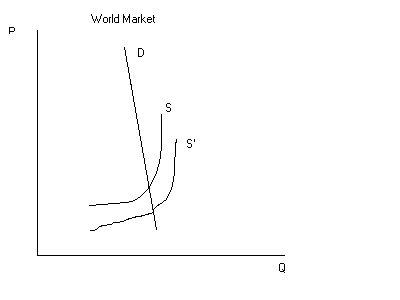
The story is a little bit different in the Mali wheat market. The price of wheat is on the vertical axis, while the quantity is on the horizontal. The domestic supply curve in Mali is S, and the domestic demand curve is D. The subsidized world price is P’w, which is the net result of many different producers subsidizing wheat production. Initial equilibrium is at e, with 0Q’ supplied by domestic producers, and Q’Q”” imported from abroad.
Now the subsidy is removed. Supply shifts upward to the true world price, Pw. Equilibrium is now at e’. Domestic production increases from 0Q’ to 0Q”. The revenues of farmers in Mali increase to 0Q”aPw, and their profits increase from fdP’w to faPw. Imports decline from Q’Q”” to Q”Q”’. Consumers in Mali now pay abce’ more for their imports of wheat, an amount equal to the savings to foreign taxpayers, who no longer have to pay for the subsidies. From the worldwide point of view this is a wash. Overall consumption of wheat declines from Q”” to Q”’ as consumers in Mali react to higher wheat prices. There is a net loss of $e’ce for Mali consumers who no longer buy wheat. But there is a net gain of $e’ge worldwide because world producers are no longer producing wheat at a price greater than what consumers are willing to pay for it.
In sum, the price earned by Mali farmers and paid by Mali consumers increases, the amount of imports decreases, and worldwide less resources are wasted on subsidized production.
edit: formatting
Attachment: wheat market (small).jpg
This has been downloaded 51 time(s).
|
|
| |
|
|
|
Lawrence of Arabia
|
 |
of the Gulag Archipelago
Apr 2001
time: 06:33
|
|
quote:
First, a graph is different from reality. The graph is drawn under the assumption that the US could not supply enough food to the world to affect the world price. This isn't necessarily true. It's just an assumption. Maybe the world price is affected a little, but so little that it shouldn't be of concern.
|
ah, but its not food - its cotton. and the graph is a model, one which is similar to reality, in many, but not all cases.
quote:
Supply isn't assumed infinite, only too large for the domestic producers to affect the price. |
which is the same thing. the fact is that if the cotton subsidy is removed, price remains the same, but there will be more sales and more revenue going to foreign farmers, which will help them out and help third world countries.
|
|
| |
All times are GMT. The time now is 05:33.
Apolyton Time is 00:33. |
top of page
|
| archivepost |
|
Forum Rules:
You may not post new threads
You may not post replies
You may not post attachments
You may not edit your posts
|
HTML code is ON
vB code is ON
Smilies are ON
[IMG] code is ON
|
|
|
|
|
|





 04-08-2004 00:53


 You're the only one considering supply infinite, I'm sure. I meant that the assumption is more commonly that the US and EU are dumping cheap food on the third world, not that the subsidies are insignificant.
 Attachment:
  |
|
.jpg)
.jpg)