|

|
Catfish
|
|
Wollongong, Australia
Aug 2000
time: 14:16
|
|
@Azazel, General Ludd, shawnmmcc:
Dudes, the reason you guys are confusing yourselves is because you're adding another layer of choice. If you randomly choose between the last two cups, then the odds of success are of course 50% - but that wasn't the question. If you always switch, your odds rise to 66.7%. If you always stick, your odds remain at 33.3%.
|
|
| |
|
|
|
This is called the Monty Hall problem for those who want to search for a nice explanation.
If you stick with original choice, you have 1/3 chance of winning.
If you change, you have 2/3.
Easiest explanation I can give is this :
There are two strategies for this game.
You can switch or keep.
If you keep, you win if you chose the right one at start and lose otherwise, so you have 1/3 of winning.
If you switch, you win if you chose a bad one at start and lose otherwise, so 2/3.
Simple no?
|
|
| |
|
|
|
quote:
Originally posted by Azazel
quote:
Az: if you switch always, you have a 2/3 chance of winning each time. If you don't ever switch, you have a 1/3 chance.
|
Once again, how come?
whatever you choose at first, you're left with two cups: one of them has a prize, the other has no prize. "switching or not switching" is just like saying "choosing this cup, or choosing that cup". The fact that you chose some cup before that is irrelevant. |
Thats were you wrong.
The cup that gets removed DEPENDS on your choice.
You did the same mistake most ppl do at first.
Suppose the answer is B and you choose A, then choice C gets eliminated, but suppose you choose C, then choice A gets eliminated.
See my explanation above.
|
|
| |
|
|
|
General Ludd
|
 |
Minion of the Dominion
Aug 2001
time: 05:16
|
|
quote:
Originally posted by Catfish
@Azazel, General Ludd, shawnmmcc:
Dudes, the reason you guys are confusing yourselves is because you're adding another layer of choice. If you randomly choose between the last two cups, then the odds of success are of course 50% - but that wasn't the question. If you always switch, your odds rise to 66.7%. If you always stick, your odds remain at 33.3%. |
The question was "what is his chance of him winning if he sticks to his choice?", and "what is his chance of winning if he switches?" It's one in two, because there are only two choices presented.
The final question asked in the problem is: Did you guess right? It could be that one, or it could be this one - this third one wasn't it, though. How can you have a 1/3 or 2/3 chance of geting a yes or no question right?
|
|
| |
|
|
|
General Ludd
|
|
Minion of the Dominion
Aug 2001
time: 05:16
|
|
quote:
Originally posted by Catfish
If you always switch, your odds rise to 66.7%. If you always stick, your odds remain at 33.3%. |
And why the emphasis on always - are you going at this problem as though the choice to switch or stay is predetermined?
That would make some sense - because if you chose one out of three and stay with it regardless of the person at the table giving your a "second chance" that could be seen as 1/3 chance of winning.
But when you make a second choice after the removal of a wrong choice you are no longer choosing between three, you are only choosing between two.
The choice to switch or stay does not happen when there are three cups on the table, only when there are two.
The only other way I could think of stretching the chances like that is if you base the second choice on the likelyhood of your first choice being right. You only had a one in three chance to get it right, so if you stay with that "one in three" choice, the alternative must be two in three, right? Which almost makes sense in a round about way, but is ignoring the reality of the final choice, which is that there are only two choices - A or B, B or C, C or A - doesn't matter, it's always one possible choice of two.
|
|
| |
|
|
|
Worthingtons
|
|
Pride Park,Derby
Jan 2002
time: 05:16
|
|
lol, cannot believe there are still believers in the 50-50 system, then again some proffessors (sp?) of Maths did originally get this wrong too.
What about boddingtons question? anyone else want to move onto that or is it too easy?
Cheers
Matt
|
|
| |
|
|
|
Mercator
|
 |
Sorekara no Nanimo
Jan 1970
time: 06:16
|
|
The final choice is indeed only between 2 cups, and indeed, in that situation there's always one cup with and one cup without a prize.
But the first choice does matter, because sometimes your first guess will be the cup with the prize and sometimes it will be an empty cup.
Since there are two "wrong" cups, you are more likely to have chosen an empty cup on your first choice.
Consider this: There's a bowl with three balls in it. Two balls are red, one ball is blue. You can take one ball out of the bowl (without looking). What's the chance that you picked the blue ball?
Now, after you took a ball I take a red ball out of the bowl (you can look again). What's the chance that you picked the blue ball now? Well, yes of course, it's still the same, namely 1/3. Me meddling with the bowl doesn't change anything about which ball you just picked.
So, if you have a blue ball in your hand, the remaining red ball is in the bowl, if you have a red ball in your hand, the blue ball is still in the bowl.
But you still have a 1/3 chance that that ball in your hand is blue. In other words, there's a 2/3 chance that the blue ball is still in the bowl.
And going back to the cups... There's a 2/3 chance that your first guess was wrong.
So the question "was my initial choice right or wrong" is NOT the same as "which of the two is the prize under?", because with that second question it's like you throw the ball in your hand back into the bowl and then try to take the blue ball out.
|
|
| |
|
|
|
General Ludd
|
|
Minion of the Dominion
Aug 2001
time: 05:16
|
|
quote:
Originally posted by Mercator
Since there are two "wrong" cups, you are more likely to have chosen an empty cup on your first choice. |
And what relevance does the chances of the first choice have on the chances of your second, different, choice?
quote:
Consider this: There's a bowl with three balls in it. Two balls are red, one ball is blue. You can take one ball out of the bowl (without looking). What's the chance that you picked the blue ball?
Now, after you took a ball I take a red ball out of the bowl (you can look again). What's the chance that you picked the blue ball now? Well, yes of course, it's still the same, namely 1/3. Me meddling with the bowl doesn't change anything about which ball you just picked. |
But in that scenario you aren't given a second choice. You just choose once, and you taking a red ball out has no baring on the outcome because the choice is already made. (and if you where given a second choice in that scenario, with being able to clearly see which is which, it would be impossible to lose - because either the blue ball would be in the bowl, or you would be holding it)
quote:
So the question "was my initial choice right or wrong" is NOT the same as "which of the two is the prize under?", because with that second question it's like you throw the ball in your hand back into the bowl and then try to take the blue ball out. |
How is it not the same? Either your choice was right and you picked the right one, or it was wrong and the remaining cup is the right one. That's one or the other. A choice of two.
|
|
| |
|
|
|
Petek

|
 |
Berkeley, CA
Jul 2000
time: 21:16
|
|
quote:
Originally posted by General Ludd
How does the first round impact the second? You can say that there was a 1/3 chance of choosing correctly in the first round, but switching or staying is 50/50 regardless.
The first round seems completely irrelevant, because the result of it is always the same - a choice between two remaining cups, one right, one wrong. It's hard to even call it a choice. |
If, in the first round, you chose the cup that has the prize, then the two remaining cups both contain nothing of value. In this case, switching to another cup loses.
On the other hand, suppose you chose an empty cup in the first round. In this case, if you switch, you will certainly win.
In light of this, the choice in the first round makes a difference.
|
|
| |
|
|
|
Snowflake
|
 |
falling, once again
Apr 2003
time: 23:16
|
|
quote:
Originally posted by General Ludd
How does the first round impact the second? You can say that there was a 1/3 chance of choosing correctly in the first round, but switching or staying is 50/50 regardless.
The first round seems completely irrelevant, because the result of it is always the same - a choice between two remaining cups, one right, one wrong. It's hard to even call it a choice. |
In the first round, after you pick a cup, the odd that it contains the ball is 1/3, and the odds that the other two cups contains the ball is 2/3. The trick is that in the second step a cup is removed from group two, knowingly, instead of randomly, in other words, information is added into the result. Essentially switching means you are choosing group two, with the 2/3 odds.
|
|
| |
|
|
|
Catfish
|
|
Wollongong, Australia
Aug 2000
time: 14:16
|
|
quote:
Originally posted by General Ludd
The question was "what is his chance of him winning if he sticks to his choice?", and "what is his chance of winning if he switches?" |
That's right. Two separate questions, two separate methods. What you are suggesting is totally random.
quote:
Originally posted by General Ludd
And why the emphasis on always - are you going at this problem as though the choice to switch or stay is predetermined? |
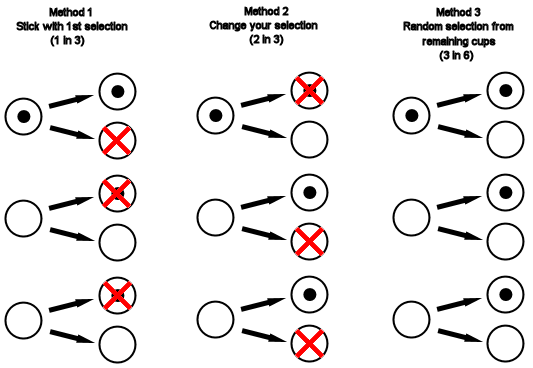
Of course! You predetermine the strategy. These are the 3 possibilities:
1. Stick with your original choice (1 in 3 chance of success),
2. Switch to the other cup (2 in 3 chance of success) or
3. Choose randomly from the last 2 cups (essentially what you're suggesting; 1 in 2 chance of success).
Using methods 1 and 2, you do not get the option of choosing between the last 2 cups – by definition the choice of your final cup has been made in the first instance, ie, there is only one "round". By using either of the first two selection methods you are reducing the number of possible outcomes. Maybe the attached diagram will help you.
quote:
Originally posted by General Ludd
There isn't a third choice in the second, defining, round. Only if you where required to decide to switch or stay in the first round could it be an X/3 chance, but that is not how the question was presented . |
Yes it was. See previous.
quote:
Originally posted by Snowflake
If the question is what the odd a woman will have a boy when she already have a boy, then the odd is 50-50. However if we know she already have two kids, and one is a boy (could be the first, or the second), then the odd that another is a boy can only be 1/3. |
I'll second that. 
 Attachment: cups.gif Attachment: cups.gif
This has been downloaded 83 time(s).
|
|
| |
|
|
|
quote:
Originally posted by General Ludd
How does the first round impact the second? You can say that there was a 1/3 chance of choosing correctly in the first round, but switching or staying is 50/50 regardless.
The first round seems completely irrelevant, because the result of it is always the same - a choice between two remaining cups, one right, one wrong. It's hard to even call it a choice. |
See the nice thing about this problem, is that its just not a thinking exercise...
You CANNOT disagree forever...
Do like Azazel did and get your cups out.
Try switching everytime, and try staying everytime, or whatever strategy you want, and come and tell us about it, and why you now understand we were right...
|
|
| |
|
|
|
Kuciwalker
|
 |
of Schmooism
Feb 2001
time: 00:16
|
|
quote:
Originally posted by Azazel
quote:
Az: if you switch always, you have a 2/3 chance of winning each time. If you don't ever switch, you have a 1/3 chance.
|
Once again, how come?
whatever you choose at first, you're left with two cups: one of them has a prize, the other has no prize. "switching or not switching" is just like saying "choosing this cup, or choosing that cup". The fact that you chose some cup before that is irrelevant. |
Two thirds of the time, you pick the wrong cup. The OTHER wrong cup is removed, and so if you switch, it must be to the right cup.
One third of the time you pick the right cup. One wrong cup is removed, and the other is still there. You switch to it.
See?
|
|
| |
|
|
|
General Ludd
|
|
Minion of the Dominion
Aug 2001
time: 05:16
|
|
quote:
Originally posted by LulThyme
See the nice thing about this problem, is that its just not a thinking exercise...
You CANNOT disagree forever... |
Yeah, I thought about it some more last night and I can see now how the second choice is tied to the first - through the language used.
Having to "stay" or "switch" ties the second round to the first, so that you are betting on the odds of the first round and aren't actually choosing a new cup. So, there's a 1 in 3 chance that you'll need to stay, and a 2 in three chance that you'll need to switch.
In order for the second round to be totally reset and 50/50, your first choice would have to be removed, so that it's no longer 'contaminating' the second choice. Either the cup you chose would have to be taken away itself, or the two remaining ones shuffled without the choice of switching or staying with the choice you originally made.
It's an interesting problem. I don't see how this can be applied to the odds of having a boy, however. What is the connecting factor in that regard? EDIT: I see now, after having actually read the question - just more word games. It's only warped odds if you're asking about how many boys of this and that, not what are the chances of a birth specifically.
Last edited by General Ludd on 26-12-2004 at 18:21
|
|
| |
|
| |
All times are GMT. The time now is 05:16.
Apolyton Time is 00:16. |
top of page
|
| archivepost |
|
Forum Rules:
You may not post new threads
You may not post replies
You may not post attachments
You may not edit your posts
|
HTML code is ON
vB code is ON
Smilies are ON
[IMG] code is ON
|
|
|
|
|
|






 26-12-2004 01:44


 )
)

 .
.

 Stop beating my poor dead horse.
 |
|