|
| |
|

|
Winston
|
 |
Danmark
Mar 1999
time: 06:30
|
|
Can't deny that. 
On Iraq, I haven't seen any polls on popular support lately, but I would estimate it to be around 60% or so. It also depends a lot on how you pose the questions, as is always the case with these things.
chegitz guevara asked for background info on the parties and the way the system is set up in Danish politics. I haven't forgotten, I have a post on pre-1945 background written up and I'm working on some other parts (post-1945, historic voter support by party, parties in government historically, and of course a little background on the standing parties' platform), but it turns out to be very time consuming. I won't post anything until it's all done, which should be sometime tomorrow, hopefully.
|
|
| |
|
|
|
Monk
|
|
I don't think we're in Brønshøj anymore
Jan 1970
time: 06:30
|
|
quote:
Originally posted by BlackCat
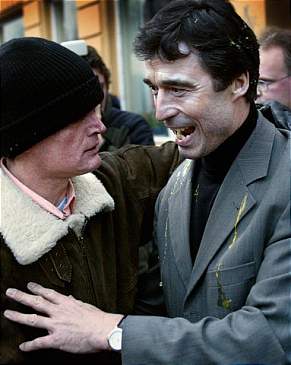
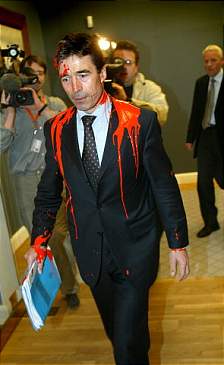
I'm not sure, but I think it was waterbased paint so it did go off in wash  |
That's not correct. PM Anders Fogh Rasmussen's suit as well as that of Foreign Minister Per Stig Møller were ruined along with the parliamentary carpet floor.
Protesters had to pay more than 100.000 DKR compensation for the damages.
Last edited by Monk on 21-01-2005 at 04:31
|
|
| |
|
|
|
Winston
|
|
Danmark
Mar 1999
time: 06:30
|
|
Ok, here's a little background on how the modern politcal landscape of my country came to be. This is just the first part, I hope to also be able to post an overview of 1945-present, short background on the platforms of the standing parties, historic support of parties since 1945, and past government constellations as well. But it takes a lot of time, and so it can't all be posted right away. I hope it's not too long a read. If you have questions, fire away.
---
Denmark is a constitutional monarchy, and its form of government is technically a constitutional, limited-monarchic one. The country got its first free constitution in 1849, following the intensified liberal and national awakening during the 1830's and 40's. This constitution, obtained peacefully, ended the absolute rule of the Monarch and granted the right to vote to male citizens above the age of 30.
Traditionally, that is to say during the early 19th century, and also for some time following the constitution, political groupings were uncemented, loosely divided into the Right, Højre, (Conservatives) supported by big landowners and high-ranking officers, and the Left, Venstre (Liberals) who had core support from farmers and smallholders.
Following a revision of the constitution in 1866 passed by Conservatives, a setback which limited voting rights to citizens owning substantial property, the Liberals formed closer ties together in an effort to oppose the ruling class. This resulted in the founding in 1870 of the party Venstre, the oldest in Denmark. A year later the Social Democratic Party was founded to give voice to the emerging industrial working class.
For the remainder of the 19th century, Venstre continued to gain support with the electorate and soon held a majority in parliament, but Højre, the landowners' party, continued to govern by means of provisional laws - and with the King's consent. In 1901, the King recognized the claim to power by Venstre, who then formed the first truly democratic government, an event which is referred to as the "Change of Systems", and the beginning of Parliamentarism.
1905 saw two new party formations; the old Højre which had been in power for most of the preceeding half century, reconstructed itself into a modern party, Det Konservative Folkeparti, Conservative People's Party. And the more progressive wing of the now ruling Venstre split out to form Det Radikale Venstre, "Radicals". So there were now 4 major parties, and those are traditionally referred to as the 4 "old" parties in Danish politics:
---
Socialdemokratiet - (Social Democrats) workers' party, mainly urban, with a traditional Social Democratic platform, much like that of other European countries, headed first government in 1924
Det Radikale Venstre - (Social-Liberals) traditionally comprising smallholders, teachers and others, with a social-liberal platform, pacifistic and increasingly idealistic in the 20th century, headed first (and only government) in 1968
Det Konservative Folkeparti - (Conservatives) traditionally with the support of business owners, mainly urban, headed first government in 1982
Venstre - (Liberals) traditionally with support from farmers and the rural population in general, but increasingly gaining support in urban areas as well, especially late in the 20th century, headed first government in 1901
---
1915 saw an amendment of the constitution which granted the vote to women, and another revision in 1953 cemented the principle of Parliamentarism (cabinet must have the confidence of Parliament), as well as the deposition of the 2-chamber system which had been in place until then.
Other enduring political parties which came into being before 1945 were:
Danmarks Kommunistiske Parti - (Communists) formed in 1918 as the Danish branch of Komintern, traditional Communist platform, but throughout the 20th century became one of the most Soviet-loyal Communist parties in Europe. Not represented in Parliament since the 1970's, but is today part of the small, Far-left conglomaration Enhedslisten which holds 4 seats.
Danmarks Retsforbund - (Georgists) formed in 1919, with a platform of high land value taxes to substitute income taxation. Not represented in Parliament since the 1970's.
---
|
|
| |
|
|
|
Winston
|
|
Danmark
Mar 1999
time: 06:30
|
|
She's still very much around yes. Much to her disappointment though, it doesn't look like immigration issues will play as large a part in this campaign as it did in 2001. A hardline approach on immigration is after all about 75% of her party's entire platform. But the government has succeeded in bringing the number of immigrants down to an almost historic low point already, so Pia Kjærsgaard and Dansk Folkeparti (Danish People's Party) could face a bit of a fight to hold on to their 12.0% share of the vote from 2001.
The three latest polls from my daily paper (Nov., Dec., Jan.) however give them 11.6, 12.5 and 11.4%, so depending on the ongoing campaign, they might do all right. They've been a surprisingly reliable part of much of the government's legislation over the past three years, considering they are basically a protest party, and oddly enough their (protest) voters may actually end up giving them credit for just that at the polls. The majority of their voters are former Social Democrats, so their continued support with the voters plays an important part in explaining why the Liberal-Conservative block is currently so very strong in Danish politics.
Last edited by Winston on 21-01-2005 at 17:44
|
|
| |
|
|
|
Winston
|
|
Danmark
Mar 1999
time: 06:30
|
|
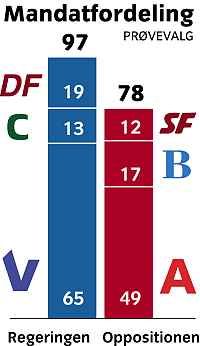
A fresh opinion poll from Jyllands-Posten conducted among 888 voters from 18-20 January predicts a landslide victory for PM Anders Fogh Rasmussen and Venstre.
It gives Venstre 35.7% and 65 seats, compared to 26.8% and 49 seats for the Social Democrats.
The poll also asked for the voters' preferred candidate for the position of Prime Minister. 50.4% pointed to Anders Fogh Rasmussen, and only 18.3% to Mogens Lykketoft. The rest were either undecided or pointed to others, Radikale Venstre's Marianne Jelved getting the most at 7.1%.
According to the poll, only six parties will be represented in Folketinget, the Danish Parliament. See graphic below for number of seats by party (left column is the government and its supporter; V=Venstre (Liberals), C=Conservatives, DF=Danish People's Party, right column is the opposition parties; A=Social Democrats, B=Radikale Venstre (Social Liberals), SF=Socialist People's Party). The 4 North Atlantic seats are left out of polls, and so the total here is 175 compared to 179 in the actual Folketing.
 Attachment: 134178_small.jpg Attachment: 134178_small.jpg
This has been downloaded 82 time(s).
Last edited by Winston on 22-01-2005 at 12:12
|
|
| |
|
| |
|
|
|
Winston
|
|
Danmark
Mar 1999
time: 06:30
|
|
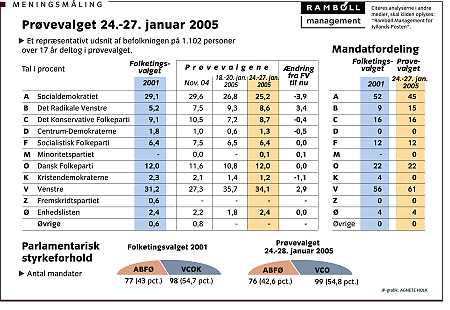
Latest poll by Rambøll, conducted for Jyllands-Posten among 1102 voters from 24-27 January resulted in 61 seats for Venstre, compared to 45 for the Social Democrats; overall 99 seats for the government and its supporter, 76 for the opposition.
Below is a graphic of the poll's results, compared to previous polls and the election of 2001.
Translated rows:
A Socialdemokratiet = Social Democrats
B Det Radikale Venstre = Social Liberals
C Det Konservative Folkeparti = Conservatives
D Centrum-Demokraterne = Center Democrats
F Socialistisk Folkeparti = Socialist People's Party
M Minoritetspartiet = Minority Party ( ) )
O Dansk Folkeparti = Danish People's Party
K Kristendemokraterne = Christian Democrats
V Venstre = Liberals
Z Fremskridtspartiet = Progress Party
Ø Enhedslisten = Far-left Socialists
Translated columns:
1) Blue = Election 2001, % of votes
2) White = Opinion poll, Nov 2004, % of votes
3) White = Opinion poll, 18-20 Jan 2005, % of votes
4) Yellow = This opinion poll, 24-27 Jan 2005, % of votes
5) Change from Election 2001 till now, % of votes
6) Blue = Seats in Parliament, Election 2001
7) Yellow = Predicted seats in Parliament, this opinion poll
The 4 North Atlantic seats are left out of polls, and so the total number of seats here is 175, compared to 179 in the actual Parliament.
* Winston concludes all is well in the Kingdom.
Attachment: 134700_large.jpg
This has been downloaded 55 time(s).
|
|
| |
All times are GMT. The time now is 05:30.
Apolyton Time is 00:30. |
top of page
|
|
|
Forum Rules:
You may not post new threads
You may not post replies
You may not post attachments
You may not edit your posts
|
HTML code is ON
vB code is ON
Smilies are ON
[IMG] code is ON
|
|
|
|
|
|






 19-01-2005 15:25


 - wrong informed.


 |
|