|
| |
|

|
Imran Siddiqui

|
 |
The Potterverse
Jan 1970
time: 00:24
|
|
quote:
I rest my case. You define fascism as a fixed, historical, unevolving fossil, based on it's superficial aspects. And why on earth would you let Hitler and Mussolini define fascism? Would you let apes define evolution? |
Would you let Darwin define evolution? That's a far better analogy. Mussolini created Fascism and Hitler was second on board. I agree with che that Hitler's was a very extreme fascism, but shared the idea to remake society, was a mass movement, and focused on the individual.
quote:
Oh really. Just another conservative, I suppose? Tell me, is killing and torturing opponents, wiping out trade unions and left wing political parties, establishing control over all media, etc. really just an extension of normal conservatism? |
Actually... yes, it can be. It is an extreme form of conservatism, but you can see it in a lot of conservative movements. If you think wiping out trade unions and left wing parties are only resigned to the fascists, then you have a wierd view of things. Plenty of conservatives have been active in doing such and yes, at times that involved killing opponents. You need to review the history of the 1880s-1930s better (especially the US government's reaction to strikers). And establishing control over the media has been done by both sides, but it isn't like conservatives are against it (unless you think Burlesconi is a fascist... he's controlled the media by more subtle means).
quote:
Why then, learned sir, did the German and Italian regimes invade country after country? |
Fascism is an ideology which bases itself on national conflict instead of class conflict. Of course class conflict led to violence in the revolutions of 1846 among others. Nations are more apt to be able to initiate national conflict.
And yes, it was also to control resources, but that was so the German state could be totally self-sustaining (autarky) so it won't have to rely on other nations.
quote:
I don't think I'm going too much out on a limb when I say this will probably benefit the owners of big banks and chemical companies more than a bankrupt grocer. |
Shifting goalposts much? Saying a policy will benefit big business more than the grocer doesn't mean that big business made the Fascists do it. Ideology made them do it.
quote:
Imran, what would your professor say to you if you argued in a paper that the lack of a reference to someone as a fascist in an online encyclopedia authored by anyone who wanted to contribute, was proof that he was not, in fact, a fascist? |
Think for a second. An online encyclopedia where anyone could contribute would probably include a reference to fascism in Pinochet's entry if most people in Latin America believe Pinochet to be a fascist... unless you are saying people of Latin Americans don't have have access to wikipedia.
It's not direct evidence, but when you think about it, your statement ends up making no sense when applies to the article which anyone could edit.
And the only one supporting your definition has been Oncle Boris. Folks on the right and left say your definition is overbroad.
quote:
It is true that Pinochet's regime shares aspects of fascism, but there was no mass movement behind the military revolt, and that is crucial. A much more suitable candidate would be the first Peron dictatorship in Argentina.
Nor does big capital turn over power to the fascists unhesitatingly. They hesitate quite a bit, and only allow them to take power as a last resort. This is because they are dangerous. Capital is much more willing to rely on a military coup, than turn over the state to a bunch of radical thugs with delusions of remaking society. |
Yep, yep. Peron was probably more fascist than Pinochet (which speaks to how Pinochet was not fascit). And capital, when it does turn over power to the fascists, does it very distastefully. Business doesn't like the rhetoric of the fascist, but if they have no other choice they'll go for it.
Last edited by Imran Siddiqui on 10-09-2005 at 23:43
|
|
| |
|
|
|
chegitz guevara
|
 |
Ft. Lauderdale, FL Communist Party of Apolyton
Jun 2000
time: 00:24
|
|
quote:
Originally posted by techumseh
As I understand your argument, we agree on the basic nature of fascism and who is served by it. But you insist on a mass movement of ruined and disaffected people before it can be called fascism, correct? Any other points of disagreement? |
It's not that I insist on a mass movement before something can be called fascism. The mass movement is fascism. Now, prior to the Chilean coup, middle class women did go into the streets banging their pans, calling for a military coup. But this wasn't a movement, it wasn't organized, and it had no ideology. The base was there though, and could have become a fascist movement resulting in a fascist state. But that wasn't necessary to crush Allende's followers.
Mass movement's are dangerous things. They can get away from you, turn on you. Had the Chilean coup been defeated, it is likely that the U.S. and Chilean comprador bourgeoisie would have turned to fascism as a way out. They didn't need to.
Pinochet's regime wasn't the worst in South America, and definately not in Latin America. That dishonor goes to Guatemala, which slaughtered over 100,000 of its own people. Argentina takes second place, with more than 40,000 killed. With an official death toll of around 5,000, Pinochet is one of the least bloody of the dictators on the 70s and 80s in Latin America. The left has an especial hate for him, because he overthrew what looked to be a peaceful road to socialism. That doesn't make him fascist.
|
|
| |
|
|
|
techumseh
|
 |
of the frozen North.
Apr 1999
time: 22:24
|
|
quote:
Originally posted by Imran Siddiqui
Would you let Darwin define evolution? That's a far better analogy. Mussolini created Fascism and Hitler was second on board. I agree with che that Hitler's was a very extreme fascism, but shared the idea to remake society, was a mass movement, and focused on the individual. |
Darwin did not create evolution. He observed it, analized it and created a theory to explain it. H&M were not the disinterested observers of fascism, seeking to understand and explain it. Come on, Imran. This is not that hard.
quote:
Actually... yes, it can be. It is an extreme form of conservatism, but you can see it in a lot of conservative movements. If you think wiping out trade unions and left wing parties are only resigned to the fascists, then you have a wierd view of things. Plenty of conservatives have been active in doing such and yes, at times that involved killing opponents. You need to review the history of the 1880s-1930s better (especially the US government's reaction to strikers). And establishing control over the media has been done by both sides, but it isn't like conservatives are against it (unless you think Burlesconi is a fascist... he's controlled the media by more subtle means). |
Sporadic and often unofficial violence and intimidation against workers is just part of the "background radiation" of a conservative society. Systematic, state organized violence and repression against working people and their organizations is very different. It is a hallmark of fascism.
quote:
quote:
Why then, learned sir, did the German and Italian regimes invade country after country? |
Fascism is an ideology which bases itself on national conflict instead of class conflict. Of course class conflict led to violence in the revolutions of 1846 [edit: you mean 1848] among others. Nations are more apt to be able to initiate national conflict. [edit: and classes are more apt to be able to initiate class conflict. And families are more apt to....]
And yes, it was also to control resources, but that was so the German state could be totally self-sustaining (autarky) so it won't have to rely on other nations. |
German agriculture was their achilles heel during the first world war, but it had been made self-sustaining before the outbreak of the second. Other resouces were availble by trade. A peaceful Germany was self-sustaining at the end of the thirties. So your explanation falls short.
quote:
Shifting goalposts much? Saying a policy will benefit big business more than the grocer doesn't mean that big business made the Fascists do it. Ideology made them do it. |
I didn't say big business MADE them do anything. They WANTED to do it, which is part of the reason big business helped them take power. And they created the ideology themselves, so it also didn't MAKE them so anything. It merely justified it.
quote:
Think for a second. An online encyclopedia where anyone could contribute would probably include a reference to fascism in Pinochet's entry if most people in Latin America believe Pinochet to be a fascist... unless you are saying people of Latin Americans don't have have access to wikipedia.
It's not direct evidence, but when you think about it, your statement ends up making no sense when applies to the article which anyone could edit.
And the only one supporting your definition has been Oncle Boris. Folks on the right and left say your definition is overbroad. |
Now who's shifting goalposts? You suffer from some of the most faulty reasoning I've ever run across. Because someone could have used the wikipedia to write that Pinochet was a fascist and didn't, that is your proof that he wasn't? Gawwd Imran. It's almost embarassing.
And as for only having Oncle Boris on my side (btw I think there are more than 2 opinions on this issue), WHO CARES? Do you think that the truth of an argument is determined by a vote of the people who spend time on OT? If I find a topic interesting, I will state my views and debate others. I don't care if I take on one person or the whole damn forum!
quote:
quote:
Originally posted by chegitz guevara
It is true that Pinochet's regime shares aspects of fascism, but there was no mass movement behind the military revolt, and that is crucial. A much more suitable candidate would be the first Peron dictatorship in Argentina.
Nor does big capital turn over power to the fascists unhesitatingly. They hesitate quite a bit, and only allow them to take power as a last resort. This is because they are dangerous. Capital is much more willing to rely on a military coup, than turn over the state to a bunch of radical thugs with delusions of remaking society. |
Yep, yep. Peron was probably more fascist than Pinochet (which speaks to how Pinochet was not fascit). And capital, when it does turn over power to the fascists, does it very distastefully. Business doesn't like the rhetoric of the fascist, but if they have no other choice they'll go for it. |
So now you've become a disciple of chegitz guevara. Congratulations, Imran! Any port in a storm, eh? 
|
|
| |
|
|
|
Imran Siddiqui
|
|
The Potterverse
Jan 1970
time: 00:24
|
|
quote:
Darwin did not create evolution. He observed it, analized it and created a theory to explain it. H&M were not the disinterested observers of fascism, seeking to understand and explain it. Come on, Imran. This is not that hard. |
THEY ****ING CREATED IT! Hell, Marx wasn't a disinterested observer of Communism, I guess we shouldn't look at him to describe that theory, eh?
quote:
Sporadic and often unofficial violence and intimidation against workers is just part of the "background radiation" of a conservative society. Systematic, state organized violence and repression against working people and their organizations is very different. It is a hallmark of fascism. |

Please.. The 1800s-1930s were a period of state sponsored violence against unions and 'radicals' in the US. Any strike was dealt with by violence and, if need be, deaths. It was how they dealt with such things. Read about the Holmstead and Pullman strikes.
Hell, until the 30s, unionizing was illegal in the US!
Well before Fascism in Europe, European monarches were engaged in systematic violence and oppression against working people and preventing them from organizing.
quote:
Other resouces were availble by trade. A peaceful Germany was self-sustaining at the end of the thirties. |
Self-pwnage!! If resources was necessary to be imported, it wasn't self-sustaining. It needed those imports. It was a reaction to the problems in WW1 where blockades almost starved the German people to surrender. It was a never again type of move.
quote:
I didn't say big business MADE them do anything. They WANTED to do it, which is part of the reason big business helped them take power. And they created the ideology themselves, so it also didn't MAKE them so anything. It merely justified it. |
Business only helped the Fascists took power in the end, when they had no other choice. Che is absolutely right that business found the Fascists distastful, but they were the only ones that could help them against the socialists. If it was so attractive to big business, why didn't they jump on board at the beginning. There is a reason.
quote:
Because someone could have used the wikipedia to write that Pinochet was a fascist and didn't, that is your proof that he wasn't? |
Um... yeah. If it was so known that Pinochet was a fascist, why wouldn't a wikipedia article, able to be added to by Latin Americans make any mention of fascism? Not even a statement saying there is some dispute if Pinochet was a fascist. ANYTHING at all?!
It's because most people don't think Pinochet as a fascist. You've basically pulled that out of your ass. It's a total BAM.
quote:
And as for only having Oncle Boris on my side (btw I think there are more than 2 opinions on this issue), WHO CARES? Do you think that the truth of an argument is determined by a vote of the people who spend time on OT? If I find a topic interesting, I will state my views and debate others. I don't care if I take on one person or the whole damn forum! |
When you are the only one arguing a position about what an ideology stands for (where left and right have chimed in), you are most likely wrong, unless you created the ideology yourself.
It is nice that you choose to argue against the world while being totally incorrect, but you are still incorrect and the lack of support is an indication that you are probably wrong.
quote:
So now you've become a disciple of chegitz guevara. |
Yes, because I think che is right on a topic, I've amazingly become a disciple of him... jeez, you become so pathetic when you've lost an argument.
|
|
| |
|
|
|
techumseh
|
|
of the frozen North.
Apr 1999
time: 22:24
|
|
Here's an interesting article on defining fascism:
quote:
The 14 Defining Characteristics Of Fascism
by Dr. Lawrence Britt
Dr. Lawrence Britt has examined the fascist regimes of Hitler (Germany), Mussolini (Italy), Franco (Spain), Suharto (Indonesia) and several Latin American regimes. Britt found 14-defining characteristics common
to each:
1. Powerful and Continuing Nationalism -
Fascist regimes tend to make constant use of patriotic mottos, slogans, symbols, songs, and other paraphernalia. Flags are seen everywhere, as are flag symbols on clothing and in public displays.
2. Disdain for the Recognition of Human Rights -
Because of fear of enemies and the need for security, the people in fascist regimes are persuaded that human rights can be ignored in certain cases because of "need." The people tend to look the other way or even approve of torture, summary executions, assassinations, long incarcerations of prisoners, etc.
3. Identification of Enemies/Scapegoats as a Unifying Cause -
The people are rallied into a unifying patriotic frenzy over the need to eliminate a perceived common threat or foe: racial , ethnic or religious minorities; liberals; communists; socialists, terrorists, etc.
4. Supremacy of the Military -
Even when there are widespread domestic problems, the military is given a disproportionate amount of government funding, and the domestic agenda is neglected. Soldiers and military service are glamorized.
5. Rampant Sexism -
The governments of fascist nations tend to be almost exclusively male-dominated. Under fascist regimes, traditional gender roles are made more rigid. Divorce, abortion and homosexuality are suppressed and the state is represented as the ultimate guardian of the family institution.
6. Controlled Mass Media -
Sometimes to media is directly controlled by the government, but in other cases, the media is indirectly controlled by government regulation, or sympathetic media spokespeople and executives. Censorship, especially in war time, is very common.
7. Obsession with National Security -
Fear is used as a motivational tool by the government over the masses.
8. Religion and Government are Intertwined -
Governments in fascist nations tend to use the most common religion in the nation as a tool to manipulate public opinion. Religious rhetoric and terminology is common from government leaders, even when the major tenets of the religion are diametrically opposed to the government's policies or actions.
9. Corporate Power is Protected -
The industrial and business aristocracy of a fascist nation often are the ones who put the government leaders into power, creating a mutually beneficial business/government relationship and power elite.
10. Labor Power is Suppressed -
Because the organizing power of labor is the only real threat to a fascist government, labor unions are either eliminated entirely, or are severely suppressed.
11. Disdain for Intellectuals and the Arts -
Fascist nations tend to promote and tolerate open hostility to higher education, and academia. It is not uncommon for professors and other academics to be censored or even arrested. Free expression in the arts and letters is openly attacked.
12. Obsession with Crime and Punishment -
Under fascist regimes, the police are given almost limitless power to enforce laws. The people are often willing to overlook police abuses and even forego civil liberties in the name of patriotism. There is often a national police force with virtually unlimited power in fascist nations.
13. Rampant Cronyism and Corruption -
Fascist regimes almost always are governed by groups of friends and associates who appoint each other to government positions and use governmental power and authority to protect their friends from accountability. It is not uncommon in fascist regimes for national resources and even treasures to be appropriated or even outright stolen by government leaders.
14. Fraudulent Elections -
Sometimes elections in fascist nations are a complete sham. Other times elections are manipulated by smear campaigns against or even assassination of opposition candidates, use of legislation to control voting numbers or political district boundaries, and manipulation of the media. Fascist nations also typically use their judiciaries to manipulate or control elections.
|
|
|
| |
|
|
|
techumseh
|
|
of the frozen North.
Apr 1999
time: 22:24
|
|
quote:
Originally posted by chegitz guevara
quote:
Originally posted by techumseh
As I understand your argument, we agree on the basic nature of fascism and who is served by it. But you insist on a mass movement of ruined and disaffected people before it can be called fascism, correct? Any other points of disagreement? |
It's not that I insist on a mass movement before something can be called fascism. The mass movement is fascism. Now, prior to the Chilean coup, middle class women did go into the streets banging their pans, calling for a military coup. But this wasn't a movement, it wasn't organized, and it had no ideology. The base was there though, and could have become a fascist movement resulting in a fascist state. But that wasn't necessary to crush Allende's followers.
Mass movement's are dangerous things. They can get away from you, turn on you. Had the Chilean coup been defeated, it is likely that the U.S. and Chilean comprador bourgeoisie would have turned to fascism as a way out. They didn't need to.
Pinochet's regime wasn't the worst in South America, and definately not in Latin America. That dishonor goes to Guatemala, which slaughtered over 100,000 of its own people. Argentina takes second place, with more than 40,000 killed. With an official death toll of around 5,000, Pinochet is one of the least bloody of the dictators on the 70s and 80s in Latin America. The left has an especial hate for him, because he overthrew what looked to be a peaceful road to socialism. That doesn't make him fascist. |
You still haven't said what defines a fascist regime. I don't think you mean to say that it's measured by how many people it kills. Letellier defines Pinochet as fascist, as do most to the Chilean exiles I've met over the years.
The upper class housewives banging pots, as well as the truckers strike, were organized events - the domestic counterpart to the US economic offensive against the Allende government. Nixon told his underlings he wanted to make the Chilean economy "scream". CIA involvement in the build up to the coup is well documented. The question really is the nature of the regime once the coup had taken place.
Generally, I think the left views Pinochet's regime as fascist, and I agree. But if it's not fascist, then how would you define it?
|
|
| |
|
| |
|
|
|
shawnmmcc
|
|
Techumsah - you've been set up, and your reply shows that you don't realize it. If you look at Hitler's writings, and every interview, memoir, etc. we have concerning the Hitler state, he invaded the Soviet Union over, to use Hitler's own language, lebanstraum, or expanded living space.
His own generals did not want him to invade, and if it had not been for his takeover of the Wehrmacht in 1938, removing the last independent opposition to him, they well might have rebelled. Business was fat, dumb, and happy with the state of affairs in the Reich, digesting all of the conquered territories and industries.
The only person who wanted to invade the Soviet Union was Hitler, and a few of his disciples. Cult - followers - non-rational decisionmaking. That is why every time someone starts using Hitler as an example of Facism they get in trouble. The regime started off as Facist, until Hitler had completed seizing every rein of power. After that it became a cult-like state, with everything implicit to that. Since it's origins were Facist, it still had many of the trappings of Facism. However, it had transmorgified into a state/cult by that point.
|
|
| |
|
|
|
techumseh
|
|
of the frozen North.
Apr 1999
time: 22:24
|
|
Well, perhaps I've been set up, but I'm not lost. William Shirer describes some of the planning that went into the invasion of the Soviet Union.
"...Halder went to work on the plans with his General Staff. Though he would later claim to have opposed the whole idea of an attack on Russia as insane, his diary for this day discloses him full of enthusiasm as he applied himself to the challenging new task."
OKW was ordered to "make a detailed survey of Soviet industry, transportation and oil centers both as a guide to targets and later on as an aid for administering Russia."
Most of the claims that Hitler acted alone in his various aggressions are based on the testimony and writings of German generals after the war. Of course, they were trying to avoid prison or worse, and their accounts are suspect.
German documents show great thoroughness in planning the industrial exploitation of conquered areas of the Soviet Union. While Hitler did talk a lot about living space, he didn't ignore industry, metallurgical deposits or oil.
I don't have ready to hand information describing the attitude of German big business towards the invasion of the Soviet Union at the moment. I'll endevour to find it. If you do, please bring it forward. As it now stands, your assertion that the Nazi's were just a cult and that no one else really wanted to attack the SU is just an assertion. Evidence, please.
|
|
| |
|
|
|
shawnmmcc
|
|
You'll note I didn't say business did not want to invade - but that they were "...fat, dumb, and happy with the state of affairs in the Reich, digesting all of the conquered territories and industries." When you told them they could get all these benefits risk free, of course they went along with it. Especially when too much opposition could get you on the wrong side of the barbed wire.
You are mixing up enthusiasm and/or pushing an agenda, i.e. invading the Soviet Union, with the efficiency of General Staff style planning. In that planning even if I disagree with you, I understand what you plan to achieve and will supply the necessary support to achieve the goal. I may bring up problems I see, and even inform you that I think your strategic or operational plan is in error (though depending on my leader I may need to be VERY careful when I disagree). But in the end I will do whatever is necessary to guarantee the success of the operation.
You are asking the wrong question. Find my anybody, besides Hitler and the Nazis (and some of their intellectual predecessors) pushing invading the Soviet Union. I don't think you are going to find much - though you may surprise me. Note I am talking about pushing the invasion independently and if possible prior to Hitler. Remember in the Hitler state it was generally a bad idea, often lethally so, not to be seen as agreeing with the Great Leader. Finding out what people truly felt will run into similiar problems to those your rightfully cite about the Wehrmacht generals claiming to have opposed Barbarossa.
|
|
| |
|
|
|
GePap
|
 |
of the Big Apple
Nov 2001
time: 23:24
|
|
quote:
Originally posted by techumseh
Here's an interesting article on defining fascism:
|
And this is supposed to mean, what? Exactly? Some guy writes an article about what he sees as his definition of fascism, though going by his list, incluidng the inclusion of Suharto as fascist, his grasp on the issue is poor, at best.
And as for your list, are we supposed to care? So if I start brinign up lists from the Weekly Standard, the National review, and the Washington Times on the meaning of Communism, would anyone take it seriously?
Oh, and trying to tie Pinochet to fascism because the Chilean Military accepted a Prussian style of military dress means what, exactly?
Oh, and Imran is correct. If you want to know what Fascism IS, the people to read are those who considered themselves Fascists and were proud of it. In reading what they aspired to, what they want, their aims, there you see what fascism is supposed to be, not by reading its caricatures.
Fascism is a mass movements with wholy POLITICAL roots. It is not the end stage of capitalism. It is not a tool of big business.
And Che is correct by saying that one simply can't look at the Nazi state and try to define Fascism by it, because the Nazi's introduced a biological component to the ideology that made it much more radical.
Marxism rests on a foundation of saying that a human being's identity is defined by the means they use to meet their basic economic needs. This is why CLASS is the defining characteristic. A factory worker in Timbuktu and one in Walla Walla have more in common with each other than with a rich capitalist in either location. This is why, under this theory, all societies, upon reaching the same economic level, face the same choices. This is why you can do a Marxist explination of Rome, or IMperial China, or the Inca Empire, because as different as everything else was, the underlying material forces and economic realities exist and they define the human condition.
Fascists would state that what defines man is their nation-the accumulation of shared values, norms, mores. That a rich factory owner in Timbuktu will share more with any fellow citizens of Timbuktu that he will ever share with any other rich factory workers anywhere.
Both Communism and Fascism seek to harness a mass political movement in a radical manner to create a new relation of man to the state and each other, but the different underlying assumptions about mankind's identity lead to significant ideological differences. NOw, because the Facists tie their identity to what are essentially old values, this makes their system somewhat unstable, as they lurch from Radicalism (in their goals) to being reactionary (because the shared national identity must be protected). It is also this that allows some to mistake the fascist for other conservatives who also place immense value in the old ways, but do so for different reasons than the fascists.
Nazi's went further, as I said before, because they introduce a biological coponent. They state that these basic shared national values and culture have a biological basis. Other fascists like the Italians made no such claims. and there is a fundamental difference between these two camps.
|
|
| |
|
|
|
BeBro
|
 |
of the Krauts
Mar 2000
time: 06:24
|
|
Just want to mention that the Nazis not only depiceted communism, or as they said "Jewish Bolshewism" as teh evil, there was also a strong sentiment against teh evil capitalism (often as teh evil Jewish capitalism) with teh evil UK and US as main agents of those great evils (edit: and that long before WWII).
Capitalism and esp. the industrialization of the 19th century there was depicted as the force that had destroyed the (idealized) good old pre-industrial German society. So looking only at the anti-communist side of Nazi rule isn't enough.
Last edited by BeBro on 11-09-2005 at 21:07
|
|
| |
|
|
|
techumseh
|
|
of the frozen North.
Apr 1999
time: 22:24
|
|
quote:
Originally posted by GePap
And this is supposed to mean, what? Exactly? Some guy writes an article about what he sees as his definition of fascism, though going by his list, incluidng the inclusion of Suharto as fascist, his grasp on the issue is poor, at best. |
I didn't claim that the article was anything more than interesting. Actually, I think he's trying to tailor the definition to fit the US. What's interesting is that things like "new man" ideology are not included in his definition .
And it's odd that you would just assume that you could just toss off Suharto's name and it would be obvious that the guy didn't know what he was talking about. Suharto led a coup which killed up to a million people, most of them communists. It was also backed by your government, but it wasn't the big bad republicans at that time (1965). No, it was your pals in the Democratic Party.
quote:
And as for your list, are we supposed to care? So if I start brinign up lists from the Weekly Standard, the National review, and the Washington Times on the meaning of Communism, would anyone take it seriously? |
I don't care if you do. At least it would improve the pathetic standard of debate on this issue. Some people seem to think they can state their uninformed opinion as fact, and carry on as if they've learned something.
quote:
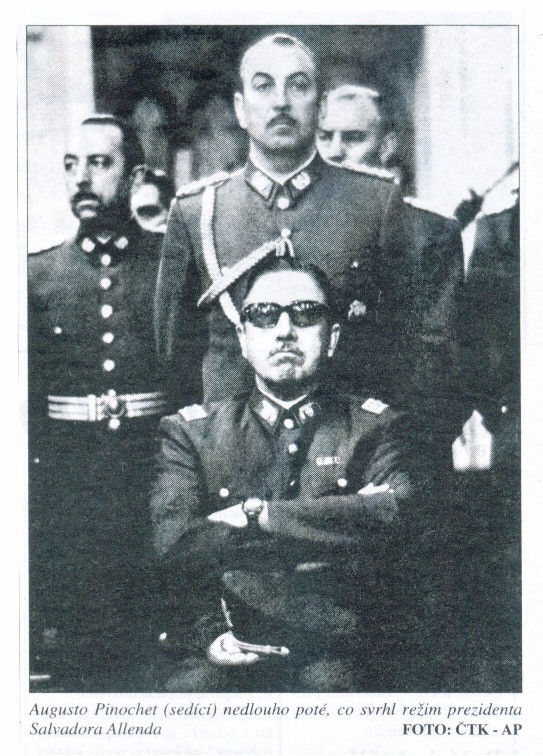
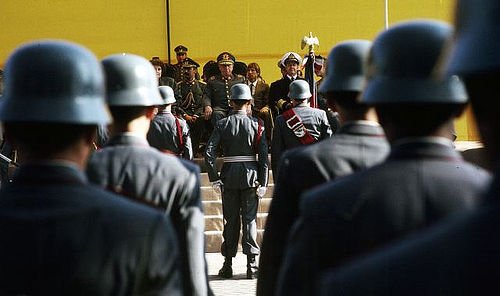
Oh, and trying to tie Pinochet to fascism because the Chilean Military accepted a Prussian style of military dress means what, exactly? |
Like I said, sometimes a picture is worth a thousand words.
quote:
Oh, and Imran is correct. If you want to know what Fascism IS, the people to read are those who considered themselves Fascists and were proud of it. In reading what they aspired to, what they want, their aims, there you see what fascism is supposed to be, not by reading its caricatures. |
No, and here we get to the nub of the issue. We need to define fascism by looking at it externally, analizing it's real goals and makeup, and seeing how it evolves. Much of the stuff H&M wrote was ideological mumbo jumbo to justify their broader goals. It was designed to befuddle the masses with mysticism and psuedo-science. To place it on a par with Voltaire, Hegel or Marx is an act of intellectual vandalism. The ideology of H&M was designed to mislead and confuse. It's clearly still doing so.
quote:
Fascism is a mass movements with wholy POLITICAL roots. It is not the end stage of capitalism. It is not a tool of big business. |
Why, because you say so?
quote:
And Che is correct by saying that one simply can't look at the Nazi state and try to define Fascism by it, because the Nazi's introduced a biological component to the ideology that made it much more radical. |
And did I disagree with this?
quote:
Marxism rests on a foundation of saying that a human being's identity is defined by the means they use to meet their basic economic needs. This is why CLASS is the defining characteristic. A factory worker in Timbuktu and one in Walla Walla have more in common with each other than with a rich capitalist in either location. This is why, under this theory, all societies, upon reaching the same economic level, face the same choices. This is why you can do a Marxist explination of Rome, or IMperial China, or the Inca Empire, because as different as everything else was, the underlying material forces and economic realities exist and they define the human condition. |
Don't lecture me on Marxism, you liberal.
quote:
Fascists would state that what defines man is their nation-the accumulation of shared values, norms, mores. That a rich factory owner in Timbuktu will share more with any fellow citizens of Timbuktu that he will ever share with any other rich factory workers anywhere.
Both Communism and Fascism seek to harness a mass political movement in a radical manner to create a new relation of man to the state and each other, but the different underlying assumptions about mankind's identity lead to significant ideological differences. NOw, because the Facists tie their identity to what are essentially old values, this makes their system somewhat unstable, as they lurch from Radicalism (in their goals) to being reactionary (because the shared national identity must be protected). It is also this that allows some to mistake the fascist for other conservatives who also place immense value in the old ways, but do so for different reasons than the fascists.
Nazi's went further, as I said before, because they introduce a biological coponent. They state that these basic shared national values and culture have a biological basis. Other fascists like the Italians made no such claims. and there is a fundamental difference between these two camps. |
Fascism arose after the rise of communism, and in response to it. There is not a fundamental difference between German and Italian fascism, nor between them and the Chilean version. All arose out of a desperate desire of the elites of their respective countries to prevent a socialist takeover. In all cases, these classes threw over their democratic trappings and jumped in with the ultra right who promised to save them, which they all did, by means of violence and terror. In all cases there were ideological justifications, but these differed in each case. Basing your analysis on the ideological trappings would lead you to believe they are all quite different. And that's the source of your error.
Last edited by techumseh on 12-09-2005 at 01:54
|
|
| |
|
| |
All times are GMT. The time now is 05:24.
Apolyton Time is 00:24. |
top of page
|
|
|
Forum Rules:
You may not post new threads
You may not post replies
You may not post attachments
You may not edit your posts
|
HTML code is ON
vB code is ON
Smilies are ON
[IMG] code is ON
|
|
|
|
|
|





 10-09-2005 22:15




 Attachment:


 |
|