|
| |
|

|
molly bloom
|
 |
Lundenwic
Oct 2001
time: 15:33
|
|
quote:
' The Scots... spend all their time in wars, and when there is no war they fight with one another.' |
Don Pedro de Ayala
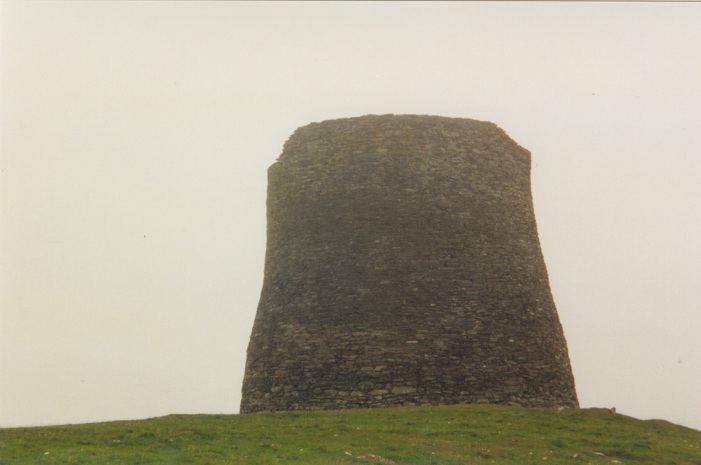
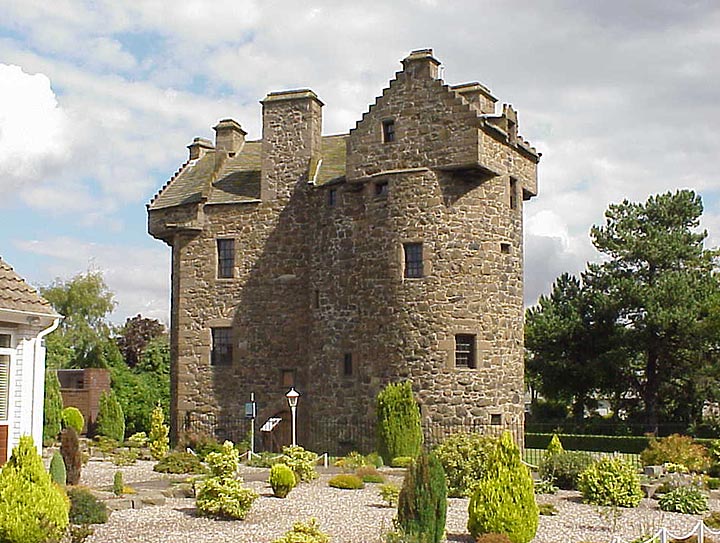
As anyone who has seen a Pictish broch or the fortified manors of the Borders can attest to...
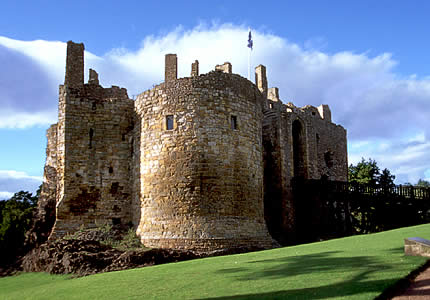
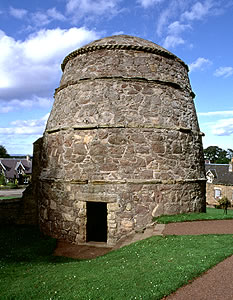
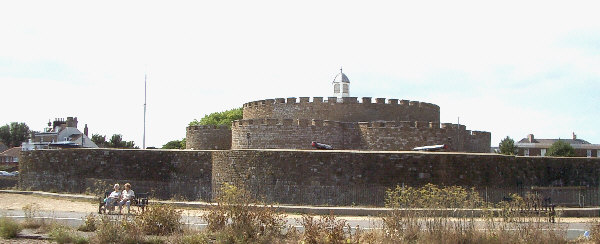
Here's Dirleton Castle, which also boasts a fine (and presumably necessary) dovecote, for those times when you couldn't rely on door to door venison and flummery delivery...
The reconstruction:
http://www.maybole.org/history/castles/dirleton.htm
This has some great photographs of the interiors:
http://www.phouka.com/travel/castle...n/dirleton.html
quote:
Dirleton is a 13th Century castle which stands on a rocky knoll, dominating the centre of the picturesque village of the same name. Constructed originally by the De Vaux family around 1225, it was one of the most formidable castles of its time. However, it was captured by an English army under Bishop Anthony Bek of Durham (1298) and was only recovered by Robert the Bruce in 1311. Bruce pulled down much of the castle to ensure the English armies could not make future use of it. Rebuilt in the 14th century by the Halyburton family, who added a new gatehouse, kitchen and Great Hall, it was further augmented by the Ruthven family in the 15th century, the castle passed to Sir Thomas Erskine (1566 - 1639) following the Gowrie Conspiracy. However, it was destroyed once again by General Monk (1650). It passed to the Nisbet family (1663), but was quickly abandoned as a residence in favour of their new and more comfortable house at Archerfield. Stone was looted from the site to build houses and walls in the local area.
The castle is now in the care of Historic Scotland and substantial ruins remain, including the draw-bridge, chapel and a pit-prison. The ruins are surrounded by fine gardens, including the World's longest herbaceous border verified by the Guinness Book of Records in 1999 and a well-preserved beehive Doo'cot from 1550.
|
 Attachment: dirleton1m.jpg Attachment: dirleton1m.jpg
This has been downloaded 98 time(s).
|
|
| |
|
|
|
molly bloom
|
|
Lundenwic
Oct 2001
time: 15:33
|
|
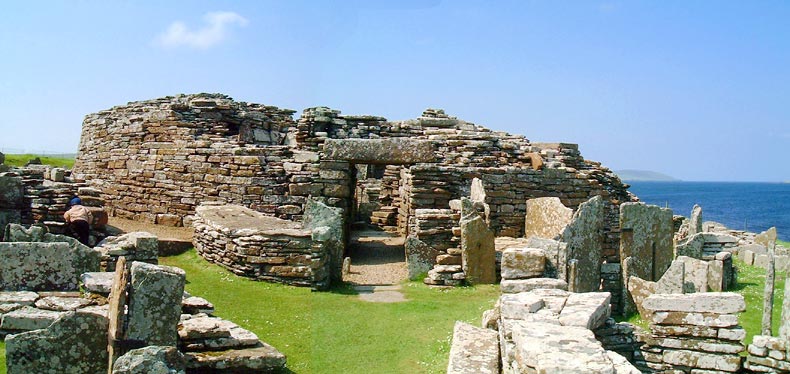
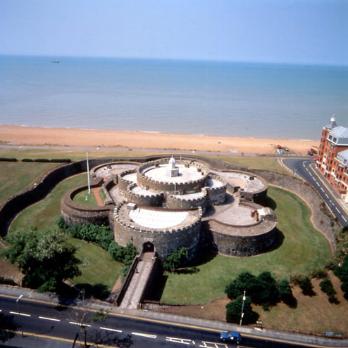
From ancient times- the Broch o' Gurness, in the Orkneys- our first line of defence against rampaging hordes of Norse students looking for cheap alcohol and less expensive degree courses (  ) . ) .
quote:
Until the summer of 1929, the site of the Broch o' Gurness was nothing more than a massive, grassy mound by the shore.
This mound was the Knowe o' Aikerness.
The Knowe o' Aikerness
The broch was discovered by Orcadian poet and antiquarian, Robert Rendall. While sketching on the knowe, one of the legs of Rendall's stool sank into the mound. Carefully removing some of the nearby stones, Rendall uncovered a staircase leading down into the knowe.
Full excavations began later that year and, for the first time in centuries, the broch and its outbuildings saw the light of day.
The entrance way to the Gurness broch tower, lined on both sides by the buildings that made up the village.
Actual dates for the broch are unclear, but it is generally agreed that it was built between 200BC and 100BC - possibly on the site of an earlier settlement.
Standing around eight metres high (26 feet), with an internal diameter of 20 metres (65 feet), the broch was a tall, easily-defended tower, surrounded by a series of small stone dwellinghouses.
The entire settlement was circled by outer defences comprising of a band of three ramparts and three ditches.
|
http://www.orkneyjar.com/history/br...ness/index.html
I suspect that this broch must have been quite imposing in its day, but that Midhowe Broch would have been even more impressive, especially seen from the sea:
http://www.orkneyjar.com/history/br...howe/index.html
Attachment: gurnessbroch.jpg
This has been downloaded 94 time(s).
|
|
| |
|
| |
|
| |
|
| |
|
| |
|
|
|
molly bloom
|
|
Lundenwic
Oct 2001
time: 15:33
|
|
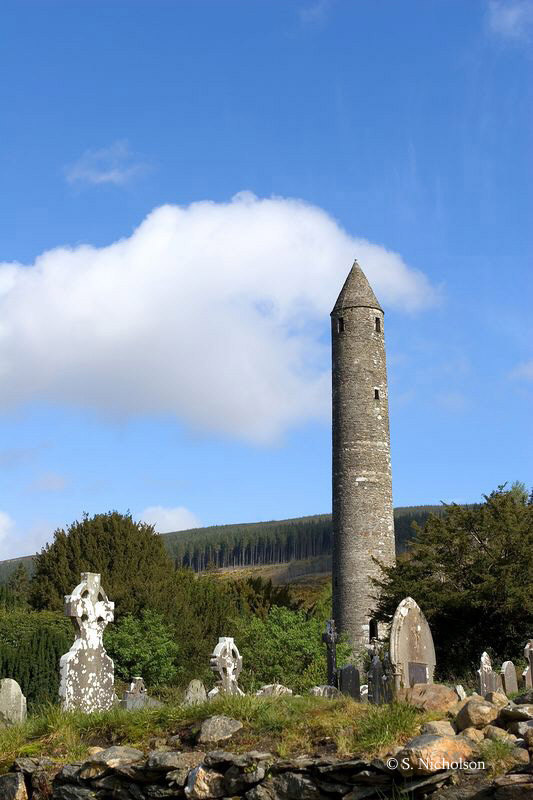
Not a castle as such, but certainly a stone-built place of refuge and defence for the monastic order who lived beneath it,the stone tower in Glendalough, County Wicklow, one of many across Ireland:
quote:
Glendalough, with its famous round tower is one of the most enduring images of County Wicklow. You can see the tower in the picture above with the lakes behind. A truly beautiful location which is steeped history.
The English name Glendalough comes from the Irish Gleann Dá Locha which translates to "The valley of the two lakes".
It was here that St. Kevin founded a monastery in the sixth century. From this beginning the site grew to become famous as a centre of learning throughout Europe. Indeed, Ireland was known as the "Island of Saints and Scholars". Standing amid the remains of this monastic settlement, one can feel a powerful sense of peace and tranquility.
The settlement continued to expand for 600 years and was destroyed in 1398. The buildings which survive date from the 8th and 12th centuries. The most famous is, of course, the round tower which is 34m high and 16m in circumference at the base. A cathedral, stone churches and decorated crosses also survived.
|
http://www.wicklow.com/glendalough/
Attachment: roundtower.jpg
This has been downloaded 74 time(s).
|
|
| |
|
|
|
molly bloom
|
|
Lundenwic
Oct 2001
time: 15:33
|
|
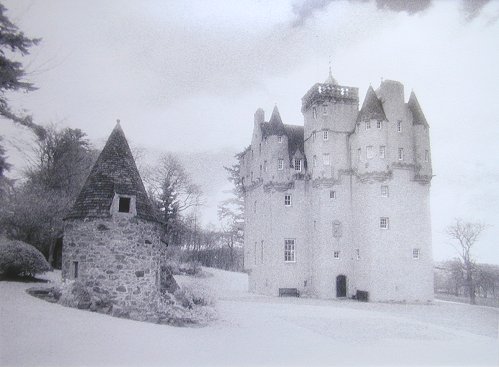
The Auld Alliance looks to have encouraged architectural similarities.
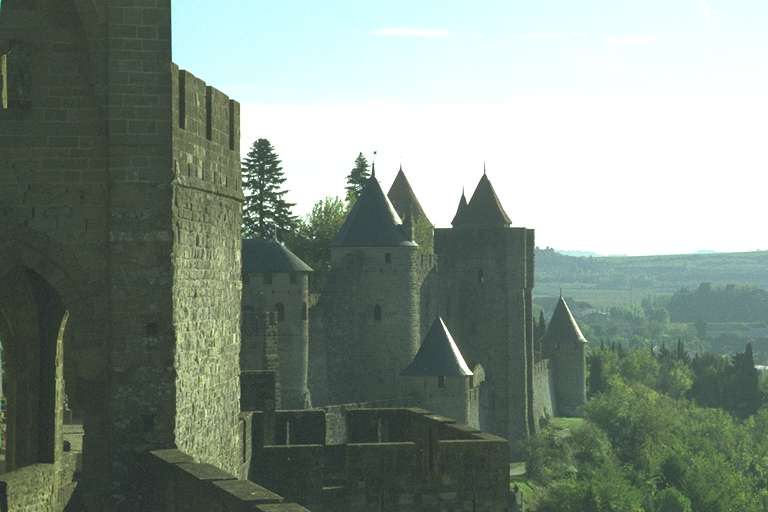
Craigievar Castle in Scotland, a fine example of Caledonian baronial, very Disney...
quote:
Named after a nearby hill, the present castle was built in 1610 by William Forbes, nicknamed "Danzig Willie" due to his extensive merchant ties to Poland. It is much earlier, (in 1457) that the name of Craigievar Castle first appears in any record, and then it is as the possession of the ancient family of Mortimer, and it is to them that the raising of the original castle is attributed. However in 1610 financial troubles forced the Mortimers to sell the lands of Craigievar along with the unfinished castle, to William Forbes of Menie.
William Forbes, who was the brother of the famous Bishop of Aberdeen, built the castle between 1610 and 1626, and his descendants in the Forbes family occupied the castle until 1963, when it was turned over to the National Trust of Scotland. William was succeeded by his son, also William, who was granted the title of Baronet of Nova Scotia in 1630.
Once Civil War broke out, Sir William was involved in many battles, leading the capture of Harthill Castle in 1640 and being captured (he later escaped) at the battle of Aberdeen in 1644.
The L-shaped castle, despite its peaceful appearance with French and Spanish turrets, was once heavily fortified, with a surrounding wall (now removed) and with a single, heavily defended entrance. The Laird of the castle and his family occupied the top part of the castle, while soldiers and an ever lit kitchen resided in the bottom plan of the castle, allowing heat to rise to the Laird's quarters.
|
http://www.geocities.com/SoHo/Squar...craigievar.html
Lovely photograph:
Attachment: craigievar.jpg
This has been downloaded 64 time(s).
|
|
| |
|
| |
|
| |
|
|
|
Wernazuma III
|
 |
Decolonize!
Aug 2000
time: 06:33
|
|
quote:
Originally posted by molly bloom
Auf Englisch, bitte... |
Former German Province of Ostmark. Czechs, Hungarians and other surrounding nations insisted on this name because the use of "Austria" would mean an aggressive expanionist imperialist claim over all of former Austrian territory.
quote:
I forgot to ask you- have you read 'Carnival in Romans' or 'Montaillou' by Emmanuel Le Roi Ladurie ?
They deal with life in Dauphine, Provence and the Catharist heresy.
|
Nope. Most of my knowledge about the Catharan heresy stems from Malcolm Lambert and Umberto Eco.
quote:
Of course you may just be a bit busy with your holiday preparations, but certainly 'Montaillou' would add a lot of background and historical flavour to your trip. |
Actually, I'm currently busy destroying documents in the Indies Archive in Seville.
I take you get percentage from BLOOMsbury? 
quote:
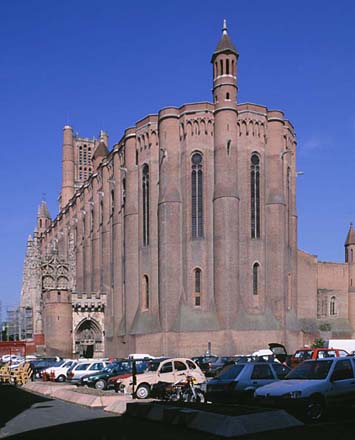
The cathedral at Albi shows how the church militant in the south of France deserved the name- it looks more like a citadel of the faith, rather than a place of worship.
|
Crush the heretics! Kill them all, God will sort out his own!  On a more serious note, I don't sympathize with the Cathars (you know, they eat babies ), but I wish the church had rather used the Waldensians to counter the Cathars than Dominicans. Instead, they decided to prosecute Waldensians themselves as heretics... On a more serious note, I don't sympathize with the Cathars (you know, they eat babies ), but I wish the church had rather used the Waldensians to counter the Cathars than Dominicans. Instead, they decided to prosecute Waldensians themselves as heretics...
|
|
| |
All times are GMT. The time now is 05:33.
Apolyton Time is 00:33. |
top of page
|
|
|
Forum Rules:
You may not post new threads
You may not post replies
You may not post attachments
You may not edit your posts
|
HTML code is ON
vB code is ON
Smilies are ON
[IMG] code is ON
|
|
|
|
|
|





 13-09-2005 15:16




 Makes me wish I would be touring Europe instead of sitting at home writing a paper *whines*




 |
|