|
| |
|

|
Locutus

|
|
ACS CTP1/2 Manager & Civ4 Co-Manager
|
 |
Hengelo, The Netherlands
Nov 1999
time: 06:15
|
|
Alexander,
Well, I can't speak for anyone else but I will certainly get involved with all the civs myself. I'll do some research and contribute to the threads as much as I can. I agree that this ought to be a team effort, the more people work on a civ, the better the final result should be.
As far as starting threads goes, people should just post whatever they have to post and leave the rest open for group disccusion. My thread was an excellent example of something 90% done which is one way to go, your thread is an excellent example of something 90% not done, which is another, equally good, way to go.
jsw363,
If you have better sugggestions for Spanish colonies, I'm all ears. Some colonies should definitely be included for the Spanish as they played an important role in the Spanish Empire but I agree the better choices could be possible. However, as I said before, Spanish history is not one of my specialties...
|
|
| |
|
|
|
Peter Triggs
|
|
Gone Fishin, Canada
Jan 2000
time: 05:15
|
|
Have you guys noticed who's 21st it is today?
Have fun tonight, Wouter.
|
|
| |
|
|
|
Oerdin
|
 |
of Internet Music.
Sep 2001
time: 21:15
|
|
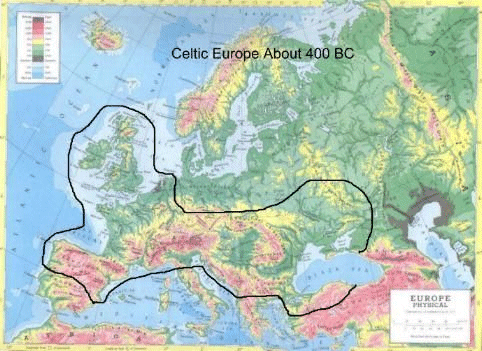
CELTS:- An ancient people who dominated much of Western , Central , Eastern Europe and Asia Minor in the 1st millennium bc, giving their language, customs, and religion to the other peoples of that area.
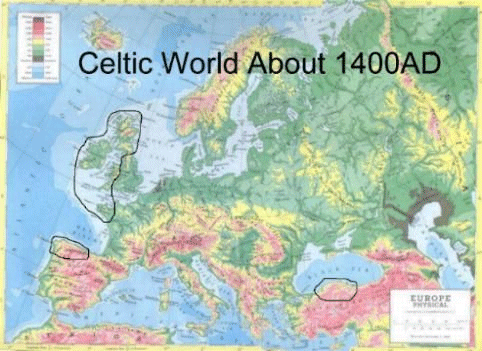
History:- The earliest found archaeological evidence associated with the Celts places them in what is now France and western Germany in the late Bronze Age around 1200 bc. In the early Iron Age, they are associated with the Halstatt culture (8th-6th cent. bc) named for an archaeological site in Upper Austria. They probably began to settle in the British Isles during this period. Between the 5th and 1st centuries bc , their influence extended from what is now Spain , the islands of the British Isles to the shores of the Black Sea , from the Ukraine to Turkey. This huge land/cultural region ( never an 'Empire') encompassing the areas mentioned influenced much of the continent of Europe and was greater in size then modern European Russia. Despite the shared religion/language and culture this large area was never politically united , finding only brief periods of unity when threatened by common foes. The later Iron Age phase of Celtic Culture is called La Tene, after a site in Switzerland and dates from the previously mentioned 5th to 1st centuries bc. Evidence from this period suggests that the Celts were the first peoples of Europe to actively use and work with iron. The word Celt is derived from Keltoi, the name given to these people by Herodotus and other Greek writers. To the Romans, the Continental Celts were known as Galli, or Gauls; those in Britain were called Britanni. In the 4th century bc the Celts invaded the Greco-Roman world, conquering northern Italy and sacking Rome, whilst also conquering Macedonia and Thessaly. They plundered Rome in 390, sacked Delphi in 279, and penetrated Asia Minor, where they were known as Galatians. The "Cisalpine Gauls" of northern Italy were conquered by the Romans in the 2nd century bc .Transalpine Gaul (modern France and the Rhineland) was subdued by Julius Caesar in the 1st century bc. and most of Britain came under Roman rule in the 1st century ad. In the same period. the Celts of central Europe being fragmented came under the domination by the Germanic peoples. In medieval and modern times the Celtic tradition and languages survived in Brittany ( Western France), Cornwall, Galicia ( North Western Spain) , Galatia ( Central Turkey), Wales, the Scottish Highlands, Isle of Man and Ireland, and to a lesser extent in the Norse/Celtic culture of Iceland.
Way of Life:- The various Celtic tribes were bound together by common speech, customs, and religion, rather than by any well defined central governments. There government was through the use of a feudal system with each tribe being headed by a king/chief and was divided by class into Druids (priests), warrior nobles, and commoners/freemen and slaves . Politically there was a great degree of democracy within the society with both men and women being treated equally and all important decisions being made at tribal gatherings in which women had an equal voice. Rulers were subject to removal at these gathering if found unsatisfactory or incompetent and succession was not necessarily hereditary. The absence of any large scale political unity amongst the tribes contributed substantially to the extinction of their way of life, making them vulnerable to their enemies. Their economy was pastoral and agricultural and they had no real urban life however trade played a large part in there economy . The nobles fought on foot with swords and spears and were fond of feasting and drinking. Celtic mythology, which included earth gods, various woodland spirits, and sun deities, was particularly rich in elfin demons and tutelaries, beings that still pervade the lore of peoples of Celtic ancestry.
|
|
| |
|
|
|
Oerdin
|
|
of Internet Music.
Sep 2001
time: 21:15
|
|
Celtic Christianity:- The Christian faith was well established in Celtic Britain by the 4th century ad, but in the 5th century the Saxons and other Germanic peoples invaded the country, driving most of the Celtic Christians into Wales and Cornwall. At the same time. St. Patrick and other British missionaries founded a new church in Ireland, which then became the centre of Celtic Christianity. The Irish church developed a distinctive organization in which bishops were subordinate to the abbots of monasteries .The Irish monks, devoted to learning as well as religion, did much to preserve a knowledge of ancient Roman literature in early medieval Europe. Between the late 6th and the early 8th centuries, Irish missionaries were active in Christianizing the Germanic peoples that had conquered the Western Roman Empire, and they founded numerous monasteries in present-day France, Germany, Switzerland , and Italy. Celtic Christianity in Ireland was weakened by the Viking invasions of the 9th and 10th centuries, and by the 12th century its characteristic institutions, which were incompatible with those of the dominant Roman church, had largely disappeared from Europe.
Art:- Celtic art is considered the first great contribution to European art made by non Mediterranean peoples. Its roots go back to the artisans of the Urnfield culture and the Hallstatt culture (8th-6th cent. bc) at the beginning of the Iron Age. It flowered in the period of the La Tene culture. Although Celtic art was influenced by ancient Persian, Greek, Etruscan, and Roman art and by that of the nomads of the Eurasian steppes it developed distinctive characteristics. These are evident in its major artefacts-weapons, vessels, and jewelry in bronze, gold, electrum and occasionally silver. Many of these objects were made for chieftains in southern Germany and France and were recovered from their tombs. The Celtic style is marked by a preference for stylised plant motifs, usually of Greek origin, and fantastic animals, derived from the Scythians and other steppe peoples; however the human figure tended to play a secondary role. Other favourite motifs are elliptical curves and opposing curves. spirals, and chevrons, also derived from steppe art. These elements were combined in dynamic yet balanced, intricate geometrical patterns carried out in relief engraving, or red, yellow, blue, and green champleve enamel on shields, swords, sheaths, helmets, bowls, and jewelry. They also appeared on painted pottery cinerary urns, food vessels, incense bowls, and drinking cups. Examples of Celtic art include torcs, or neck rings, with the two open ends ornamented with animal heads, the silver repousse Cundestorp cauldron (c. 400 bc . National Museum, Copenhagen), a bronze lozenge-shaped shield with circular medallions and small enamel circles (1st cent. bc - 1st cent. ad ), and a bronze mirror with enamelled decoration (1st cent. bc) (both British Museum. London). Also surviving are roughly carved stone monuments and wooden objects. During the period of Roman domination of Western Europe in and after the 1st century bc the art of Celtic peoples on the Continent gradually lost its distinctive style. The Celts of Ireland continued to work with traditional motifs but as Christianity took hold, they combined them with Christian motifs and employed their skills in the service of the church.
Celts Today:- Today the people who call themselves Celts or still strongly identify with there celtic history can be found in the following areas:- Brittany France, Cornwall, Galicia Spain, Galatia Turkey, Ireland, Isle of Man, Scotland and Wales. All these areas have strong Celtic elements to there culture with some of them still speaking Celtic Languages whilst others though not speaking a Celtic language have strong Celtic cultural rootes. The modern Celts have a varied and rich history and have influenced many of the worlds current great nations with their pioneering spirit and love of adventure helping to found some of the worlds most progressive and greatest nations.
|
|
| |
|
| |
|
|
|
Rosacrux
|
 |
In a Galaxy far, far away...
Oct 2001
time: 05:15
|
|
Oerdin, all right and swell, but you got the location of Galatia in Turkey completely wrong. It was downwards, in the center of asia minor and it was definitely smaller. The area you include (in the 1400 AD map) is known (still!) as the Greek Pondos.
If I recall corectly, the Gauls (Celts) of asia minor, settled there from the BC years, have officialy earned their land by a Roman (Byzantine) emperor, for whom they have fought. It was part of the Roman/byzantine empire, and later the kingdoms of the Selzuks and the Ottoman empire (never been a separate state).
I am sure for the location. A bit to the south, Galatia is not on the Black Sea, it's innerland.
And the first map is kinda exaggerating though, there were celtic populations all over this place, yes, but they weren't but isles of peoples (in fortified villages, usually) with the exeption of the Celtic populace in todays Yugoslavia (pretty much organized, they conducted the great invasion into Greece which came close to ravage the entire Greek area. It ended up pretty harsh for the Celts, though: From an army - horde, actually - of 30-40.000 men, barely 5000 made it back to their homes...
And they never "conquered" anything - definitely not Macedonia r Thessaly. They lived in areas of today Serbia and Croatia and made assaults against richer lands-kingdoms (to the south, usually).
Also, another interesting fact is the war customs of the Celts/Gauls. They went to battle naked, covered with war paintings, wearing only their jewelery, weilding an early type of broadsword and wooden shields. Any Celt warrior had to make sure he has killed the man in front of him and then he would cut off his head, so he can present it later to his leader and take his share of the loot. Oh, and they would drink their opponents blood too...
Oh, and another error, about the BC map... you include half of the kingdom of Macedonia to the celtic area, as well as the kingdom of the Molosses, the kingdom of Illyrians and Thrace, and many Greek colonies too.
Minor errors, for sure, but you are doing a great job nevertheless. I like the celtic culture in general, but I wouldn't qualify them as a civilization. They are a large ethnic group, ubernation in some sense, but never been a nation.
Last edited by Rosacrux on 16-10-2001 at 15:06
|
|
| |
|
| |
|
|
|
Solmyr
|
|
quote:
Originally posted by Locutus
Also, I finally found back the title of the wife of the Great Khan (I knew it existed but I had forgotten it): Khatun. So I changed 'Borte' in 'Khatun Borte'.
|
I think this should be "Borte Khatun". Mongols put their titles after their names (compare "Kublai Khan" or "Subudei Bahadur").
|
|
| |
|
|
|
Jay Bee
|
 |
Valladolid, CA
Jan 1970
time: 06:15
|
|
quote:
Originally posted by Locutus
As Spanish Great Leaders I selected Cortes (Aztec conqueror), Pizarro (Inca conqueror) and Don Miguel de Espinosa (a famous admiral), and I fully expect at least one Spain expect to have objections or additions to these  |
To be honest with you, I have no idea who Miguel de Espinosa was  Some other outstanding leaders: Gonzalo G. de Cordoba (the Great Captain), John of Austria (Philip II's half brother), Spinola, Farnese, Adm. Blas de Lezo, Adm. Churruca, Castaños, Roger de Flor, King Jaume I "the Conqueror", King Alfonso III "the Fighter", King Ferdinand III "the Saint"... Some other outstanding leaders: Gonzalo G. de Cordoba (the Great Captain), John of Austria (Philip II's half brother), Spinola, Farnese, Adm. Blas de Lezo, Adm. Churruca, Castaños, Roger de Flor, King Jaume I "the Conqueror", King Alfonso III "the Fighter", King Ferdinand III "the Saint"...
|
|
| |
|
| |
|
| |
|
|
|
jasev
|
 |
of the SCS Forum
Feb 2001
time: 06:15
|
|
Well Locutus, you're right. Most of spanish people haven't heard about that dutch polititian of the XIX century before  , though he was one of the writers of Dutch Constitution and he's a very important figure in dutch history. , though he was one of the writers of Dutch Constitution and he's a very important figure in dutch history.
But I was annoyed because El Cid is a well-known figure out of Spain. Everyone who studied European Literacy knows about him, like about Roland or Beowulf. And, of course, Bronston's hollywood movie and AOEII: The conquerors made him known by other people.
quote:
shouldn't he be seen as some kind of traitor then? |
Yes, you're partially right, but there's a little problem: there are two figures, the historical one (those you saw on Discovery) and the legendary one. In his Cantar, El Cid is a great hero who, after being unrightly exiled from Castile, conquers Valencia in 1044, defeating (and that is a true fact) the fanatic muslim sect of the Almoravids who had conquered the muslim Spain. He is the greatest symbol of Spain because a versicle in the Cantar: "Dios, que buen vassallo, si oviesse buen señor" (God, what a good servant, only if he had a good lord): this is an allegory of the spanish people.
|
|
| |
|
| |
|
|
|
Locutus
|
|
ACS CTP1/2 Manager & Civ4 Co-Manager
|
|
Hengelo, The Netherlands
Nov 1999
time: 06:15
|
|
quote:
Originally posted by jasev
But I was annoyed because El Cid is a well-known figure out of Spain. Everyone who studied European Literacy knows about him, like about Roland or Beowulf. |
That's your view perhaps but I doubt it. Most people don't study European Literacy, not on an academic level at least. And what people learn in highschool is very culture specific. I could understand English people might be familiar with El Cid because Spanish a actually a course you can follow on English highschools but here in the Netherlands it is not (or at least only offered on a small number of schools). Dutch education (unfortunately) focuses entirely on it's neighbours as far as foreign literacy is concerned: English, French and German (and of course ancient literacy: Latin & Greek). I imagine this is the case for most (European) countries...
Jay Bee,
Nope, sorry, never played your scenarios  
By the time I got internet access (and thus access to scenarios) CtP was about to hit the stores and I didn't bother to look at Civ2 scenarios anymore. I briefly looked at some Civ2 scenarios later on to see what is possible in terms of Civ2 modmaking, but because Civ2 is such a frustrating game to play, compared to CtP (no offense, just my not-so-humble opinion), I never got any joy from actually playing these scenarios 
The fact that Hollywood made a movie about El Cid says very little. They made a movie about William Wallace and Robert the Bruce too and let's face it: how many people outside Great Britain had heard of these guys before Braveheart?
|
|
| |
|
| |
|
| |
|
| |
|
| |
|
|
|
Ecowiz Returns
|
 |
Portugal
Aug 2001
time: 05:15
|
|
quote:
Originally posted by Locutus
Long before the Spanish civilization as we know it today came into existance other great civilizations ruled over Spain. Phoenicians, Carthaginians, Greeks, Celts and later Romans all had cities in Spain, mainly because of it's abundant natural resources (gold, silver, tin, copper, grain, wool, olive oil, wine, etc). They all lived and worked next to and with the native inhabitants, the Iberians (as the Greeks called them). Starting in the first century AD, under Roman rule, Christianity was introduced, something which would profoundly influence events in Spain in the centuries to come. After the fall of the Roman Empire in the fifth century AD various Germanic tribes - most notably the Visigoths - moved into Spain but they had little impact historically. The role of the Catholic church grew considerably during this time. In the eighth century the Arabs and the Berbers (together known to the Europeans as Moors) invaded from Africa and enforced Islamic rule over Spain, only in the northern-most regions the Christians still had some power. |
I find a bit difficult to accept this first part as Spanish civilization History or description. All these events happened in all the Iberian Peninsula, including what his, throughout more than 800 years now, Portugal's Continental territorry. So, maybe it should begun here.
quote:
It wasn't long though before the Christians began the Reconquista, the reconquest of the subcontinent which would take 700 years. |
quote:
This was originally a fairly weak confederacy of independant states but over time these states (with the exception of Portugal) went through a unification process which would eventually lead to a truly unified kingdom of Spain under Ferdinand and Isabella (see below). |
The way i recall it they were as confederate as any of the European kingdoms between themselves, ie, not at all.
quote:
In the same year, Christopher Columbus, a Genoese navigator, discovered the New World. |
Mind you, he didn't discouver the New World: he always claimed to have discouvered another maritimal route to Asia (he thought Cuba to be Japan!!!) .
quote:
In 1580 Philip also inherited Portugal and thus the Iberian Peninsula was united for the next 60 years. |
Please don't say that!
Philip II of Spain was Philip I of Portugal.
The means the crowns were never joined!
When the Spanish King tried to join the crowns, Portugal restaured the Independence.
That, and saying that Spain reached Asia (which only had Portuguese colonies) because of these meansly 60 years is too far fetched to be called hystoric record!
My editing: (I have to correct this last statement. After writing it, I recalled the Phillipines were once a Spanish colony, but that's the one I recall and frankly the only thing I recall about the Philipines in those days is about piracy)
Last edited by Ecowiz Returns on 23-11-2001 at 14:08
|
|
| |
|
| |
All times are GMT. The time now is 05:15.
Apolyton Time is 00:15. |
top of page
|
| archivepost |
|
Forum Rules:
You may not post new threads
You may not post replies
You may not post attachments
You may not edit your posts
|
HTML code is ON
vB code is ON
Smilies are ON
[IMG] code is ON
|
|
|
|
|
|





 16-10-2001 03:04


 Attachment:

 It's getting way too crowded here. Perhaps you and/or Ubik could move to a new thread?


 We should tell this case to Civ2 Inquisition. What could we expect from a Dutch protestant?


 |
|