|
| |
|

|
roquijad
|
|
Santiago
Nov 1999
time: 05:15
|
|
Very interesting topic.
1) The only two hard (implicit) assumptions regarding provinces in govt/social/riots models are a)squares conforming a province are all "near" to one and other, where "near" means kms adjusted by transportation techs and infra. If we allow players to build provinces w/o considering this "effective-distance", these models will have problems. b)provinces are controlled by only one civ (no overlapping).
2) I agree with Gary about territories being mostly feudal or having no divisions at all (when small) as the most common form of organization in history, but I understand Clash provinces are any type of territorial division, being it feudal, roman-like or whatever. The name "province" we've used until now may be a little bit deceiving, but IMHO it should be understood as any form of division.
3) A given territory will always have some sort of bureaucracy. It can be a primitive tribal organization of the people who live there or a whole set of complex institutions. The relation between this local bureaucracy and the central govt only describes how much control the latter has over the former. What I'm saying is the bureaucratic organization doesn't "appear" when a govt decides to rule the land. Existing bureaucracy isn't necessarily something the central govt implements. Administration will exist even if the central govt is so far that it doesn't have any real influence/control over the province. It'd just be fully "local".
4) I also agree a lot with Gary on the "proclamation" thing, but I believe we should avoid extreme things like the China-Chicago example (too bizarre) and avoid the overlapping situation that it easily leads to.
5) The notion of province serves mainly the purpose of having more realism in modeling economic, social as well as administrative effects in the game. In fact players don't need provinces and all territorial division may be chosen to be hidden from them, although showing them does give more flavor to the game. I pretty much like our current provincial system. I don't see any reason to change it and only the processes of creation and transformation of them need to be addressed. Here's an idea for this:
Since we need provinces (or any form of territorial division) in the game to model several things and since effective distance should be the main variable defining their size and number, I propose the following system: Imagine a map where all the proclaimed territories of a civ are painted in red. The game-engine paints in blue all squares that, measured from the capital city, can be part of the capital province considering transportation techs and infra currently available (i.e. using the effective-distance notion). Squares beyond this will remain in red, representing the need for more provinces. In any of these red squares the player may click to define the center of a new province. Using the same scheme, the game creates the new province starting from that center and using the eff-distance variable, but now also considering previously created provinces as limits. The process continues until the creation of a new province would lead to a very small one (defining previously what size is considered as a minimum). Once that point is reached, surviving red squares are assigned to the nearest province.
Note this system can be easily implemented with no player intervention at all, letting the game choose the best locations for province centers. The process could be executed every N turns to incorporate advances in transportation techs and new transportation investments. And it could be also executed by the player to incorporate new squares if the ruler through conquest has obtained more land.
The proclaimed territory, to avoid bizarre effects, should be determined by military units. Having a military unit in a given square and pressing "P", for example, would mean the square has been proclaimed. The square is included in the civ's list of proclaimed territories and is taken out of the list of all other civs (to avoid overlapping). The action of proclaiming can obviously lead to war in some circumstances.
Note also that in the process you could include feudalism effects. A Feudal Unit in a square may act as an eff-distance penalty, so the presence of these units will lead to more and smaller provinces.
Do you like it?
Yoav: If you try to develop a refined median system, here are a couple of elements I personally find bad about the pure median system:
1) It seems the median system assigns the decision ability to the actor with highest polpower (at least for govt policies having a continuos nature, which for now are the only type of variables used in the govt model). If you have more power than the rest, you get to decide everything, while you can't influence anything if your polpower isn't the highest. This all-or-nothing characteristic doesn't look realistic to me.
2) It seems you can't have degrees of despotism (or degrees of influence in govt, in general). You either have full power or you have nothing at all.
3) Because of 1), it'd be possible the ruler having no control at all over govt. I don't think this is good.
|
|
| |
|
|
|
Mark_Everson
|
 |
Canton, MI
Jan 1970
time: 00:15
|
|
Hi Rodrigo:
Thanks for your able defense of the old province system. The criticism of the old system that I agree with is:
quote:
The fact that Attila temporarily tromps through Cisalpine Gaul should not force the Romans to reorganize their [province] system, then reorganize again when he leaves. |
With the old model where a civ Must control every square of a province, the province boundaries will forever be changing. IMO this gives the player less connection to the land, and so the game. I think making provs fairly permanent, and able to change hands in parts, while retaining their name, will increase player immersion, and have a fun benefit. That is the major reason I like the idea of mostly-unchanging provinces that can be partially conquered by one side or another, and where no major bookeeping changes take place due to the conquest of several squares one way or the other. Players can rearrange, in the way you propose, Firmly held territory, definition TBD.
I think this system works fine with the current govt model. What the govt model considers to be the Roman province of Cisalpine Gaul would be only those parts controlled by the Romans. Attila could also have that same province, with him controlling the balance of the squares, although it could be named differently.
I would like the 'default' setting to be that an invading civ will keep the provincial structure of the prior civ until the invader's control has enough longevity to let it rearrange provincial borders. The sole purpose for this is to give boundaries some continuity. But this will be a good decision if the provincial boundaries were well-though-out in the first place, taking into consideration geography, transport, and ethnic groups.
Mikael also had some good thoughts that I'll reproduce here:
quote:
- ruler's control. If you have no control on a particular part of your empire, you won't be able to play with provinces' borders there.
I also believe province borders should be able to change without any player intervention. Example: a square might deliberately unite itself to a certain province because the people feel it is for their good (that way they'll get richer).
I also suspect local warlords (as described in the riots model) should be able to modify borders during their own internal wars. |
That latter point would be the case for a feudal setup where the ruler has little real control.
When radical changes in technology exist, I think the most graceful thing may be to just leave the provinces as they are. Merchants will take advantage of the more efficient transportation anyway, and govt orders can be given at the regional (groups of provinces) level.
Another alternative is to wait until several old provinces can be merged into one mega-province. That is less efficient technically than shifting the provinces all around, but I think it would help maintain the feel of the game for the player. In this area I'm still not sure this is a good solution, but I'm trying to throw out some new ideas.
That's where my thoughts are now. But this is a group decision. So I'd like to hear what you think about what I've said, and of course here if there are any show-stopper issues of doing it this way that none of us have thought of yet.
|
|
| |
|
|
|
Yoav Sissman
|
|
Excuse me for not expressing my opinion on the nature of the provincial unit so far, but I simply find it difficult for me to make my mind. 
Rodrigo:
Wow, is it possible that we don't have the same median system in mind (before any refinements are made)?
quote:
1) It seems the median system assigns the decision ability to the actor with highest polpower (at least for govt policies having a continuos nature, which for now are the only type of variables used in the govt model). If you have more power than the rest, you get to decide everything, while you can't influence anything if your polpower isn't the highest. This all-or-nothing characteristic doesn't look realistic to me. |
Oh no, the median system does not assigns the decision ability to the actor with the highest polpower. Was it not understood by now?
The gov't profile is calculated as follows:
(a) The polpower of each faction is calculated: it is the sum of the polpowers derived by it from its membership in all PBs. There is no meaningful difference between the Weighted Sum and median systems so far.
FE if the regime grants 50% polpower to the People and 20% to the Capitalist and a certain SC constitute for 10% of the people that holds 50% of the wealth, then that SC will have a polpower of 50%*10%+20%*50% = 15%. A faction that consists of 40% of the social class will have a polpower of 15%*40% = 6%.
(b) The policies of all factions regarding the DNPs are ordered for each DNP separately. In the Weighted Sum System that phase isn't needed.
(c) Now we assign each faction polpower to its stance on each of the DNPs separately.
(d) The gov't profile for each DNP will be the median of all opinions, each having a 'width' proportional to the combined power of all factions that back it up.
In the singular event when the median is exactly in between two profiles, we can use the middle point of the two (pure median approach), or if it causes problems we can decide to always choose the profile closest (or farthest?) from the ruler profile.
FE if 10% of the polpowers have PP value of below 10,
10% have it between 10 and 20,
10% between 20 and 25,
10% between 25 and 30,
10% between 30 and 35,
10% between 35 and 40,
10% between 40 and 50,
10% between 50 and 60,
10% between 60 and 75,
and 10% between 75 and 100,
The gov't profile will be around 35. In your system it will be higher (around 40) because of the boosted power of the extremists that want PP to be far from the more accepted ranges.
In both systems the degree of influence increases with the polpower, but in your NS it is also increases the distance between the value desired by a faction and the weighted sum of the others.
Also my NS doesn't favor the ruler in any way; he plays by the same rules that apply to everyone (putting foul play aside) and still can't gain any benefits from lying to his interface.
quote:
2) It seems you can't have degrees of despotism (or degrees of influence in govt, in general). You either have full power or you have nothing at all. |
Nope. This depends on 1). You need 51% polpower to have full control, and for less of that your power decreases gradually.
quote:
3) Because of 1), it'd be possible the ruler having no control at all over govt. I don't think this is good. |
As long as the ruler has a polpower of more then 0, he will have some control over the government. That control is more helpful in some cases and less in others, as it is in your system.
I'm interested in hearing about other possible flaws in the median system, but if those 3 are the only ones, then I don't feel there is much to be done to improve it, and we can test it as it is.
Mark, I sorry for kicking what may be a dead horse, but I can't allow myself to be misunderstood. 
|
|
| |
|
|
|
roquijad
|
|
Santiago
Nov 1999
time: 05:15
|
|
I'm checking the forums less frequently than I should. I apologize.
Mark: Yes, the Attila example is good and shows the current provincial system has a problem. I think it's fair to say that's its only problem and that's good because probably we're not too far from the "perfect" provincial system.
About Mikael's comments you cited, I think the first part (ruler's control) is pretty much the same as the Attila example. About the second part:
a) squares wanting to join your civ: Interesting. We can implement it, probably within the riots model as an event where the square's social classes ask you to accept their joining.
b) feudal lords changing borders: Here's where I see a key decision has to be made (affecting far beyond feudal lords). Mikael tends to see provinces as actual/real divisions of the territory, where the borders are set whether by bureaucratic decisions or by distribution of de facto powers (such as warlords). I believe many of other team members see it that way too. On the other hand, I prefer to see provinces as a modeling tool to provide realism for economic, social (cultural) and administrative effects, as I stated in my previous post. The difference of approach has implications we haven't paid enough attention to.
Suppose early in the game you have a civ with an extended (but not too large) territory. As in many historical cases, the land would be controlled and run w/o bureaucratic divisions (no "provinces" in the roman empire sense). If you take the approach of using clash-provinces only for real divisions, then this civ would only have one big clash-province. But probably it'd be too large to get realistic results in the economy or social models. Models like these need more clash-provinces. The game'd have to create more provinces to model things realisticly, but even though their number and size may be perfect for modeling purposes, they may not be the configuration the player prefers. Also, seeing these provinces, the player will naturally understand them as provinces in the roman sense or as other real divisions such as feuds, when they don't represent that. As a result the player, as Mikael does, may expect changes in province borders as a result of, FE, wars between feudal lords, when actually these borders can't change becuase they have to meet restrictions imposed by the models that created them in the first place. Furthermore, in these conditions players shouldn't be allowed to change borders because, again, they have to meet the aforementioned restrictions. Finally, the player will probably expect that, since his empire is organized in provinces, there're administrations gains involved, as they were and are in RL, when actually there's no gain at all because they're there only to provide realism. In short, provinces as a "game experience" conflict with provinces as a necessary modeling tool.
I think most of the problems I mentioned above concerning the conflict between the usefulness of provinces as a modeling tool and the "traditional" view of provinces as actual territorial divisions can be solved if:
1) provinces are created and changed during the game by the game engine for realism purposes and meeting models demands.
2) provinces configuration (size, number and location) given by the game engine is assumed to be the best configuration the central govt may choose as an administrative division of the land. This implies the player will not be allowed to change borders (there's no gain in changing them, so he shouldn't even want to change them).
3) provinces borders are not shown to avoid players "jumping to conclusions", unless:
3.1) feudal units appear in a province, in which case its borders are shown to let the player know there's something special about that province and let him know the area in control by those warlords.
3.2) a province has sufficiently high autonomy. In this case the player needs to know its borders to have an idea of the danger involved in that autonomy and the danger of potential problems like an independence attempt. Note 3.1 and 3.2 tend to be the same:the recognition of a de facto local power.
3.3) the govt decides to implement an administrative territorial division based on provinces in the roman and modern senses. In this case all provinces are shown and the game (govt model) should give him some sort of gain in the administrative side and should charge him with the costs of implementing such organization.
In this scheme provinces are always there and continuously changing borders as techs and other factors (transportation mainly) determine the optimum configuration for realism, but the player won't see them all the time. They're are visible only if a local power appears or if the player actually decides to organize his territory in provinces hoping to gain some bonuses. In this case the player doesn't play a role in defining the provinces. They're created for him (in reality they already exist and are simply shown).
The assumption in 2) is key to reach a "marriage" between the two conflicting approaches. We're imposing a game concept (administrative provinces) to match a modeling structure. The good thing is doing this has no cost at all in terms of flavor/fun, it avoids having to code two different types of provinces (game provinces, modeling provinces) and it also makes sense: game engine's configuration will be pretty much the best way a player could organize his territory.
Note a major invasion of a civ over another will preserve most of the province organization, because it is given by the game engine instead of by player design. That's good for the "borders continuity" Mark spoke of.
Because of the speed of progress, provinces will, for long periods of time, remain with little changes, giving continuity of borders and therefore producing the desired flavor and stability. However, if we fear the continuous and automatic change of borders will upset players or won't produce enough continuity, we can opt for "Plan B": Let the player decide the rearrangement of (administrative) provinces with a "create provinces" button (which is the same one used to create the adm. provinces). Note that as time passes by, the automatic rearrangement of borders has one direction: you get fewer and bigger provinces. But the game can in fact continue working with small provinces without sacrifying realism much (for some models it's even better in terms of realism to work with provinces with a size as small as possible). Essentially you'd only lose some benefits (mostly in economy) if you don't update provinces configuration as the game progresses. So, we can take advantage of this property to let the player decide when it's time for the update and gain the bonuses. Associating the rearrangement of provinces with a money cost, we can be sure players won't be pushing the button excessively and at the same time we're introducing the renewal of territorial organization as an important factor of civ's modernization. And "borders continuity" gains a lot.
What do you think?
--------
What about Attila? IMHO the best way to solve that problem is implementing these two rules:
1) enemy troops in a province act as a penalty for several things (mostly a penalty for economic production and tax collection).
2) to integrate a territory (mapsquares) to your empire you have to "declare sovereignty" like I proposed in my last post. But you must pay a money cost to do so.
The "declaration cost" represents the cost of deploying in that place a minimum of personnel and infra that allows you to perform basic activities (such as collect tax or create military units in it) and, most of all, a cost of "pacifying" the place (establish order, destroy rebellious cells and replace local dangerous authorities).
The cost should depend on the existing EGs, so if they're friendly (for example if you're recovering a land with fellow nationals) then you face a much lower declaration cost (they happily rejoin your civ). And if the land is unoccupied, then the cost is nearly null.
With these two rules the invasion of Attila produces problems for the romans in the affected provinces, but territories don't change hands immediately (and borders and provinces remain). The change in borders and provinces will only take place if Attila feels strong enough to retain the land, in which case he'll pay the declaration cost. If the place is still disputed and subject to a probable roman strikeback, Attila will prefer to save his money and avoid the risky investment. The cost ensures borders will change only when invasions are "definitive", which is IMO a better solution than letting pass some time after the place changes hands.
What do you think?
----------------
Yoav: You were right! I was in fact confusing the median with the.... "moda" (that's spanish, I don't know how to say it in english). I humbly apologize.
I have comments/criticisms:
1) Making the actual computation seems to be a little troublesome. In your example is easy to determine the median just by inspection, but in the general case building the "width" for each political position seems to need a procedure you'll have to describe in detail if you want your system to go into coding phase. In other words, please define in detail this expression for a general case:
DNP_value=MEDIAN(?,?,....,?)
2) The 51% threshold is something I don't like and I'd like you to correct. I'd expect different results if the ruler (or any other) has 51% or has 70%.
3) Suppose the following scenario:
Actor A has 2/6 of power and wants DNP_value to be 7.
Actor B has 1/6 of power and wants DNP_value=4.
Actor C has 3/6 of power and wants DNP_value=8.
Median(7,7,4,8,8,8)=7.5
But if Actor A would have said he wanted DNP_value=6, then the median would have returned 7 (what he really wanted). There seems to be incentives to lie to the interface....
-------------
I'm almost done with govt model's equations. Stay tuned!
|
|
| |
|
|
|
Mark_Everson
|
|
Canton, MI
Jan 1970
time: 00:15
|
|
Hi Rodrigo, I enjoyed the good thought-provoking post. I want some time to think about the issues you raised. Fortunately we don't need to determine an answer right now because static provinces, likely defined 'by hand', will probably get us through the next several demos.
Just a few points:
The province structure no longer drastically affects the economic behavior of the civ. All the economics are run at a square level, and unless we need to change that the economic effects of provincial structure will be minor. It is true that economic orders can be issued by province, but I don't think that will be a big issue in province sizing and configuration. All we really need to worry about for provinces is the social model, and what the player sees.
I think the general outline of your solution is ok. I have some minor points I disagree with, or would like to modify. But I want to think about your proposals a bit before I respond in detail.
BTW 'moda' is 'mode' in English, if I get what you are saying from context, quite close.
|
|
| |
|
|
|
Yoav Sissman
|
|
I'm currently having my exams period and was pushed down to lurking for a while... I hope to contribute to the AI research area when I'll be back! 
In the meanwhile:
quote:
1) Making the actual computation seems to be a little troublesome. In your example is easy to determine the median just by inspection, but in the general case building the "width" for each political position seems to need a procedure you'll have to describe in detail if you want your system to go into coding phase. In other words, please define in detail this expression for a general case:
DNP_value=MEDIAN(?,?,....,?) |
For actual coding purposes we can order the desired DNPs of all factions from lowest to highest (using a regular sorting algorithm), and then go over the list of DNPs and sum their 'weights' (which are simply floats that describe each faction's relative power) and stop when we reach 50%. The profile value in which we have crossed the 50% line is the median.
In details:
Let Factions be a list of Faction type arguments.
Let Faction be a pair of floats, the first of which representing the faction's preferred DNP and the second representing its polpower.
MEDIAN(Factions)
. order Factions by DNP.
. return ITER(Factions, 50%)
ITER(Factions, barrior )
. if barrior- pair_polpower(head_of_list((Facti
ons) < 0%
. return pair_DNP(head_of_list(Factions)
. else return ITER(rest_of_list(Factions,
. barrior- pair_polpower(head_of_list(Factio
ns))
I ignored the problem you've stated in your #3 comment, but otherwise this is the best I can do without coding the blasted thing.
quote:
2) The 51% threshold is something I don't like and I'd like you to correct. I'd expect different results if the ruler (or any other) has 51% or has 70%. |
Here's a suggestion I once provided:
quote:
If we find that giving TOTAL control for 51% polpower holders seem extreme, we can introduce an addition to the model that will make it more complicated but may prevent that.
We can decide that after a radical change in the regime the civilization gets a 'constitution' like document, which state that the government profile concerning some of the decisions can never go below or upper certain values, which have a wide consensus in the time the constitution is wrote, unless the gov't have some special majority (75%?).
We can make constitutions an optional part of the game. |
Another thing we might wanna do is increase the ruler's 'foul play' capabilities with his polpower. As for other political elements, I doubt that any single political faction (not PB) other then the ruler will reach the 50%+ percentages anyway.
But really, if we use the basic median system, the only benefit the ruler gets from having more then 51% polpower is if empire stability is low enough (for the that specific social composition) to make the system more popular then less despotic regimes.
If that doesn't supply a strong enough incentive to have a very high ruler power, then maybe indeed we should build the regimes system in such a way that the ruler hardly ever gets more then 51%. After all, that what's often happens in RL. FE some countries (like Syria and Jordan) have election processes, but have the ruler choose 50% (or 2/3) of the representatives himself. Apparently it's more popular then giving the people no power at all, and still it allows the ruler to pass whatever law he wishes (ignoring the riots issue), so we would call it dictatorship, not half democracy.
quote:
3) Suppose the following scenario:
Actor A has 2/6 of power and wants DNP_value to be 7.
Actor B has 1/6 of power and wants DNP_value=4.
Actor C has 3/6 of power and wants DNP_value=8.
Median(7,7,4,8,8,8)=7.5
But if Actor A would have said he wanted DNP_value=6, then the median would have returned 7 (what he really wanted). There seems to be incentives to lie to the interface....
|
I accept your criticism regarding the singular case where the 50% point falls in between factions.
In my last post I said:
QUOTE]In the singular event when the median is exactly in between two profiles, we can use the middle point of the two (pure median approach), or if it causes problems we can decide to always choose the profile closest (or farthest?) from the ruler profile.[/QUOTE]
In this way no manipulation will be required, and it shouldn't affect the result much, assuming the median gap isn't big.
Oh, and just one word on the provincial devision: we might want to postpone the rest of that debate until we get a bit smarter in the area of the migrations submodel, as we still have to consider its dependancy on the provincial borders.
Last edited by Yoav Sissman on 17-12-2001 at 00:20
|
|
| |
|
|
|
roquijad
|
|
Santiago
Nov 1999
time: 05:15
|
|
Announcement
A technical document with equations for the Govt Model Version 3.1 is now available. I sent it to Dom and I hope it'll be soon up in the web site for everyone to see.
Like the social model's technical doc, this one is focused only on explaining the best possible way how to code the equations. It's made for coders. If you want to understand what the model does, its assumptions and characteristics, you should refer to the descriptive document (already in the Clash web site).
Cheers.
Rodrigo
|
|
| |
|
|
|
roquijad
|
|
Santiago
Nov 1999
time: 05:15
|
|
wow! you did surprise me! thanks and merry christmas to you too! 
Your new "hobby" sounds good. I think the best thing you could do with a simple prototype is handling the negotiation process. I assume you'd prefer something with more "impact" like modeling riots as you said, but in my priorities riots model stuff is way down the list.
I'd recomend the following:
Take EG's, social classes, political blocks or whatever thing already coded and give them "opinions" (preferences) for a couple of policies. For simplicity, give them a "constant opinion", for example:
agent1: slavery=3
agent1: foreign affairs=9
agent2: slavery=5
agent2: foreign affairs=4
etc
Just like policies, give them an opinion about polpower distribution (make sure they sum 100%). We'll forget about regimes here, that is, agents won't pick a regime but will have a constant preference for each agent's polpower.
Create an interface where players could put their opinion about policies and polpower distribution.
Implement my negotiation procedure as described in the document I just released (sections VII and VIII). It shouldn't present any problems adapting it to your prototype. You can also implement the 51% voting system if you want, since that's easy. Probably Yoav's median system is a little more difficult to implement, but if you can, it'd be great.
If you do that, I think we could start having a feeling of govt model's behavior.
|
|
| |
|
|
|
Mark_Everson
|
|
Canton, MI
Jan 1970
time: 00:15
|
|
quote:
Originally posted by roquijad
I think the best thing you could do with a simple prototype is handling the negotiation process. |
That is already pretty much working, both for the usual 'negotiation' procedure where the result is a power-weighted average, and for the 51% 'voting' method. There is no code for the negotiation for the power itself. That would take a bit, but isn't particularly hard. I would be particularly interested if we can find a 'game' within which to use that. That would fulfill the aims I talk about more below.
quote:
I assume you'd prefer something with more "impact" like modeling riots as you said, but in my priorities riots model stuff is way down the list. |
Yes that was more the sort of thing that I was looking for. Not necessarily a correct riots model, but something quick-and-dirty that could get the idea across. IMO playtesters will do a lot more to test the government model if it Does something rather than just change numbers that are meaningless in gameplay. So I had in mind some kind of hookups between social-govt and another model. Economy would be good since I do that one too. Or a very crude riots model is another way.
Anyway, please think about something like that. I don't do very well coding abstract procedures that I can't test in gameplay. I can stay much more interested if there is feedback in being able to do something Really new after say 5-20 hours of coding....
quote:
Create an interface where players could put their opinion about policies and polpower distribution. |
Again, already done, aside from the power part... I will look at the most recent doc to see how its done.
If you are interested, I can send you the code to run as soon as its stable enough (maybe tomorrow). You'll need the java download that is listed as #1 on the D6 download page, and a zip I'll give you.
|
|
| |
|
|
|
Mark_Everson
|
|
Canton, MI
Jan 1970
time: 00:15
|
|
Just to give you a blast from the past, you can refresh your mind as to what is in the old implementation (of the old model) in the thread [/QUOTE] Beast Prototype v0.01 -- Test Cases (testers needed) .
Here is a quote showing the general level of funciton available:
[QUOTE] * * * *
Test Case 1: The Coalition Govt Policy System
Raising taxes.
[*]Select 'edit Civilization' from the 'Edit Objects' pulldown menu.
[*]Select 'Hill People' to edit.
[*]Click the 'Edit Ruler Preferences' button.
[*]Tell King Mung to raise taxes by 10%.
[*]Follow the above steps to edit the 'Town People'.
[*]Tell Mayor Kellog he wishes to raise taxes by 1%
[*]Click the 'One Turn' button. Read the turn's events.
[*]Go back and look at Political Structures for each govt, and analyze results.
[*]Now play with changing tax rates up or down as various rulers.
[/list]
That is a simplified example of a 'coalition' govt approach. All groups with power vote either yea or nay, depending on
any variables necessary.
For the sake of this demonstration,
[*]The People always favor tax cuts
[*]The People are unhappy about but will not stop small tax increases (below 3%).
[*]The People will fight any increases higher than 3% a year.
[*]Business *always* fights an increase.
[/list]
I thought about making religion always favor a tax increase . . . didn't know.
* * * *
Test Case 2: The 'Negotiated' Policy System
Stop the Hatred
[*]Select 'edit Civilization' from the 'Edit Objects' pulldown menu.
[*]Select 'Hill People' to edit.
[*]Click the 'Edit Ruler Preferences' button.
[*]Note current ED level is 5.
[*]Tell King Mung to stop the hatred, and cut Ethnic Discrimination to 3.
[*]Click the 'One Turn' button. Read the turn's events.
[*]Go back and look at Political Structurs for each govt, and analyze results. Especially the 'Town People'.
[/list]
That is a simplified example of a 'negotiated' govt approach. All groups' desires are 'averaged', weighted according to
their political power.
For the ED determination of each group, the formulae from the Govt Model were used, at least if I got them right:
people's ED choice = (1/(1+(5-(culture.getNationalism()/10)))) + ((100-culture.getEthnicTolerance())/10);
capital ED choice = (1/(1+(5-(culture.getNationalism()/10)))) + ((100-culture.getEthnicTolerance())/10);
religion's ED choice = (1/(1+(5-(state_religion.getNationalism()/10)))) + ((100-state_religion.getEthnicTolerance())/10);
warriors want a hard-coded 5, for the time-being.
* * * *
Please try both methods, and play with them. They will both work, but with very different feels. Should we use both?
Only one? Neither?
I've now built the structure for both, so will almost certainly retain both as options rather than throw it away. I'll finish putting the specific calculations in the rest of the policies tomorrow night, assuming there's no objections.
[This message has been edited by F_Smith (edited August 21, 2000).]
|
|
| |
|
|
|
Mark_Everson
|
|
Canton, MI
Jan 1970
time: 00:15
|
|
I had an idea for a social/govt model scenario for demo 7. It is a bit contrived, but it would show off some of the features of the govt model.
At start all civs are ethnically homogeneous, but each has a different EG. Assume there is a primitive riots model that looks at ethnic discontent from maltreatment, and adversely affects the economy, or leads to revolt if garrison is not sufficient. Also the size of civ's economies, in terms of multiples of X, assume AI is about like it is now. With better AI so that the comp players are harder to beat, they would need to be adjusted.
Player Civ:
ruler has 40-50% power
Religious component has a lot of power, 30-40%? and is ethnically and religiously intolerant
has X economic and military power, and is at war with non-player 1
Non-player 1:
has approximately X economic and military power, and a different religion and ethnicity from player Civ
Non-player 2:
has Twice X economic and military power. They are currently involved elsewhere, but are expected to be interested in conquering the other civs in 40 turns or so.
One solution for player civ to survive (no diplomacy allowed for now) is to conquer p1 and so have a civ big enough to hold off p2. The immediate problem with that is that given the hostile ED settings expected to exist, conquered peoples will be rioting all the time, screwing up the economy, and tying up needed troops.
Solution 1: player uses his influence on ethnic discrimination to reduce ED somewhat, lessening rioting/revolt.
Solution 2: player takes on the church and tries to move power away from the church to himself or other less xenophobic elements of society. This allows player/ruler to lower ED much more. Player might be able to influence the vote with a bribe to one faction or other.
Either of these might be enough to win. Without the solutions below, I expect both player and p1 will be conquered when p2 attacks. IMO this will let the player really Use the govt/social models in an entertaining way!
What do you think?
Last edited by Mark_Everson on 29-12-2001 at 07:08
|
|
| |
|
|
|
LDiCesare
|
|
La Ferté sous Jouarre France
Jan 2001
time: 05:15
|
|
Long-term question but it may have short-term impact.
Will any player be able to influence the policies of other civs?
e.g. Suppose you are the Vatican and another player/ai is medieval France. The Church has some political power, but it takes its orders from the Vatican. How do we model that? Do we?
Note it can lead to fun scenarios like declaring your own church (England) or putting a pope in Avignon (France).
I'll muse on model implications later if that is to be supported someday.
|
|
| |
|
|
|
Mikael
|
|
Rio de Janeiro
Jan 1970
time: 05:15
|
|
Laurent, there's something like that in the Diplomacy Model. In the treaty clauses part, there is the possibility for one player to ask a civ to stop misbehaving. I can't remember the details now, check it out.
|
|
| |
|
|
|
roquijad
|
|
Santiago
Nov 1999
time: 05:15
|
|
Posted by Fosse in other thread:
quote:
Team,
Regardless of the model that gets adopted I am worried that there will not be a fundamental difference in the FEEL of different government types.
In most Civ type games the government you pick just acts as filters for things like unhappieness and economy, which is artificial and feels wrong... and leads to situations in which the most noticable differnce between democracy and communism is that democracies cry when they go to war.
Something I am worrying about with Clash is whether or not I'll be able to tell the difference between being a ruling monarch or an elected official as the leader.
Ruler's influence can of course be altered to simulate how much power is given to monarchs/dictators/presidents/whatever, but will it finally give me the ability to FEEL like I'm actually changing governments instead of picking a different set of filters?
For example, Tudor England. The Church had influence over what the ruler (Henry VIII) could and could not do, so he was able to, as king, simply remove the church and establish a new one that would agree with him. In Clash terms he simply replaced the Ethics polblock that had a Governmet profile he disliked, with one that was more to his liking.
Now, in a modern democracy this is impossible, but as a king will I be able to make such drastic decisions... always bearing in mind that they might come at a cost?
From what it sounds like in the threads and model description is that I won't be able to do things like that... I'll only be able to vote that some blocks get more power while others get less. I know that there may be room for assanations and such (which is great) but Henry was able to do that legally just because he was king.
Another example would be totalitarian regimes of the 20th century.... people with power in Nazi Germany disagreed with Hitler and would even voice that opinion... but it just didn't matter because he did what he wanted.
In short, will the current government I am running under do anything more than change the influence I have over the government profile, which is the filter that my civ's raw resources are sifted through?
I really hope that a democracy will feel like one, while a theocracy will feel like one... am I even making sense?
I hope that this doesn't sound critical, and I hope that I was clear in my question. I applaud the work that is being done and will be happy to comment once I am able to test the current Demos (I'm traveling right now and only able to get on-line in NetCafes... but all I really want is to play the demos!!)
Thanks for your answers, keep up the good work |
Fosse: I believe your worries are very valid and in fact, critical. IMO is a must for a govt model to give player the FEEL you mention. I admit that, through all my time as govt model lead, I've never taken the time to explain well what experiences players will have regarding the govt model globally or, in Mark's words, where is the "fun" in this model. That's in part because govt, social and riots models are so inter-related that explaining one is really explaining the three of them and that seem to be too much for a lazy guy like me. But I'll do a little bit of that now:
Although competing for power has some fun of its own, what's gonna give you the FEEL of different regime types is what happens as a consequence of different settings of govt policies. Govt policies are meant to define how your civ behaves in several fields and also define the type of things the ruler can or cannot do. A few examples:
1) The "Foreign Affairs" policy defines how aggresive the ruler is allowed to be in the international arena. When high, the player will be able to declare war, break treaties, etc at will and when it's low the player will be forced to be more peaceful and "civilized". Note this is something that's actually handled in the Diplomacy Model. That model is fed by the govt model (mainly through the foreign affairs variable) to determine player's diplomatic options. FE, the Diplo Model, fed by a low value of FA, may determine that the ruler can break/end an alliance only if the ally has low reputation or is aggresive. So what's the FEEL? When you're in a despotism you'll be able to set FA as high as desired, allowing you to start wars and be as imperialistic as desired, but when in more representative govt, you'll have to live with a FA value that's mainly determined by the masses.... and in general, the masses won't be as enthusastic as you are about wars. Another FEEL: if you're in a fundamentalism (high religious power with intolerant religious policies), the Diplo Model will allow you to be more aggresive with civs having a different religion than with civs sharing your religion. Another FEEL: Even if you don't have a lot of power to set FA as high as you want, if your regime is something like a military dictatorship, then the military may have enough power to enforce an aggresive foreign policy.
2) The Civil Rights policy determines how arbitrary you can be with your own population. A low value will give you the ability to do things like:
2.1) Forced Migrations.
2.2) Apply "martial law" (use military units to crash uprisings)
2.3) Prosecute political adversaries.
Again, when in despotism you'll be able to set a low civil rights value, allowing you to do all those things. But in representative govts you'll live with a CR value set by the masses, who in general don't like those sort of things, so you won't be able to do them. CR can also be used in combination with policies Ethnic Discrimination and Religious Discrimination, so while you may not be allowed to be rude with "majorities", low ED or RD can authorize you to do those nasty things to those poor minorities.
3) Policies Private Property and Social Policies define the type of economy you have. When in despotism you'll be able to set them to the values you want, imposing, FE, a communism even if your population doesn't like it. But in representive govts you'll be forced to accept other settings. In particular, the people of your civ may decide the State has to face more social spending if you're not giving them enough. Another FEEL: The way the govt spends money will depend on who controls the funds (power structure), so, FE, in a religious regime the govt will spend more in religious infra than it would in other forms of govt.
There's a key aspect of the govt model: It does nothing but tell other models what to do about specific things. It tells the Diplo Model what restrictions to apply on player's options. It tells the Econ Model how to manage economy. It tells the Military Model if troops can perform martial law or not. It tells the Riots Model what intelligence measures exist to control uprisings. The FEEL you talk about, as you can see, isn't given directly by the govt model, but by its influence on other models.
In a way, then, the govt model is far from being "finished", since most of those relations with the rest models aren't yet constructed. So far I haven't pushed to create in those other models the necessary links to the govt model, mostly because I think any intervention from the govt model will be easy to implement via already existing paramenters in those models. I might be wrong, but I think if the rest models are well built, which I believe is the case, then when the govt model "comes in" it will only increase/decrease "artificially" some of the variables the models are already handling. The links IMO will be easy to create and so, can wait.
The govt model, on its own, has also some fun to offer, giving you the FEEL you look for: in the last model version I described what I called "one-time hits". They are a way in which the player can change potentially all power structure values and policies values (although in general the change doesn't have to be that dramatic), skipping all the negotiation procedures. It's a way to have important changes immediately. As a cost social classes piss off and also the sense of stability falls (which affects several aspects of the social+govt+riots model), but the thing is, the annoying level of social classes and the degree the stability falls depends on one side on the magnitude of the change, but more importantly, on ruler's prior-to-the-change power. If the ruler is essentially despotic, those type of actions by him are, really, expected, so the damage is low. But when the govt is more representative the ruler is not supposed to make changes like that, "outside the law". The damage will be big. And as a ruler, you can expect strong reactions. That's where the Riots Model gets in charge of the "fun": civil disorder, attempts of murder, military coups...
Summing up, the mere fact of not making the ruler all mighty all the time, as well as adjusting the way the govt model influences the rest models according to the mentality of given social groups (religious, military, etc), will be able to give the FEEL of different govt types. IMO, when all links between models are made, we'll have the sort of things you look for.
Here in the forums govt model's discussions have been mostly focused on exactly how the interaction between the ruler and social class functions in "negotiations", which is really a small piece of the whole plan, although it's certainly important. That's why sometimes the big picture seems less clear. On the other side, my personal effort has been mainly focused on making social classes "think", which is the toughest job. By that, I mean making social classes have an opinion about govt policies and govt power structure according to their "social role" (military mentality, aristocratic mentality, etc) that at the same time must lie in the context of the particular cultural profile of the social class, so we can have, FE, civs with more affinity to religion than others. And if that wasn't enough, I have also to make possible that that opinion change overtime, so FE people can be more willing to accept a despotism in antiquity than they would in modern times. The complexity of that part of the modeling is one of the reasons why I haven't payed yet much attention to how to build the relationships between the govt model and the rest models, that at the end is the part players will experience more directly in gameplay.
I feel we're approaching the time when we'll have to start connecting the govt model to the rest models. But for now I'm not worry about it. Probably within the demos plan the right moment to start working on that will define it.
Regards,
Rodrigo
|
|
| |
|
|
|
Fosse
|
|
U.S.A.
Mar 2002
time: 23:15
|
|
Thanks Rodrigo, this cleared things up for me immensly, and I'm even more looking forward to the day when I can test out the government model as it interacts with everything else.
Another question... are the political blocks able to take any actions themselves, or only influence what actions I can and cannot easily take. Would the military hawks, for example, be able to march a legion into a peaceful neighbor's territory if that legion isn't loyal enough to me as the leader?
Which would leave me in the unfortunate position of having to either carry out a war I didn't want or trying to replace my military leaders.... but since those armies might be loyal to them do I reall want to do that? On the other hand the people don't want the war.... so do I face a military coup or a full fledged revolution? And what about that war I just got dragged into?
Or will the model work so that I am allowed or not allowed to attack, and I only need to worry about my polblocks influencing my power?
Or have these questions already been covered and I just haven't looked carefully enough in the right places... so much to read... so many questions....
|
|
| |
|
|
|
Mark_Everson
|
|
Canton, MI
Jan 1970
time: 00:15
|
|
My next big item for me after Demo 7.2 is to try to get the Govt model working again. To that end I thought that boosting this thread up would be worthwhile. I am going to reference here the threadAlternative "Negotiation System" for Govt Model - opinions needed!! since that is the direction the govt negotiation model was headed when last it was discussed.
Last edited by Mark_Everson on 30-12-2002 at 19:42
|
|
| |
|
|
|
LDiCesare
|
|
La Ferté sous Jouarre France
Jan 2001
time: 05:15
|
|
Ouch, this is a big bump...
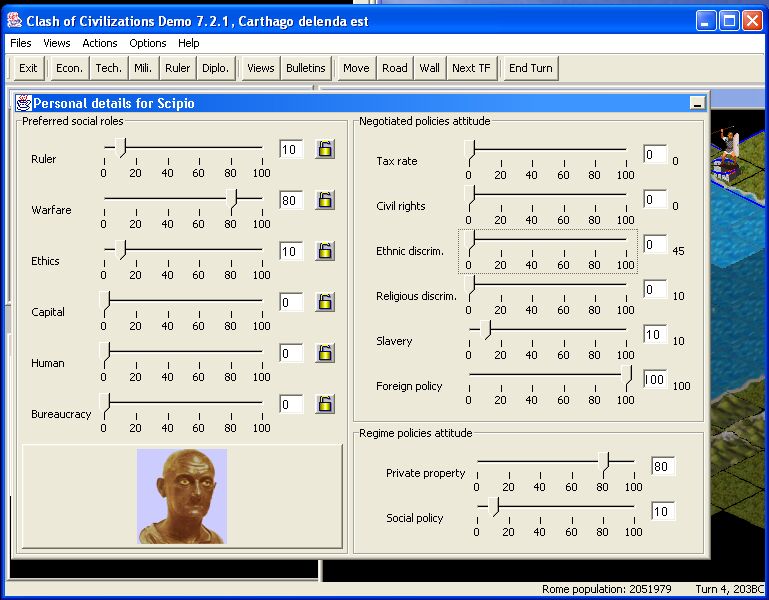
As I implemented riots, I wanted to allow people to prevent them but it shouldn't be that easy, so I plugged the interface to the government model, AS IT WAS CODED. It's been a while since the last discussion (see thread pointed to by Mark above), but here's what the UI looks like now.
The figures to the right are the resulting value after the negociated policies kicked in. (There's currently a one-turn delay so the feedbacl is poor, but I should be able to handle that soon.) Check the Ethnic Discrimination value of 45 while the ruler's preference is 0.
Note the model used is an average of all values, not a NS system or whatever we talked about in the other thread Mark linked in the above post.
The NS system would be better than what we have now as it would block Machiavelism. The last system described in the other thread would require more things in the user interface (a toggle or slider for priority for each and every policy). See my comments in the other thread.
 Attachment: rulerpanel.jpg Attachment: rulerpanel.jpg
This has been downloaded 45 time(s).
|
|
| |
|
|
|
LDiCesare
|
|
La Ferté sous Jouarre France
Jan 2001
time: 05:15
|
|
I've been using an approach from the user towards the model in my coding so far. This means I started by the UI and negociated policies, gave each powerblock a set of preferences, and checked the negociated policies stuff was working. The actual power distribution is also determined in a file.
I'm now working on the lower layer, where the preferences for each power block are computed from the social classes.
<rant>
Who coded SocialGroup?
This class and others revolvng around it have lots of stuff computing a GovernmentProfile, the whole thing being called in Administration.updateGovernmentPolicies(). This method is, of course, never called by anyone Icould find. It looks like it is supposed to update some government profile, whether a desired or actual profile I don't know. Does anyone know what this thing is about?
Also, why is SocialGroup the name of the class best mapping the model's social class?
I hate bits of code dangling around unconnected to anything useful.
</rant>
If I get the equations right, the model requires knowledge of the current government in order to compute the people's preferences:
quote:
p=E*RPW + W*MPW + K*CPW
RPW is the political power of the Religious Block in the Current Govt Profile.
MPW is the political power of the Military Block in the Current Govt Profile.
CPW is the political power of the Capitalists Block in the Current Govt Profile.
Civil Rights=EmpireStability*((0.5*(IND-TRAD)-p)/(1-p)
|
What's the rationale behind this? Is it that people want more liberty if they have more?
And what if IND == TRAD in this equation?
I'm also puzzled by the comment:
quote:
Note for me: la libertad que realmente goza una clase es CR*(1-p)+p |
Since a class wants a liberty of 1, it wants 1 = CR*(1-p)+p thus 1-p = CR*(1-p) thus CR=1. What's p doing here? And what name could I give to 'p'?
The tax rate also depends on this p factor.
There are two reasons why I'd like to understand the p stuff, which is current government dependant:
-One is I can't put a name on it, and don't like to not understand what I'm doing. The rationale on why one's preferences for an ideal government depend on the current government escapes me. I'd understand a link to known governments, some tech or stuff, but don't get this one.
-Second one is this implies I would have to update every ethnic group in every square whose civ changes. This means adding a pointer from the social class (SocialGroup object) to its square/government. This has implications in the code I don't want to start doing until I understand the underlying reasons.
|
|
| |
|
|
|
Mark_Everson
|
|
Canton, MI
Jan 1970
time: 00:15
|
|
quote:
Originally posted by LDiCesare
<rant>
Who coded SocialGroup? |
It doesn't look familiar to me. But OTOH, if it's screwed up that increases the likelihood that I did it!
quote:
If I get the equations right, the model requires knowledge of the current government in order to compute the people's preferences: |
That is also my take on it.
quote:
And what if IND == TRAD in this equation? |
Yeah, that's a problem. Obviously either a typo or an error.
quote:
There are two reasons why I'd like to understand the p stuff, which is current government dependant:
-One is I can't put a name on it, and don't like to not understand what I'm doing. |
Based on a limited review... I'd call p something like the Social Class' Effective Influence in the current govt. It's not exactly that, but that's the closest I can come.
I have no clue on the rest of your questions. Unfortunately, Rodrigo is on vacation all this month, and didn't expect to have internet access. Given that is the case, I'd advise getting this working in a crudely sensible fashion with minimal code complications, and revisiting it when Rodrigo is back.
[edit] fix bad tags
Last edited by Mark_Everson on 07-02-2004 at 20:41
|
|
| |
|
|
|
LDiCesare
|
|
La Ferté sous Jouarre France
Jan 2001
time: 05:15
|
|
quote:
quote:
If I get the equations right, the model requires knowledge of the current government in order to compute the people's preferences:
That is also my take on it.
|
Except of course this leads to circular dependencies. I have to compute the actual government profile, which depends on every social class profile, which depends on the government profile. I could store a current and previous profile, but that leaves open the question of how do I initialize the thing?
I'm struggling with the equations. I hope I got something wrong somewhere. Right now people are wanting the government to pay taxes to them (negative tax rates - actually VERY negative tax rates), which doesn't work very well... But then they do riot quite well.
|
|
| |
|
| |
All times are GMT. The time now is 05:15.
Apolyton Time is 00:15. |
top of page
|
|
|
Forum Rules:
You may not post new threads
You may not post replies
You may not post attachments
You may not edit your posts
|
HTML code is ON
vB code is ON
Smilies are ON
[IMG] code is ON
|
|
|
|
|
|






 20-11-2001 04:30


 - how about if you could bribe barbarians or other units to attack/destroy one of your own assets (perhaps bordering with a state you want to fight) in order to influence public opinion?!}
 |
|