 |
| |
|

|
Mark_Everson
|
 |
Canton, MI
Jan 1970
time: 00:17
|
|
I thought I should try to pull all the discussion together here. (should we start a dedicate thread?) If you find useful material on this topic, please either re-post it here, or provide a link. Based on that we can come up with a spec. We really need both a short-term spec, to band-aid issues to reduce conquest MM in D7.3 and D8, and also a long-term approach.
This was precipitated by the comments from TheCid that I have quoted below. Just to be clear, the problems he cites are only temporarily what happens in Clash D7.2 due to lack of development in important parts of the program, like the Govt model.
From the Demo 7 Download and Comments thread:
quote:
Originally posted by TheCid
About annexing territory:
I believe that when having a unit go over a territory should not be enough to keep it in the long term. As things stand now, each tile that a unit goes over, becomes his nation's and as a result, the resources produced benefit its own population. However, in reality, when a raiding army goes through a land (like Hannibal for instance), as soon as he's far enough... the resources (and tile ownership from the game perspective) would revert to the original owner's.
I believe that to keep a territory, we need to keep a military presence within some distance (say 2 tiles) otherwise the tile should automatically revert to original owner's until such a time as the population of the tile has switched allegiance to the new civ. This way, in the Hannibal scenario, Hannibal would only control as much territory as was near his army. No take away all the resource-generating squares from the romans just by having walked on them.
|
We have several good suggestions, and now that militia are implemented we have some extra tools to help solve these issues.
New ideas are welcome, and after a few weeks, if not sooner, lets try to finalize at least the interim specs.
Thanks!
Mark
|
|
| |
|
|
|
Simon Loverix
|
|
Tongeren, Belgium
Apr 2001
time: 05:17
|
|
Are slaves going to be a separate group? If they are, I think they shouldn't be separate, since there have been so many social statutes: sometimes slaves were wealthy and free in their movement, sometimes farmers that were technically free had almost no possiblity to move.
|
|
| |
|
|
|
Richard Bruns
|
|
NC, USA
Nov 1999
time: 06:17
|
|
After playing the Jericho scenario and turning every part of the map except the desert blue, I realized that Clash basically gives all players ICS for free if there is any empty terrain that is worth anything. This gets out of hand very quickly; I was able to get my civ to an incredible size and power in that scenario, as were other playtesters who left one square in enemy hands.
In order to prevent this, I think that at least 50% of the useful land on the map should start with someone occupying it, so that after a short time there is someone everywhere and players no longer get that free expansion.
This comment may earn me the title of "Master of the Obvious" but I think it needs to be said that we cannot use the Civilization map generation system where everything starts off as blank except for a few spots. Even in the whole-history game the player should start with a map even more densely populated with other people than the Jericho map.
|
|
| |
|
| |
|
|
|
Fosse
|
|
U.S.A.
Mar 2002
time: 23:17
|
|
There could also be a maxiumum practical size for any particular province. So you could theoretically take over the whole map, but not by sitting idly and letting your starting province grow like a blob until it covers the world.
The size at which a province can effectivly manage itself could increase as time goes on.
I say this because I don't really see anything wrong with a great deal of the world being empty at the dawn of civilization. As putting even 1000 people into half of the squares will result in extemely huge world populations at a time in ancient history when humans may not have had those numbers.
|
|
| |
|
|
|
Richard Bruns
|
|
NC, USA
Nov 1999
time: 06:17
|
|
A full-world map will only have a few thousand inhabitable squares, so it would be perfectly reasonable for each one of them to have a few thousand people each. Even in prehistory there were millions of people on the planet. I think the game feels more reasonable in the Roman scenarios, where everything is inhabited already.
Although limiting province size is good; I believe we already had plans to do that at some point.
|
|
| |
|
|
|
ogj20
|
|
Sorry to go off-topic, but since I'm having difficulty finding a thread where it would be appropriate to offer to help out in coding, bug-hunting, playtesting etc. I thought I'd just drop something in here and hope someone points me in the right direction.
|
|
| |
|
|
|
LDiCesare
|
|
La Ferté sous Jouarre France
Jan 2001
time: 05:17
|
|
ogj, you can contact Mark Everson or check this thread: http://apolyton.net/forums/showthre...413#post1674856
It is about recent bugs. It would be a good place to tell what your interests are and see if you see any bug/thing that you'd like to tinker with in order to get into the code.
Also, the D7 comments has had a LOT of comments and bug reports recently so you can probably check it too.
|
|
| |
|
|
|
ogj20
|
|
On the subject of migration of people, can I ask if the system as currently implemeted handles migration between populated square?
I know that if the people feel that the unoccupied square next door is worth moving into (It seems in minimum units of 1000 people) they will colonise it, but do they move to an already occupied square (owned by the same civ) if it is a better place to live? I get the feeling from playing the demo that they don't, but I think they should, and also that they should be able to move in smaller increments, maybe 100's, or perhaps even in as small an increment as individuals.
Also, what factors are there to encourage or discourage the growth of cities, i.e. squares with unusually high population levels?
I feel there should be factors that encourage city growth built into the economic model (i.e. a larger population density allows higher prices to be maintained as a wider variety of economic activity becomes viable), which there might be, but there are no details of the utility function of the populace on the website.
On the other hand structural factors like sanitation investment levels should hold down the maximum population, as well as the economic effects of unbalancing the micro-economy by overpopulating the square (higher food prices because it has to be bought in from next door, a larger proportion of the population employed in production/services etc.)
|
|
| |
|
|
|
yellowdaddy
|
 |
Saoir-Ebhor, Sasainn a tuath, Rialtas Aontach
Apr 2003
time: 05:17
|
|
in ancient times, when empires extracted tribute, did they have to have a constant military prescence? or was it more that they visited from time to time, and maybe had some political marriages, to create some link with the ruling classes (i'm thinking of ancient china).
regards to populating squares.
well, it's no good just filling them all with people, or picking an arbitrary percentage.
Most human settlement and civilisation is centred along fertile rivers like the Nile, Indus and Huang-He.
And in the early half of a "from the Dawn of civ" game, there'd be plenty of good land uninhabited, or only temporarily inhabited by wandering tribes.
(not including undiscovered islands like NZ)
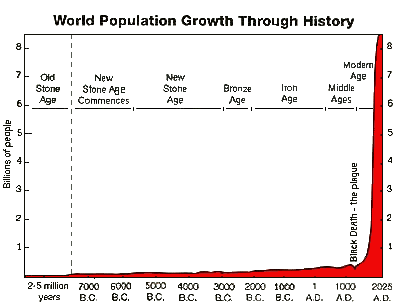
pre-industrial rev, world pop is fairly stable and low compared to today.
although this graph doesn't show it, I've seen reliable estimates that World population around 1AD was around 200 million. And I'll bet most of those lived in China, northwest India, Mesopotamia and along the Nile.
Even most dark age european tribes would have numbered only in the low thousands, and rarely more than 10,000. AFAIK. World Population at the beginning of the game (9000BC) around 4 million.
http://www.census.gov/ipc/www/worldhis.html
|
|
| |
|
|
|
Mark_Everson
|
|
Canton, MI
Jan 1970
time: 00:17
|
|
quote:
Originally posted by yellowdaddy
in ancient times, when empires extracted tribute, did they have to have a constant military prescence? |
No. But threat of retribution from not too far away was always helpful in maintaining order.
quote:
regards to populating squares.
well, it's no good just filling them all with people, or picking an arbitrary percentage.
Most human settlement and civilisation is centred along fertile rivers like the Nile, Indus and Huang-He.
And in the early half of a "from the Dawn of civ" game, there'd be plenty of good land uninhabited, or only temporarily inhabited by wandering tribes.
(not including undiscovered islands like NZ) |
Population densities did vary greatly. But almost everywhere capable of sustaining people had population at some level. Nomadic (pastoralist) population densities are one to a few people per sq km. So you should expect a Clash square as we have them now to have populations of order 10k at a minimum. Agricultural civs typically have population densities about an order of magnitude or more higher. Pretty much every square that can sustain agriculture should have a substantial population.
I don't understand the point of your last paragraph. We should roughly match those figures once everything is tuned. Right now we don't really have a good way of doing foraging or pastoralist peoples well. Once we have that done decently, it will improve the match with the real world population densities.
[edit: added text in bold to clarify my statements.
Last edited by Mark_Everson on 03-03-2004 at 07:47
|
|
| |
|
|
|
yellowdaddy
|
|
Saoir-Ebhor, Sasainn a tuath, Rialtas Aontach
Apr 2003
time: 05:17
|
|
quote:
I say this because I don't really see anything wrong with a great deal of the world being empty at the dawn of civilization. As putting even 1000 people into half of the squares will result in extemely huge world populations at a time in ancient history when humans may not have had those numbers. |
quote:
A full-world map will only have a few thousand inhabitable squares, so it would be perfectly reasonable for each one of them to have a few thousand people each. Even in prehistory there were millions of people on the planet. I think the game feels more reasonable in the Roman scenarios, where everything is inhabited already. |
I think i might have been replying to this.
the game starts at 9000BC, the "copper age" i suppose
I think its plausible to say that (based on books I enjoy flicking through) that NOT all of the inhabitable squares have populations - human population is overwhelmingly coastal and riparian.
Even nomadism is a "technology" that hunter-gatherers must learn.
I think it's fair to suppose that only 1% of the human race at this time would live (for more than a few turns) in a polygon without close proximity to a significant body of water.
I'd guess at 33% by the sea, the other 66% probably in the floodplains (including jungle floodplains).
Imagining a game with a starting world pop of up to 4,000,000 (divided into maybe 80 original "peoples", upto 50,000 each?! - what is the starting pop?)...
maybe the global startig pop should be lower, so that each people starts of with about 10,000, about 1,000,000 in total as a world pop, then with most of these living alon rivers, lakes and coasts, there are bound to be a significant number of uninhabited areas, at least until the Iron Age, I reckon.
bear in mind that the faster developing civs (in the Bronze age and early Iron Age) are likely to be based near large rivers, and they will have a "gravitational effect" on other smaller ones adjacent to them - they'll be drawn by trade and culture I should think.
this site is a useful resource, which i'll use for doing the faces and races for characters.
http://racialreality.shorturl.com/
it certainly compelled me to edit this post.
it seems that there'd be a lot more habitation of squares than i'd thought, but still away from major rivers and bodies of water most of this must be very low numbers of occasional migration.
it'd certainly be great if the next demo can include some migration and nomadism... if playing the DOC (Dawn of Civ) game, the first 10,000 years from 9000BC are likely to feature a lot of EG's merging, splitting and moving around, if we want a good dollop of realism.
on another note, if whole world scenarios for significant periods are made, like Alexander TG & Ancient China, F.E., it could make for some great historical experiments for players.
Last edited by yellowdaddy on 03-03-2004 at 00:40
|
|
| |
|
|
|
Gary Thomas
|
 |
New Zealand
Mar 2001
time: 17:17
|
|
quote:
the game starts at 9000BC, the "copper age" i suppose |
The "game" consists of scenarios, so the game begins when the scenario does. However, there has been agreement that the game is not suitable for pre-agricultural eras. So, in that sense, it starts around 9000 BC.
There are a number of books on the spread of agriculture (a good one, if my memory serves, is "The Emergence of Agriculture"). They all make the point that the main impact of agriculture was to support a very much higher population. For practical purposes we could regard squares that still have a hunter-gatherer population as being empty - compared to agricultural squares they were. So the colonization of empty squares actually represents the spread of agriculture.
Nomadism is not a technology learned by hunter-gatherers. There is good evidence to indicate that nomadism could not exist without a nearby agricultural society to provide goods that the nomads could not produce. Hence nomadism is a symbiotic (or sometimes parasitic) culture dependent on, and hence developed after, nearby agricultural societies.
The Dawn scenario is not actually intended to be realistic - it is a tutorial scenario, designed as such. Although the original concept was mine, others have contributed so much that it is now a genuine collective effort.
quote:
on another note, if whole world scenarios for significant periods are made |
I take it that this is an offer to provide historically accurate scenarios. A word of warning - making a decent map for Clash, and I speak from a lot of experience, is a very difficult and time-consuming exercise. That is why I am so keen on making a scenario editor.
Cheers
Last edited by Gary Thomas on 04-03-2004 at 00:51
|
|
| |
|
|
|
Lord God Jinnai
|
 |
St. Louis
Sep 1999
time: 23:17
|
|
The 1st permenant settlements existed in and around present day western turkey and isreal. These "cities" were present before the invention of agriculture and were based solely on trade.
The existance of these "cities" which were only 2-3 known to have existed before agriculture were small in comparison to even the early agricultural cities, but numbered in the hundreds, perhaps up to 1 or 2 thousand. They were more like Trade Posts than cities though.
In any event, there are 2 points for the 1st cities to form. Along rivers, usually at the mouth (near ocean/sea) or between multiple trade routes of other major settlements.
As the 1st permentant settlments shows, it is not always the best land that should come 1st nor does the ability of the land itself to sustain the population matter.
Last edited by Lord God Jinnai on 04-03-2004 at 13:23
|
|
| |
|
|
|
Lord God Jinnai
|
|
St. Louis
Sep 1999
time: 23:17
|
|
quote:
what do you mean? didn't China, Sumer, Egypt and Harappa last a fair while? |
Well they all had agriculture an based economy...i'm talking about a trade-based economy which relieas on both agriculture and resources from atleast 3 locations. The centerpoint being a city nexus.quote:
You mean Catal Huyuk? Are you sure there was no agriculture? Any sources... or shall I google? |
Umm, well there is more than just one. I know it was mentioned in one of Discovery Channel's specials, but not what and also i believe in National Geographics, but not which one, although i do not believe offhand it was Catal Huyuk because these towns were upper mesolithic, not neolithic.
Now that i think about it the permenant settlements were based around fishing.
Last edited by Lord God Jinnai on 07-03-2004 at 21:11
|
|
| |
|
|
|
Gary Thomas
|
|
New Zealand
Mar 2001
time: 17:17
|
|
As far as I am aware, the first known permanent sites date from the Kebaran period in Palestine (about 18,000 BC to 11,000 BC), the earliest that I know of being the excavation at Ain Gev I on the eastern shore of the sea of Galilee, 15,000 BC. Although that site contained stone slabs and a stone mortar for grinding grain, this does not imply agriculture - the grain was wild grain.
Agriculture first appeared in the Natufian period (11,000 BC to 9,300 BC). This culture was more widespread and stretched from Palestine, through Syria and across to the Euphrates. Hunting was still an important food source at that time.
Chatal Huyuk (6,850 BC - 6,300 BC) was a lot later and a long way from area the in which agriculture first developed, being in southern Anatolia, north of the Taurus Mountains.
Trade is recorded from 15,000 BC (at Wadi Hasa - sea shells, 100 km from the sea). In later periods (the Aceramic Neolithic period) obsidian (used for tools) was discovered 800 km from its source.
This information comes from "The Cultural Atlas of Mesopotamia and the Ancient Near East" by Michael Roaf.
A detailed study is "The Emergence of Agriculture" by Bruce Smith. This concentrates on the beginnings of agriculture, as opposed to the general history and development of the area.
Another good source is "The Cambridge Ancient History, Part 1, Prolegomina and Prehistory". The 3rd Edition, which is the one I have, is a bit dated now - it was revised in 1970.
Cheers
|
|
| |
|
|
|
Martin the Dane
|
 |
Aarhus, Denmark
Feb 2000
time: 06:17
|
|
Well back to the topic.
I was looking through this thread this morning, and thought that I would offer a few of my thoughts on the matter.
When I started considering the topic some years ago, I thought that a fully populated map was the most logical approach. Then at some point I realized that civilizations did not consist of all the people in an area, but by the cultural and governmental institutions in a geographical area.
The result of my realization was that I no longer had a preference for the fully populated map, but rather for a combination of the populated and empty map.
1: Most of the area capable of supporting a population should have an indigenous population. The ethnicity of this population should not necessarily be the same as the closest civs’ and might not even be uniform. There could conceivably be a hunter gatherer tribe living in the forested areas, a nomadic cattle herder tribe living on the marginally habitable land, a farming tribe occupying the best agricultural land, a trading tribe traveling between the settlements, and a priest tribe living among several of the other tribes, all within the same geographical area.
2: A particular civilizations encroachment on a given geographic area might or might not result in conflict (ranging from resentment to open war).
3: The player should be able to control and direct the behavior of his/here’s/it’s civ., but only influence, not control, the behavior of the individual citizens. So the player could use his army to move a number of people from A to B, or create the incentives for the people to do so, but not force Mr. and Mrs. Jones to make that move.
4: The player/scenario author should be able to determine what area the members of his civ. should be allowed to move to, diplomatic considerations taken into account.
5: The player/scenario author should have control over province boundaries, not necessary total control, but at some level depending on settings in the scenario.
I look forward to play around with D8, and possibly get back into working on the tutorial.
|
|
| |
|
|
|
yellowdaddy
|
|
Saoir-Ebhor, Sasainn a tuath, Rialtas Aontach
Apr 2003
time: 05:17
|
|
quote:
Most of the area capable of supporting a population should have an indigenous population. The ethnicity of this population should not necessarily be the same as the closest civs’ and might not even be uniform. There could conceivably be a hunter gatherer tribe living in the forested areas, a nomadic cattle herder tribe living on the marginally habitable land, a farming tribe occupying the best agricultural land, a trading tribe traveling between the settlements, and a priest tribe living among several of the other tribes, all within the same geographical area. |
I researched and posted a list of ethnolinguistic groups a while back. The idea being that these form the orignal Peoples at the Dawn of Civ, and each has a bank of names for tribes that they split into (and nations which the tribes can split into), the system allows for merging as well to form completely new EGs.
I would like to see all these original peoples dropped (like a pipette of colour into a fishtank) on the land randomly or according to history on the Earth map, and their progeny spread whereever their AI takes them.
That way all the people that live in the gameworld have a connection to one origin or other, and are not just randomly plonked there as tribes as any old name for any old reason.
If the AI works well, all these peoples should adopt lifestyles and develop civilisations appropriate for their environment - rather than having stereotypical predispositions (like the Mongols are more nomadic, or the Greeks are more scientific).
I think it will give the game a feel appropriate to the kind of detail, simulation and depth it has in other areas.
OK, it won't be ideal - you may want to calculate a bit of ethnic pre-spreading to fill out the terrain a bit, but in principle i think it's less desirable to plonk generic "hunter-gatherers" all over the place, who have no real stake in the game.
|
|
| |
|
|
|
alms66
|
|
Louisiana
Oct 1999
time: 23:17
|
|
Historically, people moved from the outlying areas to the city, not vice-versa as is seen in Clash currently. Death rates in the cities were so high that, without this influx of migrants, the cities would soon cease to exist. So I have the following (rough) proposal to help bring Clash more into historical line:
Each tile has an isCity boolean value. Expansion/Settlement occurs somewhat similar to the way it does now, but when the population limit is reached in a tile (5000 now - shouldn't this be based on infrastructure levels, and not an arbitrary number?), then have three population units of 25% each (or 1250 each at the 5000 level) look for the nearest tile with the isCity value set to true. If the site is economically viable, free from war, and oppression of the ethnic group moving (as well as other factors), that population unit determines if it moves to the city. If it does, then that's that, if it doesn't then it moves to the nearest or best "empty" tile as done currently. This will keep population levels relatively low, and thus the economy relatively low as is historically correct (I'm assuming cities get some bonuses in this regard because I'm not sure). Also, the "empty" land will fill in quickly and city populations will grow large.
Conditions for the isCity value to change to true are:
-- The player creates a city --
This isn't done as it is currently in Clash or as it is in Civ, this is done as in history. The ruler tells his engineers to build a city here, and it is done. Whether or not it remains a city for long depends on if people move to it and how viable the location is to be a city. Basically, in current Clash terms, there is a button "create city" on the toolbar. When pressed, the selected tile's isCity is set to true and a large sum (and I mean large, this should be very expensive) of money is taken from the treasury to build the local infrastructure. Mechanisms need to be included to ensure that not every "money city" will be viable, nor will they all become ghost towns via the decision making of the population units described above.
-- Trade creates a city -- (Should these be automatic or just a chance of occurrence?)
When 2-4 (?) trade routes cross a single square and there is x amount of money (need to determine by testing) passing through, via goods and merchant's cash, set the isCity value true.
-or-
When 5 (?) or more trade routes cross a single square set the value to true.
-- Infrastructure creates a city -- (There may need to be minimum numbers here also, rather than just the percentages listed.)
If the housing infrastructure is at least 25% greater than any other tile within a given radius, and there is at least one trade route within the tile, it may become a city (5% chance?).
-or-
If all infrastructure is at least 10% greater than any other tile within a given radius, the tile may become a city (5% chance?).
This proposal above is relatively simple, IMO more historically "correct," and easily expanded or modified. We can do something more sophisticated in the long run, if desired, though I think the above system, with some tweaks, the right numbers in the right places and some good algorithms behind the decision making will work very well for inner-civ migration, expansion and city creation. I know this would be a sort of "step back" if we were to go and change this stuff now, but I think it would be a better system to use and I'd rather change it now than a year from now when it would be that much harder to do.
Anyway, I'm looking forward to discussion on this issue.
|
|
| |
|
|
|
alms66
|
|
Louisiana
Oct 1999
time: 23:17
|
|
Before making the above post, I read some of this thread. One thing that really caught my attention was the discussion on Nomadic and "Barbarian" civs.
*See the first few posts in this thread*
Everyone seemed to want a "name" for barbarian civs instead of calling them Barbarians. Some suggestions were made such as Tribes, Free States, Minor Civs, etc. I believe that Minor Civs was decided on for now. And while they may very well be minor civs, calling the Celts the Celtic Minor Civ doesn't feel quite right to me. So, assuming that all civs will be called Civilizations or Empires like so:
Spanish Civilization/Empire
Roman Civilization/Empire
etc.
Then call barbarian civs (and nomad civs for that matter) Peoples like so:
Celtic Peoples
Iberian Peoples
Leaving us with:
Civilizations - the Normal Player and AI civs
Minor Civs - the "barbarian" civs
Nomadic Civs - the nomads....
And on the subject of nomads:
All sorts of proposals have been mentioned for handling nomads. To my knowledge, no one has posted anything like the following:
Add Nomad-ism as a civ trait, the higher the trait, the more nomadic the people. Discovery of a certain tech, Agriculture?, causes this trait to decline rapidly. Contact with other "settled" civs causes the trait to decline as well, though more slowly than actually having the tech yourself. Prevent Nomadic civs from building cities by tying the creation of cities to a tech, let's call it Urbanization and have Agriculture as a prerequisite for that tech. Limit the number of cities that any civ (not just nomad civs) can build based on this Urbanization tech. As Agriculture rises in level, so too does Urbanization, and as Urbanization rises, so too do the number of cities, or possible cities, thus modeling the transition from nomadic to settled civ, without having to add too many special rules. The only special rules needed, other than what's listed above, is a modification to migration code based on the nomadic trait, and a reduction in the population growth (which may not actually be a special rule, if we give enough weight to this Agriculture tech in the population growth equations).
As for the special migration code, basically the entire population of the civ wanders around their territory moving one square per turn. When the population gets too large (5000 anyone?), the group splits into 4 (25% population units) and each group goes on as before moving from square to square. When there is no more room to move within the nomadic civ's territory without pushing the max population limit, the group should settle that square (which should be an activity that feeds the Agriculture and Urbanization techs). Though I would hope we could get the numbers right to the point that no nomadic civ will ever get to the point that the population units cannot move around without breaking the pop limit.... or is that what we want to happen?
|
|
| |
|
| |
All times are GMT. The time now is 05:17.
Apolyton Time is 00:17. |
top of page
|
|
|
Forum Rules:
You may not post new threads
You may not post replies
You may not post attachments
You may not edit your posts
|
HTML code is ON
vB code is ON
Smilies are ON
[IMG] code is ON
|
|
|
|
|
|





 20-12-2002 05:32


 |
|