|
| |
|

|
Catt
|
 |
California - SF Bay Area
May 2002
time: 21:22
|
|
My game doesn't lend itself to an entertaining story, but I'll post a more detailed review with screenshots after I finish. I wanted to chime in earlier because it appears that I followed a unique opening strategy - at least unique compared to the other spoilers.
I played the standard game, Emperor level, and selected the Persians for the industrious workers and the cheap libraries and universities. I moved my settler to the SW, as much as to prevent my initial city from using all of the bonus resources close by as to bring the whale into play -- I figured one city could work the whale and cows and a second city could work the two wheats.
My early exploration hinted that growth would not be an issue, but that happiness would. Knowing that I needed to research on my own on my isolated island, I wanted my cities to grow large so they could produce a good chunk of commerce for science research. Large cities need happiness; lack of happiness meant problems. Lack of local luxuries, combined with no trading until nearly the Industrial Age presented me with my first dilemma - do I beeline for Republic and its commerce bonus, or do I beeline for Monarchy for its military police happiness effects and hope to research my way to a lead under a Monarchy? I elected to beeline for Monarchy. I figured that with 3 MPs in each city, a temple, the one local luxury I could grow my cities to 6 without worries; throw in a little luxury spending and I could probably get to 8 or 9 -- building the Hanging Gardens would add an extra content citizen, and assuming a city other than my capitol built it, I could grow this designated "wonder-city" (because of the palace pre-build opportunity) up towards 12 citizens as early as I wanted to. I planned a later switch to Republic if I was able to build Sistine and/or JS Bachs. The two revolutions worried me a bit without a religious civ, but I decided I really wanted the growth potential of a MP-inspired Monarchy.
My initial research path was (IIRC): Ceremonial Burial, Warrior Code, Mysticism, Polytheism and Monarchy, with a switch to Monarchy and out of Despotism as soon as I got there. I really wanted the contentedness of the HG  . This research path, something I've never tried before, had some interesting consequences. First off, I built the HG before anyone built any wonder (IIRC) - perhaps the Colossus was built already? But a huge problem with the research path was the dearth of improvements available for building -- temples went up in cities right away, but after temples there was nothing to build. With more than enough workers and the island rapidly being settled, I actually put a few cities on producing wealth during the ancient ages! -- again something I've never done before and obviously not a very efficient growth path. If I had to do it over again, I would stop off at certain techs just to be able to build other city improvements rather than having ancient towns building wealth. . This research path, something I've never tried before, had some interesting consequences. First off, I built the HG before anyone built any wonder (IIRC) - perhaps the Colossus was built already? But a huge problem with the research path was the dearth of improvements available for building -- temples went up in cities right away, but after temples there was nothing to build. With more than enough workers and the island rapidly being settled, I actually put a few cities on producing wealth during the ancient ages! -- again something I've never done before and obviously not a very efficient growth path. If I had to do it over again, I would stop off at certain techs just to be able to build other city improvements rather than having ancient towns building wealth.
Again due to my happiness concerns, I beelined towards Sistine (even without a religious civ) and JS Bachs. Upon receiving Monotheism, I researched Theology, Education and Musuc Theory. I managed to build them both before heading back down the tech tree to go after Sun Tzu's and Leo's. Long after I built JS Bachs, the French finally built Sun Tzu's - but interestingly there wasn't any sort of a wonder cascade I could see -- I managed to research Engineering, start Leo's (had a small pre-build in place), and dropped back to research Republic. I switched to Republic during the Leo's build (hoping for a short anarchy and hoping not to lose Leo's by a few turns). My anarchy lasted only 3 turns! On Emperor! Needless to say, a great stroke of luck - I managed to build Leo's quite easily.
Question: I've never seen anything definitive on the length of anarchies -- does anyone know if it is completely random, or, as some have speculated / claimed, does a happier overall civ enjoy better luck with anarchy length?
I'll leave the rest for a more detailed game report with screenshots, but I'll just finish by saying that my unconventional opening put me in about the same position as everyone else. Upon first contact, I discovered that I either had a one-tech lead or a one tech deficit behind France (depending on how you looked at it). France and Greece were the powerhouses; Egypt was backwards but gaining quickly and was in a very nice position to become a monster - as in others' games, the Chinese had been conquered before I even had a chance to meet Mao.
Final thought - I agree with several others who have said the same thing -- I think this game was easier than most -- I never would have guessed I could research my way into the tech lead all alone, on Emperor, using Monarchy for a good chunk of time and suffering through two revolutions.
Catt 
|
|
| |
|
|
|
Chemical Ollie
|
 |
Bored of this board
Jan 2002
time: 06:22
|
|
Nathan, I do not feel too uncomfortable with only 12 cities, as most of them had 12 pop quite early, and all land tiles but a few mountain and tundra was in use.
I wanted some Greek ass. They were powerful but had mostly old units and that island would be perfect for my FP. However, when I had a fleet loaded with 20 cavallery and a few cannons and muskets, something happened that would change my whole game:
The Egypts, who were Polite with me, dumped a shitload of troops right at my incense city. When I asked them to leave, they declared war. The city was defended by 2 muskets and a knight. I rushed a barracks and upgraded the knight to cavallery. I also made the stupid move of moving a defender to a lux tile to protect it from being pillaged, as that would screw up my trades. The Nubi hordes would probably have taken it anyway, but you never know. The town was captured, and all my trading partners turned their back on me. It was a long distance to sail if I wanted it back.
I decided to sail to Egypt instead, and raze my way to get the city back in a peace deal. When my fleet was passing east of Greece, Japan joined in on Egypts side. I made my own pacts with Greece and Iroquis to keep the Nubis and Japs busy. As Japan was quite weak, I fell for the temptation of splitting my fleet that was just a few turns away from landing there. 14 units landed and the Japanese spearmen & swords had no chance against the Roman and Iroqui cavallery. Just a few turns later, they were gone. I kept a few cities to get a foothold on that continent.
My landing in Egypt was a total failure. 2 of by boats were sunk, and the 8 cavallery that got to target were sitting ducks without musketmen support. Now France, Germany and Iroquis had joined the Egyptian side and only Greece was on my side. The pathetic Brits were stupid enought to singlemindedly land some useless troops on my continent. The Egyptians offered me peace for 400 gold and I took the bitter deal to get rid of a painful war disorder. I shipped some more troops to former Japan and held my positions against the Iroquis until they grew tired and made peace. That war gave me 2 leaders. I used one for Universal Suffrage, which triggered an extremely well-timed golden age.
I invaded England and razed one city with ease. Then London proved to be a real pain and it took numerous turns of attacking, healing wonded troops, shipping new ones, bombarding etc before the town fell to a force of 20+ cavallery. The last Brittish town was easier and they are now in OCC on the tiny Island north of their penisula. Still, Liz had the guts to demand tribute for making peace! I did not fall in.
I have traded twice for coal with Greece, first surprisingly cheap but then for 50 gpt. The GA gave me factories at a convenient rate. However, the Egyptians beat me to both Longevity and ToE just 1-2 turns before i got the requiered tech. My Great Leader is idling in Kyoto and eager to build something. I think I will try to ship him home to the mainland and use him for Hoover. Problem is, both Egypt and Iroquis have re-declared war on me, and the Egypts have millions of frigates and iron clads just waiting to sink my fleet.
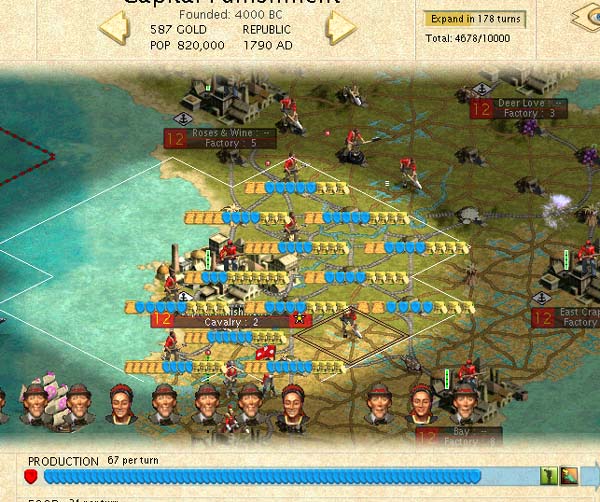
On the positive side: A golden age with railroads and mobilisation is not bad at all (see the tile production on the screenshot).
 Attachment: golden production.jpg Attachment: golden production.jpg
This has been downloaded 79 time(s).
|
|
| |
|
|
|
Theseus

|
 |
The warmonger formerly known as rpodos. Gathering Storm! Apolyton Spirit!!
Apr 2002
time: 00:22
|
|
DOH! What was thinking with that forest bit??!! Olaf, you are right... I should have only put forests on the unshielded tiles. Well, it looked cool...
Anyway, your report is fascinating... dramatically different from most of the other games.
You learned (and teach... this is AU after all!!) a good lesson though, that intercontinental invasions MUST be done with overwhelming force.
I haven't continued my report yet, but as a quickie, I did upgrade all those Horsemen to Cavs, and did a two prong invasion (quickly followed by a third as soon as my Galleons could get back, load, and sail) of the eastern horn of Greece, ranging from the northern tip of what had previously been England down to furs... each prong of the attack included 32 Cavs, 4 Riflemen, 2 Immortals, and 2 Cannon. It was, shall we say, a success.
|
|
| |
|
|
|
nbarclay
|
 |
Huntsville, Alabama
Dec 1999
time: 23:22
|
|
quote:
Originally posted by Olaf Hårfagre
Nathan, I do not feel too uncomfortable with only 12 cities, as most of them had 12 pop quite early, and all land tiles but a few mountain and tundra was in use. |
The catch is that for wealth, and hence for research, ocean tiles are ultimately every bit as important as land tiles. Coastal tiles give half again as much gold as most land tiles under Republic, and twice as much under Monarchy. If you had more cities, you probably wouldn't be having such a hard time in the tech race.
I went with a 17-city build that lets all my cities reach size twelve (although they aren't quite all there yet) in order to maximize research. My northernmost and southernmost cities actually each took away a land tile I could have worked, but the extra water they let me work comes in handy. Also note that keeping the outlying cities from getting huge will help keep them in WLTED (Emperor, since I'm Persia) now that I have lots of luxuries, which is good for production. And I can work practically every bit of land on the continent before hospitals, which is also a significant plus for the pre-industrial and early industrial game.
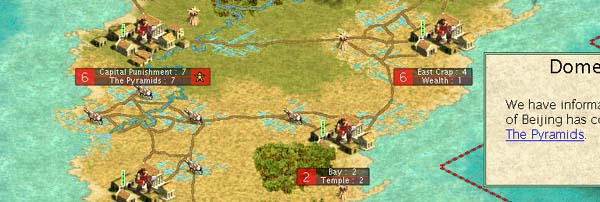
By the way, I built my Forbidden Palace in Arbela, just three tiles northeast of my capital. It's definitely not an optimal location for the early game, but if I can get a leader and move my palace to a conquered land (possibly in the Japan/Iroquois/France sector), the FP will be perfectly situated to keep my core going strong.
Nathan
Attachment: persia.jpg
This has been downloaded 91 time(s).
|
|
| |
|
|
|
Dominae
|
|
I see that I'm a bit late in starting 106 (my first AU game!), so I'll try not to repeat too much wisdom that has already been posted.
First off I'd like to note that it's really helpful to keep a log when playing (if only for the AU games). Not only does it make it easier to post the results of your game, but if forces you to really think about your long-term strategies (although I haven't tried this, I suppose you could also read through your log when you're done to see what you've learned).
I usually restart when I see that I'm alone on a continent, so this scenario forced me to make some novel and interesting decisions. I've already posted my early-game strategies on the 106 Hints and Tips thread, so I won't repeat them here.
Ok, on to the game!
I first set my research on The Republic and proceeded to colonize the continent. I actually irrigated most of the tiles early in order to get my pop up as quickly as possible. To maintain happiness, I set the Luxury slider to 10% and used 2 Warriors as police in every city. Once I hit Republic I beelined for Construction, got all my cities to size 12 and built every improvement I could build (including Coliseums). I then went back and mined over most of the irrigation so as not to have any surplus food.
I tried for The Colossus early, but the English beat me to it by about 4 turns. As there was nothing else to build, I jumped my palace to a city 4 tiles distant, which had not effect on corruption whatsoever. I got the Pyramids (not really that useful), and got within 2 turns of building The Great Library (for the sole purpose of denying to the AI) when I saw that it would trigger my GA! At the time, this didn't seem very attractive, so I again switched to Palace and put it right back where it started (big waste of time).
At this point there wasn't much to do until the Middle ages so I looked ahead. I saw from the rate of tech depreciation that I was remaining competitive in tech, but was by no means ahead. I deduced that most of the other civs must be on their own seperate islands because they weren't engaging in any sort of tech loop that makes the AI seem to research incredibly fast. So my long-term goal became to be first in the water with Caravels allowing me to colonize any undiscovered land masses and be the first to contact all other civs. I was itching to pick a fight after all this waiting, so I also decided I was going to conquer my nearest neighbor, which I knew was the English because I could see their borders to the southeast. I proceeded to pre-build an invasion army (mostly Horsemen and Immortals at this point), and a few "colonization teams" consisting of Settler/Worker/Spearmen.
I got Monotheism as my free advance and saw that Navigation was a on a straight path from it. I also saw that it went straight through Education, so I was happy not to have built the Great Library. I built Cathedrals in all my cities, finished the Sistine Chapel and sold all my Coliseums. This allowed me to put my Luxury slider down to 0% (hopefully for good). I continued to build my invasion force.
[I'm starting to copy from my notes at this point, so please forgive the change in narrative style...]
1140AD I discover Astronomy and start researching Navigation. I use Coliseums to pre-build Caravels in all my coastal cities. I ended up building around 15 Caravels total in the next 10 turns. Things were going well, but I was worried that the English would prove too strong (i.e. have Pikemen/Musketmen in all their cities) for me to conquer.
1260AD, I contact the English, and they're still in the Ancient era! London has only Spearmen as defenders. I trade for Territory map and that's it...I can contact the Greeks by myself, thank you very much.
1275AD, I contact the Germans: I'm slightly ahead in tech, and they haven't met anyone. We trade Territory maps. I eye their largish continent with all its defensible mountains as a nice land to conduct an invasion.
1285AD, I contact the Greeks. Here, we're on the same level technologically, but he's got about twice the land area that I do. I resign myself to have Alexander as a long-term opponent.
Finally, in 1295AD, I invade England with a small force of 15 Immortals and 12 Horsemen, which I consider enough to overrun their puny civ. I'm forced to declare peace for a few turns because of War Weariness, but I wipe them out in 1400AD.
In the meantime, my Caravels are sailing around the globe and contact all the other civs. I see that no one else has discovered Navigation, and there is much rejoicing (yeah, Monty Python reference!). I can place the civs in "trading circles":
1. Greeks and English (nearly dead)
2. Germans
3. French, Japanese, Iroquois
4. Egyptians
I make it a policy to keep these circles from meeting for as long as possible (even though they'd give me their firstborn children for any comm). This policy really pays off, and I manage to pull ahead in tech and still make enough money to fund a new war against the Greeks (the Germans were too far away, and I already have a foothold on the Greek continent via the English cities).
Feeling I have momentum, I invade Greece in 1435AD with around 30 Knights and 15 Musketmen, just 5 turns before I discover Military Tradition. I figure I'll be able to rush buy a Harbor and a Barracks in some newly-conquered city, which is way more convenient than trucking my Knights back to my continent (or even any of the ex-English cities). 5 turns is a lot too, because the Greeks were just about to discover Gunpowder (or so I surmise).
All hell breaks loose at this point when a Polite French emissary assures me that her 4 Knights will leave my territory around a city I build on the island south of the French continent (they have a couple of cities there too). I don't trust her one bit, and sure enough she declares war the next turn. I'm quite worried because she's now ahead of me in tech and becoming quite the superpower. However, after losing that one colony I see that her plans weren't very ambitious: she never attacks my main continent (heh-heh, crazy AI). I turn lemons into lemonade by signing an Alliance agains the French with both the Japanese and the Germans. Hopefully this will focus her superior powers of production into a long and futile war.
Meanwhile, I'm conquering Greece, and picking the spot for my FP that I can now rush build with the Leader I just got. I'll post the (somewhat shorter) conclusion in a day or two.
Dominae
|
|
| |
|
|
|
Killerdaffy
|
 |
in other words a gang leader aspiring to Presidency
Nov 2001
time: 06:22
|
|
It's 4000BC and the Persians emerge on the banks of the Karun River and close to the immeasurable expanse of the ocean. The nomads find some cattle close by to the south and some plants called 'wheat' to the north which, according to some locals, are not only edible but highly nutritious. Before settling, though, the Shah (adhering to the customs of the 'Emperor' class he belongs to) decides to send out some workers to scout out the immediate environs. Because they had spotted some suspicious outlines in the darkness to the south, the scouts move into that direction along the riverbank, discovering even more cattle. Persepolis will truely be a great city!!
In 3250BC the new city of Ctesiphon is founded to the south, taking advantage of even more cattle. This truly is a fertile land. A local tribe also provide us with maps of the northern parts of these lands making this look more and more like an island.
In 1725BC the imperial palace is being refurnished, after the Shah thought that cave simply wasn't befitting his status any more. In unrelated news some pirates were spotted aproaching the island from the high seas for the first time recently.
The Colossus is being erected across the future entrance to Persepolis Harbor in 1675BC. The lead architect decided it would be easier to build the 33m (110 imperial ft.) structure first and dig the harbor channel passing underneath it afterwards instead of the other way around, as several other court advisors had proposed. His next project would be even larger he said in an interview, even though details were only to be released in several centuries.
Wow! This time that architect guy has really outdone himself!! The 'Pyramids' rise on a plateau close to the river, completed just 20 years before travellers report of 'The Oracle' being erected in a far away city called 'Kyoto'. While it doesn't seem to have any direct impact on the local climate the travellers attribute this to the fact that several other tribes haven't signed the appropriate treaties, yet.
Not much later we finally found a way to store important data about our civilization: It's called 'The Great Library' and was constructed in Ctesiphon in 150BC. A nice secondary effect is to have a so-called 'Golden Age' right after giving power to another new institution called the Senate.
Our architect showed us plans for a 'Great Wall' recently. He said he didn't really know what it would be good for but we let him build it anyway, just to keep in in practice. Some guy named 'Brian' was born 260 years ago.
960AD and our glorious Caravels just dicovered the Greeks. They are technologically backward, though. In fact, nobody seems to have discovered Education, yet, never mind anything after that. Some people hadn't even made it into Medieval...
Met the Egyptian in 1090AD. They have Gunpowder but no Astronomy...
Those filthy Greeks declared war on us!!! It's 1285AD, just 10 turns before our luxury trade was going to end and our 40 cavalry attack was planned.
We made peace with the evil Greeks in 1345AD, after first taking their iron and one of their saltpeter. We hope to have them attacking again soon, since we are bleeding them dry with further trade deals.
Hm, the Egyptians are catching up, just advancing to Industrial (the Barbarian uprisings were expensive, costing the imperial treasury several hundred gold).
Short analysis, since I probably wont play this game any further: I surmised that gunning for Literature quickly and then take on Republic with the Libraries was the best choice for Persia. The only problem was the early GA, which I basically couldn't avoid after getting the Pyramids (later made all Ancient less Oracle & HG, all Medieval minus Sun Tzu). I figured waiting out contact with the other civs would take too much time, so I beelined for Navigation, with the only diversion to Bach's. Greece attacked me two turns too early, destroying 10-15 Horsemen in the process, since only half of my force was upgraded at that point. They will die within a few turns, though.
Generally I was surprised that I could outresearch the AI this easily. I made some minor mistakes that cost several turns over the ages but still Egypt was the only one in the same league in research terms. It might be harder to do with Rome.
Attachment: post.jpg
This has been downloaded 81 time(s).
|
|
| |
|
|
|
Catt
|
|
California - SF Bay Area
May 2002
time: 21:22
|
|
I played the standard game, Emperor level, and selected the Persians for the industrious workers and cheap science buildings.
Persian Isolationist
Xerxes began his empire by directing his initial followers to settle on the coast to the southwest of the start location. He intended to construct Persepolis where his citizens could work the rich cattle herds, and establish a second city to the north whose citizens could work the rich wheat fields located there. He also intended that the two cities could “share” the wheat fields when needed, to allow population growth to the north or south as circumstances demanded. Persian scientists were directed to study the mysteries of Ceremonial Burial so as to enable the building of temples. Xerxes is a strong fan of early temples; they provide much needed contentedness to the citizenry, they provide border expansion which allows citizens to work additional (hopefully better) terrain features, and they become cultural powerhouses, ensuring Persia future recognition as a culturally superior (or at least not inferior) empire. At a cost of 60 shields temples were expensive, but Xerxes felt them necessary.
Early Persian exploration indicated that the lands were teaming with cattle and game, and that wheat fields were plentiful. The coastal and sea shores also appeared to be abundant with fish and whales. Xerxes concluded that population growth – and thus the rapid settling of the Persian landmass – would not be challenging. On the other hand, a rapidly growing population also tends to run out of elbow room quickly, and Xerxes saw few available luxuries with which to provide ease and happiness to the masses. Wine was plentiful, but wine alone would not suffice.
Xerxes had been told in a dream that the Persians would occupy in toto their island home and that contact with a wider world and other civilizations would not occur for millennia, except for the occasional meeting of barbarian folk. Believing in his dream, Xerxes planned for the development of the Persian civilization. Since military threats were virtually non-existent, Xerxes knew he could channel the Persian energies into culture and scientific pursuits; but Xerxes also knew that accomplishing too much too early could drive his civilization into a Golden Age, and Xerxes, given the choice, preferred to preserve that opportunity until later in the game when he was able to contact other civilizations.
Xerxes was soon faced with his first strategic decision – how best to promote the scientific efforts of his people? Xerxes, again in a dream, had foreseen a form of government called Republic that would allow his cities to prosper through increased trade and commerce – the spoils of such increased commerce could be devoted to research efforts. But this Republican form of government provided the populace with perhaps a bit too much freedom – if the empire could not provide sufficient luxury items, contentedness-inducing city improvements and entertainment (through spending or the hiring of local entertainers), then the Persian Republic could stagnate and fail to live up to its promise. Xerxes also foresaw a form of government called Monarchy under which Xerxes would be crowned king and, though his people would be less free and therefore enjoy no significant commercial advantages, they would be comforted and controlled by the kings troops stationed in each city. Xerxes also hoped to benefit from a magical wonder called the Hanging Gardens which would provide additional contentedness to his people, but about which it was said only a King (or someone how could become a King if he was so inclined) could build it. Xerxes, after much less thought than was probably prudent, elected to seize the crown and declare Persia a Monarchy as soon as possible – regardless of his ultimate decision to move towards Republic or Monarchy, Xerxes knew he needed to through off the yoke of dictatorial despot as soon as possible in order to inspire his people to greater productivity. Persian scientists were ordered to research towards an understanding of Monarchy.
Daily life proceeded without much great news for centuries as the Persians settled the whole of their land and worked towards becoming a Monarchy. In 825 BC the Venerable Bede compiled his history of the world and proclaimed the Glorious Persians to be the largest nation in the world. But while working hard towards monarchy and with little knowledge of technologies useful in building city improvements or advanced military units, some of Persia’s oldest cities soon began producing nothing but wealth which was then devoted to further scientific research. Although Xerxes was disappointed with this inefficient process, he had made his decision and was proceeding towards his crown. The occasional daredevil smuggler brave enough to test the oceans occasionally brought news of other civilizations. In 1550 BC, Xerxes learned that the English had constructed an immense, bronze harbor statue called the Colossus. Later, in 690 BC, smugglers told of the majestic Pyramids built by the Japanese and, in that same year, the humble Oracle built by the Iroquois.
In 350 BC, Xerxes’ scientists and politicians had perfected their knowledge of the most efficient and appropriate means of governing a sprawling nation as a Monarchy, and following a brief period of anarchy (4 turns) as the old gave way to the new, Xerxes established the Persian crown. In 270 BC, Susa completed the Hanging Gardens. Having reached his goal of becoming the empire’s sovereign, Xerxes instructed his scientists to research technologies that would allow his cities to grow, prosper, and advance. Particular emphasis was placed on Construction, which would allow aqueducts, and Mapmaking, which would allow increased food harvests from the Persian coastlines.
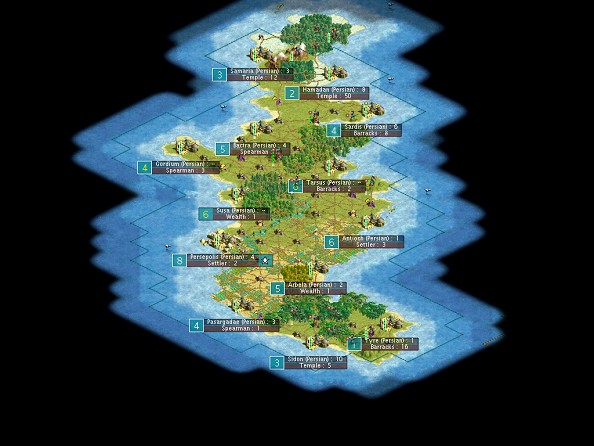
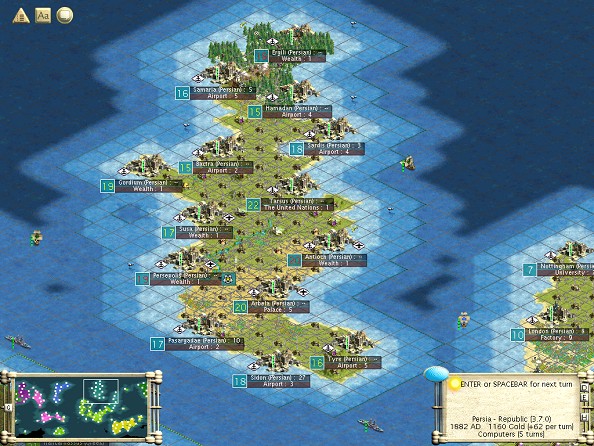
In 110 BC, a Persian Forbidden Palace was built almost directly to the northeast of Persepolis on the eastern coast. A look at the Persian empire as of 70 BC follows:
Attachment: 70 bc - persia.jpg
This has been downloaded 72 time(s).
|
|
| |
|
|
|
Catt
|
|
California - SF Bay Area
May 2002
time: 21:22
|
|
Not one to leave anything out, Xerxes also desired Literature and the ability to construct his cheap libraries – in other words, Xerxes settled on a mad dash for all ancient age technologies, with an emphasis on “growth helping” improvements to leverage his choice of Monarchy and the larger towns and cities it allowed, and “culture helping” improvements. Unlike many other previous empires Xerxes had governed, Currency fell relatively low on his list of desired technologies as just about all of the Persian commerce income was spent on scientific research. Xerxes also established a garrison of 3 troops in each city as it grew beyond the first few population points – this garrison of 3 seemed to provide just the right amount of security on comfort to each city’s citizens . In 130 AD the English built the Great Library, and just thereafter the Greeks built the Great Wall. By the time the Persians were ready to enter the Middle Ages (indeed well before such time) Xerxes’ people had settled all of the Persian homeland – with no barbarian uprising visible, Xerxes was completely in the dark as to the technological advancement of the other civilizations, except for his science advisors occasional comments as to being “moderately advanced” or “technologically advanced!” Also during this time, smugglers reported that the Chinese had been completely destroyed.
Xerxes knew that his empire must someday adopt a more representative form of government, and in order to do so once again focused on his need for a happy citizenry. Persian scientists mastered the secrets of Monotheism in no time, and continued onward to Theology. Xerxes exhorted his people to push forward, and hoped to build one or both of the Sistine Chapel and JS Bach’s Cathedral. With cathedrals rapidly built in most all Persian cities, they could each grow to size 12 without many happiness concerns. Xerxes encouraged this, but was still able to maintain a large commitment to science while spending almost nothing on entertainment. Upon the discovery of Theology, a Persian city immediately switched production to Sistine Chapel and the Persian scientists sought to unravel the mysteries of Education. With that accomplished, the set their sights on Music Theory, while the Persian cities across the land rapidly constructed universities. Only after having completed Music Theory did Xerxes direct the research of Engineering, Feudalism, and Invention. In 1010 AD, Sistine Chapel was completed in Tarsus; in 1120 AD, Sun Tzu’s Art of War was completed in the French city of Paris, and in 1230 AD JS Bach’s Cathedral was completed in Arbela.
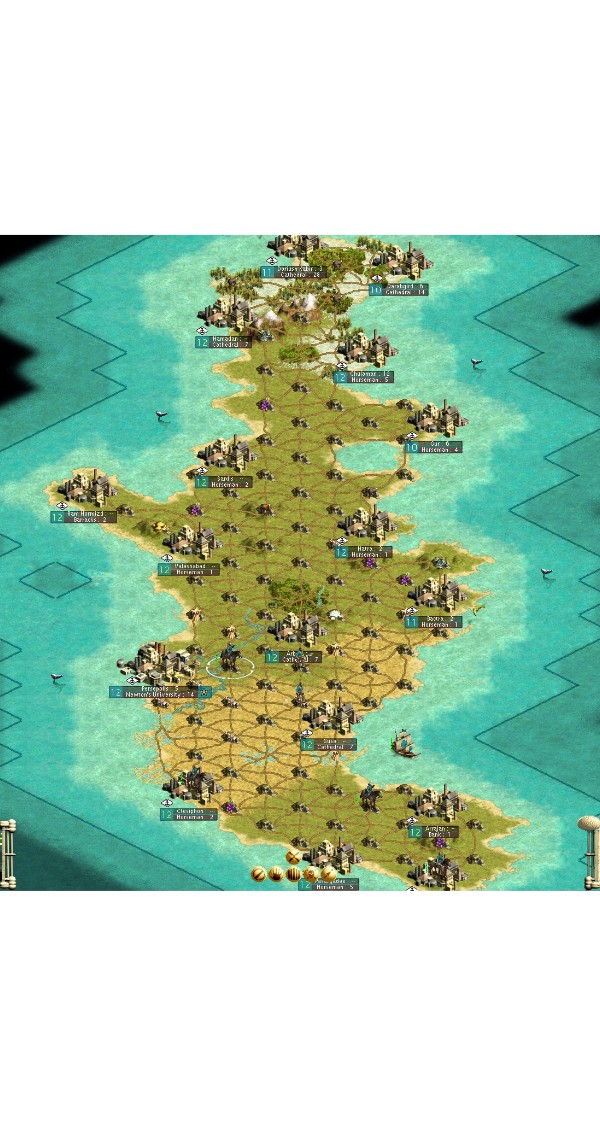
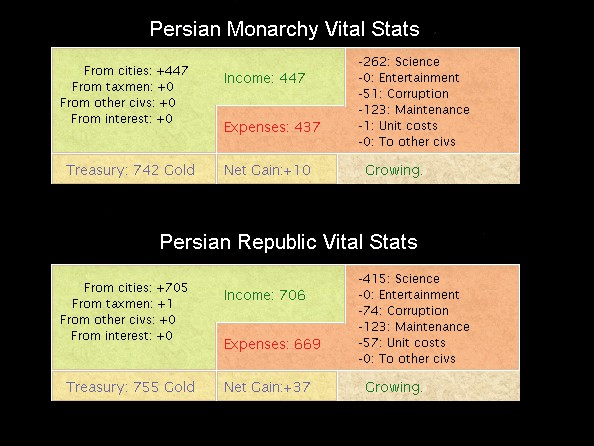
The Persian ability to secure both Sistine Chapel and JS Bach’s Cathedral encouraged Xerxes, and he knew he now provided far more “entertainment value” to his people than was necessary – a switch to a representative government was not only feasible, it was almost an imperative. Xerxes, of course, feared a long period of instability and anarchy should he take off the crown, but he had made the decision to take that chance many centuries before and felt “no time like the present” to make the switch. After completing the necessary research on Engineering and starting the construction of Leonardo’s Workshop, Persian scientists researched Republic and – holding his breath – Xerxes elected to initiate the revolution. With a magical stroke of luck, the Persian populace seemed ready for a revolution, and the brief period of anarchy was as short and uneventful as Xerxes could have hoped for, lasting only three turns. In 1315 AD, the Persian Republic was born. A compilation of certain Persian vital statistics following the switch to Republic appears below.
Attachment: gov switch comparison.jpg
This has been downloaded 72 time(s).
|
|
| |
|
|
|
Catt
|
|
California - SF Bay Area
May 2002
time: 21:22
|
|
Xerxes disbanded much of his military forces after assuming the chief executive role of the Persian government. Each city was left with one foot-soldier defender, and a very small force of Persian Immortals was deployed among Persian cities from north to south as a rapid reaction force should another civilization master ocean travel and arrive with hostile intent. Xerxes considered the seas to be Persia’s greatest defensive asset.
Rather than race towards Navigation and the freedom of travel it provided, Xerxes decided to act the true isolationist and focus his empire’s efforts on “building” a scientific, cultural and economic powerhouse. Persian scientists directed their research efforts at modern Banking and Economics. Shortly after the Persian city of Tarsus completed Leonardo’s workshop, Xerxes learned that the Greek city of Athens completed Copernicus’ Observatory. This gave Xerxes a good sense of where the Greeks lay in terms of technological advancement, since it represented the first real wonder “lost” to a more advanced civilization. Xerxes didn’t really consider the wonder lost because he had already resolved not to build it – he wanted a Persian Golden Age following worldwide contact and communication. Perhaps more surprising was the completion of Magellan’s Voyage by the French in 1385 AD. The Persians had not yet researched Astronomy, but the French had managed to not only research it but also to build the world wonder made available by it. Xerxes waited for sight of the first foreign ocean-going vessel.
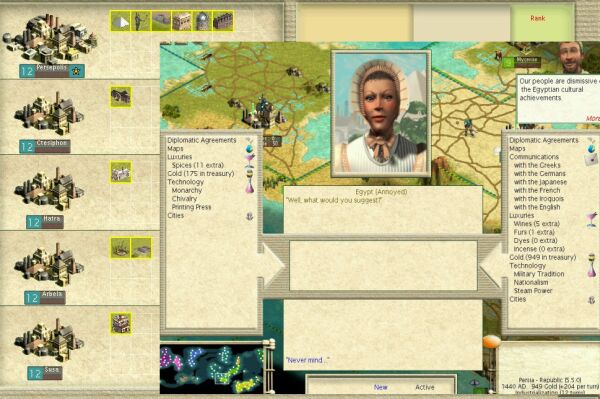
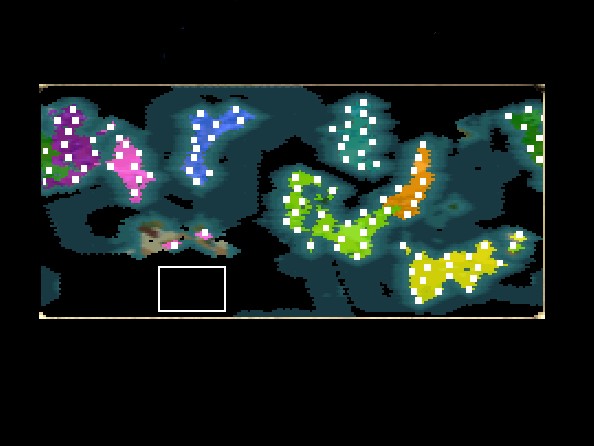
First contact came in 1415 AD with the sighting of a French caravel off the western Persian shore. Xerxes cautiously made contact with the French, and subsequently traded with Joan in order to secure communications with three other previously unknown civs as well as to acquire knowledge of the world map. A few turns later, Xerxes was able to purchase communications with the three remaining civs from Joan. A histograph in 1415 AD showed Persia with a 200+ point score lead over the Iroquois. A later histograph from 1430 AD (showing all civs) showed Greece in the lead, Egypt in second, and Persia in third. A breakdown of the technology status of each civ follows (Persia at the time was 1 turn from completing Metallurgy):
France: Slightly Ahead – Had Metallurgy, Astronomy & Navigation, but not Banking, Economics or Music Theory
Greece: About Even – Had Metallurgy and Astronomy, but not Economics
Egypt: Just Behind – Had Metallurgy but not Economics
England: Trailing – Persia could trade Chemistry, Economics or Music Theory
Iroquois: Trailing – Persia could trade Education or Gunpowder
Germany: Backwards – Persia could trade Engineering, Chivalry or Theology
Japan: Terminally Backwards – Persia could trade Currency or Republic
A minimap from shortly after full contact follows:
Attachment: 1450 minimap.jpg
This has been downloaded 73 time(s).
|
|
| |
|
|
|
Catt
|
|
California - SF Bay Area
May 2002
time: 21:22
|
|
Xerxes easily traded Banking and Economics for the missing Astronomy, Metallurgy & Navigation, world maps, relevant communications, and hefty gold and gpt deals. A few turns after the trades, in 1475 AD, Persia completed its work on Smith’s Trading Company.
Shortly after communications and diplomatic missions were established, Xerxes began trading excess Persian wine for luxury items from all over the world. He tried to space each luxury trade by a few turns at least, just so not all trade deals came up for renewal at the same time. As the Persian empire entered the Industrial Ages, only the French and the Greeks presented any present challenge to Persian economic and production hegemony, although Cleopatra’s Egypt was poised to grow into a superpower. Xerxes took a second unconventional approach in this endeavor by deviating from a somewhat well-worn technology research path. After completing Steam Power and Industrialization (Universal Suffrage completed in 1670 AD), Persian scientists studied Medicine and then Sanitation. Although Xerxes has in the past relegated Sanitation to that bin of technologies of only secondary importance, in present circumstances Xerxes coveted the growth opportunities afforded by modern hospitals – for one, Xerxes had a large surfeit of contentedness and happiness improvements and wonders, ensuring a reasonably happy citizenry even in eventual metropolises (metropolis?), for another, the physical landmass of Persian lands was smallish compared to more sprawling empires like those of Greece and Egypt – these factors combined made an earlier-than-normal approach to hospitals seem prudent. As hospitals were constructed in Persian cities, large numbers of workers that had been conscripted from the cities in order to lay a rail line in all areas of the empire were ordered home, where they rejoined the cities, and Persian metropolises were springing up and growing very rapidly.
Each of Greece and France actually began building the Theory of Evolution a turn or two before Persia had completed its research on the Scientific Method, but Xerxes was unconcerned – his engineers had already started making all appropriate preparations for a quick wonder build (pre-build), and Xerxes was confident that he would succeed in beating all others to the magical Theory. It was particularly magical for the Persians, as it would announce the start of a great Persian Golden Age and allow Persia to vault forward in terms of scientific, economic and productive power. In 1762 AD, shortly after completing research on Replaceable Parts, Xerxes dedicated the magnificent statue depicting the Theory of Evolution and the Persian empire launched its Golden Age. With the benefits of a Golden Age, a metropolis’ production, a factory and a coal plant, Persepolis constructed the Hoover Dam in approximately 12 turns, and all of Persia surged forward in production power. Technologies were researched in 4 or sometimes 5 turns with 100% of Persian commerce devoted to scientific research. Hundreds of extra gold poured into the treasury’s coffers nonetheless. With a small tech lead, Persia was unable to use its excess gold to purchase technologies other than a small purchase of Espionage from someone.
As the Persian march towards Motorized Transportation continued, Xerxes began to rethink his near-term goals. Xerxes had previously been informed in dreams that Elizabeth of the English was a thoroughly untrustworthy leader. At this point in history, in approximately the mid-Industrial Ages, England was a sorry mess, having fought a brutal war of attrition against the Egyptians for many, many years. The Egyptians achieved naval dominance, and fleets of 15+ Egyptian frigates ruthlessly bombarded the English countryside, removing much evidence of civilized improvements from the land. Towards the end of the Egyptian wars, England was also involved in a very short skirmish with the Greeks, but quickly made peace after having lost a large English city. Xerxes, trusting his dreams’ tales that Elizabeth was unfit to govern, had plotted use an invasion force of tanks and infantry to blitzkrieg the English and subdue the entire nation in a few short years. But with a Persian golden age ready to launch, and no real improvements to build for many turns, Xerxes decided that an infantry and cavalry invasion force would be sufficient to seize the English lands – and with them a monopoly of dyes and a source of coal. Investigation of the English nation showed that Elizabeth’s scientists had still not yet discovered riflemen, and that therefore Persian troops were unlikely to face anything other than cavalry and musketmen. An invasion fleet of 6 galleons was rapidly assembled, and a strike force of 15 cavalry, 8 infantry, 2 workers and a lone elite warrior sailed for the English coast.
Xerxes contacted Liz and shared his regrettable view that nothing other than war was possible at this time, and the Persian forces landed on English land. English resistance was almost nonexistent: after landing, Persian forces captured and garrisoned one English town and one English city – several dyes were confiscated. Although Xerxes’ commanders did take some risks in garrisoning captured cities, they calculated that even a successful uprising by the English citizens would only slightly delay the inevitable capture of all English cities, but would not otherwise succeed in changing the ultimate outcome. A third town was taken, and with it an additional supply of rubber. By this time, an additional strike force of approximately 14 cavalry and 6 infantry landed south of London. Upon landing it captured two additional English cities, securing all dyes for Persia and leaving England with only London and Nottingham at the far northern tip of English lands. Both fell on successive turns and England was no more.
Although the English war was over quickly (approximately 8 – 10 turns), the Persian strike forces were slowed somewhat due to the true nature of the operation taking place. While Xerxes certainly did seek control of the dyes and a stable supply of coal, the grander Persian goal was to secure a strong, defensible foothold on the Greek border. Xerxes anticipated future war with Greece, and a defensible beachhead near Greece’s core would radically alter the balance of power. Xerxes did not plan to start a war with Greece – he preferred to play out the scenario with a mostly “builder” style, but he doubted that Alexander would refrain from striking opportunistically at Persian interests. A defensive force of multiple infantry and cavalry were therefore detached from the Persian strike force to serve as border-city garrisons along the southern border with Greece.
A galleon-full of Persian workers was shipped from Persia to New Persia where, with the help of previously transported Persian workers and the few captured English workers, the New Persian countryside was rapidly transformed to a railroaded, improved terrain. Workers were then retired and joined nearby cities. Xerxes was quite pleased with the levels of corruption and waste in New Persia – it was inconsequential enough that New Persian cities built universities, cathedrals and banks before ever bothering with courthouses – Xerxes estimated that an 80-shield and 1 gpt courthouse would increase production by a few shields at most, and since production was already adequate (and the Persian treasury was overflowing with gold), no New Persian cities even bothered building courthouses.
As the Persian golden age ended, most of the cavalry remaining in Persia proper was disbanded in favor of the new-fangled tanks that Persia had recently discovered. Xerxes listened carefully to his military advisors – they were unanimous that a Persian attack on Germany, the Iroquois, or Japan would result in very few Persian losses and blindingly fast conquest – and Xerxes agreed with his advisors, for these nations were hopelessly outclassed in terms of technology and productive power. A Persian assault could indeed take all three empires apart in a matter of only a very short time – certainly short enough that Persian cities would only feel the slightest instance of war weariness. Nonetheless, Xerxes decided to finish the game as peacefully as possible – igniting no wars, joining none, but preparing an adequate defense. One factor in his decision was the exceedingly long period of time other civilizations were taking in making their seemingly very deliberate decisions. Following the English conquest, Xerxes frequently had sufficient time to complete his turn, and then scamper off to the refrigerator for another ale, with perhaps a pit stop at the lavatory as well, only to find that he hadn’t slowed the world’s progress by his actions in the least bit – and this was in times of AI peace! So Xerxes said “No” to aggressive expansion and conquest, and “Yes” to the fastest possible victory (or defeat). Persian scientists were directed to pursue Fission and the UN.
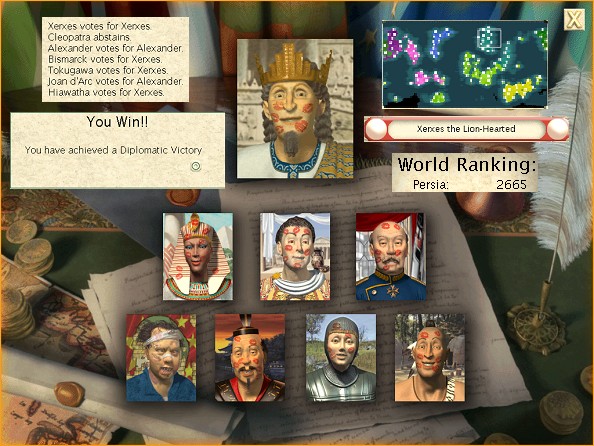
In 1884 AD, the Persian’s completed the UN, and were 5 or so turns away from completing the SETI project. Each of France and Greece was about even with the Persia in terms of technological advancement, the Greeks having completed research on Space Flight but not having researched Fission. Xerxes petitioned the world to be elected UN leader, but frankly wasn’t sure of a successful vote. While the Persians had maintained trading and often Right of Passage relations with many nations, Xerxes had never cast his lot with anyone in a military alliance or a defensive mutual protection pact. He also wasn’t even sure how many candidates would stand, and feared a three-way race among seven civs would be difficult to win. With a sigh of relief, Xerxes was very pleased to see that only he and Alexander were candidates, and with a bigger sigh of relief found that he had managed to earn the mantle of leadership with four votes for Xerxes, two for Alexander, and one abstention. A prolonged space race had been avoided.
Attachment: end compilation.jpg
This has been downloaded 73 time(s).
|
|
| |
|
|
|
Catt
|
|
California - SF Bay Area
May 2002
time: 21:22
|
|
Additional Game Notes:
* I’ve never done such a quirky opening research route and wouldn’t do it again (at least not exactly as a complete beeline to Monarchy). I’m too lazy to try and do a comprehensive analysis of Republic versus Monarchy in circumstances such as AU 106’s map, but my gut told me that I could grow my cities very large very quickly if I could control happiness. One way to analyze the choice is to figure that, all else being equal, a Monarchy could have cities with 3 higher population – assuming the 3 additional pop work coastal squares or roaded river tiles, that equates to 6 additional gold, or the equivalent bonus a Republic town of size 6 generates. If coastal or roaded river tiles are unavailable, only 3 additional gold are generated. With plentiful coast squares available, I figured Monarchy to be an advantage only if it would be significantly challenging to grow cities beyond size 6. Under AU 106 at Emperor level, I felt cities above size 6 would be a great deal of trouble until at least cathedrals.
* I employed a moderately dense build pattern, certainly not as dense as possible but also not avoiding overlap. With my unconventional government strategy, I needed to assure at least 12 quality workable tiles, and preferably room for 16 – 18 citizens in the late game. I fit 14 cities on my Persian island.
* I did a fair amount of forest planting and clearing for shields in the hinterlands. I did some, but very little in the aggregate, of build in the core and disband in the hinterlands. Corruption and waste were rarely problematic and with micromanagement of citizen laborers, and rapid growth through the plentiful bonus tiles and worker-pop transfers, I found even the most distant of cities could produce a fair number of shields.
* AI development was interesting. Japan either lost a few fights or was just very unlucky with terrain. They appeared to be crippled early. Egypt was apparently aggressive early (could have also been the early GA compared to China’s) and eliminated the Chinese pretty promptly.
* After reading the other spoilers I am absolutely amazed at how closely my game seems to have followed Sir Ralph’s (despite different strategies). The ending maps are astonishingly close, the victory condition and timing nearly identical, and the scoring nearly identical.
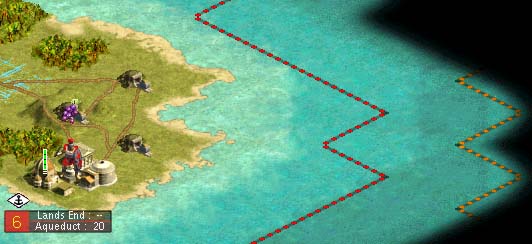
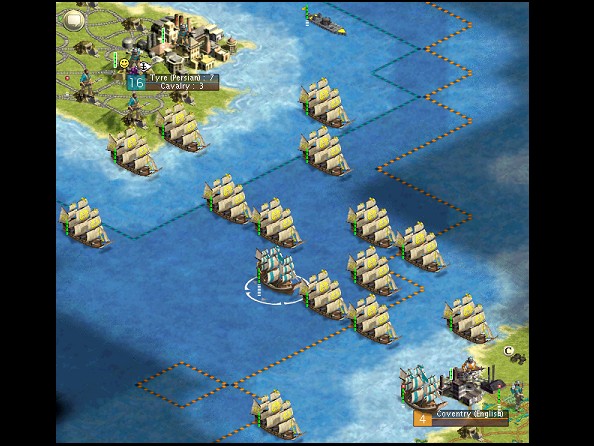
One final note: I’ve seen a number of threads about how the AI won’t build navies and/or refuse to use overwhelming force. The Egyptians fielded a ridiculously powerful wooden fleet and used it to bomb the English into submission. My invasion of England followed the conclusion of the Egyptian-English war by only a few turns, and the formidable Egyptian fleet had not only not cleared the Persian-English channel, but presented navigation challenges in reaching the designated landing zone.
Attachment: ai navy.jpg
This has been downloaded 71 time(s).
|
|
| |
|
|
|
nbarclay
|
|
Huntsville, Alabama
Dec 1999
time: 23:22
|
|
At least in the absence of military needs, Republic is actually a lot better for having big cities than Monarchy is, at least near the core. Each extra citizen in a Republic brings in at least two extra gold (less whatever corruption saps off), but needs only one to keep him from causing riots. So the luxury slider can be used to grow the core to size twelve while outlying cities are left at whatever size corruption leaves them able to support, and the civ makes a profit from doing so. (An alternative is to grow only the capital and similarly wealthy cities to size twelve, leaving the rest a bit smaller.)
In contrast, if I'm calculating correctly, Monarchy would require the use of the luxury slider to go past size six before colosseums on Emperor (one citizen born content, a temple, one lux, and three MPs). And without Republic's gold bonus, the benefit of using the luxury slider is a lot more marginal; if a land tile without a gold bonus is worked, you can even lose financially due to corruption.
One reason building troops in my core and disbanding them in outlying areas was so useful to me was that my northernmost and southernmost clusters of cities were deliberately overcrowded in terms of land tiles available in order to maximize my access to coastal and sea tiles. That left them even less productive than corruption alone could account for. Of course I wouldn't have done it if I'd had better things for my core cities to do, but it seemed more cost-effective than building wealth - and very possibly more potent for science as well since it helped me get courthouses and libraries in place sooner.
Nathan
|
|
| |
|
|
|
Killerdaffy
|
|
in other words a gang leader aspiring to Presidency
Nov 2001
time: 06:22
|
|
Catt,
great AAR!
Interesting to compare the different games and see the exact same thing happening to China (early elimination) and Japan (building an early wonder but then falling behind). Only the extent of the Greek domination over the English is variable, probably because it depends more on the role of the dice in combat. It would be worth switching some of the starting positions on such a map to see how different AIs fare in different places.
Edited: Spelling
Last edited by Killerdaffy on 25-09-2002 at 15:06
|
|
| |
|
|
|
Chemical Ollie
|
|
Bored of this board
Jan 2002
time: 06:22
|
|
Catt, I was planning to have a late game similar to yours and win by diplomacy, but an Egyptian backstabbing act ruined the rest of my game.
It's about 1870 and I'm in deep sh*t. The whole world is in war with me and refuse to talk, my people is rioting and all my bridgeheads on foreign continents have been lost or are under serious pressure from enemy attacks. I am still stuck with using infantry and artillery while at least 3 civs are pounding me with bombers. I have not met any tanks yet, but they are expected any turn.
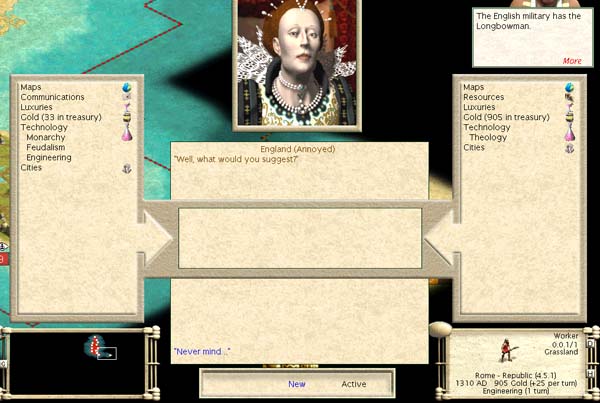
I was only 5 turns from electronics when the Greeks did a really dirty backstab by sneak-attacking London and breaking an ongoing trade deal where I paid a generous gpt for 2 luxuries. I had to increase the luxury slider to compensate for the lux and maximise gold to upgrade the cannons and riflemen in London. My leader is still idling in my capitol, eager to build Hoover. The upgraded troops did not help and my 5 infantry, 10 cavallery and 10 artillery will fall to a 50+ unit horde on the next turn (only 2 wounded cav left) I will at least disband the artillery to deny it to them. Or why not disband the whole town, with Colossus, Great Library and everthing. I'm allready hated by everone anyway.
My plan for the continued game is to focus totally on invading Greece. The other outposts are important, as one has the Suffrage and one has diamonds, but I can't bring in quick reinforcements before I get flight. If war weariness grows outrageous, I could always change to monarchy.
An interesting question is, what did I do wrong in the early diplomacy, when the whole world was polite with me for trading lux and tech? Why did they backstab me and f*ck up the rest of my game? Why were there no warnings? I have seen the AI turn from annoyed or catious to sneak attack, but never from polite to war.
|
|
| |
|
| |
|
|
|
Theseus
|
|
The warmonger formerly known as rpodos. Gathering Storm! Apolyton Spirit!!
Apr 2002
time: 00:22
|
|
Great AARs!!
Catt, I think I'm most impressed thus far with your game... I think Monarchy may have been the right call here, which almost no one else did.
Olaf, I think you may have simply overextended yourself... to the point where 1) you couldn;t do enough to get attacked AI civs back into good diplo relations, 2) you couldn't build enough to have a happy and productive empire, and 3) as a result, you couldn't keep up in tech, nor build enough military to hold onto your spoils... then you got into a negative spiral, where each loss / weakening tipped the balance in favor of the AI civs feasting on your ragged position. Have no fear though, I'm sure you can find a way to break out.
AI civ performance is so different in these games!! In mine, Japan took over the Iroquois, Greece took over England, Egypt left China alone, and France succesfully grabbed all three of the north to south islands. France has remained neck and neck with me for tech, as did Japan, and Greece was right up there until I ruined Alex' day.
My progress yesterday: Finished punishing the Greeks for now, having taking all the cities down to Troy (the fur patch), and razed the two in between there and Athens, and have Infantry in forts blocking the 3 tile chokepint to the northeast. The last battles produced my first GL, which I used for an Army... I'm on top of all the GWs I want with pre-builds, and I still want to take the other half of Greece (almost 60 elite Cavs remaining).
Nailed ToE and Hoover, and am about to enter the industrial corridor with a 2 tech lead over France. Hoover triggered my GA, and most core cities are building factories and hospitals.
Having 7 luxuries concurrent with the GA is great... the captured Greek cities are doing very well; btw, fast Library builds are amazing for culture. I'm running at 1.8.1, techs in 4-6 turns, and still pulling in 500-700 gpt. I'm pulling my late industrial trick: selling to the rich and gifting to the poor (which means at some point gifting to almost everyone)... all civs except Greece are either polite or gracious (Japan!!). In this case, I'll use it to pull a diplowin, I think.
In my game, Japan has the fleet... I got the IA up, and was impressed to see that they have 25 Frigates!!
|
|
| |
|
|
|
nbarclay
|
|
Huntsville, Alabama
Dec 1999
time: 23:22
|
|
quote:
Originally posted by Catt
I guess I don't understand this fully - particularly the "needs only one to keep him from causing riots." Does it take only one gold peice to move one citizen from unhappy to content (or content to happy and therefore off-setting an unhappy citizen?). And how do you deal with the rounding issue of the sliders. At the time I eventually made the switch to Republic, moving the slider to ebven 10% would cost approximately 70 gold per turn - and I wouldn't get a mood improvement in 70 citizens throughout the empire. In a city producing 30 total commerce, with the luxury slider set at 10%, that's 3 gold in entertainment - but I wouldn't see mood improvement in 3 citizens would I (it's never seemed that way to me before, but I haven't every watched terribly closely or studied it)?
|
I've only really looked closely in the early game before marketplaces, but there, it's definitely one gold for one unhappy->content or content->happy. I can't say for sure whether or not the gold gets bled off before marketplaces and banks have a chance to provide their multiplicative effect, though. I need to check when I get a chance. (Still, losing a multiplicative effect on gold that wouldn't exist at all under Monarchy isn't exactly a devastating prospect.)
When I switched to Republic, my capital was able to go to size twelve with the happiness slider at 30%, and I'm pretty sure several other cities did as well even before I built coliseums. (The fact that at that size, my cities were invariably working a few coast, river, and/or wine tiles helped.) Outlying areas stayed smaller, but even the worst of them was able to get to size six if I worked enough coastal tiles.
Nathan
Last edited by nbarclay on 25-09-2002 at 23:13
|
|
| |
|
|
|
Theseus
|
|
The warmonger formerly known as rpodos. Gathering Storm! Apolyton Spirit!!
Apr 2002
time: 00:22
|
|
As a republic, I got pretty much all of my towns / cities to their max size fairly easily... the cost however, was that I didn;t really have much WLTKD until I started kicking medieval age butt. If I remember, at 10-30% luxury, with colosseums, cathedrals, and marketplaces (in that order, as soon as available):
Towns: 2 happy, 3 content, 1 unhappy
Cities: 4 happy, 6 content, 2 unhappy
I also definitely had money troubles, but that was my own fault for building such as massive standing military under Republic, and possibly from the later than normal marketplaces.
|
|
| |
All times are GMT. The time now is 05:22.
Apolyton Time is 00:22. |
top of page
|
|
|
Forum Rules:
You may not post new threads
You may not post replies
You may not post attachments
You may not edit your posts
|
HTML code is ON
vB code is ON
Smilies are ON
[IMG] code is ON
|
|
|
|
|
|





 23-09-2002 23:23


 ), how big could your core cities grow and at what entertainment slider position was this? And how big could your outlying cities grow without happiness problems?
 |
|