|
| |
|

|
One_Brow
|
|
quote:
Originally posted by The Vagabond
quote:
We have A:Sagace, B:Vaga, and C:ZTau 3 logicians and friends.
Ming The Moderator takes a set of 8 stamps, 4 red and 4 green, known to the logicians, and loosely affixes two to the forehead of each logician so that each logician can see all the other stamps except those 2 in the moderator's pocket and the two on her own head. He asks them in turn if they know the colors of their own stamps: A: "No" B: "No" C: "No" A: "No B: "Yes"
What are the colors of her stamps, and what is the situation? |
It seems to me the following configuration works out nicely:
A has 2 red stamps; B -- 1 red and 1 green stamps; C -- 2 green stamps. (Or else, A has 2 green stamps while C has 2 red stamps.) |
Actually, it cold be any configuration where B has one stamp of each color.
Notation: (RR) RG RG GG refers to two reds in the pocket, one each on A, one each on B, two greens on C.
There are 21 total possible combinations.
A no: Eliminate (RR) RR GG GG, (GG) GG RR RR
B no: Eliminate (RR) GG RR GG, (GG) RR GG RR
C no: Eliminate (RR) GG GG RR, (GG) RR RR GG,
(RG) RR GG RG, (RG) GG RR RG (since if he had two of one color, A or B would have said "yes")
Note we have elimiated all cases where both A and B have two stamps of the same color.
A no: Eliminate all cases where B has two stamps of same color, since that would mean A has RG.
All of the following combinations are still possible with the given information after A's second no:
(RR) RG RG GG
(RR) GG RG RG
(RG) RR RG GG
(RG) RG RG RG
(RG) GG RG RR
(GG) RG RG RR
(GG) RR RG RG
|
|
| |
|
|
|
Zero-Tau
|
|
Elsewhere
Aug 2002
time: 06:23
|
|
quote:
Originally posted by Sagacious Dolphin
That can't be right...
When A says "no", that reveals to B that he is not GG, and therefore must have at least one R.
B can only see two Rs, therefore says "no". This reveals to C that he can not have a red. Else B would have seen 3Rs and known that he was GR and would have said "yes".
Knowing that he can't be RR or RG, C says "Yes" - he is GG |
Bad logic here. When A says no, B learns that he is not GG. However, because C does not know what he himself has, he cannot know that B is aware that he isn't GG. So C cannot exclude GR as a possibility for himself.
One_Brow: Yep, all the combinations you listed are possible after A's second "no", but not in all of them is it possible for B to figure out his own stamp immediately afterwards. That would be a further reduction of the number of combinations.
|
|
| |
|
|
|
One_Brow
|
|
Zero-Tau,
The key is that when C says "no", both A and B know that at least one of them, perhpas both, is RG. On any combination where both A and B are uni-color, either A or B will know the answer or C will determine that he is RG. Since A does not know for sure that A is RG, B can not be uni-color, and so knows that he is RG.
quote:
Originally posted by Sagacious Dolphin
That can't be right...
When A says "no", that reveals to B that he is not GG, and therefore must have at least one R.
B can only see two Rs, therefore says "no". This reveals to C that he can not have a red. Else B would have seen 3Rs and known that he was GR and would have said "yes".
Knowing that he can't be RR or RG, C says "Yes" - he is GG |
I assume you are referring to the case
(RG) RR RG GG.
A says no: B knows he has a red. C does not know that B knows he has a red. C knows he could be RG or GG. C does not know the difference between:
(GG) RR RG RG
(RG) RR RG GG
If the first case were true, B would not know that B had a red, for B would still see (RG) RR GG RG as a possibiltiy, and could not choose between that and the actual distribution.
|
|
| |
|
|
|
One Brow is right...
All the configuration with B having RG and only those are right.
Whats interesting, is that if I told you in the problem that the solution for B exists and is unique, you could have guessed immediatly that it is RG, because by symmetry, if B has RR, then if we switch all the red and greens, it could guess GG.
Now Ill leave you a few hour to make a new one...
I dont mind posting more, though then I cant answer them and in a way I feel this has become Lul's Brain Teaser Thread 
(Of course I dont mind going on, if you guys like those, just tell me if I should raise the level of diff or lower, or ask more a certain kind of question, I like to ask questions I believe anyone can answer, not just those with a math or other training.)
|
|
| |
|
|
|
Zero-Tau
|
|
Elsewhere
Aug 2002
time: 06:23
|
|
Mmm.. time for a new one.
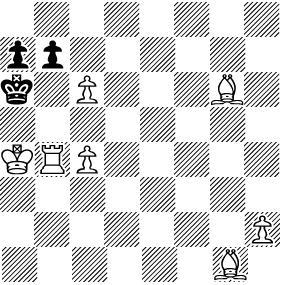
Take a look at the chess position below. It is white's turn. What were the last 5 moves?
 Attachment: chess.jpg Attachment: chess.jpg
This has been downloaded 25 time(s).
|
|
| |
|
|
|
Zero-Tau
|
|
Elsewhere
Aug 2002
time: 06:23
|
|
Black did start at the top, and he did move his king last. Yes, it is possible (albeit tricky).
|
|
| |
|
|
|
Zero-Tau
|
|
Elsewhere
Aug 2002
time: 06:23
|
|
Yep. Now you should be able to figure out the rest.
|
|
| |
|
| |
|
|
|
Sorry vaga, I dont like it...
Not that it makes me mad I just dont find it too funny...
Maybe because I study in math i dunno...
My first thought upon reading it was "even that formula is not unique". For example we could have m'=m\2 and then E=vm' so the joke doesnt even make sense...
Maybe my explanation makes no sense I just find it is too far-fetched to be still funny...
|
|
| |
|
|
|
Ok next one:
What is the smallest number of coins that you can't make a dollar with? For what N does there not exist a set of N coins adding up to a dollar? It is possible to make a dollar with 1 current U.S. coin (a Susan B. Anthony), 2 coins (2 fifty cent pieces), 3 coins (2 quarters and a fifty cent piece), etc. It is not possible to make exactly a dollar with 101 coins.
|
|
| |
|
| |
|
|
|
One_Brow
|
|
Recently, has been an Eisenhower dollar, an Anthony dollar, and now a Sacajawea dollar.
John F. Kennedy was on the mostr recent 50-cent peice.
The denominations are: 1, 5, 10, 25, 50, 100
The answer is 77 coins. It's farily easy to get to 20 without pennies. After that, you can use a combination of pennies, nickels, and dimes to get all the way to 76 (70 pennies and 6 nickels). 77 requires the use of 75 pennies, and there are no two coins to make up the remining 25 cents.
My turn again:
There is a unusual planet that has only six people, three men (Ron, George, and Bill) and three women (Barb, Nancy, Hilary). Each of the men likes to "visit" each of the women, and vice-versa. Since they don't like to meet each other when they go visiting, and since the planet is not very large (yet sufficiently dense that it maintains an atmosphere, has no hills and valleys, and can't be tunneled), they were able to contruct on the surface one path to lead exclusively from each man's home to each woman's home (or vice-versa). To be clear, there is a path from Ron's House to Barb's house which does intersect any other path, another to Nancy's house, and seven paths.
What is another unusual fact about this planet?
Last edited by One_Brow on 27-11-2002 at 18:32
|
|
| |
|
|
|
One_Brow
|
|
Since Ignorance hasn't posted another, I'll go again:
As we all know, standard Tic-Tac-Toe (3x3) ends in a draw if both sides make the best plays.
If you expand the playing field to (4x3), the first player always wins.
Let's now expand the game to 4-in-a-row. For the sake of ease, the grid sizes must be different by no more than one (so 3x3 and 3x4 allowed, not 3x5).
What is the largest grid size in which the second player can force a tie in a game of four-in-a-row?
|
|
| |
All times are GMT. The time now is 05:23.
Apolyton Time is 00:23. |
top of page
|
| archivepost |
|
Forum Rules:
You may not post new threads
You may not post replies
You may not post attachments
You may not edit your posts
|
HTML code is ON
vB code is ON
Smilies are ON
[IMG] code is ON
|
|
|
|
|
|






 26-11-2002 19:41


 Nobody is close for the moment. Should I tell the answer yet, before this thread is closed?




 |
|