|
| |
|

|
Heresson
|
 |
of frogs
Jun 2000
time: 06:24
|
|
quote:
Originally posted by MagyarCrusader
So prehaps '75 should be the starting year?
How much of Asia Minor did the Turks take from Manzikert? Was it all the way to Bosporus? |
At the start, yes (there were some exclaves remaining, especially on the shores), but after I crusade and Aleksy's
reconquista, their posessities shrank to the interior only,
east to Filomenion city (still it was majority of the land).
Definitely Byzantium is better choice than Poland or Hungary, but I agree with Mister Jeszenka, some civ is needed to halt German expansion to the east, and Hungary isn't enough. Perhaps You could merge Poland and Hungary into 1 civ?
When it comes to Lithuania, yes, it was large - for a while-
but culturless and generally weak despite its size (it managed to take Ruthenian duchies only thanks to that they were weakened by Mongols). It was absorbed into Poland anyway.
|
|
| |
|
|
|
tanelorn
|
 |
of the deep blue sea
Jun 2001
time: 07:24
|
|
Norman conquest of Southern Italy
10th-
11th
Cent-
uries
A.D. The Norman Conquest of southern Italy begins. The first adventurers from the coast of Normandy, France, hire themselves out to the rival rulers of Benevento, Salerno, Naples, and Capua. As a reward they are given the city of Aversa. But as their numbers increase, the Normans band together to fight on their own.
1053-
1059
A.D. By this time Robert Guiscard (i.e. "the Wise", or, "Wily") has established a Norman kingdom in southern Italy. He conquers Calabria (the toe of the Italian peninsula), Benevento (1054 A.D.), and allies himself with Pope Nicholas II (r. 1059-1061), whom he protects from being dominated by Germanic rulers, and receives papal sanction to rule Calabria, Puglia (the heel of the Italian peninsula), and the island of Sicily. Robert sends his younger brother Roger to conquer Sicily, and himself sets out to conquer Puglia from the Byzantines.
The Normans have many classical texts translated from the Greek and Arabic into Latin. Together with the Greek texts that are collected in Byzantium and rediscovered in the libraries of the monasteries of Europe, these works will bring about a revolution both in Roman Catholic theology and in secular learning.
1071
A.D. Robert Guiscard captures Bari. With Puglia conquered, and with it Byzantium's rule in southern Italy ended, Robert next sets out to conquer Constantinople. But he is called back by Pope Gregory VII (r. 1073-1085) to defend the papacy against the Holy Roman Emperor Henry IV.
1084
A.D. Robert Guiscard captures the city of Rome from Henry IV's army. But when the people of Rome revolt against Robert's army, Robert sacks and burns the city.
1060-
1091
A.D. Roger Guiscard's conquest of the island of Sicily from the Saracens. The Moslems of Sicily and southern Italy are Berbers from North Africa (the race of St. Augustine) and Spanish Moslems, a diverse people but they are all called Saracens ("People from the East") by the Italians.
1085-
1101
A.D. With the death of his brother Robert Guiscard, Roger becomes the ruler of Norman Italy or the "Two Sicilies" as it is called -- i.e. of the island of Sicily and the southern half of the Italian peninsula.
1101-
1154
A.D. During the reign of Roger II, a nephew of Robert Guiscard, Naples and Capua are added to the Norman Kingdom. Abruzzo is captured from the Holy Roman Emperors, and North Africa from Tripoli to Tunis is taken from the Saracens.
1130
A.D. Roger II changes his title from Count to King. The capital city of his "Kingdom of the Two Sicilies" is Palermo.
1194
A.D. Roger II's heirs, who have already lost the Norman's North African possessions, end Norman rule in southern Italy by surrendering the Kingdom of the Two Sicilies to the Holy Roman (i.e. German) Emperor Henry VI under the pretext that Henry has married a woman from the Norman court.
|
|
| |
|
|
|
Heresson
|
|
of frogs
Jun 2000
time: 06:24
|
|
quote:
It's also a matter of perspective, Poland becomes a major power at the very end of the middle ages, during the height of the period the Teutonic Knights pretty much vitimized Polish tribes for fun and profit.
|
(I didn't notice it earlier)
First of all, it's not a proper term when it comes to Poland at this time. Secondly, TK were brought there by Poles and were originally Polish vassals. Their might, which I would start from taking Gda?sk from Poland (1306 or so) to Grunwald battle (1410) was very short period, as well.
Poland was a major power also earlier; in the start of XI century, when it took Luzycze, Bohemia, Moravia, Slovakia, part of Prussia, subdueed Kiev for some time, fought succesively with the Empire and made alliance with Patzinaks and Byzantines. Later however pagan rebellion
and joint neighbour attack brought the period of Polish might to a temporary end.
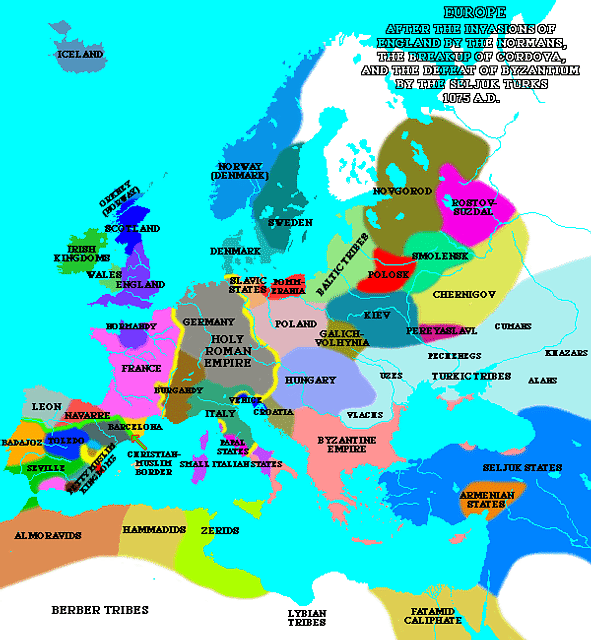
I urge You to not treat the above map too seriously. There are some major - perhaps just to me - mistakes there.
Nothing to it, not all can be shown on the map.
|
|
| |
|
| |
|
|
|
tanelorn
|
|
of the deep blue sea
Jun 2001
time: 07:24
|
|
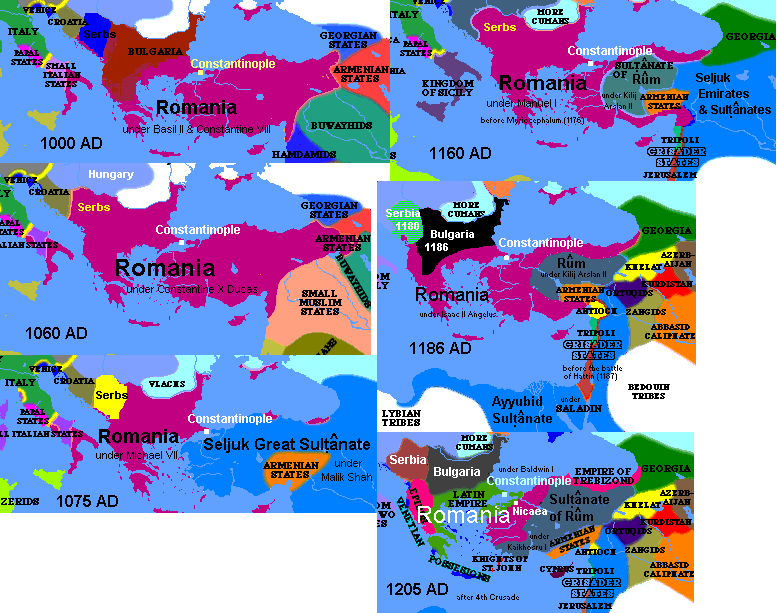
Ok, mostly agree with you, comments:
1) Yes, its 4 years since the battle of Mantzikert, Armenia.
Southern Italy and Sicily are in Norman hands since 1971- the same year-, this is why I posted the Norman conquest timeline further up the thread.
2) Unfortunatelly, they did. It was Alexius Comnenus political skill (rather than military genius) that got the coasts back, 20 years later. He benefited from the first crusade, by obtaining a mock up "oath of fealty" by the crusading leaders, even from the same Normans he had repelled from Greece in the meantime. He marched his troops right behind them and secured the cities for Byzantium, until they refused to fight battles in his name and he found himself overstreched, thus he didn't press further to the interior. Central anatolia remained firmly in turkish hands until Manuel Comnenus, who reconquered much of it briefly, before the devastating defeat at Myriokefalon. Then, the interior was lost for good by the Byzantines.
3/4) Serbia (more towards modern day bosnia-hertzegovina at the time) was in and out of (nominal) vassalage to the Roman empire as shown in the previous six maps I included.
5) Croatia shifted between Hungary and Holy Roman Empire of the German nation
6) Agreeed. Also Edessa was more isolated, but had a large Armenian population and leadership, who welcomed the crusaders, when they arived.
7) Abkhazia?
8) Up to Arp-Aslan, yes they are under a central leadership (his). Shortly after Mantzikert, he dies, his agreement to withdraw never materialises and his recent conquests in Asia minor are divided between the Seldjuk states of Rum (Rome!), Konya (Iconion) and the Danishmed state centered at Kayseri (Caesaria). During this time Georgians regain their independence.
9) True.
10 & 13) Nope, I have two maps showing these borders. Give specific dates (year etc.)
11 There is no 11
12 Ok, this is a generalisaton because polabian is kind of alien term, at least for me. I take your word for it though.
14 Who said they are? They are of Persian/Parthian/Skythic stock and survive in the Caucasus to this day. Some migrated as far as Potugal during the Germanic invasions, the rest stayed as a buffer state between the Hunnic Khazars (who were advocates of Judaism) and the Roman & Persian/Arab/Turkic empires.
15 You are right.
16 Ok, overgeneralization.
I didn't paint this second map myself, I only used it as a reference point. It was done by some Croatian guy, I think. So there.
What etc? I really like this, lets hone our history skills! 
|
|
| |
|
|
|
Heresson
|
|
of frogs
Jun 2000
time: 06:24
|
|
2) Unfortunatelly, they did. It was Alexius Comnenus political skill (rather than military genius) that got the coasts back, 20 years later. He benefited from the first crusade, by obtaining a mock up "oath of fealty" by the crusading leaders, even from the same Normans he had repelled from Greece in the meantime. He marched his troops right behind them and secured the cities for Byzantium, until they refused to fight battles in his name and he found himself overstreched, thus he didn't press further to the interior. Central anatolia remained firmly in turkish hands until Manuel Comnenus, who reconquered much of it briefly, before the devastating defeat at Myriokefalon. Then, the interior was lost for good by the Byzantines.
I know. But at this time, still many cities, inland, and especially at the shores, were in Byzantine hands.
Antiochia didn't fall until the start of Alexios' reign, in 1081 or so.
3/4) Serbia (more towards modern day bosnia-hertzegovina at the time) was in and out of (nominal) vassalage to the Roman empire as shown in the previous six maps I included.
As You say, nominal. And it is shown here as their province.
5) Croatia shifted between Hungary and Holy Roman Empire of the German nation
I just have some doubts towards its size. It seems so... small. But I'm not any specialist on that.
6) Agreeed. Also Edessa was more isolated, but had a large Armenian population and leadership, who welcomed the crusaders, when they arived.
The question with Edessa was such that it was captured by Turks, given a Turkish gouvernor, but when He died, Toros, an Armenian, started ruling the city.
I'm not quite sure if it still isn't the year when He wasn't yet ruling it.
7) Abkhazia?
No, a kingdom around Kutaisi.
I don't remember to be honest. I just remember that it was independant.
8) Up to Arp-Aslan, yes they are under a central leadership (his). Shortly after Mantzikert, he dies, his agreement to withdraw never materialises and his recent conquests in Asia minor are divided between the Seldjuk states of Rum (Rome!), Konya (Iconion) and the Danishmed state centered at Kayseri (Caesaria). During this time Georgians regain their independence.
I thought that Ikonion sultanate starts only after the fall of Nicea?
10 & 13) Nope, I have two maps showing these borders. Give specific dates (year etc.)
I don't remember exactly, but I am sure of what I say.
Czechia was part of Poland for only a couple of years at the start of XI century; Luzycze, but not that much of it, for a bit longer. eastern Pomorze stayed Polish up to the
XII century; I remember that W³adys³aw Herman ordered to burn all the cities in Poland, and Gdañsk was burned too. But his son had to reconquer it several years later, in second or third decade of XII century
14 Who said they are?
It comes out of the map
Sorry, haven't got time for more.
|
|
| |
All times are GMT. The time now is 05:24.
Apolyton Time is 00:24. |
top of page
|
| archivepost |
|
Forum Rules:
You may not post new threads
You may not post replies
You may not post attachments
You may not edit your posts
|
HTML code is ON
vB code is ON
Smilies are ON
[IMG] code is ON
|
|
|
|
|
|





 28-12-2002 17:51


 Attachment:
  Attachment:
  ) and then transmuting all the units from i.e. 3/3/1 to 1/0/1 via a Leonardo's workshop sort of wonder and then strenghtening them again by the time that Alexios came to power in 1081.




 |
|