|

|
Dominae
|
|
quote:
Originally posted by Theseus
/Valley Girl voice on
Uh.. yeaah!
/Valley Girl voice off |
/Homer Simpson on
Whatever, Theseus!
/Homer Simpson off
|
|
| |
|
|
|
Theseus

|
 |
The warmonger formerly known as rpodos. Gathering Storm! Apolyton Spirit!!
Apr 2002
time: 00:26
|
|
America, solely because of Ind, is just fine for me with this one (but yeah, thanks a lot buddy!).
I've also been quickly joining workers to the 'keeper' cities once I get rid of a camp, cause I've gotten so much work done so fast... a nice subtlety to the new approach.
DeepO is absolutely right about terrain. Not just good stuff, but bad as well. He's only sorta right about managing these smaller, tighter towns... the downside is that when they start getting close to their max size pre-camp-abandonment, they need very close monitoring in terms of which town / city uses which tiles. Sort of a pain in the b-tt.
But man... the power of early ICS, abandonment of camps, and pumping up your keepers with workers and even settlers...
I knew it, first in a hunch, then in SR's theory, and now in a first application. It'll only get better as more people try it and polish it.
Where's Aeson, damnit?!
|
|
| |
|
|
|
DeepO
|
 |
supporting Candle'Bre
Jan 2002
time: 06:26
|
|
Theseus, you're right about smaller cities requiring more MM to get them perfect, but that's not really an argument. Most of the times you could also not micromanage, and let the governor pick tiles, it will certainly not be optimal, but comparable with 19 or 21-tile cities. So, all the MM you put in gives more efficiency... and if your not still churning out settlers and workers in all cities at the same time, you only need to set it once, and not look back unless you notice an obvious problem. If there is just one tile to pick, that tile gest picked... after building a worker, a city will grow back into it's original tile-pattern if there is no pressure from other cities to take the tile.
Even with MM, it seems to be worth it to use this more flexible pattern, even if it requires a bit more work. Again, it's a matter of pace of the game, in a PBEM, you will have plenty of time to set all workers optimally, while in huge SP games with 200 cities, nobody can be bothered with keeping all of them in perfect shape.
DeepO
|
|
| |
|
|
|
theNiceOne
|
|
quote:
Originally posted by Sir Ralph
A playable 3-tile pattern with exactly 12 tiles per city is this:
code:
. . . . x . . . . . .
. . . . . . . . . . .
. . . . . . . x . . .
. . x . . o . . . . .
. . . . o o o . . . x
. . . o o O o o . . .
x . . . o o o . . . .
. . . . . o . . x . .
. . . x . . . . . . .
. . . . . . . . . . .
. . . . . . x . . . .
The x'es and the big O are cities, the small o's are the tiles dedicated to the big O city (as example). |
This is exactly the pattern I've been defending and converting players to at CFC. It's interesting to see the difference in focus in this thread and city spacing threads at CFC, where most of the players seems to be using the OCS scheme.
My favourite is the above layout, as it lets all cities grow to size 12 and still has the benefit of only 2 tiles between each city for a one-turn move of defenders in case of emergency.
BTW Catt, I think its time to rename OCS from Optimal City Spacing to Open City Spacing as "optimal" is misleading in all but aestethic sense.
|
|
| |
|
|
|
Sir Ralph
|
 |
Long live teh Schwampel!
Dec 2001
time: 06:26
|
|
quote:
Originally posted by badams52
But I have some questions on these camp cities. How large do you let them get and how do you go about disbanding them? Starvation? Rushing workers/settlers? Building settlers without growth? From my experience, waiting to disband cities isn't a quick process, so how long will it take? |
Camps are maximum size 6 cities and get a barracks and maybe a temple as only improvements. They get the "crappier" terrain, compared with the cities, and need no food surplus after reaching size 6. In the ancient age they build spearmen, swordsmen and horsemen, in the medieval age cheaper units up to musketmen. A size 6 city with 8 production (should be not hard to achieve) can make a standard musketman in 8 turns, or a pikeman in 4.
Each permanent city gets 2 such camps not farther than 2 tiles away. After construction, the first camp gets disbanded, on the verge of the industrial age the second. They get disbanded by producing workers. Especially with the 2nd camp this should go fairly quick, since the terrain is already improved.
The first chunk of workers improves the terrain and then gets added to "their" city, to grow it quickly up to size 12. The second chunk builds railroads, a part stays and deals with pollution (along with the slaves), the other also gets added to "their" metropolis. The fact, that due to the workers the cities don't need a granary to grow quickly.
|
|
| |
|
|
|
alexman
|
 |
Hunt Valley, MD
Jan 1970
time: 00:26
|
|
Let me just point out that these elaborate patterns look great when there is no terrain attached to them, but in practice, the coastline and other terrain features always force you to do something different. This is actually a good thing. It makes you think about your choices, instead of building cities like a robot.
Having said that, I like Sir Ralph's proposed scheme. Early-game expansion power combined with late-game efficiency: every builder's dream!
I have only one concern: Building improvements in just the first ring of those permenant cities will be painfully slow because of corruption. For example, the 'o' city five tiles away from the capital will have about 56% corruption before a courthouse (46% with a commercial civ  ). For a permenant city that is supposed to build almost all improvements, that will be very slow progress, and keep in mind that this is just in the first ring of permenant cities around the capital! ). For a permenant city that is supposed to build almost all improvements, that will be very slow progress, and keep in mind that this is just in the first ring of permenant cities around the capital!
My favored approach is to build my core with a tight spacing, and not to worry about what happens after the ancient age. The ideal scanario is that by the middle ages I get a leader and move my palace to an AI core that has loose spacing, which is more suitable for building expensive improvements and units.
|
|
| |
|
|
|
Catt
|
 |
California - SF Bay Area
May 2002
time: 21:26
|
|
quote:
Originally posted by alexman
Let me just point out that these elaborate patterns look great when there is no terrain attached to them, but in practice, the coastline and other terrain features always force you to do something different. This is actually a good thing. It makes you think about your choices, instead of building cities like a robot. |
 Totally agree. Totally agree.
(And most of what I find fun about Civ is dealing with unique circumstances. The other big part that I find fun is deatiled discussions on "breaking the game" by deciphering the most brutally efficient gameplay methods (such as this thread offers), even if I don't subsequently use them  ). ).
quote:
My favored approach is to build my core with a tight spacing, and not to worry about what happens after the ancient age. The ideal scanario is that by the middle ages I get a leader and move my palace to an AI core that has loose spacing, which is more suitable for building expensive improvements and units. |
That's how I tend to play my SP games as well -- 3-tile spacing (with the occasional 4-tile where called for and the very rare 2-tile) for the native core, and take the AI's city placement largely as found, which is quite loose and tends towards OCP or even greater. Though I plan on exploring DDGCS.
quote:
Originally posted by theNiceOne
BTW Catt, I think its time to rename OCS from Optimal City Spacing to Open City Spacing as "optimal" is misleading in all but aestethic sense. |
I agree in principle, although I fear there is far too much baggage associated with OCP as "optimal" to do more than create mild confusion.
Catt
|
|
| |
|
|
|
Arrian
|
 |
Kneel before Grog!
Jul 2001
time: 00:26
|
|
Catt, Dominae, others...
I think 'tis I who used different spacing terminology and gave rise to Catt's post. I tend to count the tiles between cities, but not the city tiles.
Having said that, everyone else does it the other way, and so I will use that method.
Hence, I'm an incorrigible 4 to 5 tile spacer. Can't help it. Occasionally, in special circumstances due to terrain, I will drop to 3 tile spacing. I vaguely remember building a city with only 1 tile between it and another ONCE, to steal a luxury.
That said, I agree that calling my method "Optimal" is misleading. My city spacing is the one part of my gameplay that I know of that is clearly sub-optimal, and I accept that.
Why aim for Metros? Why use wider spacing? So that when you have 1/2 the world under your control, you have an efficient, aesthetically pleasing empire. I cannot provide a better reason.
-Arrian, perfectionist warmonger
|
|
| |
|
| |
|
|
|
Master Zen
|
 |
of naughty
Jan 2003
time: 23:26
|
|
"The best laid plans do not survive first contact with the enemy"
-von Clausewitz
I quote this to make sure everyone agrees that no matter how we plan our ideal city pattern, TERRAIN, and TERRAIN alone will dictate if it will be in fact as ideal as we thought.
Therefore, although I really liked Sir Ralph's scheme, we must be ready to think fast in case terrain is not favourable to us.
Although personally I like to see nice OCP maps, I think this type of placement should not even be considered in a MP game.
Last edited by Master Zen on 19-02-2003 at 03:34
|
|
| |
|
|
|
nbarclay
|
 |
Huntsville, Alabama
Dec 1999
time: 23:26
|
|
I usually use SOTPCS (Seat-Of-The-Pants City Spacing), aiming for 12 workable tiles per city or not much over but not following any particular geometric pattern. I don't care about geometry; I want my cities working the best tiles possible as early as possible. And the way I figure it, if I can't win a game using spacing oriented toward size 12, there's no way I'd win it with wider spacing. If the game is a tough one, I'll need the tighter spacing just to stay competitive through the medieval era. Otherwise, I'll have leveraged my tighter spacing into enough of a lead by the time I get Sanitation that the reduced efficiency of having more, smaller cities won't matter.
My impression is that camp cities work best for people who like early warmongering. Swordsmen (including those who did their initial training with clubs instead of swords) couldn't care less whether their home towns had temples, libraries, marketplaces, and so forth. All they care about is that they had a decent barracks.
In contrast, in a builder-style early game, temporary camp cities are worth far less. Building city improvements in them is essentially worthless, other than barracks to whatever extent units will be produced, and the increased corruption they cause interferes with the productivity of cities that are trying to build improvements that will last the rest of the game.
I probably ought to learn to make better use of temporary cities in games where I'm planning a relatively early military campaign. In my last couple such efforts, I found myself with the gold for the massive warrior upgrades I had planned but I took too long getting enough vet warriors for my planned upgrades. But with the kind of more peaceful early games I usually favor if I have enough space, I suspect that such cities would do more harm than good.
Nathan
Last edited by nbarclay on 19-02-2003 at 04:29
|
|
| |
|
|
|
yxhuvud
|
|
Master Zen:
It is not only the terrain that states how the cities should be placed. where your opponents are situated and where their cities are also play a big importance on where to put my cities (and more importantly, in what order I place them).
|
|
| |
|
|
|
Fosse
|
|
U.S.A.
Mar 2002
time: 23:26
|
|
The discussion is interesting, but I can't add much now... papers papers papers...
I'd like to propose the name "Ralphing" for this new technique though.
|
|
| |
|
|
|
Dominae
|
|
No offense to Sir Ralph, but I'm not really understanding why this technique is "new". The "camp" idea has been around forever, and implicit in it is the idea that you'll get some large productive cities when the camps are finally disbanded. The exact layout is irrelevant.
Forget the fact that I'm not 100% sold on the idea. Now, are we naming something here just for the sake of naming something? This is all a lot of buzz around what many people have in fact been since the game first came out (almost). Again, no offense to Sir Ralph.
Dominae
|
|
| |
|
|
|
Theseus
|
|
The warmonger formerly known as rpodos. Gathering Storm! Apolyton Spirit!!
Apr 2002
time: 00:26
|
|
Dominae, I know what you mean, this is not entirely new.
In fact, I realized this evening that I had done it myself in the AU game we played as Rome... I forget which one, maybe it was Son of SVC... where we started on a small and relatively crappy island to the north (one of my favorite games of all time, btw).
But the difference was that tight city packing was a response to the environment, not a purposeful paradigm for early power and late metros.
Yup, some people have been doing this purposely (Aeson), but not as a systematic methodology.
It's a big conceptual move forward, for me at least.
Naming it:
Ralphing.

Back in the day, this was slang for throwing up!
|
|
| |
|
|
|
Capt Dizle
|
|
From the moment I saw how the game worked I adopted a very simple and effective city placing scheme.
Around my capital I place four mega cities five spaces in each direction, thats four between. But I don't build them first.
That spacing allows each mega city a full 21 tile set to work in the endgame. These cities get the works, full infrastructure.
That spacing allows for four tile "holes" wherein one might place camps, and is flexible to allow them to be built as few as two spaces (one between)from the capital. These are going to be used for workers, settlers, and troops and being very close suffer little corruption. The only infrastructure you really need is a barracks and if on the coast you can put in a harbor to use the sea. These camps are usually built early, but which set gets built first can also depend on expansion needs.
Adjust all this to terrain and you guys can work the puzzle forever and never get a better set because this spacing allows maximum flexibility and immediate power.
|
|
| |
|
|
|
badams52
|
 |
near the magic kingdom
May 2002
time: 21:26
|
|
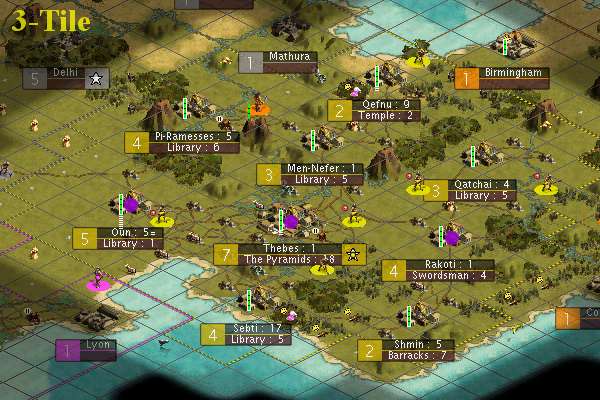
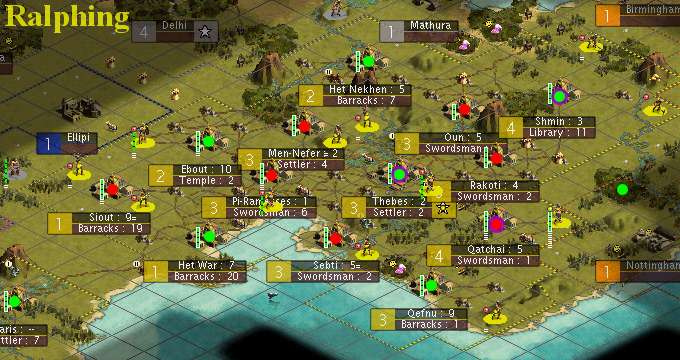
Okay here we go people. Using AU201 (Ultimate Power) with AU1.05 and playing Egypt on Monarch level, I decided to test out two schemes: 3-tile spacing and "Ralphing" as you have now called it. I spent my time and resources REXing as fast as I could and the first few worker moves were identical in the two games. The worker moves began to change as other cities were founded. For both games, the goody hut produced pottery (luck of the draw).
In the 3-tile game, I got one more goody hut that produced a warrior and did a little more exploring and finding the other civs (partly thanks to the extra warrior early on). When I stopped at 775 BC, I was getting ready to wage war on either the Indians or the French, probably the Indians first and then the French. I ended up building libraries earlier in this game since I got the writing tech advance from England faster then I did in the Ralphing game. Also having gotten to the point of not being able to expand anymore without a large army, I took to building culture.
In the Ralphing game, my expansion looks like it stopped at about the same time as the 3-tile game, but at that point, I was better equipt to go to war. I upgraded my warriors to swordsmen (thanks Dominae), sacked a city and captured Paris giving rise to the placement of Het War and Siout. Just before the picture, I'm about to declare war on England and annex their territory.
I stopped both games at 775 BC and took screenshots.
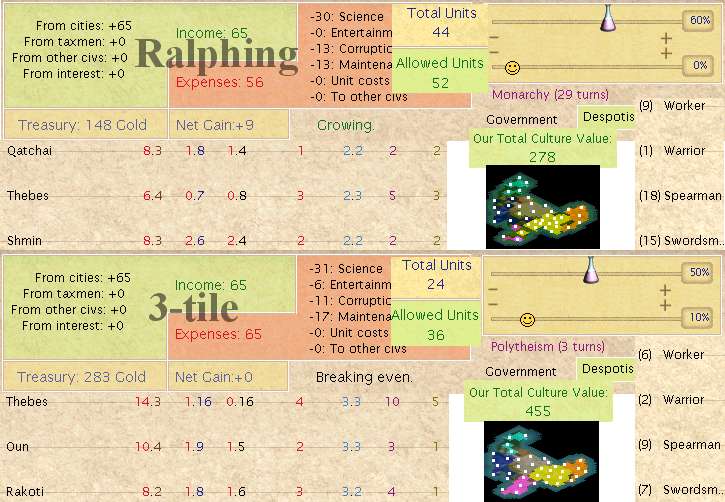
The screenshots are pretty self explanatory. You can see that the main difference in the two styles is that Ralphing gives you many more units and free units (at least in despotism and monarchy) while the income from the cities in both remains the same though Ralphing yeilded me 14 cities compared to 3-tile's nine. 3-Tile allowed larger cities and more production per city while Ralphing garnered slightly more overall production.
The 3 purple dots are the 3 highest producing which cities you are going to see in the follow up images comparing different advisors.
 Attachment: au201-3tile-775bc-tc64.jpg Attachment: au201-3tile-775bc-tc64.jpg
This has been downloaded 164 time(s).
|
|
| |
|
| |
All times are GMT. The time now is 05:26.
Apolyton Time is 00:26. |
top of page
|
| archivepost |
|
Forum Rules:
You may not post new threads
You may not post replies
You may not post attachments
You may not edit your posts
|
HTML code is ON
vB code is ON
Smilies are ON
[IMG] code is ON
|
|
|
|
|
|






 18-02-2003 06:20


 )
)


 |
|