 |

|
Bereta_Eder
|
|
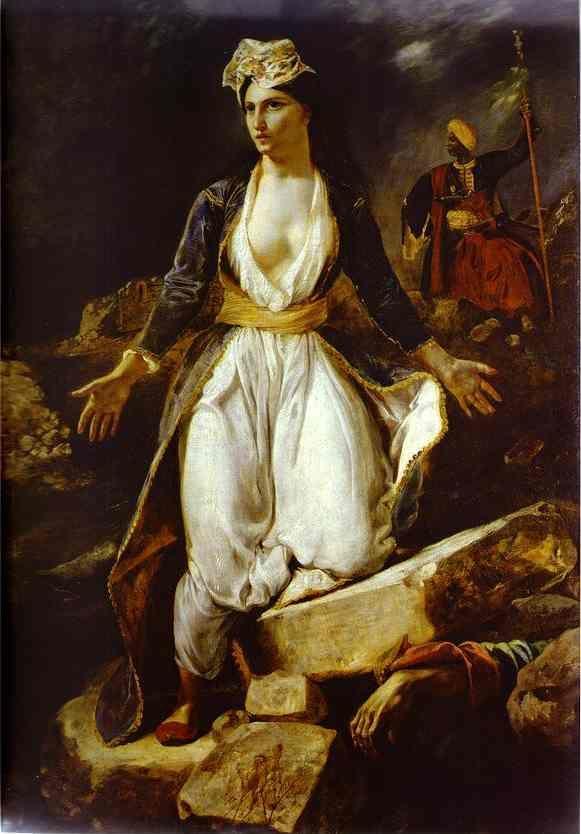
Greek flag= lines =the letters "freedom or death"
cross= cross
|
|
| |
|
|
|
Bereta_Eder
|
|
colours= sea, sky
pretty simple explanation.
you had christians fighting for freedom or death and there was blue sea and sky
|
|
| |
|
|
|
Bereta_Eder
|
|
Or lord byron (note that english didnt like the french back then too)
http://www.fordham.edu/halsall/mod/byron-greece.html
Trust not for freedom to the Franks---
They have a king who buys and sells:
In native swords and native ranks,
The only hope of courage dwells:
But Turkish force and Latin fraud
Would break your shield, however broad.
Fill high the bowl with Samian wine!
Our virgins dance beneath the shade---
I see their glorious black eyes shine;
But, gazing on each glowing maid,
My own the burning tear-drop laves,
To think such breasts must suckle slaves.
Place me on Sunium's marble steep---
Where nothing, save the waves and I,
May hear our mutual murmurs sweep:
There, swan-like, let me sing and die;
A land of slaves shall ne'er be mine---
Dash down yon cup of Samian wine!
|
|
| |
|
|
|
Alinestra Covelia
|
 |
I sense the dodgy presence of Bing - a presence I've not felt since...
Feb 2000
time: 00:28
|
|
quote:
Originally posted by DaShi
The Japanese flag is a JigglyPuff as seen from above. |

The British and American flags have already been discussed here, so I don't need to go over them. The only other country that I've lived in for a long time is China, so it makes sense to explain that.
The Chinese flag takes after the Communist color scheme of gold and red. Gold is said to represent the sweat of the workers' labor, red to symbolize the blood of their sacrifice.
The first modern flag of China, established during the period of time it spent as a Republic, featured five colors for the five major ethnic groups within China. It was different from the current one in that it ran along the red-white-blue theme, but the number five remains important.
The current flag also pays respect to this ethnic range - the five smaller gold stars represent each group. The large gold star in the corner represents the country as a whole.
As of the last census, the Chinese government identified 56 ethnic groups living within the Chinese borders. Of these, the Han majority constitutes maybe 90% of the population (the Han are also the most populous ethnicity in the world). Add the four next largest minorities, and you have 99% of the Chinese population accounted for.
If China's government decides to change the flag, for whatever reason, I think it might be good to represent all 56 ethnicities with a star. They all get seats in the National Party Congress, which means (at least in theory) they all have a representative in the government. But that will probably have to wait later when the political situation in China has developed further.

Last edited by Alinestra Covelia on 06-06-2003 at 20:35
|
|
| |
|
|
|
lightblue
|
|
L'Boro, UK
Oct 2001
time: 05:28
|
|
The Dutch national flag takes after the heraldry colours of William of Orange. The red used to be orange, but some kind of dye process meant that the orange turned red after time, and in the 18th century sometime we adopted red instead. Intersting little tidbit I just discovered is that the Dutch flag was the first maritime (which is where most of these flags come from originally, on land they fought under coats of arms) flag to incorporate the 3 horizontal bars. The former south african flag was "oranje-blanje-bleu" as a sign of descendency of the Boer from the Dutch.
If you want to go symbolic you could say that the blue represents the sea, the white the sky and the red/orange the royal family, although currently orange pennants are flown above the flag during the royal birthdays.
The Luxembourg flag is surprisingly not derived from the Dutch flag (it is the same aside from a lighter shade of blue), even though Luxembourg was part of Holland between 1815 and 1839 (I think). It is derived from the Grand Ducal coat of arms which consists of a red lion on a light blue and white horizontally striped background.
|
|
| |
|
| |
|
| |
|
| |
|
| |
|
|
|
South killer
|
|

Nobody really knows what the argentine flag colors were chosen for, but it is said that they represent the colours of the sky, simbolizing freedom.
The true fact is that the colours were first used when the Virreinato Del Rio De La Plata (vicerroyalty of the river plate) called a meeting to elect new authorities (the first argentinian authority, before independence). Two guys named French and Berutti (those where their surnames) started giving light-blued and white strips to argentinians attending the meeting, to diferenciate them from spaniards.
When independence war begun the revolutionary General Belgrano decided to use those colours on the national flag. Since then, the argentinian flag has been light-blued and white.
A lot of years later, the ''Sol De Mayo'' (Sun of May) was added. Nowadays, the flag with the sun is used in war and in all diplomatic events outside of Argentina, while the flag without the sun is used in not-very formal acts inside the country.
Last edited by South killer on 07-06-2003 at 08:21
|
|
| |
All times are GMT. The time now is 05:28.
Apolyton Time is 00:28. |
top of page
|
| archivepost |
|
Forum Rules:
You may not post new threads
You may not post replies
You may not post attachments
You may not edit your posts
|
HTML code is ON
vB code is ON
Smilies are ON
[IMG] code is ON
|
|
|
|
|
|






 06-06-2003 09:06




 not very creative. Try again.


 Seems a stretch that all of the majority muslim countries are on the rise at the same time.
  |
|