 |
| |
|

|
Meldor
|
|
Houston, Texas
Dec 2001
time: 23:29
|
|
quote:
Originally posted by Kidicious
I never said that jobs weren't created. I said that the umemployment rate is what matters. Another thing that matters is the inequality in income. |
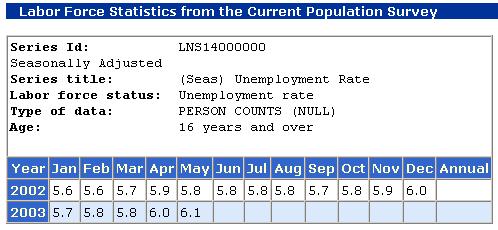
Okay, so jobs being created don't have anything to do with the unemplyment rate? Which btw, has been pretty much level over the last year (by the charts I have seen).
quote:
Originally posted by Kidicious
You're responsible for getting your own cites now since you decided to just pretend that I was making an argument that I wasn't making last time. Everyone knows that the weekly jobless claims have been over 400,000 for quite some time now. |
Let's put this one to bed. The 400,000 NEW claims level is considered normal. Anything above that is thought to be a "soft" market, and anything below that is considered good. For the week ended June 14th the figure was 356,000 adjusted, which is good. You treat this number like an indication of jobs being lost at that rate. The 400,000 level is just turn-over. The same amount get a job, the same amount lose a job. It should also be noted for fairness, that the lower rate seen for the current figures could also be a reflection of the bad weather being seen in the midwest and north-east. Less people tend to file if the weather is bad, go figure. They put it off until the weather is better.
quote:
Originally posted by Kidicious
You convenienly got confused again. I have no idea what you are talking about. I just explained the long term and short term trends. |
I'll leave this one to vel
|
|
| |
|
| |
|
|
|
Velociryx
|
 |
of Candle'Bre
Apr 1999
time: 05:29
|
|
Oh, and in case anybody is curious (since I know Kid won't voluntarily bring it up), the article lists five major contributors to mental retardation:
Genetic conditions, Problems during pregnancy, Problems at birth, Problems after birth, Poverty and cultural deprivation--listed last. I've not finished reading the article yet, but so far, there's no mention of which of these figures is the leading contributor (haven't seen any percentages yet), but of course, if you just look at Kid's post, you get the impression that the article says that poverty CAUSES mental retardation, which was exactly what he wanted.
Clearly, his own source does not say as much.
But I'm a shameless liar? (kid's words) 
-=Vel=-
|
|
| |
|
|
|
Meldor
|
|
Houston, Texas
Dec 2001
time: 23:29
|
|
Let me help you out Vel with some stuff from the National Center on Birth Defects and Developmental Disabilities, part of the CDC. They list the following common causes of Mental Retardation: quote:
Down syndrome, fetal alcohol syndrome, and fragile X syndrome, all of which occur before birth. |
And list other causes (uncommon) as: quote:
genetic conditions (such as Cri-du-chat syndrome or Prader-Willi syndrome), infections (such as congenital cytomegalovirus), or birth defects that affect the brain (such as hydrocephalus or cortical atrophy). Other causes of mental retardation (such as asphyxia) happen while a baby is being born or soon after birth. Still other causes of mental retardation do not happen until a child is older. These may include serious head injury, stroke, or certain infections such as meningitis. |
I didn't see either poverty or capitalism on that list.
|
|
| |
|
| |
|
|
|
Kidicious
|
 |
Diety of Kidiverse
Mar 2003
time: 21:29
|
|
quote:
Originally posted by Berzerker
And did that result in both a loss of jobs producing horse buggies and a gain in auto builders? |
Let's say hypothetically that we had to use the old technology and that there were people with the necessary skills who were unemployed. Yes, there would be net job creation.
Last edited by Kidicious on 26-06-2003 at 08:40
|
|
| |
|
| |
|
|
|
Berzerker
|
 |
topeka, kansas,USA
May 1999
time: 23:29
|
|
Kid - quote:
Let's say hypothetically that we had to use the old technology and that there were people with the necessary skills who were unemployed. Yes, there would be net job creation. |
Why use a hypothetical that requires no advances in technology? That's the whole point of productivity gains, they usually result from technological advances. I can't figure out the rest of your argument, can you re-phrase it?
quote:
I'm I right in assuming that you guys think that new technologies that create productivity gains require more labor to produce the same goods? |
No, there may be a loss in that specific field - buggy workers decline as autos are built - since the innovation may increase production using fewer workers (like the cotton gin), but the gains can create jobs in other areas. As autos replaced horse buggies, the innovation opened up new areas of employment. Mechanics, gas stations, road builders, etc., followed by every other industry ultimatly dependent on the innovation. There are more jobs in the world than 200 years ago and more people - who constitute a productivity gain of sorts - to fill them.
This happened because of innovation and the resulting productivity gains. If we didn't have the productivity gains, we couldn't feed 6 billion people...
|
|
| |
|
|
|
Kidicious
|
|
Diety of Kidiverse
Mar 2003
time: 21:29
|
|
quote:
Originally posted by Berzerker
Kid -
Why use a hypothetical that requires no advances in technology? That's the whole point of productivity gains, they usually result from technological advances. I can't figure out the rest of your argument, can you re-phrase it?
|
I did that because you can't compare the number of jobs back then to the number of jobs today. I didn't want you to get confused.
Ok, let's compare the labor required to transport goods back then to the labor to transport the same amount of goods today. Today the same amount of labor can transport more goods. Is that clearer?
quote:
Originally posted by Berzerker
No, there may be a loss in that specific field - buggy workers decline as autos are built - since the innovation may increase production using fewer workers (like the cotton gin), but the gains can create jobs in other areas. As autos replaced horse buggies, the innovation opened up new areas of employment. Mechanics, gas stations, road builders, etc., followed by every other industry ultimatly dependent on the innovation. There are more jobs in the world than 200 years ago and more people - who constitute a productivity gain of sorts - to fill them.
This happened because of innovation and the resulting productivity gains. If we didn't have the productivity gains, we couldn't feed 6 billion people... |
We can't complicate matters with demand for goods that provide utility for consumers. That's not a productivity gain. The automobile does both, provides more utility than horse power and is more productive than horse power. If we look at just the productivity gains, we see that there are less jobs required to, for example transport the same amount of people and goods, even with the gas stations and roads. If that weren't true then the automobile would not be a true productivity gain.
Now I'm not sure if your trying to make this point, but the automobile is also a consumer product that has replaced horses. It also requires more labor than horses. People want cars more even though they cost more because they get more utility. So if you take the automobile as both a productivity gain and a new consumer product yes it did create more jobs. Well maybe, I'm not sure about that. There may have been a study done, but I'm not aware of it.
|
|
| |
|
|
|
Kidicious
|
|
Diety of Kidiverse
Mar 2003
time: 21:29
|
|
Since we're on the subject of productivity improvements and consumer spending, consumer spending is independent of productivity improvements. There is no tendecy for new consumer goods and services to be introduced to the market at the same time as the productivity improvements to clear the labor market. That is the cause of depressions.
In the case of the automobile it created productivity gains and increased consumer spending. Unfortunately Henry Ford began building more cars than could be afforded or desired in the market. That's when capitalism takes a big hit, a period where no new spending is occuring and productivity gains are cutting into employment.
edit: typos
Last edited by Kidicious on 26-06-2003 at 11:25
|
|
| |
|
|
|
Berzerker
|
|
topeka, kansas,USA
May 1999
time: 23:29
|
|
Kid - quote:
We can't complicate matters with demand for goods that provide utility for consumers. That's not a productivity gain. |
Producing more food (with less labor) is not a productivity gain?
I'm not sure why utility matters...
quote:
The automobile does both, provides more utility than horse power and is more productive than horse power. |
And thanks to the automobile, we produce more food which creates jobs in all sorts of areas. But no doubt buggy makers lost business and employees.
quote:
If we look at just the productivity gains, we see that there are less jobs required to, for example transport the same amount of people and goods, even with the gas stations and roads. If that weren't true then the automobile would not be a true productivity gain. |
But you're ignoring that a productivity gain opens other avenues for employment thereby expanding the economy.
Yes, we could move more goods with less labor because of the automobile, but that frees up people for those new avenues of employment jobs.
quote:
Now I'm not sure if your trying to make this point, but the automobile is also a consumer product that has replaced horses. It also requires more labor than horses. People want cars more even though they cost more because they get more utility. So if you take the automobile as both a productivity gain and a new consumer product yes it did create more jobs. Well maybe, I'm not sure about that. There may have been a study done, but I'm not aware of it. |
A productivity gain is kind of irrelevant without demand for the product realised by the gain. C'mon Kid, how many jobs existed 200 years ago? And how many exist today? What allowed for the difference? Production gains, including larger populations...
|
|
| |
|
| |
All times are GMT. The time now is 05:29.
Apolyton Time is 00:29. |
top of page
|
| archivepost |
|
Forum Rules:
You may not post new threads
You may not post replies
You may not post attachments
You may not edit your posts
|
HTML code is ON
vB code is ON
Smilies are ON
[IMG] code is ON
|
|
|
|
|
|





 25-06-2003 20:43



 Rock on, Meldor, and thank ya!


 |
|