 |
| |
|

|
Albert Speer
|
|
Puerile Polemic
Mar 1999
time: 00:29
|
|
quote:
These communication difficulties occur at every scale, local regional and continental, making trade impracticible for all but the most valubable items. Thus ideas from other places as well as many scarce materials remained where they were. |
i have one of those history atlases that shows clearly the dramatic change in the african populations in ancient times, showing there must have been mass migrations and contact between all of africa... not on the scale of central asia but still significant... i'll try to find a map online but i'll briefly describe some population changes.
Africa south of the Kongo but also including east africa in 2000 BC was made up of Khoisan speaking peoples. the linguistic group in the Kongo is not known by historians but probably was not Niger-Kordofanian/Bantu. The Sudan, Chad, and Niger were of the Nilo-Saharan language group. The Bantu existed only along a region in west africa from roughly Nigeria to Liberia.
By 1000 AD, however, the Khoisan group was reduces to mainly the Nama and Ikung peoples in southwest africa while the Bantu filled up west africa, the kongo, and bantu peoples like the Xhosa and Shona were in south africa.
so the point is, there was plenty of migrations and contact between all of sub-saharan africa...
and yes, i now realize that the philly public school system was probably exaggerating the glories of sub-saharan africa. nevertheless, it was more advanced than i think people here are thinking
thanks
|
|
| |
|
| |
|
|
|
Inverse Icarus
|
 |
flying too low to the ground
May 2001
time: 00:29
|
|
quote:
Originally posted by Ecthelion
*insert UberKrux style reply here*
 @ Krux @ Krux  |
man, i wish i had more time to post here on poly. hard with 2 jobs and, you know, sleep.
anyway, not to disappoint you:
it all went bad when the great nations and Ghana of Nubia adopted a welfare program. Pretty much the rest of the continent didn't see any reason to produce anything, saw no reason to enhanse the society at all. they just signed up at their local Nubian/Ghanaian welfare office, and let the gold and salt come to them.
After a long time of doing this, Ghana and Nubia inevitably collapsed, while the "breeder" african class grew too large for the actual working class to support. when the "breeders" realized they were not getting their welfare goods, they rose up and killed all of the working class. With the entire working class dead, the surviving Africans now had a genetic predisposition to laziness, welfare scamming, and flat out leeching off society.
NEXT WEEK! GANGSTA CULTURE!
(edit: off to work! fun fun fun!)
Last edited by Inverse Icarus on 28-07-2003 at 15:40
|
|
| |
|
|
|
DAVOUT
|
 |
AUERSTADT
Jun 2002
time: 05:29
|
|
Isolation, diseases, absence of competition from invaders, lack of writing, all these reasons together, and possibly more, can explain that Africa did not enter the technology age. But they do not explain why, after the decolonisation where they have largely disappeared, it is so difficult (and is seems even impossible) for the African nations to enter the cycle of development.
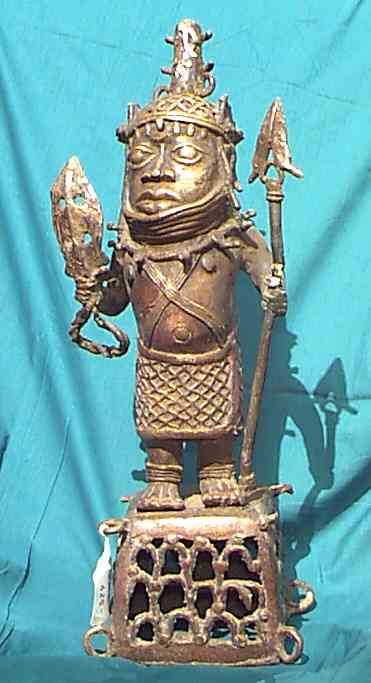
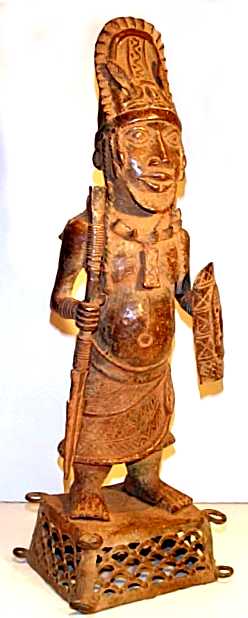
All those who have been in school with black African students know that their abilities are not the problem. They possibly express more easily talents in literature and associated fields, but this is obviously expected from children who grown up in the total absence of science and technology. But they have also displayed immense talents in arts, and they have to-day fabulous sculptors.
One of the reasons still explaining this situation could be due to the extended family structure and internal rules which demands for any member to care for all others. Individual wise men cannot emerge from the family (unless by virtue of seniority when they are very old), because that would imply that they studied alone, and being alone is not allowed. For the same reason, reading is difficult and not appreciated by the family because it cut you from the others. Can you imagine what would be your attitude regarding science and technology if your family had consistently forbidden you to read?
During the last forty years, all development plans have failed; it looks like African only utilizes those artefacts that make the situation worse : medicine which increases overpopulations, firearms for African wars, or tribal wars (which unfortunately did not put an end to entire genocides committed with machetes), income from natural resources generating elite corruption.
The analysis of the African problem has yet to be done, and there is not much to expect from spectacular actions addressing specific points.
|
|
| |
|
|
|
Albert Speer
|
|
Puerile Polemic
Mar 1999
time: 00:29
|
|
Davout:
Isolation?
didn't i just say that the ethnic groups in africa changed constantly due to massive migrations? How did the Bantu go from Nigeria to south africa if there was no contact between african groups?
quote:
They were no African merchants, soldiers and explorers visiting the rest of the known world, which resulted in an almost inexistant acquisition of knoledge from abroad. |
There is that famous story of Mansa Musa and his massive pilgrimage to Mekka... and the cities of Timbuktu and Jenne attracted scholars from various parts of the world.
|
|
| |
|
|
|
KrazyHorse
|
 |
Macedonia
May 2001
time: 00:29
|
|
quote:
Originally posted by Albert Speer
During my vacation, I've taken a little bit of interest for the precolonial European empires such as the English/French/Germans, the Romans and the Swedes. (Mind you, I didn't put enough energy into it to actually buy books )
I am not talking about Alexander's Greece here, but about European Civs.
Argguably save for the Swedes, these empires took most of their 'civilised' traits (technology, weaponry, political structure) from the Greeks or other influential mediterranean powers. Even Rome owes its success to its Greek-influenced political structure.
Besides, they almost systematically got their butt spanked by non-European countries or tribes. Heck, even Rome the golden Capitol was unable to defend itself from nomadic raiders.
Europeans developed their way to the top of the food chain, and had dropped nomadism for a very long time, without any influence from the outside. Ethnic wars were many, yet the Europeans barely developped tech / efficient political structures by themselves. |
This would be a good reply, except that it's just plain wrong on a number of counts.
|
|
| |
|
|
|
C0ckney
|
|
Big Up The Macedonian Massive
Apr 2000
time: 05:29
|
|
quote:
Originally posted by Spiffor
Is that the one where this king spent 18 tons of gold during his pilgrimage, devaluating gold in the whole Arab world for years ? |
yes, the price of gold in egypt didn't recover for 50 years.
but to respond to what albert said, so what? some king made a pilgrimage and spent a lot of money. there wasn't any continuious contact between egypt and west africa, people from west africe didn't travel there, or even to the margreb, the trade was in the hands of arabs and berbers. so there was hardly anyone who saw the arab world from west africa and could take some of its ideas back with them.
|
|
| |
|
|
|
Spiffor
|
 |
CPA - Evil Clone brigade
Nov 2001
time: 06:29
|
|
quote:
Originally posted by MrFun
If they received foreign merchants and diplomats, and from them, obtained maps of other areas of the world and conducted regular trade and foreign relations, I cannot see how they were isolated. |
The Niger Delta Kingdoms were less isolated than, say, Tokugawa's Japan, but trade was still difficult with the Arabs, because of the desert and because of the Berber raiders. Despite the presence of a few Arab scholars in Timbuktu and Jenné, these cities remained pretty much mysterious to the Arabs (and legendary to the Europeans). Quite a few places in Africa weren't isolated, that's for sure, but they weren't connected with the rest of the world as densely as Mediterranean or European powers.
Timbuktu managed to be an important religious center for west and northwest Africa in general, but it doesn't seem to have played any part in science. Worse, I didn't even find anything about a betterment of agriculture, weaponry or writing under the Niger Delta kingdoms. I'm still puzzled as to why.
|
|
| |
|
|
|
Albert Speer
|
|
Puerile Polemic
Mar 1999
time: 00:29
|
|
yeah i don't think any african 'primitiveness' (which i think people here are under-estimating african advancements) is due to isolation... like i said, african peoples had plenty of contact with each other and clearly the northern areas of west africa (mali, songhai, hausa, etc.) did have contact with the rest of the world albeit the sahara was a barrier.
and what about east africa? Sure Ethiopia had nearly no contact with the Christian world (aside from Byzantium) until the crusades but it had plenty of contact with the arabs... and down the coast, the somali and swahili all the way down to Mombasa and Zanzibar had plenty of contact with the arab world (the swahili language is even based on arabic).
so african isolation might explain some slight backwardness in possibly Zimbabwe and the Kongo kingdom but the Sudan down to Zanzibar and west africa south til Benin had contact with the middle eastern world for centuries.
|
|
| |
|
|
|
Heresson
|
 |
of frogs
Jun 2000
time: 06:29
|
|
quote:
Originally posted by C0ckney
and i agree with az here, ethiopia owes almost nothing to arabs, in fact its isolation (and some timely portuguese aid) is really what kept it alive as a state. |
In fact, Axum, first Aethiopian, culture, was founded by south-Arabian emmigrants.
quote:
The person who made their alphabet was the same who wrote the Georgian and Armenian one. probably some Orthodox monk.
|
Not quite.
I remember that Armenian alphabet was invented by Mesrop Masztoc, somewhere in V century, and the Georgian one was based on it I think. When it comes to Aethiopian one, I don't know much about it, perhaps it is based on Syrian one, but I saw it and it didn't look familiar at all. Still, it had nothing to do with Georgian and Armenian one.
quote:
Europe has dominated the ME for a thousand years, from Alexander to the rise of the muslims.
|
But haven't ME dominated Europe? Christianity is a ME religion. The greatest culture of Europe in Middle Ages, Byzantines, owed as much to Syria and Egypt as to Roman tradition.
quote:
Africa has a relatively short coastline, despite being the second largest continent. Most of the African nations, if I remember correctly, were some distance inland, and they did most of their trade by camel over the Sahara.
|
Camels weren't introduced to Africa earlier than in Roman times., that's what I've learned. But tell me, when the sub-saharean cultures started to appear? in fact, I'm ignorant in this subject... Can anyone gimme a history of sub-saharean Africa, outline of it?
generally, I like the thought of the coastline importance...
But shouldn't be Indonesia or Oceania the most developed land in the world, then?
quote:
even the mighty Romans couldn't even beat off the Huns
|
I do not recall any Hun empire on former Roman territories
quote:
*cough* *cough* Mongols, Huns, Turks, Avars.
|
Mongols and Turks weren't all that backwards. Turkey managed to continue Byzantine architecture tradition,
on a scale Byzantines weren't able to deal with since Justinian (of course, thanks to the aboundance of money and local, Greek, architects). Their administration was more efficient
Mongols weren't a completely wild tribe either. Thanks to christian contacts, they had their own alphabet. they had some respect towards science and trade. Anyway, Avar, Hun and to a smaller extent, Mongol empires were pretty short-lasting, and they dominated only in military area, and not even there;
Mongols were repeatedly defeated by Mamluks, who were Turk in fact at the time, Avars weren't such a great empire, and anyway, they were quite easily defeated by Byzantines and later Franks occasionally. Huns received a great defeat from the Romans also.
What I mean to say is that Europe dominated in many ways. Mongols, Huns and Avars never had (at least good) fleet by the way. Europe in XIX century, when Africa was finally divided, dominated over all the rest of the world in any way.
quote:
For a very long time Egypt accounted for the majority of the population of the continent of Africa
...
|
But Egypt has little to do with Africa... It isn't black, it is separated from the rest except for Nile, and I even read that some ancent geographs were counting it into Asia. This suprised me a bit.
|
|
| |
|
|
|
C0ckney
|
|
Big Up The Macedonian Massive
Apr 2000
time: 05:29
|
|
east african kingdoms (the ones on the coast at any rate) were run by an arab elite, the arabs ran the caravans into the interior, the only way people from the interior got out was by becoming slaves or mercenaries and they didn't come back.
ethopia was incredibily isolationalist, most of its contact with arabs and other muslims was simply fighting wars with them. in fact the fall of the christian kingdoms of nubia in the 15th century can partly be put down to ethopia's refusal to help them, or even to send missionaries to sustain the faith of the people.
|
|
| |
All times are GMT. The time now is 05:29.
Apolyton Time is 00:29. |
top of page
|
| archivepost |
|
Forum Rules:
You may not post new threads
You may not post replies
You may not post attachments
You may not edit your posts
|
HTML code is ON
vB code is ON
Smilies are ON
[IMG] code is ON
|
|
|
|
|
|





 28-07-2003 11:29










 |
|