Apolyton Archive  |  Preserved copy of the Apolyton Civilization Site and its forums as they stood in September 2005. Read-only; nothing here can be posted to or replied to.  |  Forum index |  About this archive |  The 1998–2001 UBB forums
Today on Apolyton WARDELL INTERVIEW PROMO A.C.S. HISTORY CHAPTER 4 GET CIV4 /w FREE PLUS! A.C.S. PHOTO GALLERY GET A.O.M. V1.1
Apolyton Civilization Forums
main| civ2| civ3| civ4| smac| ctp2| ron| moo3| galciv| galciv2| alt| about|
ApolytonPLUS | register | search | faq | new posts | pm (-/-) | upload | members
hall of fame new! | civgroups | civgroups news | interviews | the column | radio | chat | directory | news | store | PLUS
Apolyton Civilization Forums : Powered by vBulletin version 2.0.3 Apolyton Civilization Forums > Miscellaneous > Archive > Off-Topic-Archive > Poly math geniuses--Jules needs your help!
Show a Printable Version | Email This Page to Someone! | Receive updates to this thread | Report this to Apolyton news!

bottom of page
  
Author
Thread   
Pages (2): [ 1   2   ]
< Last Thread     Next Thread > Post New Thread     Post A Reply
Jules is offline Jules
Chieftain
Chairman & CEO, Dallas Oil Company
Jul 2001
time: 00:31
  Old Post 05-11-2003 00:06 Visit Jules's homepage!
Edit/Delete Message Reply w/Quote
#1 Report this post to a moderator
Poly math geniuses--Jules needs your help! Enter the AD-FREE zone

The problem below is excerpted from "Money is Memory" by Narayana Kocherlakota (Journal of Economic Theory 81, 232-251, 1998).

"Consider a world with an infinite number of trading posts located at the integer points along the real line. In period 1 and in every period thereafter, at each trading post there are J "stayers" and J "movers." At the end of each period t, the movers move 2^(t-1) trading posts to the right; the stayers stay at their current trading posts....

Suppose the matching process pairs stayer j with mover j at each trading post. Consider the mover j who started life at trading post 0; in period t, he arrives at trading post 2^(t-1) - 1. It is tedious but simple to show that for this agent, the set of trading histories (Qt) [I will explain] contains all stayers and movers labled j who begin life at posts {0, 1, ..., 2^(t-1) - 1}. At the same time, the set Qt for mover j at trading post (2^t - 1) contains all stayers and movers labelled j who began life at posts {2^(t-1), ..., 2^t - 1}."

Now some remarks about Qt, the set of trading histories. Qt consists of mover j himself and his trading partners in period t, all of their trading partners in period (t-1), all of those people's trading partners in (t-2), and so on.

So for example, if mover j begins at trading post 0, in t=5 he arrives at trading post 15 (0-->1-->3-->7-->15). Remember that the mover is matched with a stayer at each trading post. So his trading partners at t=5 includes the stayers at 0, 1, 3, 7, and 15. But the set Qt also contains their trading partners at period t=4. For instance, the stayer at trading post 15 had trading partners who were movers who began life at trading posts 8, 12, 14, and 15. At t=3, each of these movers had trading partners who were stayers. And so on until you work all the way back to t=1. You should then find that Qt for mover j contains all movers and stayers who begin life at posts {0, 1, 2, 3, ..., 15}.

Now Kocherlakota may think it is simple to show this in general for any t, but this is where I need some help.

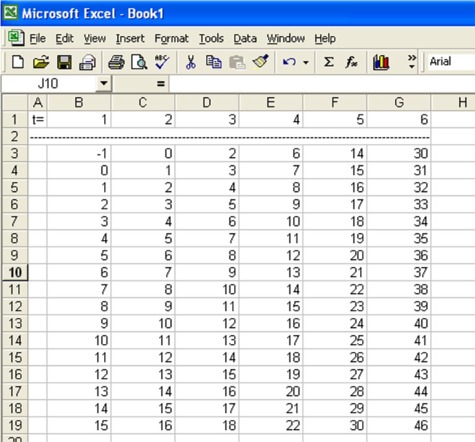
Attachment: kocherlakota.jpg
This has been downloaded 131 time(s).

JohnT is offline JohnT

Emperor
Capitalist
Mar 1999
time: 00:31
  Old Post 05-11-2003 00:09
Edit/Delete Message Reply w/Quote
#2 Report this post to a moderator
Tired of ads?

I think the only "official" Polymath genius on these boards is MtG.

Japher is offline Japher
Prince
Ook! Ook! Ack! Ack! Ack!
Jun 2002
time: 05:31
  Old Post 05-11-2003 03:19
Edit/Delete Message Reply w/Quote
#3 Report this post to a moderator
Support Apolyton buy from Amazon

quote:
Consider the mover j who started life at trading post 0; in period t, he arrives at trading post 2^(t-1) - 1


I don't think that equation is right for the position of the mover j. With that you get that j's current position would be p(t)=2^(t-1)+(p-1); where p(t) is position at time t and p is position at time=0. With that you get that at t=0, p(t=0)=-p-0.5 where it should be p(t=0)=p...

Yet, I graphed the position versus the step increase and fitted a line with an R value of 1 to it and got

y=2x-(p-1) or p(t)=2m-(p-1)

or p(t)-p=2m+1 where m=2^(t-1)

really just 2*(2^(t-1))-1 for j who started at 0

I don't really know what you are trying to prove, but I just thought I would point that out.

Jules is offline Jules
Chieftain
Chairman & CEO, Dallas Oil Company
Jul 2001
time: 00:31
  Old Post 05-11-2003 04:23 Visit Jules's homepage!
Edit/Delete Message Reply w/Quote
#4 Report this post to a moderator
Support Apolyton, buy Civilization: The Boardgame

quote:
Originally posted by Japher
I don't think that equation is right for the position of the mover j. With that you get that j's current position would be p(t)=2^(t-1)+(p-1); where p(t) is position at time t and p is position at time=0. With that you get that at t=0, p(t=0)=-p-0.5 where it should be p(t=0)=p...


Ahh, I see where you're confused. There is no t=0. The game is assumed to start at t=1; nothing exists before that. So t can be all the integers strictly greater than zero. The Excel table I posted was for the purposes of assisting people with the numerical example I gave: suppose mover j begins life at trading post zero (t=1)and we forward to period t=5. Sorry I didn't explain it earlier, but I had to rush to class. The row above the dotted line marks the time periods (in this case t = 1, 2, 3, 4, 5, 6). Below each time period is just a segment of trading post positions (which will hypothetically extend all the way back to negative infinity and all the way forward to positive infinity). So the example we have is mover j is at TP zero at t=1 (go down the t=1 column to find zero). At the end of t=1, mover j moves 2^(1-1) = 1 TPs to the right and ends up at TP one at the beginning of period t=2, 2^(2-1) - 1 = 1 (move to the cell directly to the right). Then at the end of t=2, j moves 2^(2-1) = 2 TPs to the right and is at TP three at the beginning of t=3, 2^(3-1) - 1 = 3. And so on until at t=6, j arrives at TP 31.

btw, I quoted this directly out of a published paper, so the formula better be right. It would be rather embarrassing to both the author and the Journal of Economic Theory if there was a mistake.

Japher is offline Japher
Prince
Ook! Ook! Ack! Ack! Ack!
Jun 2002
time: 05:31
  Old Post 05-11-2003 04:49
Edit/Delete Message Reply w/Quote
#5 Report this post to a moderator
Full PM-box? Change here!

quote:
You should then find that Qt for mover j contains all movers and stayers who begin life at posts


I don't think I understand the pairing. Let me see if I do..

A mover from TP 0 moves to TP 31 via the equation 2^(t-1)... This gives the intervals at which he moves the 1, 2, 4, 8, etc... thus getting to posts 1, 3, 7, 15, etc... At each post he makes a connection [Q(t)] with the stayer, the stayer has connections will all the subsequent movers that have "visited" this stayer. Since the stayer has connections with these other movers this gives the current mover a connection with those stayers...

I.e. Bob starts at 0 goes to 1 where he meets Greg. Greg has just got done visiting with Henry who, at t=1, went to 2 (because of the equation). Now, Bob has a connection with Greg who has a connection with Henry thus Bob has a connection with Henry and Greg... This continues.

Eventually, when Bob gets to post 31 he will have had a connection with everyone from post 1-31 whether they are direct connections or indirect... Correct?

If so then to include the stayer at TP 0 you would have to start at t=0... Right? Also, this produce an exponential number of connections which is intuitively right. Though that really gets you know where.

I read some of Kocherlakota stuff today, and I don't understand it, I am no economist.

Japher is offline Japher
Prince
Ook! Ook! Ack! Ack! Ack!
Jun 2002
time: 05:31
  Old Post 05-11-2003 05:19
Edit/Delete Message Reply w/Quote
#6 Report this post to a moderator
Inflate your Upload Space

edit: gibberish

Jules is offline Jules
Chieftain
Chairman & CEO, Dallas Oil Company
Jul 2001
time: 00:31
  Old Post 05-11-2003 05:21 Visit Jules's homepage!
Edit/Delete Message Reply w/Quote
#7 Report this post to a moderator
Support Apolyton, buy Civilization 2

quote:
Originally posted by Japher
I don't really know what you are trying to prove, but I just thought I would point that out.

And now the punchline....

"Good thing I didn't tell them about the horny economist--!"

No, wait!


The purpose of this paper is to provide a logic for the essentiality of money in conducting transactions. Why do we need this tangible thing called money if it's possible to keep a perfect record of all a person's transactions, on a computer say? So when you receive income, the computer will just credit your account and when you purchase goods your account will automatically be debited and the appropriate seller credited. And the computer will do this over your entire lifetime and for all agents you transact with, directly or indirectly.

One possibility is that in the real world we don't have this kind of perfect recordkeeping device, so agents may be hesitant to enter into commitments. Hence the existence of tangible money may be welfare improving. This motivates the title of the paper, "Money is Memory." The author shows that under certain assumptions, the existence of money produces the same outcome as when there exists perfect memory.

The trading post game I described above is one possible application of a general framework which the author goes on to describe. One crucial assumption we need is that the agent has no direct or indirect information about his future trading partners. So for the exercise, we are supposed to show why we need this odd 2^(t-1) movement rule in order to satisfy the above assumption.

So I need to show that for mover j who begins the game at TP zero, at any time t his set Qt of all direct and indirect trading partners is all movers and stayers who begin at TPs {0, 1, ..., 2^(t-1) - 1}. Also at time t there is a mover at TP (2^t - 1), which is where our mover j is going to be at time (t + 1), whose set Qt consists of all movers and stayers who begin life at TPs {2^(t-1), ..., 2^t - 1}. Notice that the intersection of these two sets is empty, which implies that the assumption is satisfied: at any time t, mover j has no direct or indirect information about his future trading partners.

Sorry I didn't explain any of this earlier, but I was a bit rushed.

Japher is offline Japher
Prince
Ook! Ook! Ack! Ack! Ack!
Jun 2002
time: 05:31
  Old Post 05-11-2003 05:21
Edit/Delete Message Reply w/Quote
#8 Report this post to a moderator
Support Apolyton buy from Amazon

edit: more gibberish

Jules is offline Jules
Chieftain
Chairman & CEO, Dallas Oil Company
Jul 2001
time: 00:31
  Old Post 05-11-2003 05:29 Visit Jules's homepage!
Edit/Delete Message Reply w/Quote
#9 Report this post to a moderator
Support Apolyton, buy Alpha Centauri

quote:
Originally posted by Japher
I don't think I understand the pairing. Let me see if I do..

A mover from TP 0 moves to TP 31 via the equation 2^(t-1)... This gives the intervals at which he moves the 1, 2, 4, 8, etc... thus getting to posts 1, 3, 7, 15, etc... At each post he makes a connection [Q(t)] with the stayer, the stayer has connections will all the subsequent movers that have "visited" this stayer. Since the stayer has connections with these other movers this gives the current mover a connection with those stayers...

I.e. Bob starts at 0 goes to 1 where he meets Greg. Greg has just got done visiting with Henry who, at t=1, went to 2 (because of the equation). Now, Bob has a connection with Greg who has a connection with Henry thus Bob has a connection with Henry and Greg... This continues.

Eventually, when Bob gets to post 31 he will have had a connection with everyone from post 1-31 whether they are direct connections or indirect... Correct?

Yes. You've got it right.


quote:
If so then to include the stayer at TP 0 you would have to start at t=0... Right?

No, because the set Qt also includes the person you meet today. So at t=1, mover j at TP 0 is matched with a stayer at TP 0.

Urban Ranger is offline Urban Ranger
Apolyton Duke of Off-Topic

Donate to the Red Cross
The City State of Noosphere, CPA special envoy
May 1999
time: 13:31
  Old Post 05-11-2003 21:43
Edit/Delete Message Reply w/Quote
#10 Report this post to a moderator
Avatar Enlargement: We've got the solution

quote:
Originally posted by JohnT
I think the only "official" Polymath genius on these boards is MtG.


What about Chowlett, the math major at Cambridge, or the physicists?

Urban Ranger is offline Urban Ranger
Apolyton Duke of Off-Topic

Donate to the Red Cross
The City State of Noosphere, CPA special envoy
May 1999
time: 13:31
  Old Post 05-11-2003 21:48
Edit/Delete Message Reply w/Quote
#11 Report this post to a moderator
Re: Poly math geniuses--Jules needs your help! Support Apolyton buy from Amazon

quote:
Originally posted by Jules
Consider the mover j who started life at trading post 0; in period t, he arrives at trading post 2^(t-1) - 1.


That doesn't seem right.

As t starts at 1, 2^(t-1) would be the series 1, 2, 4, 8, ...

So, trader j should arrive at post 2^(t-1) + t0 -1 at time t, which would be post 1 at t=1.

Edit: fixed equation

Last edited by Urban Ranger on 05-11-2003 at 22:54

Japher is offline Japher
Prince
Ook! Ook! Ack! Ack! Ack!
Jun 2002
time: 05:31
  Old Post 05-11-2003 22:04
Edit/Delete Message Reply w/Quote
#12 Report this post to a moderator
Support Apolyton buy from Amazon

Yeah, I find this confussing as for j to move from t=1 to t=2 you move 2^(1-1) not 2^(2-1), or they move at the t they WERE at not the t the ARE at.

t=1, j=0

to get to t=2, j moves 2^(1-1)=1, to 2 => t=2, j=1

to get to t=3, j moves 2^(2-1)=2, to 3 => t=3, j=3

to get to t=4, j moves 2^(3-1)=4, to 7 => t=4, j=7

.
.
.

which is not how most people write an equation (maybe this is how they do it in economics?).

JohnT is offline JohnT

Emperor
Capitalist
Mar 1999
time: 00:31
  Old Post 05-11-2003 22:07
Edit/Delete Message Reply w/Quote
#13 Report this post to a moderator
Support Apolyton, pre-order Civilization IV

quote:
Originally posted by Urban Ranger


What about Chowlett, the math major at Cambridge, or the physicists?


The fact that you felt you had to specify what field they are knowledgable in automatically disqualifies them from Polymath status. Good going, UR!

KrazyHorse is offline KrazyHorse
King
Macedonia
May 2001
time: 00:31
  Old Post 05-11-2003 23:58 Visit KrazyHorse's homepage!
Edit/Delete Message Reply w/Quote
#14 Report this post to a moderator
Support Apolyton buy from Amazon

Proof is by a ridiculously simple induction.

JohnT is offline JohnT

Emperor
Capitalist
Mar 1999
time: 00:31
  Old Post 06-11-2003 00:02
Edit/Delete Message Reply w/Quote
#15 Report this post to a moderator
Support Apolyton, buy Galactic Civilizations

Proof by definition.

KrazyHorse is offline KrazyHorse
King
Macedonia
May 2001
time: 00:31
  Old Post 06-11-2003 00:11 Visit KrazyHorse's homepage!
Edit/Delete Message Reply w/Quote
#16 Report this post to a moderator
Support Apolyton, buy Civilization III: Complete

Duh. Did you think nobody else was getting the pun?

KrazyHorse is offline KrazyHorse
King
Macedonia
May 2001
time: 00:31
  Old Post 06-11-2003 00:12 Visit KrazyHorse's homepage!
Edit/Delete Message Reply w/Quote
#17 Report this post to a moderator
Put an end to popups!

I did enjoy how you got UR, though...

JohnT is offline JohnT

Emperor
Capitalist
Mar 1999
time: 00:31
  Old Post 06-11-2003 00:28
Edit/Delete Message Reply w/Quote
#18 Report this post to a moderator
Browse Apolyton AD-FREE

quote:
Originally posted by KrazyHorse
Duh. Did you think nobody else was getting the pun?


Perhaps I misunderstood what you were saying/to whom you were saying it to in the post above mine. My apologies.

KrazyHorse is offline KrazyHorse
King
Macedonia
May 2001
time: 00:31
  Old Post 06-11-2003 00:31 Visit KrazyHorse's homepage!
Edit/Delete Message Reply w/Quote
#19 Report this post to a moderator
Support Apolyton

I was answering the original question. I skimmed over the UR/you banter...

JohnT is offline JohnT

Emperor
Capitalist
Mar 1999
time: 00:31
  Old Post 06-11-2003 00:33
Edit/Delete Message Reply w/Quote
#20 Report this post to a moderator
Support Apolyton

Oh, I just ignored all that math stuff in my attempt to fill this thread with some tasty spam.

Urban Ranger is offline Urban Ranger
Apolyton Duke of Off-Topic

Donate to the Red Cross
The City State of Noosphere, CPA special envoy
May 1999
time: 13:31
  Old Post 06-11-2003 10:07
Edit/Delete Message Reply w/Quote
#21 Report this post to a moderator
Support Apolyton buy from Amazon

quote:
Originally posted by JohnT


The fact that you felt you had to specify what field they are knowledgable in automatically disqualifies them from Polymath status. Good going, UR!


Yeah, but an expert at polymath is not what you think it meant. So there

Jules is offline Jules
Chieftain
Chairman & CEO, Dallas Oil Company
Jul 2001
time: 00:31
  Old Post 06-11-2003 11:18 Visit Jules's homepage!
Edit/Delete Message Reply w/Quote
#22 Report this post to a moderator
Browse Apolyton AD-FREE

quote:
Originally posted by JohnT
Oh, I just ignored all that math stuff in my attempt to fill this thread with some tasty spam.

I thank you for keeping the thread bumped at least.

*Jules drops the 50-ton weight on JohnT*


But unfortunately I'm no closer to solving the problem.

KrazyHorse is offline KrazyHorse
King
Macedonia
May 2001
time: 00:31
  Old Post 06-11-2003 20:15 Visit KrazyHorse's homepage!
Edit/Delete Message Reply w/Quote
#23 Report this post to a moderator
Get a bigger avatar today!

Use ****ing induction like I told you to.

Assume it's true for the t case and use to prove for t+1

The only trickey thing to realize is that your inductive hypothesis for the stayer has to take into account that the movers he's seen started life at 2^(t-1) and beyond

After that it's simply a matter of the union of two sets.

You've covered proofs by induction, right?

Urban Ranger is offline Urban Ranger
Apolyton Duke of Off-Topic

Donate to the Red Cross
The City State of Noosphere, CPA special envoy
May 1999
time: 13:31
  Old Post 06-11-2003 20:23
Edit/Delete Message Reply w/Quote
#24 Report this post to a moderator
Support Apolyton, buy Civilization: The Boardgame

I think he is having problems with the non-trivial case.

KrazyHorse is offline KrazyHorse
King
Macedonia
May 2001
time: 00:31
  Old Post 06-11-2003 21:21 Visit KrazyHorse's homepage!
Edit/Delete Message Reply w/Quote
#25 Report this post to a moderator
Full PM-box? Change here!

Which non-trivial case? There is none. The trading histories are obvious for all t due to the nice property that the sum of 2^n from n=0 to t is equal to 2^(t+1)-1

If the number of steps moved was not 2^(t-1) but was instead some other power then it would be slightly trickier. If it was a more complicated function of t then it would border on the unsolvable.

Urban Ranger is offline Urban Ranger
Apolyton Duke of Off-Topic

Donate to the Red Cross
The City State of Noosphere, CPA special envoy
May 1999
time: 13:31
  Old Post 06-11-2003 21:45
Edit/Delete Message Reply w/Quote
#26 Report this post to a moderator
Support Apolyton, buy Civilization 2

2^(t-1) is not the number of steps moved, but the step size at t.

Jules is offline Jules
Chieftain
Chairman & CEO, Dallas Oil Company
Jul 2001
time: 00:31
  Old Post 07-11-2003 02:13 Visit Jules's homepage!
Edit/Delete Message Reply w/Quote
#27 Report this post to a moderator
Avatar Enlargement: We've got the solution

quote:
Originally posted by KrazyHorse
Use ****ing induction like I told you to.

Assume it's true for the t case and use to prove for t+1

The only trickey thing to realize is that your inductive hypothesis for the stayer has to take into account that the movers he's seen started life at 2^(t-1) and beyond

After that it's simply a matter of the union of two sets.

You've covered proofs by induction, right?

Yeah, I know I have to use proof by induction, but it's been a looooong time since I've done one of those.

And, yeah, the more I stared at a particular numerical example, the more I think I see how to generalize it. Thanks.

Jules is offline Jules
Chieftain
Chairman & CEO, Dallas Oil Company
Jul 2001
time: 00:31
  Old Post 07-11-2003 12:41 Visit Jules's homepage!
Edit/Delete Message Reply w/Quote
#28 Report this post to a moderator
Increase the size of your Attachments


Perhaps it is as simple as KrazyHorse suggested.

1) Assuming it is true for the t case, then mover j's set Qt is all movers and stayers indexed j who started life at {0, 1, 2, ..., 2^(t-1) - 1}.

2) But also at time t, there is another mover j at TP (2^t - 1) who began life at TP 2^(t-1). His set Qt contains all movers and stayers indexed j who started life at {2^(t-1), ..., 2^t - 1}, because we are assuming that the rule holds for the t case.

3) Then in t+1, our original mover j's set Qt+1 is just
{0, 1, 2, ..., 2^(t-1) - 1} U {2^(t-1), ..., 2^t - 1} = {0, 1, 2, ..., 2^t - 1}.

So it holds for the t+1 case. QED?


EDIT: I think the key thing to recognize in going from 2) to 3) is that the set Qt for mover j who begins life at TP 2^(t-1) is identical to the set Qt for stayer j at TP 2^t - 1.

Last edited by Jules on 07-11-2003 at 15:48

MrWhereItsAt is offline MrWhereItsAt
Emperor
New Year's Resolution: 2005 is the year of Where It's At - come get some.
Nov 2001
time: 17:31
  Old Post 07-11-2003 17:31
Edit/Delete Message Reply w/Quote
#29 Report this post to a moderator
Support Apolyton or Terrorists Win

Design an experiment to test it.

Jules is offline Jules
Chieftain
Chairman & CEO, Dallas Oil Company
Jul 2001
time: 00:31
  Old Post 07-11-2003 17:47 Visit Jules's homepage!
Edit/Delete Message Reply w/Quote
#30 Report this post to a moderator
Tired of ads?

Do I get to use Poly posters as guinea pigs?


Ok, taking applications for movers and stayers here in this thread! What shall we use as the consumption good? How about beer?! Now all we need is a really, really, really long straight line!

 
Pages (2): [ 1   2   ]
< Last Thread     Next Thread > Post New Thread     Post A Reply
All times are GMT. The time now is 05:31.
Apolyton Time is 00:31.
    top of page
Rate This Thread:
archivepost
Forum Jump:
Forum Rules:
You may not post new threads
You may not post replies
You may not post attachments
You may not edit your posts
HTML code is ON
vB code is ON
Smilies are ON
[IMG] code is ON


Contact Us - Apolyton Civilization Site - Support Us!

Building a better Apolyton through better information. Click here and take our poll!
Non-US visitors, click here!

Powered by: vBulletin Version 2.0.3
Copyright ©2000, 2001, Jelsoft Enterprises Limited.

Page generated in 0.0653 seconds (92.16% PHP - 7.84% MySQL) with 31 queries
Page Loading Time:

Support Apolyton: Amazon USA | Amazon UK | Amazon DE | Amazon FR |
Support Apolyton and get FREE PLUS, Buy from Chips&Bits: Galactic Civilizations | Galactic Civilizations: Deluxe Edition | Call to Power 2 | Civilization: The Boardgame | GURPS/ Alpha Centauri | Alpha Centauri | Civilization IV | Civilization III: Complete |


Front Page | Civilization IV | Civilization III | Civilization II | Call to Power II | Alpha Centauri | Master of Orion III
Rise of Nations | Galactic Civilizations | Galactic Civilizations II | Misc
Alt.Civs | Civ I | C:CtP I | About | News | Directory | Apolyton Store | Forums | Chat | Columns | Interviews | Newsletter
Scenario League | CSC | Clash of Civs | Spanish Site | CtP Maps | Cradle of Civ | WesW's Ctp1/2 Site | Civ3 Haven

apolyton.net | apolyton.com | civilization2.net | civilization3.net | civilization4.net | civilizationiv.info | calltopower.net | galciv.net | galciv2.net | moo3.net