|

|
Artifex
|
|
Kentucky USA
Apr 2002
time: 05:33
|
|
On the higher diff levels is it advisable to even ICS your core cities? I know close placement is good for farther away but I have been placing my core cities CXXXCXXXC, like that.
Was wondering if I should change to CXXCXXC?
Opinions?
Last edited by Artifex on 14-01-2004 at 02:52
|
|
| |
|
|
|
Artifex
|
|
Kentucky USA
Apr 2002
time: 05:33
|
|
I play emperor..so is CXXXC too much spacing on Emperor for your core cities?
And above emperor do you need to go CXCXC? I know alot of this depends on if you have mountains and stuff.
|
|
| |
|
|
|
Footballgod128
|
|
Pigeon Forge, Tennessee
Dec 2003
time: 00:33
|
|
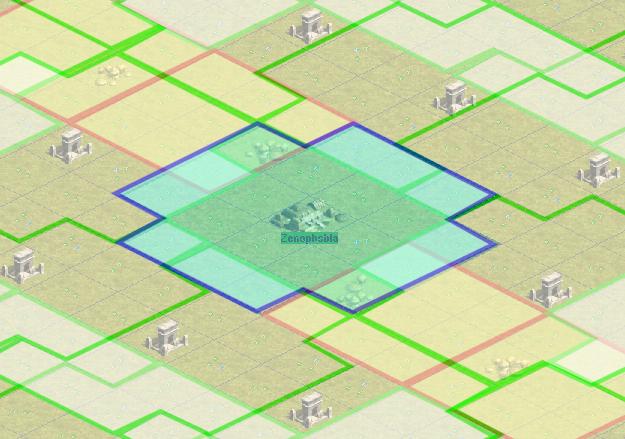
whats a camp, those things that workers make...?
and how is that used, can someone paste a pic or just a game where its used or something.... i think im really lost here
|
|
| |
|
|
|
vulture
|
 |
Leeds, UK
Jun 2001
time: 05:33
|
|
quote:
Originally posted by Footballgod128
whats a camp, those things that workers make...?
and how is that used, can someone paste a pic or just a game where its used or something.... i think im really lost here |
Camps, in this context, are just cities that you build with no intention of keeping them forever.
Late in the game, when all your cities are getting close to size 20 or so, having cities spaced with no overlap is the best way to maximise your production. Plus, it looks nice. The problem with spacing cities like this is that for all of the ancient and medieval era, you have a lot of tiles in your territory that aren't doing anything - each city has 20 tiles around it that only it can work, but is only size 6 (or 12) and so works only a few of them. One way to get more production out of your empire during these times is, once you've expanded to claim as much ground as possible, start building 'temporary' cities in between your permanent ones. The permanent city uses say 12 of the tiles in its radius, and the nearby temporary city can use another 6 or 7, so that you end up using almost all of the land. These temporary cities shouldn't waste time building improvements, since they eventually get disbanded, and the improvements are wasted. They just build a barracks, and then start putting out military units and occasional workers. Hence they are often called military camps (or just camps). This means you get a sizeable military fairly quickly, whilst also allowing your permanent cities to concentrate on building infrastructure.
When you get to the industrial era, and hospitals, your permanent cities can grow beyond size 12, and will need the tiles worked by the camps (plus, with improvements like banks and universities, they get double the production from each tile). The camps are disbanded by producing nothing but workers (or settlers if you prefer), with the excess population typically used to set up railroads ASAP and then join the permanent cities to provide rapid population growth up to size 20 or so (or you might skip the railroading bit if you already have enough workers running around).
That's pretty much all there is to it, aside from the fact that depending on the size and shape of your empire, you might get more overall production disbanding camps earlier than that. But that's quite a complicated thing to work out.
|
|
| |
|
|
|
Dominae
|
|
What I currently think about (core) city placement:
1. Core cities should be placed in the best positions, as dicated by the lay of the land. If this means 2-tile placement somewhere, so be it. If this means 5-tile placement (to grab a bonus Food resource, or deny a Lux to the AI), so be it. Never deny yourself a good city-spot just because it does not fit into your standard placement scheme. This is the most important rule.
2. However, it's usually not a great idea to chase that perfect spot halfway across the continent, so there's actually an art to placing cities in the early-game.
3. Strict adherence to specific city placement strategies is counter-productive: if you do this, there's a chance you're not doing #1, which is bad. A common example is sticking to OCP for aesthetic reasons. A less common example is camp-building; oftentimes your starting location simply does not support multiple camp cities. Similarly with blindly Ralphing, or 3-tile spacing.
4. The second-most important consideration after #1 is a projection of tile when your cities reach size 12. You want each city to have access to 12 good tiles, and no more, because Hospitals are too far away to incorporate size 13+ cities into your city placement strategy (in other words, the payoff of planning for Metros is simply not worth it). On average, this implies something close to a 3-tile city-placement strategy, but keep in mind point #1.
5. A continuation of #3 above: it's okay not to disband camps if they prove useful throughout the Medieval era, or even into the Industrial era. If this occurs, it's probably because your city placement around the camp was not as good as it could have been. Just because a city is two tiles away from another does not mean it should be disbanded ASAP.
6. If the situation does call for 2-tile spacing at numerous spots (ICS), it's usually better to expand further out then backfill for the 2-tile cities. ICS-ing right from the start, you'll find yourself with very little land (i.e. tiles), and probably lacking a Strategic resource or three.
7. Coastal city-sites are good candidates for close city-spacing. It's often easy to forget that, with Harbors, all those Coast and Sea tiles can be just as useful as land tiles.
Hope this helps.
Dominae
Last edited by Dominae on 15-01-2004 at 11:16
|
|
| |
|
|
|
ErikM
|
|
What I usually try to do is to forget about this Maltese cross city layout and imagine that each city works 3x4 rectangle. Then I try to layout these 3x4s with no overlap so that all land squares are worked. Rectangles are much easier to tile up together.
|
|
| |
|
|
|
steven8r
|
 |
of Central Texas
May 2002
time: 23:33
|
|
First, a nod to Footballgod for asking about camps. I too, was wondering about that terminology.
Ok, let's see if I have this correct:
"camp" = a temporary city mostly devoid of Improvements that is used for a particular purpose (building Units, Settlers, Workers, whatever) and is intended to be Abandoned later in the game.
Is that it?
quote:
Originally posted by Dominae
6. Coastal city-sites are good candidates for close city-spacing. It's often easy to forget that, with Harbors, all those Coast and Sea tiles can be just as useful as land tiles.
Dominae |
Dom, this part confuses me somewhat 
With Harbors, the only thing Coastal Cities can get from the Sea is the Food required to sustain the population. It's not until Offshore Platform that any shields can be obtained from the Sea. So I'm guessing that Harbors with a couple of 'terrestrial' tiles to provide Shields would be required?
Thanks,
 Steven Steven
|
|
| |
|
|
|
Dominae
|
|
quote:
Originally posted by steven8r
Dom, this part confuses me somewhat
With Harbors, the only thing Coastal Cities can get from the Sea is the Food required to sustain the population. It's not until Offshore Platform that any shields can be obtained from the Sea. So I'm guessing that Harbors with a couple of 'terrestrial' tiles to provide Shields would be required?
|
The basic idea is that of city specialization. It's simply not efficient to try and turn every city into a production and commerce powerhouse; it takes too long, and spends too many Shields.
For instance, why build a Barracks in all your cities if some of them will not be building military units most of the time? Much better to designate a few cities as perpetual military unit producers, and let the other cities concentrate on other things. This saves on maintenance and Shields. This is half the idea of "camps", the other half being that those cities that do specialize in military unit production can be abandoned later on since they've got almost nothing in the way of infrastructure (usually just a Barracks).
The same concept applies to coastal city-sites. What will these be best at? Commerce. There's no point in trying to build military units there, because as you point out they will be producing very few Shields until Miniaturization. Instead, Harbors, Marketplaces, Libraries and other Commerce-boosting improvements should be focussed on, at the expense of most everything else. Where do you get the Shields to do all this? Use Gold instead Shields; the few hundred Gold you spend on getting just one of those cities commercially productive will pay itself off in no time.
Once you see Coast/Sea tiles as viable tiles despite their zero Shield output, you'll find have that much more land to exploit and, in particular, more land tiles for your inland cities to use.
Dominae
|
|
| |
|
|
|
Capt Dizle
|
|
Being a contrarian, I try to adhere to a perfectionist city placement scheme with camps in the donut holes. Adjust for terrain. Works perfectly well.
The close spacing you really need to do is a cluster around the starting location. Afterwards spread out to grab land and dot the coastline pretty good.
|
|
| |
|
|
|
Footballgod128
|
|
Pigeon Forge, Tennessee
Dec 2003
time: 00:33
|
|
thanks for the pic, that helps alot, is the diff colors the places its things should be placed, the people getting the resources or whatever(dunno the name...)
and steven, for some reason, i wanna think your from texas, but, i dunno why.......
am i right.......
|
|
| |
|
|
|
Theseus

|
 |
The warmonger formerly known as rpodos. Gathering Storm! Apolyton Spirit!!
Apr 2002
time: 00:33
|
|
quote:
Originally posted by Dominae
What I currently think about (core) city placement:
1. Core cities should be placed in the best positions, as dicated by the lay of the land. If this means 2-tile placement somewhere, so be it. If this means 5-tile placement (to grab a bonus Food resource, or deny a Lux to the AI), so be it. Never deny yourself a good city-spot just because it does not fit into your standard placement scheme. This is the most important rule.
2. However, it's usually not a great idea to chase that perfect spot halfway across the continent, so there's actually an art to placing cities in the early-game.
3. Adherence to specific city placement strategies is actually counter-productive: if you do this, there's a chance you're not doing #1, which is bad. A common example is sticking to OCP for aesthetic reasons. A less common example is camp-building; oftentimes your starting location simply does not support multiple camp cities. Similarly with blindly Ralphing, or 3-tile spacing.
3. The second-most important consideration after #1 is a projection of tile when your cities reach size 12. You want each city to have access to 12 good tiles, and no more, because Hospitals are too far away to incorporate size 13+ cities into your city placement strategy (in other words, the payoff of planning for Metros is simply not worth it). On average, this implies something close to a 3-tile city-placement strategy, but keep in mind point #1 above.
4. A continuation of #3 above: it's okay not to disband camps if they prove useful throughout the Medieval era, or even into the Industrial era. If this occurs, it's probably because your city placement around the camp was not as good as it could have been. Just because a city is two tiles away from another does not mean it should be disbanded ASAP.
5. If the situation does call for 2-tile spacing at numerous spots (ICS), it's usually better to expand further out then backfill for the 2-tile cities. ICS-ing right from the start, you'll find yourself with very little land (i.e. tiles), and probably lacking a Strategic resource or three.
6. Coastal city-sites are good candidates for close city-spacing. It's often easy to forget that, with Harbors, all those Coast and Sea tiles can be just as useful as land tiles.
Hope this helps.
Dominae |
Domming?  (Don't hate me, Dominae, but what if it sticks?? (Don't hate me, Dominae, but what if it sticks??  ) )
To Catt's point, I have at times been ridiculously obsessed with CP (i.e., city placement), and I'm pretty sure I am to blame for the naming of Ralphing and Zenning (and Domming!). 
|
|
| |
|
| |
|
|
|
nbarclay
|
 |
Huntsville, Alabama
Dec 1999
time: 23:33
|
|
My city placement foillows absolutely no geometric pattern, but rather follows three main goals.
(1) Make maximum use of high-value tiles, including bonus tiles, grassland with shield, and rivers. Even when I'm not playing agricultural, I like river cities for their extra gold and the fact that they don't need to waste shields on aqueducts. (Note that distance from the capital is an extremely important aspect of value, since it is net output after waste and corruption, not gross output before, that counts. Chasing a distant cow can be a serious waste of a settler who ought to be building a city close to home.)
(2) Use essentiallly all available land and most available coast and sea at size 12. Coastal cities can usually work a lot of land tiles early in the game and then shift to using a higher and higher percentage of coast and sea as the inland cities grow in population and need more land tiles. (Balancing the use of tiles that are a drain on food - hills, mountain, and for non-agricultural civs desert - among cities is also important; a mountain is worth a lot more to a city that can feed a laborer to work it!)
(3) Take advantage of city placement to fill in borders without waiting for individual cities' cultural borders grow. That gives a wider selection of tiles to work than if each city had to choose among only the eight tiles immediately surrounding it.
The end result is a hodge-podge where city placement varies radically in both distance and direction, but where my overall use of the land available is good. I suffer a bit financially in the late game from having to maintain improvements in more cities than if I built hospitals and had huge metropolises, but the benefit in the early game more than makes up for it.
Nathan
|
|
| |
All times are GMT. The time now is 05:33.
Apolyton Time is 00:33. |
top of page
|
|
|
Forum Rules:
You may not post new threads
You may not post replies
You may not post attachments
You may not edit your posts
|
HTML code is ON
vB code is ON
Smilies are ON
[IMG] code is ON
|
|
|
|
|
|





 14-01-2004 02:22






 Attachment:


 |
|