|
| |
|

|
Aeson
|
 |
orangesoda
Nov 2001
time: 22:33
|
|
I disagree a bit with the tech rate discussion. 50 turn Writing isn't bad if you have some purpose in mind for the cash, especially at the higher difficulties using some sort of Granary/Worker start.
Without river tiles (and the Tobacco being poor shield production and harder to get Workers over to improve), you can't squeeze much more spare commerce out of your capitol than what you are getting on turn 1 in that timeframe. At most you can expect 3 more commerce freed up by garrisons and the incense, but that is less than optimal to build 2 military units so early and settle the desert anyways. The rest of the commerce from growing is going to be needed for the luxury slider.
I was able to save up several hundred gold for upgrading Warriors by going 50 turn Writing (after full bore to Pottery), and given the settings, beat some of the AI's to it anyways. This on Deity.
The thing that really makes a difference in this case is getting the Settler from the hut. That way you can expect to almost double your commerce intake very early. Then you certainly can get Writing rather quickly and Writing in 50 is definitely a bad move (of course you wouldn't know that until turn 10). Without a Settler though, you are going to be on a much slower research pace. On Deity I counted beakers and IIRC it was going to be around 45 turns at the fastest. That MWIA didn't get a Settler makes 50 turn Writing much more likely to be a good move. Though going for Pottery first would probably be better.
At worst, you can use that gold later to fund deficit researching or buy techs, keeping your overall tech rate pretty much the same. I was able to upgrade units, keep tech parity, and switch to a Republic ASAP, and stay at war in a Republic because of a large treasury. Gold has always been very important, and moreso in C3C than it was.
|
|
| |
|
|
|
Aeson
|
|
orangesoda
Nov 2001
time: 22:33
|
|
The first hut gave me a Warrior BTW. Second hut gave me 25g. In neither case did I allow the huts to give Barbarians. The first hut I had no military of course, and I surrounded the marsh hut with Warriors and Workers, so there was no place for Barbs to pop up. The only other huts I popped were both by building a city, and both gave maps.
My build at the start was going to be Worker, Warrior, Granary, but popping the Warrior from the hut let me go Worker, Granary. Then another 2 Workers so that I could improve the Game tiles and get my capitol to be able to build a 4 turn Settler ASAP. Only then did I start building Settlers.
First city was built next to the two game, which were both chopped to help build a Granary right off. Then I built next to the Wheat, and had it building Workers because the terrain needed a lot of them and it was better than delaying Settlers from my Capitol. By this time I could see how little room was available, otherwise I might have gone with another Granary.
|
|
| |
|
|
|
ducki
|
|
quote:
Originally posted by Aeson
I disagree a bit with the tech rate discussion. 50 turn Writing isn't bad if you have some purpose in mind for the cash, especially at the higher difficulties using some sort of Granary/Worker start. |
The difference here is you are assuming Pottery - MWIA went straight for Writing as the first tech and did it at minimum research, unless I misunderstood.
quote:
I was able to save up several hundred gold for upgrading Warriors by going 50 turn Writing (after full bore to Pottery), and given the settings, beat some of the AI's to it anyways. |
I'm not disputing minimum research on the second goal(after you've already grown some) - only on the first, and primarily was disputing MWIA's assertion that - on founding his first city - all research levels were equal, IE they would all result in 50-turn research - which they don't once he grows... or am I incorrect in assuming more citizens/towns = more commerce = faster research(based on slider settings)?
quote:
The thing that really makes a difference in this case is getting the Settler from the hut. ... On Deity I counted beakers and IIRC it was going to be around 45 turns at the fastest. |
Just out of curiousity, does this take into account when you would settle your first built settler and the added commerce from that as well as extra citizen in Const.?
quote:
That MWIA didn't get a Settler makes 50 turn Writing much more likely to be a good move. Though going for Pottery first would probably be better.
|
Would it be a good middle ground to start out your first tech at 100% no matter the goal and as soon as you grow/settle another town, evaluate again?
That would seem to give you more flexibility - if you spend the first 7 turns(to growth) at minimal, can't possibly be less than 50 turns, research, is there any way to get those beakers back? Can you compensate on growth for those 7 "lost" turns worth of extra beaker somehow?
quote:
I was able to upgrade units, keep tech parity, and switch to a Republic ASAP, and stay at war in a Republic because of a large treasury. Gold has always been very important, and moreso in C3C than it was. |
But you still did your first tech at 100%, though.
As I mentioned in passing above, my main thrust was against the assertion that - when you found your capitol on the first turn - just because the interface tells you 10% research is "equivalent" to 100% research, that's not actually true due to the fact that you'll grow in 7 turns(if working the fish, which also has extra commerce) giving you additional beakers by working the tile you improved during those growing turns and likely decreasing the number of turns to research the tech.
It may, in fact, be a "good" plan to research Writing in 50, I'm not necessarily arguing that.
I am arguing that you shouldn't take the Turns to Complete Research that are shown on turn 1 to be "true" unless they are less than your turns to grow. They might be close, but they are not quite "true".
(This entire post is in the spirit of debate and learning. I know Aeson and Dom both know much more about this than I and the quoting of Aeson merely helped me visualize where my assumptions differ from experienced opinions. Disclaimer done.)
|
|
| |
|
|
|
Dominae
|
|
Aeson, I'm not opposed to 50-turn research per se, as long as you keep that slider at 10% the whole fifty turns. But what many players do is put the slider at 10%, then raise it later on when they see they can speed up the rate. Although they manage to research the tech in less than fifty turns, had they put the slider at 100% from the start they could have discovered the tech in even less time. The game's ETA on a tech is not a really good measure in the early-game, because it can fluctuate wildly.
|
|
| |
|
|
|
ducki
|
|
quote:
An exploration approach to tech acquisition should include maximum early flexibility |
Doesn't research at 10% - on turn 1 - actually give you minimum flexibility, where research at 100% - on turn 1 - give you maximum flexibility in the ability to reevaluate and change your research rate downward if you are still happy with 50turns, whereas the former means you are locked in at necessarily lower research rate?
I'm just curious about why minimal research is viewed as more flexible in this case - turn 1 research rate - than 100% with the option of adjusting down when you grow.
Thanks in advance.
|
|
| |
|
|
|
ducki
|
|
Ah, gotcha, jshelr - we were talking about different kinds of flexibility. I was too focused purely on research rate flexibilty as opposed to general game flexibility. I still prefer (at least for turn 1, first tech) to start out at 100% and adjust downward as happiness and fiscal needs dictate rather than starting at 10% and building bank from turn 1. After the first tech, or even halfway through the first one, I often decide my bank account is more important, but I find it harder to do it the other way around. Thanks for the clarification.
|
|
| |
|
|
|
Aeson
|
|
orangesoda
Nov 2001
time: 22:33
|
|
quote:
or am I incorrect in assuming more citizens/towns = more commerce = faster research(based on slider settings)? |
You don't always have faster research capacity 'on the way' that will alter things within that 50 turn timeframe. High difficulties and/or larger maps often make the first 'big' tech 50 turns no matter what you do. If the tech rate (Standard) on this map had matched the dimensions (Large) I think that would have really become apparent for probably Writing, Map Making, and the government techs early on. Even sometimes when you can beat 50 turns it's preferable to just save the gold instead of a few turns. From a pure economic efficiency standpoint, 50 turn techs are always best. You always will get the tech for the cheapest possible price, and you can buy anything else you need and don't have time for from the AI for less than it costs to research. When considering the relative standing between you and your opponents though, the most 'powerful' option can vary widely.
As an example I would put the Ottomans vs the Iroquois in same settings played by the same player. On one hand your biggest edge is in speeding up tech rate to Military Tradition as much as possible. On the other hand (Iroquois) your biggest edge is in slowing down the tech rate as much as possible (given that the Horseback Riding needs to be delayed a bit to get any use of upgrading) to give your Mounted Warriors more time to work. SGL's and Philosophy add another dimension to this, but probably should not be used as a decisive factors.
In general, more cities do mean faster research. A city gives you a certain amount of born content citizens and the city tile. More citizens don't necessarily mean faster research though, and in some cases can actually make it slower. If you need garrisons that's a shield and possible commerce support cost that needs to be factored in. The shield cost especially is prohibitive early on, and slows down all your other builds. Which is why I try to make due with as few garrisons as possible. They just don't add enough value in most cases to offset their initial cost of production. Any units built tend to be more valuable exploring and escoring Settlers/Workers in this timeframe.
In this case, with no rivers and scarce/low production commerce bonus tiles, you will be getting 1 commerce from the tiles you are using until you are able to use the Tobacco. You should be using the Fish off and on from turn 1, but can only use it consistantly at a higher population. The Tobacco is in the same category, as you give up production to use them, and so only once you meet your production needs will you be able to gain any commerce. Probably from size 2-5 you are going to be adding 1 commerce tiles that need to dedicate that commerce to keeping the Laborer productive.
quote:
Just out of curiousity, does this take into account when you would settle your first built settler and the added commerce from that as well as extra citizen in Const.? |
When figuring out my max time for Writing, I took into account growth and production/expansion possibilities. Given the Fish and the Tobacco being commerce bonus tiles that could be used (or fully utilized) only at higher populations, they actually made commerce better near term by keeping the capitol population high (size 2+ for the fish, size 6+ for the Tobacco once I got around to improving them) instead of building Settlers. To get Writing at maximum speed, I would have had to delay Settlers and Workers, along with forcing the use and improvement of less production tiles. The other alternative was to forgo a Granary and build Settlers right off. Both would have resulted in getting Writing faster than 50 turns, but at a long term expense that is difficult to quantify, but definitely prohibitive IMO.
It was also more efficient from a build perspective to get out a few Workers because production was able to go 4/6 for 2 turn Workers with fewer terrain improvements than it could go 6/8/7/9 for 4 turn Settlers. Those Workers were then able to make the second city site more valuable in a shorter timeframe by chopping and irrigating the Game tiles, catching the city up to where it would have been (or slightly better off) if the Settler came before the Workers.
quote:
Would it be a good middle ground to start out your first tech at 100% no matter the goal and as soon as you grow/settle another town, evaluate again? |
There are no hard and fast rules, which is mainly what I was trying to point out by responding. My disagreement is not with the fact that you can get a tech faster than 50 turns even when you start out at a 50 turn rate... it's with the qualification of that statement. "You can", not "you will" or "you should". Even better would be qualifying the statement based on difficulty and settings.
If you can get a tech faster than 50 turns (not always), then you have to evaluate the opportunity cost and the value of getting that tech earlier. Sometimes the tech earlier makes a lot of sense and the cost isn't much (the case with Pottery usually), in others, there is little to gain and a huge cost.
In this case, if I had been the Dutch and started with Pottery, a 10% and20% 50 turn Writing would have been the first tech I went for. So definitely not the first tech should be 100% no matter what.
|
|
| |
|
|
|
Theseus

|
 |
The warmonger formerly known as rpodos. Gathering Storm! Apolyton Spirit!!
Apr 2002
time: 00:33
|
|
I'll be posting my AARs shortly, but this discussion reminded me of something I did, and my thinking at the time.
I too researched Pottery at max... but when I went for Writing next, I initially cut my research rate down to 20/10%, but later increased it to 80%.
My thinking? (...and I don't remember having seen it thought of this way before)
Well, yes, I subscribe to max research, even if it looks like it doesn;t do much to increase the rate... if I know that my total beaker production per turn is going to improve significantly during the course of researching that tech. With your first town, that will clearly (usually) be happening due to increased pop. Depending on how you're doing in terms of settling new towns, that might add pop too.
But, in this case, having completed a granary pretty shortly after Pottery, and thus using Constantinople as a Settler Pump, it seemed to me that my total bpt was going to remain static and fairly low for a while, so I'd be better off economically to use those turns at the 50 turn rate (i.e., higher than my own native bpt production), until such time as net increasing total pop could cut down the research rate, with a corollary benefit of building up some gold.
Make sense?
|
|
| |
|
|
|
ducki
|
|
@Aeson: Thanks for the detailed explanation. I don't know that I understand fully enough to agree, but at least I understand enough to experiment and reassess other comments.
@Theseus - Make sense? Not really, but probably because I need to better understand precisely how research works.
If you start low and adjust up, haven't you permanently lost a certain opportunity window? I fully understand why I personally start high and then adjust down, strictly in terms of research time, but your explanation almost sounds like that old joke about selling at a loss and making it up on volume. 
I'm positive that there's some little switch in my head that needs to be thrown, just like Food/Shield-per-turn Averaging with regards to Time to Build and Time to Growth and the Settler-Pump, so wonderfully thrown by y'all on my Emperor thread.
That's not to say I don't get the inherent benefit of a big bank account, especially thanks to Aeson above, it's just that I'm seeing a missed beaker as a lost beaker and since research is cumulative, there are a lot of "points of no return" on the way to a tech - once you go past a certain point at minimum research, there's no way you can get it faster than, say, minimum/2.
I'm betting there's a really beautiful way to graph what I'm trying to say. I'll have to think it through more, read more, and probably end up understanding everyone's viewpoint much better to boot.
EDIT: You know how sometimes you can cut a tech down from 5 turns to 4 or 2 turns to 1 by MMing and finding (sometimes) just one or two Scientist(s) for a turn? That's kind of the flipside of this, IMO. If you are researching hard but are just a few beakers short, you can sometimes find those beakers - if you hobble yourself early by minimizing beakers, you're going to have a harder time "finding" enough beakers to cut that turn off. I know this is not directly analogous, but I think at least most of you will be able to read between the lines, connect the dots and get the gist of what I'm driving at on this example, and maybe express it better than my own ramble.
In short, start high->adjust down makes sense to me; start low->adjust up does not compute. Color me ignorant on yet another topic. Must find threads on research.
Last edited by ducki on 17-02-2004 at 02:02
|
|
| |
|
| |
|
|
|
Dominae
|
|
quote:
Originally posted by Aeson
Nobody starts low and expects to raise the tax rate later on... |
Actually, many players do do this, which is why I commented on it in the first place.
The common misconception is as follows: if the game says 50 turns whether my Science is at 10% or at 100%, I may as well put it at 10% and adjust upward later, since 10% and 100% give me the same research rate. Like I said, the problem is with thinking in terms of how long the game tells you it's going to take, instead of how many Beakers you need.
This has nothing to do with the 50-turn gambit, although it probably confuses the matter even further.
Dominae
|
|
| |
|
|
|
Theseus
|
|
The warmonger formerly known as rpodos. Gathering Storm! Apolyton Spirit!!
Apr 2002
time: 00:33
|
|
AU Mod, Emperor
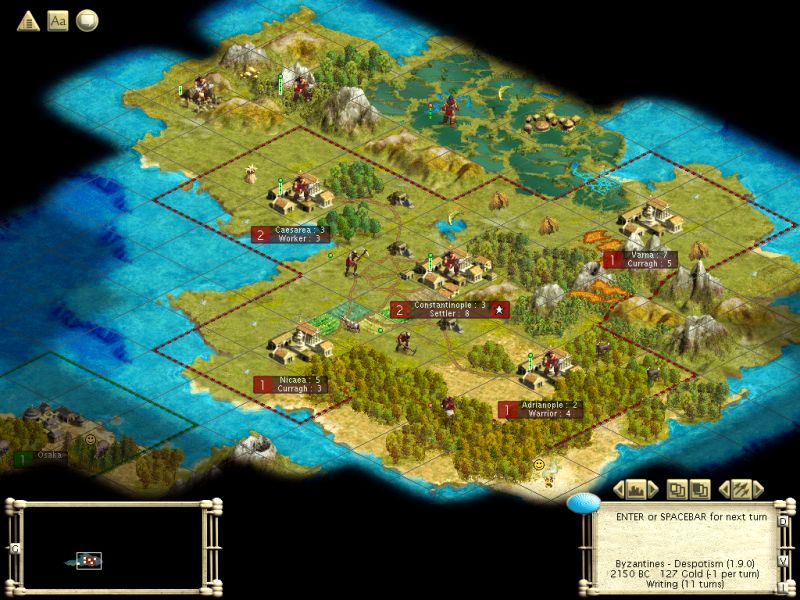
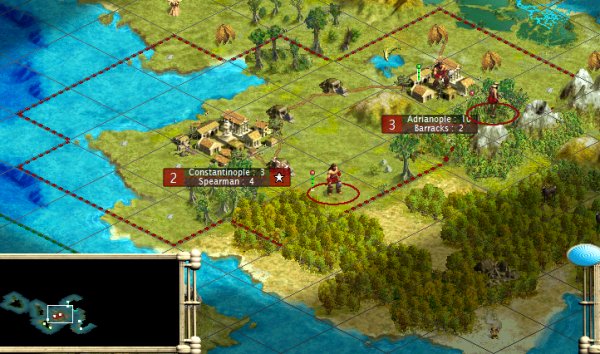
Like many, I settled on the spot, raced for Pottery, irrigated toward the cow, built non-military, and lucked out with a Settler from the hut, which became Adrianapole, which will build Warriors for MPs.
On the completion of Pottery, research Writing, at only 20% for the moment, later 90% as more towns are in place. A pre-build in Constantinople gets a Granary done almost right away, and then Settlers and Caesarea and Nicaea built next, and both set immediately to Curraughs. Realized it was an island pretty quickly, so decided to jam towns in , with the expectation that some, as to be determined , would later be treated as camps and disbanded.
Two Warriors sent up the mountains to gain experience with Barbs, lost one. Waiting till more units in place before popping the marsh hut.
In 2190 BC I get my first Curraugh out and meet Toku, who, after trades, is waaaay ahead of me with The Wheel, Warrior Code, and Mysticism. Hut lucky or in contact with someone else, the rotten b*stard. That alone earns my hatred (well, Samurais have something to with it to), and I paint a target on the sonuvabee-yatch.
At this point I think to check the space race via F10 to view who the opponents are... hmm, interesting. Good opponents for a seafaring epic! On that note, btw, thanks again for getting this set up... it's already a LOT of fun! 
So, in 2150 BC:
5 towns with 7 pop
1 Settler
2 Workers
6 Warriors
1 Curraugh
 Attachment: 501-2150bc.jpg Attachment: 501-2150bc.jpg
This has been downloaded 106 time(s).
|
|
| |
|
|
|
ducki
|
|
quote:
Originally posted by Dominae
The common misconception is as follows: if the game says 50 turns whether my Science is at 10% or at 100%, I may as well put it at 10% and adjust upward later, since 10% and 100% give me the same research rate. Like I said, the problem is with thinking in terms of how long the game tells you it's going to take, instead of how many Beakers you need.
|
That's exactly what I've been trying to say, and doing a damn poor job of it; in particular, MWIA's language prompted me to speak up, since it was of the "might as well settle for" type 50-turn @ 10% - at least, that's how I heard it.
I am glad I argued it, though, as I've learned a lot more by opening my ignorant mouth and letting the vets give me some schoolin' than t'other way 'round. Thanks guys!
Edit: Nice start, Theseus - I wish I'd been able to convince myself to go even tighter than I did, though I still had a lot of sharing problems later on and quite a few towns working sea/coast tiles almost exclusively so my powerhouses could have the "good" tiles.
|
|
| |
|
|
|
MrWhereItsAt
|
 |
New Year's Resolution: 2005 is the year of Where It's At - come get some.
Nov 2001
time: 17:33
|
|
Whoops! Let me start this off by repeating how apathetic I felt when I started the game - I didn't want to have this AU slip away from me, after making so much noise about wanting it recently, but when I started I just hadn't the heart or interest to think things through properly.
I started with Writing as I was tired enough to have forgotten my recent lesson, and one that has proven very successful for me to - Pottery and early Granaries first. The reason I chose Writing was because I knew Alphabet and Writing are two of the more valuable techs to have to trade with first up, and I suspected I would meet at least one civ early on.
I started with 20% science (the minimum whilst still researching) because I knew that it would be quite some time before I needed Writing (quite some time before contacting another civ) and I knew that I would be unlikely to raise my trade sufficiently in most of that time for a higher rate to be of much benefit in reducing the time from 50 turns anyway. 20-25 turns later on I noticed that I could have started to do better - but by then I reckoned it was worth more to get the gold for trading with: I did NOT reckon on the civs I contacted early being so stingy with techs for my gold.
Next failures: I did not, upon discovering my gold was worth little for trades, earmark it for Sword or Horsemen upgrades, and thus I ended up switching to 100% after I got Writing and just starting to whittle away at my coffers to maintain that rate with later techs. When I realised later it was there for just that purpose, I had not built Warriors or Chariots for the task.
What you could say I have learned even thusfar - nothing new. All my failures (but for the damn bad hut luck) were things I had learned in the past - now I find it hard to believe I did not start with Pottery at 100%, I cannot believe I forgot about Curraghs until I founded a coast city well advanced into the game, and I cannot believe I missed the chance to upgrade Warriors with cash, something I have done in every game for many months now.
I will now go and reread everyone's comments and, with my brain in gear now, try to respond in a way that was far more intelligent than my gameplay to date. 
|
|
| |
|
|
|
MrWhereItsAt
|
|
New Year's Resolution: 2005 is the year of Where It's At - come get some.
Nov 2001
time: 17:33
|
|
Wow. Having now read almost all of the above, I am glad I sparked off such good debate. But this is pure serendipity, as it was my sheer idiocy that led to this.
I have since noticed two more mistakes of mine that, every other game, I have not made. I did not push for a settler pump ANYWHERE for quite some time, and I did not even solve those few simultaneous equations that are so easy early on in the game to ensure no food or shields are wasted...
And now I am thinking a little more properly, I may as well add my POV to the thread: as I have only played as high as Monarch, it is as my general rule best to start with 100% research, as a few extra turns of 1-3 gold will not make much difference at any stage of the game. After scouting a little more and growth to 2 or 3 in your capital, you will be able to see the effects of the slider much better (even without figuring out the beaker costs), and decide whether you will be able to make enough beakers for a high rate to be your best option or not. It is at this point you can make a proper informed decision.
Lastly, I have to say that so far I am failing AU501 through sheer lack of thought - perhaps I'm not cut out for the cut and thrust. Is there going to be an Apolyton Polytechnic or Apolyton Hairdressing School I would be better suited for? 
|
|
| |
|
| |
|
| |
|
| |
All times are GMT. The time now is 05:33.
Apolyton Time is 00:33. |
top of page
|
|
|
Forum Rules:
You may not post new threads
You may not post replies
You may not post attachments
You may not edit your posts
|
HTML code is ON
vB code is ON
Smilies are ON
[IMG] code is ON
|
|
|
|
|
|





 16-02-2004 22:34










 |
|