|
| |
|

|
Sava
|
 |
GO GO GO!
Mar 2001
time: 23:34
|
|
quote:
Promises, Promises
By PAUL KRUGMAN
Despite a string of dismal employment reports, the administration insists that its economic program, which has relied entirely on tax cuts focused on the affluent, will produce big job gains any day now. Should we believe these promises?
Each February, the Economic Report of the President forecasts nonfarm payroll employment — generally considered the best measure of job growth — for the next several years. The black line in the chart above (inspired by a joint report from the Economic Policy Institute and the Center on Budget and Policy Priorities) shows the actual performance of employment, both before and after its peak in March 2001. The gray lines show the forecasts in the 2002, 2003 and 2004 reports. Notice that the February 2004 forecast, which, as in previous years, is based on data only through the preceding October, is already 900,000 jobs too high.
Economic forecasting isn't an exact science, but wishful thinking on this scale is unprecedented. Nor can the administration use its all-purpose excuse: all of these forecasts date from after 9/11. What you see in this chart is the signature of a corrupted policy process, in which political propaganda takes the place of professional analysis.
|
link: http://www.nytimes.com/2004/03/09/opinion/09KRUG.html
here's the graph:

 that graph sure illustrates how absurd the administration's job creation predictions are... that graph sure illustrates how absurd the administration's job creation predictions are...
George Bush is trying to run on his "leadership" after 9-11... the right wing attack dogs are trying to paint Kerry as a "flip-flopper"... but once again IT'S THE ECONOMY STUPIDS! 
Bush says he's not going to make the same mistakes as his father did in losing a re-election bid. Dubya's going to make all new ones.
Hopefully, this should put to rest the retarded supply-side arguments for tax-cuts. If not, supply-siders need to seek professional help. 
|
|
| |
|
|
|
MrBaggins
|
|
I completely agree with the premise. The republican party hasn't been able to magically conjure jobs... but then I don't believe that presidents have much to do with positive influences on the economy, only lost potential.
The only times where government has a truly direct and significant hand in job creation is either (a) not messing up a vibrant economy, or (b) massive programs of public works, like FDR or Hitler... and those are extreme and can't be often repeated.
The president doesn't come up with policies... he chooses between options that are presented to him by the various departments of government. Many of these choices are "no-brainer" decisions, that are effectively structured so that only one good choice could be made.
If you want an example of a truly independent policy, look at the invasion of Iraq. It was quite obviously on an innevitable thing that the president wanted to do, from the get go, due to some form of revenge that shrub had in mind (due to what saddam did to daddy, perhaps?) and that really wasn't thought through that well, and turned out to be, globally speaking, a pretty average to bad idea.
Call me personally pragmatic, but I could think of a lot better uses for several billion dollars a day, than liberating ungrateful people, who I'll never have anything to personally do with.
For the most part the presidents job is to be the public face of the presidency. He is the figurehead and his ability to get a message across is vital.
This president, however, isn't a very good public speaker. He's certainly not able to improvise speeches to any degree, which makes me consider that he probably has very little input in the public speeches that he does make.
Like or lothe him personally, Clinton is the epitome of what a president should look and sound like, particularly in global politics. Bush is an embarasment in comparison. Kerry? well he doesn't look particularly presidential... he looks gaunt, but he can speak competently, and improvises well, which I consider one of the most important attributes of the office that he's running for.
Last edited by MrBaggins on 09-03-2004 at 21:20
|
|
| |
|
| |
|
|
|
MrBaggins
|
|
I'm leaning towards the thinking that protectionism is the way to go, right now... and I'm hearing a lot of echoed sentiments in my acquaintances.
Essentially, jobs lost overseas due to US labor costs have a very, very negative effect in many ways...
The country is losing revenue streams from payroll tax, income tax, sales tax and so on... not to mention a general decline in standard of living when middle class people are forced into lower paying jobs.
This situation has come about, I perceive, from the increased importance of the stock indices. More people are investing, and watching the markets, and those people have votes and thus influence the corporate direction, which encourages profit seeking in whatever way possible. A simple way to increase profits is to outsource labor to cheaper markets.
Its short-sighted and counter productive.
What would I do? I'd impose tarrifs on foreign employment, based on comparitive cost-of-living and working standards, so that there was no tarrif, for say Western European employment, but it cost money to employ people from India, say.
|
|
| |
|
|
|
MrBaggins
|
|
quote:
Originally posted by Sava
I think going to the protectionism extreme will be counter-productive. Kerry has some good ideas; like tax credits and other incentives to employ Americans. I'd like to see NAFTA and the China agreement renegotiated. Trade is good, but there needs to be a balance. |
True.. but we have a problem with the profits-at-any-cost corporate mentalities now... and the downside effects to those, outweigh the benefits of free trade with unequal economies... such as India. With free trade in such instances, more wealth is lost to them than gained by us, especially when outsourcing is considered.
Trade is optimal when you're trading with roughly equal partners, like western europe and japan, for instance.
|
|
| |
|
|
|
MrBaggins
|
|
I think we've reached a concensus, sava. I agree.
|
|
| |
|
|
|
MrBaggins
|
|
quote:
Originally posted by GePap
Protectionism is not the answer to this problem. Do I have an answer? No. This might be a structural change in the economy, which can only be dealt by reworking social programs. |
Why is protectionism in a limited circumstance counter-productive, however? You've not answered that question.
|
|
| |
|
|
|
MrBaggins
|
|
DanS> I'd disagree with your assessment. I'd say that the productivity helps not the entire populace, but primarily the corporate balance sheets, which might translate to dividends (to the upper and a steadily shrinking middle class), but rarely will that wealth trickle down.
While productivity is increasing, in fact, there is no overwhelming reason to hire new people, as a company is showing growth, without the risk of new hires.
|
|
| |
|
|
|
MrBaggins
|
|
quote:
Originally posted by GePap
Becuase it is never limited in time,
|
No clue what you're referring to here.
quote:
and it send a bad message anyway to states, that the solution to internal political worries is monkeying with the international trade system. |
Which would concern those who we are currently leaking wealth and jobs too. I'd rather discriminate against several third/second world countries, than my own populace.
Our natural trading partners would actually see more trade, and be happier. Equal trading partners should be trading... where possible. You shouldn't have poor nations just leeching off large ones.
|
|
| |
|
|
|
MrBaggins
|
|
quote:
Originally posted by DanS
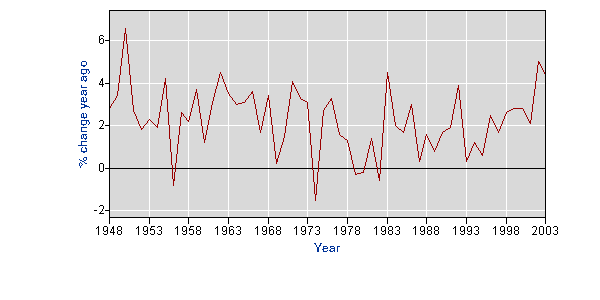
That's bullshit, Baggins. Corporations are taking a very low percentage of their business in profits. It's flowing through to the employees. See the following graph that I prepared showing this fact. |
These figures entirely ignore capital reinvestment and debt repayment.
|
|
| |
|
|
|
MrBaggins
|
|
quote:
Originally posted by GePap
Yes, corporate pay is way out of line-it hurts profits.
|
Another good point... executives typically make disproportionate salaries to their actual value to the corporation.
|
|
| |
|
|
|
MrBaggins
|
|
quote:
Originally posted by GePap
The fact is that richer nations win form tarde more than small ones-I have no idea were you get the notion it is poor states that gain the most from free trade-since they begin with a huge disadvantage. |
Case in point the recent tech-job exodus to India.
Every job lost negatively effects the US at a number of levels... payroll tax (partially), income tax and sales tax for instance... it sucks that wealth out of the US economic cycle.
|
|
| |
All times are GMT. The time now is 05:34.
Apolyton Time is 00:34. |
top of page
|
| archivepost |
|
Forum Rules:
You may not post new threads
You may not post replies
You may not post attachments
You may not edit your posts
|
HTML code is ON
vB code is ON
Smilies are ON
[IMG] code is ON
|
|
|
|
|
|





 09-03-2004 20:34





 BTW, unemployment held steady (at 5..6% I believe...) but that's only because about 400,000 people stopped looking for work. Another factor (besides gas prices) that may hurt job growth is the increased productivity we are seeing. Increased productivity means we can do more with less (workers). While productivity gains may be good for costs, it means less jobs.



 Attachment:
 |
|