|
| |
|

|
Kaos XIII
|
 |
beautiful coastal city of... Que te Importa
May 2003
time: 00:35
|
|
With the tires making a loud screeching noise, the caravan of motor cars, speed away in a furious race to the Town Hall, where the Town councilors expect them for a reception. The drivers are at this point, flooring it, as they make their way through the old city. After the incident, they were ordered not to stop, anywhere until they reached the Town Hall. Left behind among the screams of shear horror, is a scene of chaos and death. Everyone inside the vehicles is terrified and in a state of panic, at what had just occurred. One of the cars is actually sent to the ‘Garrison Hospital’, after the outrage, because of some injuries.
Once arriving at the Town Hall, the car doors fling open, revealing the Emperor’s nephew extremely angry and frightened. The Town councilors, with the Mayor at the head, which awaited them, are not aware of the incident. As the Archduke, (title given to the Emperor’s nephew almost 40 years earlier) appears, the Mayor begins his address of welcome, when the Archduke interrupts him angrily saying, “Herr Burgermeister, it is perfectly outrageous!!! We have come to your city on a visit and have had a BOMB thrown at us.”
The Archduke pauses for a moment, and then says: “Now you may go on.” Thereupon, the Mayor delivers his address and the Archduke makes a suitable reply.
After the reception, the Archduke is informed that the perpetrator has been caught. For the first time since the incident the Archduke is able to crack a smile. "Hang him as soon as you can”, is his only reply. Now more collected, he insists on visiting his assistant at the Garrison Hospital, whom had been injured in the bomb attack. Inside the safety of his motor car, he remarks to his wife, “you know I was thinking about getting this particular assistant replaced anyway. This terrorist act might just be a blessing in disguise, hee hee.”
“Now that’s just evil”, his wife responds in a playful voice. “I’m glad to see you more calm now.”
“Of course, I feel better now that, that scum has been arrested, can you imagine if my country were to lose such a great man and the heir to the throne”, responds the Archduke in typical narcissistic fashion.
As they leave in their motor cars, the powers that be, decide to change the route, which is to take them to the Hospital. The cavalcade makes their way back down the Appel Quay, without any concern since the assassin has been captured and probably getting the beating of his life, right about now. After crossing one bridge, they arrive at a second bridge, however the first car, followed by the Archduke’s car turns to the right instead of the left, because the drivers have not been informed of the change in plan. The cars behind in the caravan begin to slam on their horns and then some began yelling, “You’re going the wrong way! Turn around!” Inside the second car, the Archduke listens to the screams and begins to yell at his driver, “You imbecile, you are taking us the wrong way. Back up and take us through the new route, you low-wage, uneducated, ****.” His wife, concerned over his temper responds, “relax it was just a simple wrong turn.”
As the Archduke’s car backs up, a young, thin, baby-faced man not older than 20 years old appears and pulls out a handgun……..BANG!, BANG! Two quick shots in rapid succession aim directly at the Archduke’s vehicle. The first shot strikes the Archduke’s wife in the abdomen, while the second hits the Archduke in the neck and pierces his jugular vein. Blood pours out uncontrollably and soon the windows of the car, appear with a red tint. The Archduke’s wife becomes unconscious immediately and falls across the knees of her husband, her dress now completely soaked in blood. The Archduke also loses consciousness in a few seconds, his head pulls back, his face looking up at the interior lining of the car. Blood, slowly begins to fill in his mouth and throat, clogging his breathing, he begins to choke. The motor car, in which they are seated, drives straight to the Cognacs, where an army surgeon renders first aid, but it’s all in vain.
As word spreads of the shooting and assassination throughout the city, the locals can only reply with….”ZIVIO!!!, ZIVIO!!!”
----------------------------------
1 Week later:
After weeks of cool temperature, it finally appears that the long awaited summer season has begun. On this early July day, the sun reveals itself, warmer than usual. The flowers are in full bloom and outdoor festivals are abound. The beaches are packed, as the citizenry breathes in the warm breezes of the shore. Women have long ditched their heavy winter coats, for more relaxing clothing, showing off their figures. It’s also perfect for the kids, out of school they spend their time playing with their friends. Yes, throughout the streets of Europe, from Paris to Berlin, Vienna to Moscow and many more, the children let out screams of joy. But it won’t be long now, when they will be screaming out of terror.
Meanwhile, aboard the "Hohenzollern" yacht looking out toward the waters of the Kattegat strait is our ‘Dear Leader’ trying to shield his face from the sun. He has deep regrets for being decked out in a military uniform, on such a warm day. But his biggest concern is, if the people at his party are aware of his discomfort. He and everyone else are in a somewhat somber mood, as they head for the Norwegian coast. A great friend has been assassinated, just a mere week ago. Adding to the grief is the fact that he is unable to attend the funeral, due to security concerns.
He is 55 years old and very tired, due to the long busy day he had yesterday. As he picks up a glass of Mosel wine with his right hand, he has no second thoughts, or worries about the decisions he took less than 24 hours ago. Our leader is oblivious to the fact, that yesterday, he sentenced us all to war.
|
|
| |
|
| |
|
| |
|
| |
|
| |
|
| |
|
|
|
Kaos XIII
|
|
beautiful coastal city of... Que te Importa
May 2003
time: 00:35
|
|
Note: While the following story does contain some elements of truth, this story is above all, primarily fiction. Actions and conversations depicted here, are NOT an attempt to re-write history. I would also like to point out at this moment, that quotes within this story, containing negative remarks about people’s nationalities should be, for the most part, credited to Wilhelm himself. It was all researched. 
Blank Cheque
1 Day ago:
It’s 2 PM on a Friday and the Imperial Chancellor Theobald von Bethmann-Hollweg is making his way through the front of the summer Royal Palace in Potsdam, outside Berlin. Upon learning of his arrival, Friedrich Wilhelm Viktor Albert, the King of Prussia and German Kaiser (the ‘Dear Leader’) advances to meet him and says, “Afternoon Chancellor, please step into my private office.”
Once inside and after receiving a cup of coffee, Bethmann asks, “So, what is the latest news?”
Kaiser Wilhelm also drinking coffee, proceeds to put his cup down and grabs a paper document with his right hand, and proclaims, “I hold here in my hand a confidential, personal hand-written letter. The Austrian Ambassador handed it to me during our lunch. It’s from the Austro-Hungarian Emperor, Franz Josef. It depicts the present situation from the Austro-Hungarian point of view, and describes the measures which Vienna has in view.”
“What are the measures?”, asks Chancellor Bethmann.
Wilhelm now places the letter on the table and proceeds to scratch an itch he has on the back of his right ear and says, “they will send an ultimatum to Serbia. The demands among other things include; creating a joint Austro-Serbian commission to investigate the murder and ordering the Serbian government to condemn any propaganda against Austria-Hungary.”
“That seems reasonable. Although it’s quite clear the Serb government is without a doubt, responsible for the travesty of last week”, responds Bethmann.
“Indeed it is reasonable, but you never know with these Serbs. Serbia is not a state in the European sense of the word; it is a band of brigands!”
“Or Russians, whom have been making a lot of noise”, adds Bethmann, showing a concern over the Russians threat, that they will back their Slavic-Serbian brothers, against any military response from Austria-Hungary.
Thinking that Bethmann just insulted him by mentioning the Russians, as if he didn’t know about it, Wilhelm responds angrily, “I’m not blind to the danger which threatens Austria-Hungary and thus the Triple Alliance as a result of the Russian and Serbian Pan-Slavic agitation, which I also know involves the Socialist Republic of France, somehow.”
“Well, I didn’t mean to imply…..”
“That’s enough, tomorrow I leave for Norway. I will respond to the Emperor Franz Josef’s letter proclaiming that Germany will back Austria-Hungary, in whatever action she may take toward Serbia. Inform our friends in the Reichstag (industrialists). I shall prepare for my vacation now”, says Wilhelm excited for his upcoming vacation since his girlfriend, and not his wife, will accompany him.
Constitutionally, Wilhelm needs the Chancellor’s approval, but in reality it is the Kaiser whom dominates foreign policy. Bethmann replies in an effort to ease the tension, “Enjoy your vacation. It will have a quieting effect on all of Europe. This crisis is just like, so many before.”
“It’s not exactly like the other crisis, this time……..I’m not chickening out”, responds Wilhelm in reference to the Moroccan crisis 3 years ago. He adds, “In any case, there’s nothing to worry about, I’m sure this will be resolved without any conflict. I don’t understand why some people are panicking now.”
-----------------------------------------------------------------
But this crisis, isn’t just a week old. It began decades ago. Here comes a history lesson. If not interested, skip to next post.
Unification
The Franco-Prussian War (1870-1871) ended with a unified, militarily triumphant and economically powerful Germany. After 1871, it challenged the balance of power on which the peace of Europe had long depended. But the architect of German unity, Chancellor Otto von Bismarck, was not interested in further expanding German power at the risk of a Europe-wide war. Rather, he strove to preserve Germany's newly acquired position as the dominant power in Europe.
To achieve this goal he set out to isolate France, which nurtured a smoldering grievance against Germany. After the Franco-Prussian War, France was forced to cede its eastern province of Alsace and part of the adjoining province of Lorraine to Germany under the Treaty of Frankfurt. During Bismarck’s 19-year tenure as chancellor from 1871 to 1890, Germany was the undisputed master of Europe while the new French Republic that had been established after the Franco-Prussian War remained militarily weak and diplomatically isolated. However, France never gave up hope of recovering “the lost provinces,” whose population was split between French- and German-speakers.
Bismarck was at pains to reassure the other European powers that Germany posed no threat to their interests. He shrewdly crafted a network of alliances and agreements with all of the other European powers except France. Bismarck contracted the Triple Alliance of 1882 with Austria-Hungary and Italy to strengthen German power against France and to help balance power in the Balkans between Austria-Hungary and Russia. In 1887 he signed a Reinsurance Treaty with Russia. This treaty pledged Russia to neutrality in the event of a war between France and Germany and promised German neutrality in case of war between Austria-Hungary and Russia.
Ehrgeiz
However, when Bismarck “retired” in 1890, his carefully crafted policy of isolating France began to unravel. The impetuous new German emperor, Friedrich Wilhelm Viktor Albert, abandoned Bismarck’s cautious foreign policy. When Kaiser Wilhelm refused to renew Germany's treaty with Russia, the French approached Russian tsar Alexander III. By 1894 France and Russia had concluded a treaty of alliance, in which each country pledged to come to the assistance of the other in case of war with Germany. The Franco-Russian alliance obliged Germany to face the prospect of having to fight a war on two fronts, which would prevent Germany from concentrating all its military might against a single foe.
Wilhelm also decided that Germany must become a great naval power. The British were at first scornful, then irritated, and finally alarmed as Germany embarked on major battleship-building programs. The country, which under Bismarck had been content with its role as the most powerful nation on the European continent, now aspired to become a global power.
Concern about Wilhelm’s new global ambitions and naval policy prompted Britain and France to establish a friendly diplomatic relationship called the Entente Cordiale in 1904. Thereafter these two powers developed closer political ties and began to discuss possible forms of military and naval cooperation in the event of war in Europe. In 1907 Britain settled its outstanding conflicts with France's ally Russia, and the same year, these three powers began to cooperate in a loose diplomatic association that was known as the Triple Entente.
In the decade following, Britain, France, and Russia began to compete with Germany and Austria-Hungary in a costly arms race. Anglo-German naval rivalry was accompanied by a competitive military buildup between France and Russia on the one hand and Germany and Austria-Hungary on the other. With the tension so build up from this time forward, only a spark was necessary to set off an explosion.
© 1993-2003 Microsoft Corporation. All rights reserved.
|
|
| |
|
|
|
Kaos XIII
|
|
beautiful coastal city of... Que te Importa
May 2003
time: 00:35
|
|
While on vacation in Norway, Wilhelm does not pay much attention to the diplomatic happenings. His only knowledge comes from the local papers, which appear to be blowing things out of proportion. On the contrary, throughout Europe, German Ambassadors work hard, specifically in London, to keep the conflict localized, between Austria and Serbia. Unbeknownst to all in Berlin however, the British Foreign Minister, Lord Grey has already told the Russian Ambassador, “Germans can no longer be counted on as peacemakers under all circumstances.”
July 23, 1914 at 6 PM, Austria-Hungary delivers the ultimatum to Serbia. What the world does not know, is that the Austrian demands are calculated to humiliate the Serbs, so that they will reject the ultimatum. Back in Berlin, diplomats and ambassadors continue to send out telegrams to the different European capitals, urging the conflict stay localized. The very next day, France announces support of Russia, in case of a Russian war with Austria.
July 25, 1914; Wilhelm is awoken early in the morning, he is very cranky because he’s been awoken earlier than usual. On this morning an urgent message in a telegram, from Chancellor Bethmann awaits him. It says;
Your Majesty. Our Ambassador to Vienna, Count Heinrich von Tschirschky has informed me that the Austrian note is, as he put it, ‘composed to preclude acceptance by the Serbs.’
Wilhelm’s only response is, “oh shi’ite, I think it’s time to go back to Germany.”
--------------
Back in Belgrade, the Serb parliament meets in a special session and agrees to a reply. At the urging of Britain and Russia, the Serbs accept ‘most’ of the demands with reservations. After receiving the Serbian response, Austria-Hungary declares, that “the Serbian reply is unsatisfactory.” Vienna immediately breaks off diplomatic relations with Belgrade and the Serbian envoy is dismissed, literally told to “get the f*** out.” The Austro-Hungarian Government then proceeds to declare martial law and begins mobilizing. Upon hearing the news, King Peter of Serbia moves the capital from Belgrade to Kraguyavatz. News reaches Berlin, where large nationalist crowds gather in the streets chanting. “Serbia must pay!, Franz must be avenged! Austrian brothers, you are not alone!”
Chief of the General Staff General Helmuth von Moltke and General Erich von Falkenhayn are ordered back to Berlin, away from their own vacations. Like Wilhelm, they had been encouraged to go on vacation to calm the fears of Europe, that Germany was instigating the conflict.
July 26, 1914; Panic ensues in Belgrade, as war is now assured, the Serbian army begins mobilizing. Austria then mobilizes on Russian frontier, as a precaution, or perhaps they know the inevitable response. In Berlin, the Reichstag is split among the socialists and nationalists. Back in the Royal Palace, Wilhelm is informed by the Chancellor, “The Italian Government has said that, they have no interest in supporting Austria.”
“Those little, mutha’ f******* thieves! So our allies are betraying us also!”
“There are also reports, that France has taken precautionary military measures, French officers and men excused for harvesting are being recalled to their units.”
“It’s not surprising, those bastards are only encouraging a European-wide conflict”, an angry Wilhelm responds.
“But there is some good news from Constantinople where our Ambassador has informed me that, ‘not only Bulgaria, but also Romania and Turkey would range themselves on the side of the Alliance, if Austria should administer a severe lesson to Serbia.”, adds Bethmann.
Upon hearing the good news, Wilhelm replies, “We shall remind these gentlemen of this at the right moment. OK, we need to discuss this further with all of the Ministers, I’m going to convene a Crown Council at Potsdam on the 29th.”
July 28, 1914 – Wilhelm, after seeing the Serb reply to the Austrian ultimatum, and in an effort to appeal as a peacemaker, issues the ‘Halt-in-Belgrade’ order to Vienna. It arrives in the afternoon, much too late. At 11:00 AM on July 28, Austria-Hungary declared war on Serbia.
French General Staff informs Russian military attaché in Paris that the French Army is fully ready and active to do her duty as an ally of Russia. French Army moves to the German frontier areas. Throughout Germany, the pro-war rallies turn into anti-war rallies, as socialists de-cry the insanity.
July 29, 1914 - Vienna refuses any negotiations with Serbia, Belgrade is continually shelled by Austrian artillery. Throughout the cities of Europe, trade is paralyzed., the business centers are at a standstill. The harbors, marketplaces are complete ghost towns. Trains, heading from France and Russia to Germany, or Austria are cancelled, as a cloud of uncertainty rises over the continent.
At the Potsdam Crown Council, Kaiser Wilhelm, Imperial Chancellor Bethmann, and Chief of the General Staff, General von Moltke among other Ministers and Generals raise the imminence of war. Most of the conversation centered on Great Britain.
“The situation has been spiraling out of control” says Wilhelm as he now shows a sign of a worrying face. “The Russians are itching to aid the Serbs. They are just waiting for the nefarious Brits to announce official support for their irresponsible acts.”
“We should not have to wait for Russia to attack our brothers in Austria. It is time for a general mobilization! We cannot delay any longer, France and Russia grow stronger by the day!”, shouts General Moltke. A very cocky general, despite the fact he only holds that title because of his uncle’s performance in the 1870’s.
Bethmann, always the concerned liberal responds, “No, we must delay. We must allow the world to see, that we are trying our best for peace. Besides, any mobilization will only encourage the British to get involve over France.”
At this moment, the meeting is interrupted as the Chancellor is called out, to meet one of his assistants outside the room.
Kaiser Wilhelm again speaks, “Our sources from Russia, have informed us that the Ruskies are holding out for a quick Serbian victory. It’s very unlikely that’s going to happen. But we mustn’t mobilize first.”
The door of the room opens once more, as Bethmann returns to his seat. He is now carrying a brief with the words ‘top secret’ written on them. The room is dead silent, as he takes out the documents and says, “I just received a dispatch from our Ambassador in London. As he folds out the top-secret documents and begins to read; “Sir Edward Grey has summoned me. The Minister was absolutely calm, but very serious, and he received me with the word that the situation was becoming more and more tense…..”
Interrupting, Wilhelm adds, “The strongest and most unparalleled trait of English pharisee that I ever saw! Never would I make an agreement concerning the fleet with such low-down fellows!”
Bethmann continuing on, “But he deemed mediation an urgent necessity if those concerned did not wish to have things become a European catastrophe…..”
At this point, Wilhelm explodes and goes out an unrelenting rant;
“If, instead of mediation, there should be a warning to St. Petersburg and Paris to the effect that England would not help them, it would immediately calm matters. England uncovers herself, now that she thinks us chasing scarecrows and that our fate is, so to speak, sealed. The vile rabble of shopkeepers ought to deceive us by means of dinner and speeches. The grossest deceit lay in the words addressed to me by the King through Henry: ‘We shall remain neutral and try to keep out of this as long as possible.’ Grey inflicts a denial upon the King and what he said to Lichnowky is due to his remorse because he feels that he has deceived us. At the same time, it is a threat combined with a bluff for detaching us from Austria, preventing mobilization, and throwing back upon us the responsibility for war. He knows quite well that if he said one single word in earnest and energetically to Paris and St. Petersburg and invited them to be neutral, both would instantly be quiet. But, instead of this, he threatens us! The ignoble clown! Vile dog's excrement! England alone bears the responsibility for war or peace and it is no longer we! This must be proved publicly!”
After a brief pause, he continues.
“... Here we have, in all its nakedness, the terrible situation slowly and surely engineered by Edward VII (Wilhelm’s uncle), continued and systematically developed by conversations, afterward denied, of England with Paris and St. Petersburg, and finally brought to its conclusion by George V, and now to be made a reality. Thus, the stupidity and awkwardness of our ally are to be the rope for hanging us.... A grandiose conception, which arouses admiration even in him, who is to be ruined thereby! Edward VII, after his death, is stronger than I, who am alive, I . . . And we are caught in the noose.... Now all these machinations should be exposed pitilessly, the mask of Christian pacifism should be publicly torn off, and this Pharisaical hypocrisy about peace should be pilloried! And our consuls in Turkey and the Indies, our agents, etc., should foment a savage insurrection of the entire Muslim world against this nation of odious shopkeepers, these conscienceless liars, since, even if we are to be bled white, England must at least lose India.”
-------------------------------------------------------
July 31, 1914 - 12:00 PM;
Running through the halls of the Royal Palace, Wilhelm’s assistant sweating profoundly finally reaches the Kaiser. “You have an urgent message, from General Moltke”, he hands over the telegram enclosed in an envelope. As Wilhelm slowly reads the message word per word, blood begins to rush to his face, he suddenly begins to feel warm and steamed, immense rage is taking over.
He immediately makes his way to the Reichstag, which has now been summoned. At 1 PM Wilhelm appears and is met with a glorious applause from all members, socialists and nationalists. Before the members of the Reichstag, Wilhelm begins to speak;
“One hour ago, I was informed of the Russian order of mobilization. I have sent a message to the Tsar, in which I issue an ultimatum for Russia to halt demobilization within 24 hours. I will also send an ultimatum to Paris demanding to know if France will stay neutral. I am now declaring martial law and proclaiming Germany, in a state of imminent war.”
Everyone already knew of the Russian mobilization, but nonetheless, applause and cheers from the Reichstag erupts in a fury of nationalism.
Wilhelm pleased with the response from friends and enemies, continues, “I thank you from the bottom of my heart for the expression of your loyalty and your esteem. When it comes to war, all parties cease and we are all brothers. One or another party has attacked me in peacetime, but now I forgive them wholeheartedly. If our neighbors do not give us peace, then we hope and wish that our good German sword will come victorious out of this war!”
------------------------------------------
The Supreme Command
That very same day, Chief General Moltke congregates with the ‘Supreme Command’ at a military installation in the industrial city of Düsseldorf. Among those in attendance is Grand Admiral Alfred von Tirpitz (Commander of the German Navy), leaders of the soon-to-be western front Erich von Falkenhayn, and the Crown Prince Rupprecht of Bavaria. Also in attendance are the leaders of the eastern front, Paul von Hindenburg and Erich Ludendorff.
Gathered around a large round table filled with maps and charts, Moltke opens the meeting, by saying “Ever since the birth of a strong, unified Germany more than 40 years ago, we have known, that war in Europe was not a matter of if, but when. The envious nations around us, France and Russia, have feared our strength and resolve. Soon they will seek to destroy us. But unbeknownst to our enemies, our plan for victory has been drawn and set for almost 9 years.” Unfolding out a series of maps on the large table, Moltke announces, “Generals, I give you the Schlieffen Plan. Once the Kaiser announces our mobilization, the process will be put to effect in accordance with the Schlieffen Plan. France will be crushed in less that 6 weeks.”
Hindenburg whispers to Ludendorff, “what a pompous jerk.” Ludendorff, tries to contain his smirk.
It’s not quite a revealing moment, since most of the top brass were already aware of the Schlieffen Plan. But the most important aspect of the plan, remained unresolved…..Belgium.
Pretending to not hear Hindenburg’s whispers, Moltke adds, “The Flemish remain officially neutral, but they are only playing games, for we are all fully aware that they will back the French. A request for free passage through Belgium, will be sent to their King. If the King refuses, then he and only he, is solely to blame for the unyielding suffering, which shall descend upon Belgium.”
Falkenhayn, whom also has no love for Moltke asks, “Has the Kaiser approved the Schlieffen plan? I heard from close sources that he has some reservations?”
“Not yet, but he will”, answers Moltke. “His reservations don’t mean much to me, we have been waiting to implement the plan for 9 years now. And now is the perfect time. Once the ‘war to end all wars’ begins, it is we, the Generals, whom will be in charge of Germany.”
“You’re right about that”, says Hindenburg a man with visions of power and grandeur.
The Crown Prince Rupprecht of Bavaria, the only man with any diplomatic experience, among the room full of war-hawks asks, “What about the Brits, aren’t there still negotiations being done. Violating Belgium neutrality, really isn’t going to look favorable.”
“I’m not concerned with negotiating with the British anymore, I have just learned that England has cut the Emden cable. That is a war measure!”, answers back Moltke.
“And while Grey is still negotiating, the unbelievable scoundrels!”, the Crown Prince angrily says.
Admiral Tirpitz in an effort to downplay the British role says, “We shouldn’t worry about Britain, it’s very doubtful that there will even be fleet actions. They are not going to risk losing the only thing they have, their navy.”
Chief General Moltke, now fired up with all the news shouts out, “Fort in den Kampf!”
All the men on the room reply with similar veracity, “Fort in den Kampf!”
Acting in accord with the Schlieffen Plan, ten German divisions are to be sent east to maintain a defensive posture against the Russian army. Meanwhile most of the remaining divisions are to be concentrated into the right wing of the German army in the west. This wing is to march through Belgium and envelop the French army, and in a vast wheeling movement, sweep into Paris from the west.

The following day; – German ultimatum to Russia expires at noon, at 12:52 PM Germany formally declares war on Russia. Outside the Royal Palace a large crowd gathers. The ever-lasting fire of nationalism burns deep inside the men, women and children present. The flags of Serbia, Britain, France and Russia are all unfurled onto the square below, where they are set ablaze, as the citizens begin chanting in unison, “Marsch, Marsch! Marsch - wär‘s zum Tod!” Suddenly, there is a roar from the crowd, as Kaiser Wilhelm appears from the balcony of the Royal Palace. The cheers turn into silence as Wilhelm begins to speak;
“A momentous hour has struck for Germany. Envious rivals everywhere force us to legitimate defense. My efforts to the very last moment in bringing our opponents to reason and peace, have failed. The sword has been forced into our hands. We shall use the sword, with the help of God, so that we may sheathe it again with honor. War will demand enormous sacrifices of the German people, but we shall show the enemy what it means to attack Germany. And so I commend you to God. Go forth into the churches, kneel down before God, and implore his help for our brave army.”
Europe – August 1914.

Franco-German trench lines on the border.

|
|
| |
|
|
|
Kaos XIII
|
|
beautiful coastal city of... Que te Importa
May 2003
time: 00:35
|
|
August 1914
1914 2 August;– Two urgent British Cabinet meetings convene during 11AM-2PM and 6:30 PM-8PM. During the second meeting, the Cabinet agrees that if Belgium were invaded, Britain will declare war on Germany. The Trafalgar Square anti-war demonstrations evaporate and pro-war sentiment spreads in Britain.
In the eastern front, skirmishes against the Russians had already begun. Railroads and bridges were being destroyed, as well as artillery exchanges across the border. There is even a report of a captured German railroad post, doubtful.
----------------------------
At a meeting between Wilhelm and Moltke, the situation with France is discussed. The night before Wilhelm had not slept at all, in fact he hadn’t slept for several days, as the prospect of an all out European war weighs heavily on him. He begins to show signs of distress, “There is no point for a war with France. We can keep them neutral and still avoid it somehow.”
“Kaiser, the ultimatum to France has expired, the French have made it clear they will not stay neutral. All of our troops are ready and in position in accordance with the Schliefen plan”, answers back Moltke, confused about the Kaiser’s change of heart. Moltke is also a bit disturbed.
“I want to delay the western front”, says Wilhelm.
Moltke now furious, but not showing it says, “the process of mobilization is such, that once it is implement it becomes a juggernaut. We cannot stop, what has started.”
Primarily, the pro-war industrialists in the Reichstag back the Kaiser’s legitimacy as the ultimate ruler. To confront the Generals would be to confront his own power base, at a time when his enemies, liberal socialists, are much too strong. Kaiser Wilhelm is unwilling and unable to force the Chief General to back down.
The German Ambassador is to deliver an ultimatum to the Belgian Government at 8 PM, it concerns stipulations, which would allow Germany ‘Rite of Passage’ over Belgium. The Belgians are given 12 hours to reply.
---------------------------------
At 9 PM, the Belgian King holds Council of State. The meeting lasts until midnight as they argue over the ultimatum.
1914 3 August;– At 2:30 AM Belgian Council of State re-convenes to approve the reply to German ultimatum, they are finally finished at 4:00 AM. The reply is returned to Germany at 7 AM, it is a rejection.
General Moltke designs the first strike at Belgium to occur early, the next morning. But that same afternoon, the French launch a surprise attack on the German positions in the border region. It is a surprise because we are not officially at war with France. Wilhelm is none too pleased to hear the reports of the ungentlemanly move. At 5:30 PM Germany officially declares war on France. The foreign Ambassadors are told to return home.
----------------------------
On August 4 at 8:02 AM, our Army crosses the border into Belgium. At 11 AM, the British Cabinet meets after hearing of the Belgian invasion and issues ultimatum to expire at midnight. Whitehall is filled with crowds in support of British intervention in war. There will be no response to Britain from Germany. It’s WAR! In Berlin, the Kaiser makes a speech in the Reichstag in the morning. He later stops for church services and reconvenes for the German Chancellor speech at 3 PM. The Socialists agree to set their differences aside and vote in support war and vote for war credits. In Berlin, buildings are now draped in the ‘War Ensign’ flag, as young men form long lines at recruit stations, excited over the romanticized adventure of bayonet charges. It’s been 100 years since the last Europe-wide war, and sometimes it’s good to get rid of all the bad blood built up during peace.
Imperial Guards passing review before Wilhelm II

The Western Front
Note: The Army unit in Civ3 is called a Corps in this scenario
Franco-German Border:
At the Franco-German border, the French Corps led by Joffre, Nivelle, Petain, and Foch provide a decisive advantage against our entrenched Machine Gunners and Infantry. Because the bulk of our force (130 Inf. Units!) has been sent to Belgium, the men at the border are left with no reinforcements. The French Artillery creates death traps in our trenches. Border towns also get the full brunt of the attack, with many buildings getting ripped apart. Many of our young soldiers choose to run away, rather than stay and die, SHAMEFUL! But this is what is so distressing about the kind of warfare we are up against---being harried like this by an invisible enemy and standing up against all the dangers of battle without any of the exhilaration or enthusiasm of a bayonet charge. How wonderful it must have been during the Napoleonic Era. From the Vosges Mountain to the Belgian border it is now the ‘War of the trenches.’ By the end of the month, the reported casualty losses were demoralizing, but despite it all the men held the trench line, bravely.
Franco-German Border - Casualties:
Deutschland
3 A. Machine Gunners
3 G. Infantry
France
0 (That’s right NONE!  ) )
Fighting in Belgium:
The first objective in Belgium is Liège. The Ardennes forest around the town provides perfect cover as our troops take their position, setting up camps. Unfortunately the forest also slows us down immensely. For days, the city takes a pounding, first by our, Field Guns. We then let them have some of our Field Arty. Finally, we decided the Belgians should a little of our Howitzers. From the air, our Zeppelins unfurled a wave a terror, unknown in the history of warfare. Even our own troops shuttered at the sight of the devastation being unleashed from the air.
But Moltke whom had foolishly predicted we’d be fighting in French territory by the end of the month, now appeared indecisive. So far, he has concentrated taking several forts from the Belgians, with our Kavallerie (Cavalry). Although very successful, the days turn to weeks and Liège remains in Belgian hands. 
Through personal couriers, General Falkenhayn complains to the Kaiser about the leadership, “Moltke is an absolute IDIOT! We have been standing around in the forest, when we should be fighting. Belgium should be entirely ours and yet, not one major city has fallen.” Wilhelm is also unimpressed with the slow moving, but in an effort to calm Falkenhayn, he responds that, “Moltke should be given more time to perform.”
Fighting in Belgium - Casualties:
Deutschland
2 Kavallerie
Belgium
1 E. Machine Gunners
4 E. Infantry
The Eastern Front
Battle of Memel:
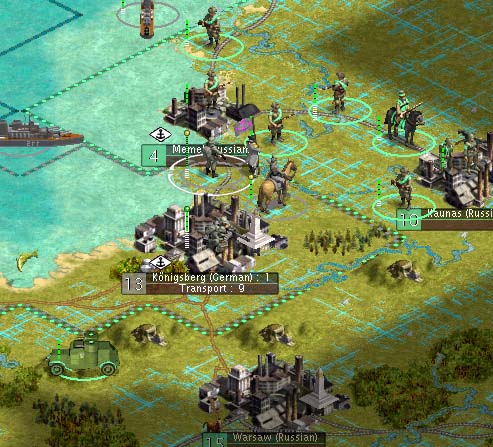
While problems plague the Western front, it is still nothing compared with the Eastern front. Here the Generals, Ludendorff and Hindenburg struggle with an extreme shortage of men and materials against an onslaught of Russians. In accordance with the Schlieffen Plan, the men at the eastern front were not to launch any attack, but only defend. This has left them quite vulnerable as Russian Cossacks launch raids and retreat at will. But one such raid on the eastern most city of Memel is proving to be vastly different. There the Russians keep coming and coming, with no retreat.
After several days of fighting, the Russians break through the outer barricades. Civilian defenders take up arms as they fight the invading Asian hordes, in house to house street battles. Hindenburg demands reinforcements to be sent to the east, but Moltke declines his demands. The Asian onslaught continues with overwhelming force, and Hindenburg reluctantly orders the retreat to Königsberg. Civilians and troops board transports in the shipyards, protected by the arriving Navy. Many more just walk. The news hits hard, Memel has fallen to the Russians in a fierce battle. Hindenburg vows to the Kaiser, “Memel will be free again.”
Battle of Memel - Casualties:
Deutschland
1 A. Machine Gunners
2 Kavallerie
5 G. Infantry
Russia
8 Cossacks
 Attachment: sot04.jpg Attachment: sot04.jpg
This has been downloaded 46 time(s).
Last edited by Kaos XIII on 20-04-2004 at 01:12
|
|
| |
|
| |
|
| |
|
|
|
Kaos XIII
|
|
beautiful coastal city of... Que te Importa
May 2003
time: 00:35
|
|
Thanks everyone!
Note: The casualty list will not be cumulative, as there are too many battles to keep track of. It’ll just be a report on the war dead for that battle, on that month (turn).
September 1914
The Western Front
Battle of the North Sea:
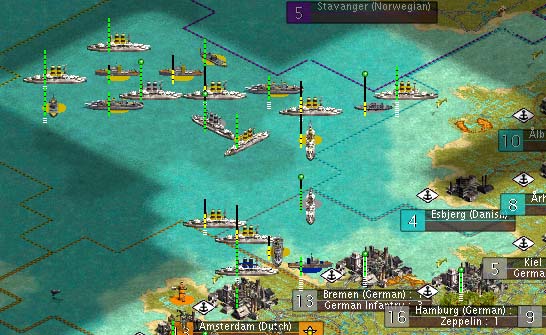
Admiral Tirpitz had previously reassured the Kaiser about the possibility of a lack of fleet action. But as the waters in the North Sea became colder, the sea hostilities became hotter. Early in the month, reports indicated the presence of many enemy ships, including several large cruisers, pre-dreads and BB’s. Considering that his current force at sea might not be strong enough to deal with the situation sufficiently rapidly, Tirpitz unleashed from the harbors of Bremen, Hamburg, Kiel and Lübeck, our own cruisers, pre-dreads, subs, destroyers which had not been sent to the East. It was evident that to be of any value, the support must be overwhelming, and carried out at the highest speed possible. We sent over 30 vessels to duke it out with the British.
Due to the mist coming from the southeast in September, there was a serious concern over losing the sight of submarines, and any possible sortie in force from the enemy's harbors. Our high speed, however, made submarine attack difficult, and the smoothness of the sea made their detection comparatively easy. Very quickly our two Navies came into contact and the Battle of the North Sea began.
Soon we found out, the British had sent large ships New Zealand, Princess Royal, Ajax, Liverpool, Orion, Colossus among many more which, were in route to bomb our shores. But we are not afraid, although our navy is outnumbered, among our own fleet are the BB’s Rhineland, Westfalen, Mainz, Kaiser, Heigoland, Nassau. Steaming through the cold waters our Navy battles the British for days. The turrets never stop, as each navy tires to outflank the other at high speeds. Among the many duties, the ships are also there to pick up survivors, and prisoners.
It gets very clear however, that the British have sent even more ships that we had thought. It didn’t matter how many British ships we destroy, because there seems to be 3, or 4 more waiting to counter. It becomes too overwhelming for our Navy and unfortunately many men are losing their lives. At the end of September, Admiral Tirpitz orders, what was left of our Navy to Bremen and Hamburg to get repaired. Of the 9 main BB’s that went into the North Sea, only the Wesfalen, Posen and Thuringin returned. 
When Admiral Tirpitz arrives to meet his friend the Kaiser, he does not mention the losses. “Your Majesty, we gave as good as we got. If not more”, says the Admiral.
However, Wilhelm had already known about the rumors of the many lost ships, “You numb-nuts, it doesn’t matter, because they have a bigger Navy than ours to begin with. There is no point in matching them in kill ratios.”
Disturbed over the personal attack, Tirpitz continues lying his a** off, “I understand, but we still have sufficient numbers left to defend the northern coast. And need I remind you, of our successes in the East. Besides things will go much smoother if you finally allow for unrestricted naval warfare.”
“That is not a politically viable option, you know that. The entire world will turn on us”, responds Wilhelm upset, over Tirpitz insistence of unrestricted warfare.
Frustrated, the Admiral answers, “How do you expect us to win, with one hand tied behind our back. Great Britain must be starved to death.”
“The neutral nations support Great Britain, but as long as none declares war we should try to keep them out of this. We have enough enemies as it is”, says Wilhelm.
Tirpitz had completely changed the conversation without the Kaiser knowing it. The Admiral is often called the “Eternal”, the name refers to his uncanny ability to remain in power despite his many failings.
Battle of the North Sea - Casualties:
Deutschland
4 Submarines
5 Destroyers
5 L. Cruisers
2 Arm. Cruisers
2 Pre-Dreadnoughts
4 BC
6 BB
Great Britain
6 Submarines
8 Destroyers
7 L. Cruisers
2 A. Cruisers
6 Pre-Dreadnoughts
0 BC
1 BB
Franco-German Border:
Along the Vosges Hills, our men showed considerable disorganization, as we took heavy losses. The situation of the trench line undergoes no essential change. The French troops continue to attack, but it becomes more and more evident to them, that the defensive preparations made are more extensive the closer they get. All their attacks fail, although in some places they are repeated and repulsed with heavy slaughter.
On our part, we attempt to advance slightly, and are unsuccessful as regards gain of ground, but it leads to the withdrawal and destruction of the enemy's infantry and artillery. The French Machine Gunners are holding strong lines of trenches, among and along the edge of the numerous woods which crown the slopes. These trenches are elaborately constructed and cleverly concealed. In many places there are wire entanglements and length of rabbit fencing. From Metz to the Vosges, the French have been fighting fiercely, but have also been unsuccessful in gaining ground. Even with all the Arty barrages the fighting is at close quarters and of the most desperate nature, the streets of nearby villagers are filled with dead on both sides. Unlike last month, we have dealt the French a heavy blow. The much-awaited charges have begun across the trenches, but it doesn’t seem as exciting, as our troops previously hoped.
Franco-German Border - Casualties:
Deutschland
1 Flame-thrower
3 G. Infantry
France
7 F. Infantry
3 Cavalry
Battle of Liège/ Belgium:
After much indecision, Moltke orders the full assault on the city and the rest of Belgium. We have been continually pounding the city for weeks with our siege gunners. When the big siege mortars enter into action they hurl against the enemy, shells weighing 1,000 kilos (nearly a ton), the explosive force surpasses anything known. Their approach is to be heard in an acute buzzing; and they burst with a thunderous roar, raising clouds of missiles, stones and dust. Inside the city, civilians and troops choke from the heavy dust. The screams of the enemy is heard and echoed in our positions. This only encourages our troops to go on the hunt.
This is the situation in Liège, as our troops charge the besieged town. We storm in from all directions in a hale of gunfire. We search every house systematically for Belgian soldiers that have been dispersed or in hiding. Along with the soldiers we confront many civilians whom have taken up arms. But these Guerrillas are quickly scattered and killed. The Belgians are in full retreat, as we chase them into the countryside. The city is ours! Soon after that, with fix bayonets, we go from house to house, from door to door, and though the harvest is very meager, we are not turned away quite empty-handed, as the inhabitants have to deliver up all privately owned fire-arms, ammunition, etc. The chief functionary of a local resident, who accompanies us, is to explain to every citizen that the finding of arms after the search will lead to punishment by court-martial. And court-martial means---death.
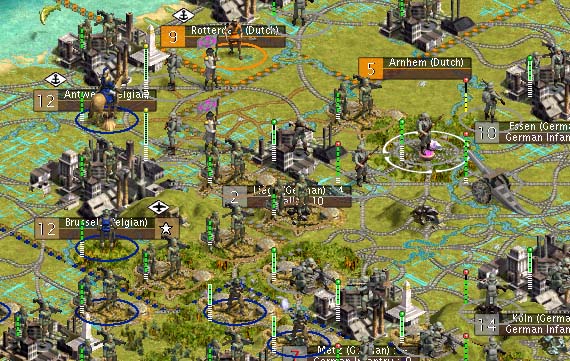
After the capture of Liège, Moltke insist on the full conquering of Belgium. But that’s impossible as we begin to confront French Infantry and Cavalry throughout the Belgian countryside. Moltke now becomes increasingly fidgety and neurotic. In Germany, everyone has lost faith in Moltke including the powerful industrialist families. When Moltke is ordered back to Berlin, he suffers a mental breakdown. Wilhelm then calls 53 year old Erich von Falkenhayn to tell him, the next move;
“Moltke is losing it, I can no longer keep him in command.”
Falkenhayn replies “This is an intelligent move, the belligerent General ended up being a little kitty.”
‘Sad really, Moltke is unworthy of the name he carries. His uncle must be turning over in his grave. But enough of that. I’ve called to tell you, that you, will be named the new Chief General.”
“Excellent, this is what I always wanted. I will make all Germans proud, you’ll see. Just like with the Chinese Boxer Rebellion”, responds Falkenhayn almost giggling like a little school girl.
“BTW, how is my son doing?”, asks Wilhelm. Crown Prince Wilhelm is the eldest of 5 sons. Wilhelm has little command experience, even though he trained as an officer at Potsdam at the age of 18. In line however with the German tradition of royal army command, he was given charge of Fifth Army in the western front, in August 1914. He is 32 years old.
“He’s doing superb, you should be proud of him. He will make an excellent leader one day”, Falkenhayn says, clearly hiding his true feelings. The second Supreme Command begins.
Battle of Liège/ Belgium - Casualties:
Deutschland
1 Kavallerie
5 G. Infantry
Belgium
7 E. Infantry
1 E. Machine Gunners
4 Guerrillas
France
1 F. Infantry
1 Cavalry
|
|
| |
|
|
|
Kaos XIII
|
|
beautiful coastal city of... Que te Importa
May 2003
time: 00:35
|
|
The Eastern Front
2nd Battle of Memel:
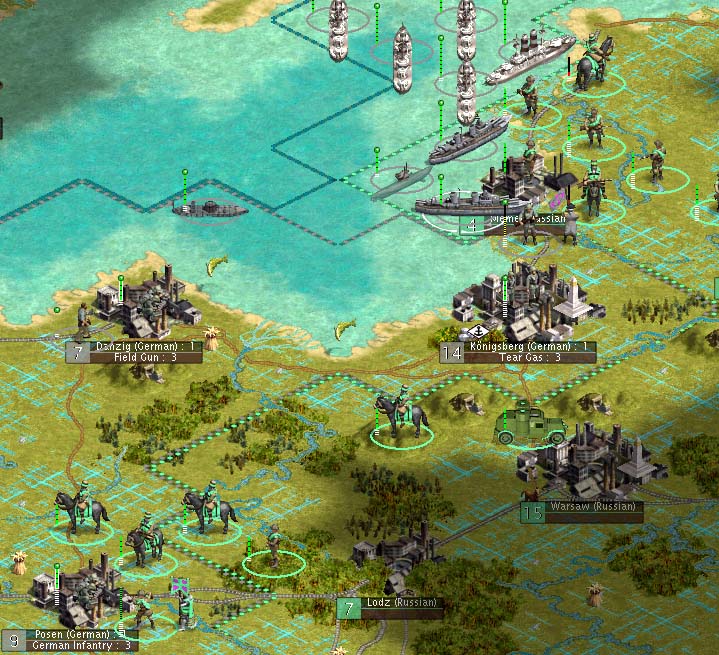
With Memel in Russian control, our ships are ordered to do a full naval bombardment on the city. Some of our German civilians are caught in this crossfire. But I’m sure they welcome it, as it means their liberation if they’re still alive. From Königsberg, Hindenburg sets out to recapture our lost city. Hindenburg is an old man at 67, but one of the greatest commanders of Germany alive. He actually retired in 1911, but was recalled during all the madness with the Archduke.
Although no reinforcements from the west are received, there is a significant garrison in Königsberg. After the constant bombing from the sea, our troops rush in retake Memel. As we approach the city from he south, the destruction of many buildings is evident, although possibly from our navy, we vehemently blame it on the enemy. The Russians are not ready for our attack and many flee when they see our soldiers’ approach, those who don’t retreat, get shot. Our troops have vengeance on their mind as we charge the Russians, yelling, “many enemies, many honors.” We quickly move into the center of the city and take over the shipyards, many Russian bodies now strewn along the streets. Soon the people of Memel come out, singing and dancing over the liberation. Church bells ring throughout the city as the Asian hoard is sent scampering home. The party last for days, as our troops are celebrated like heroes. Many of the Russian dead bodies are thrown into the sea, for the fish to eat.
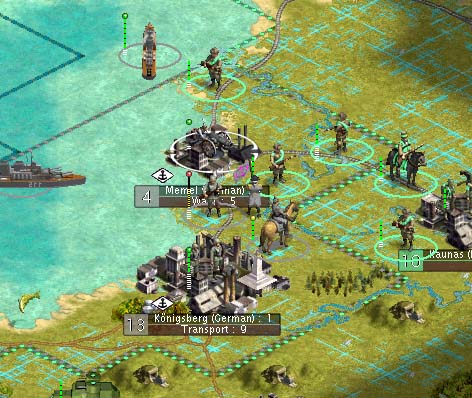
But the party soon ends. We are still surrounded by the Russians from almost all directions and the Russians counter in full mass. The first sign of the upcoming battle comes from the sea, as Russian subs and destroyers arrive for the fight. The fight is now on! Like a repeat of last month, the Russians break through our defenses, using a massive amount of men. Our troops fight valiantly for Memel, killing one Russian after another. But it seems there isn’t enough bullets for every Russian. Ammunition runs low, as the fighting again commences in house to house battles. It is the biggest battle of the war thus far. The fighting is so close, that bayonet charges and hand-to-hand combat ensues. Blood spills into the streets and onto the Baltic Sea. But the Asian attack is relentless. We are short on arms and men, with hundreds more being lost every hour. Hindenburg has no choice, but to order the commanders in the field, to retreat back to Königsberg.
But that isn’t the worse news out of the eastern front. In Hindenburg’s birth-town of Posen, Germany south of Königsberg the governor raises alarm, as sightings of Russian soldiers are reported. The Russkies were opening a second front in the east. The people begin to panic as small scale rioting occurs, probably from socialists. Hindenburg is told of the situation and makes it very clear in a telegram to Wilhelm and Falkenhayn, that “the eastern front is on the verge of collapse if there are no reinforcements sent. Posen, Memel, Königsberg could soon be overwhelmed!”
2nd Battle of Memel - Casualties:
Deutschland
2 Destroyers
2 L. Cruisers
11 G. Infantry
Russia
2 Destroyers
17 R. Infantry
10 Cossacks
1 Guerrilla
Attachment: sot07.jpg
This has been downloaded 37 time(s).
|
|
| |
|
| |
|
| |
|
| |
|
|
|
Kaos XIII
|
|
beautiful coastal city of... Que te Importa
May 2003
time: 00:35
|
|
October 1914
As summer turns to fall, the first signs of the war cost are appearing in Germany. Funeral services are now a daily occurrence in many towns, as bodies of the youth are brought home, from the east and the west. Under the threat of being ‘shutdown’ local newspapers only report the good news. The Memel situation is reported as a ‘strategic withdrawal’. Meanwhile headlines from underground papers, mostly socialists, report of catastrophic events, ‘Memel FALLS, Panic in Königsberg as they are next, Thousands dead in the West’.
Back in Potsdam, Kaiser Wilhelm learns of the news he has been waiting for. The Ottoman Turks have joined the Central Powers. “Our alliance is a force to be reckoned, now that the Muslamic barbarians have joined us”, says Wilhelm upon hearing the news. Hoping to regain lost territory in the Balkans, the Turks declare war on the Entente. Our brothers in Austria-Hungary have met fierce resistance from the Serbs. Fortunately, the Russians have not broken through their lines, as of yet.
The Western Front
Very beautiful fall days have now arrived throughout Europe. The nights are full of stars and trees are being painted in the colors of autumn. But it’s clear to all, this weather will not last; the gray winter days will set in soon. In the war room, the time has come for Erich von Falkenhayn to prove he is deserving of the ‘Chief General’ title. His first plan calls for the complete annihilation of Belgium done in one full thrust.
A massive amount of troops are ordered on the move for Antwerp, Brussels and Ypres. You have no idea how beautiful it is to see the troops marching along the road in columns as far as the eye can see, with the captains and lieutenants on horseback at the head of their companies. Our uniforms completely clean and pressed. But imagine how thrilling it will be tomorrow and the following days, marching toward the front, with the noise of battle growing continually louder before them.
Battle of Antwerp:
The battle for Antwerp starts like all the rest, with an extraordinary evidence of the artillery fire. The tree branches of the woods are all ripped to pieces; large size trees get broken clean off in the middle. Debris starts to fill up fast in the city as we move in for the kill. There is not a house on the main street that is escaping the fire. Quickly Antwerp falls, and remaining is nothing but blackened walls and here and there, the inhabitants standing with shocked faces in their ruined doorways. The scene of the marching columns down the ruined streets, a scene that should be becoming more familiar to us.
Battle of Antwerp - Casualties:
Deutschland
1 A. Vehicle
Belgium
1 E. Machine Gunners
2 Guerrilla
France
1 A. Vehicle
2 Cavalry
Battle of Brussels:
Simultaneously with the attack on Antwerp, the men outside Brussels launch the assault on the capital. The Belgians defend their capital as if their life depended on it, actually it kind of does. Where as in Antwerp and Liège we were fighting guerillas, here we are fighting the top Belgian force. We come expecting a 1 day battle, but instead we get bogged down in different parts of the cities and the hours turn into days. It is a battle of the most barbarity. It doesn’t matter how brave one is, the fear of going down in such a dreadful hell can put fear into anybody. But little by little, we begin to reign in control of the city. Soon the belligerents fade away and Brussels is in German hands.
Battle of Brussels - Casualties:
Deutschland
7 G. Infantry
Belgium
2 E. Machine Gunners
3 E. Infantry
2 Guerrilla
Battle of Ypres:
With Brussels and Antwerp complete, only Ypres remained. Men from both the Brussels and Antwerp fighting were sent in droves to take Ypres. Along the way, there are major scuffles with French troops. Among the bullets flying by, we also yell insults at each other. It is with great joy, that we remind them that soon, we’ll be fighting in France.
A limited number of sea vessels are sent to bombard the city, as well as confront the French navy. Ypres is a small coastal town, but it is the Belgians last desperate stronghold. That desperation shows, as we take on the biggest casualties thus far in the western front. We are not even fighting professional soldiers, more guerilla type units, but one can see the look of enraged defiance on the Belgian faces. The battle goes from house to house, and soon the men are beating each other with the buts of their rifles, they are so close.
In the end, Ypres is secured and the ‘Rape of Belgium’ is complete, but at a staggering cost, 10 Infantry units in Ypres. With Belgium gone, newly named Chief General Falkenhayn arrives for troop inspections and to consult with the Generals. He visits many of the battle sites and is revolted by the sight of seeing young men with their skulls caved in, their intestines ripped out and their arms and legs scattered about.
In a letter to his wife, Falkenhayn writes;
“I arrived around noon yesterday in Belgium. Although Belgium is completely under our control I can still hear the sounds of artillery going off. The major fighting has been over for several days, and yet many bodies lay lying all over the place. The stench is terrible, something unimaginable. I’ve not seen anything like it before, Peking was nothing compared to this.”
Battle of Ypres - Casualties:
Deutschland
10 G. Infantry
1 BB
Belgium
1 E. Machine Gunners
6 Guerrilla
France
1 A. Cruiser
2 Cavalry
Rape of Belgium complete
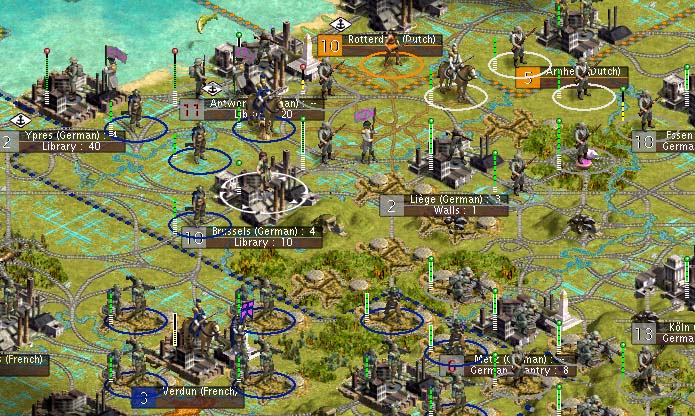
While Falkenhayn visits Belgium, the French Generals execute a surprise counter in the Argonne.
Battle of Metz:
For 3 months our city of Metz, has been subjected to constant bombardment from the trench line. In return we have been firing at the French city of Nancy. But not since the early days has there ever been an attempt to cross the trench line until now. The French Corps units consisting of Cavalry units arrive in force, forcing our troops to retreat and to leave their trenches behind. Soon the Road to Metz is open and the French launch a daring attack on the VERY heavily defended city. The defenders of Metz fight bravely, but unfortunately they were caught off guard. Many buildings were destroyed in the battle, as civilians’ stream out of the town to the east. Lot’s of men were lost in Metz, but we still held on to the city.
Battle of Metz - Casualties:
Deutschland
5 G. Infantry
France
0
|
|
| |
|
|
|
Kaos XIII
|
|
beautiful coastal city of... Que te Importa
May 2003
time: 00:35
|
|
The Eastern Front
While some men are now being sent to the east, Hindenburg is still seriously upset over the lack of large reinforcements available. He discusses this with a friend named Max Bullinger, a leading industrialist.
Hindenburg on a private phone says, “I’m sick and tired over the lack of attention in the east, by those idiots in charge. Moltke, Falkenhayn they’re all the same. France should have already been defeated 6 weeks ago!”
“How can I help?”, asks the industrialist speaking with a large cigar in his mouth.
“Put some pressure on the Kaiser for me. And get your newspaper friends involved also.”
Chucking, Max asks, “That’s a big favor, what’s in it for me?”
Hindenburg responds, “Well once Falkenhayn is gone, I’ll be a step closer to being in charge. Most likely I will be in charge because I’m just, that damn good. Once in power, I think you will see some more contracts going your way.”
Considerably more happy, that this conversation hasn’t been a complete waste of time, Max says, “I like how you think. I’ll talk to some paper editor guys, don’t worry they are very trustworthy.”
3rd Battle of Memel:
While Hindenburg prepared for the defenses around Posen, his no. 2, Gen. Ludendorff plans once again, for the Battle of Memel. Ludendorff is also responsible for Königsberg, whose garrison is quickly dwindling. The battle begins once more at sea, where we still hold the advantage. We blast their ships and their troops inside. The charge to Memel by our Infantry and Cav makes a sweeping move to the east, in an effort to cut off the Russkie Infantry. Like the previous battles, this one turns into a street battle from buildings and houses.
This time our force is not that large and we need all the units to remain at full strength after the eventual capture of Memel, to defend. But unfortunately the liberation of Memel is becoming too costly, as our troops keep going down. Anyway, we are able to force the Russkies into a retreat. Memel is free once again. Unfortunately, the price is too much, there is hardly anyone left to defend. The top commander in Memel, named Zwingli, makes swift demands from Ludendorff, “We’ve been cut down a lot. There were too many losses, we need more troops.”
From Königsberg, Ludendorff responds, “There are no more men. Königsberg needs the present garrison here. You must defend Memel with what you have.”
Angrily Zwingli says, “You are crazy! We’re outnumbered by around 4 to 1.”
Ludendorff screams right back, “Prove your worth as a commander! DEFEND!”
“Did you hear what I said, it’s 4 to 1!”
In a relaxed and calm voice, Ludendorff now says, “So many enemies, so many honors.”
“*******”, is Zwingli’s only response, as he hangs up the phone.
Liberation of Memel, again
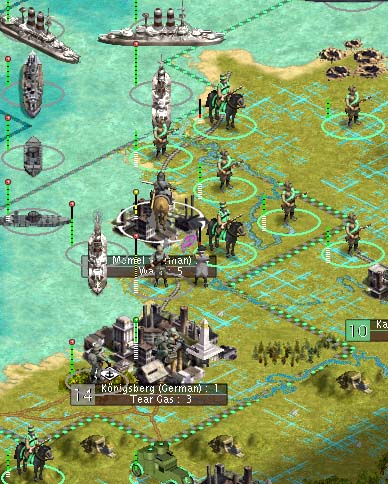
The defense of Memel begins with many of our troops running throughout the streets trying to defend several key locations at the same time. But the effort is futile, there are just too many Russians. The city falls again for the 3rd time.
3rd Battle of Memel - Casualties:
Deutschland
1 A. Cruisers
6 G. Infantry
3 Kavallerie
Russia
3 A. Cruisers
3 Destroyers
14 R. Infantry
2 Cossacks
1 Guerrilla
Back in Posen, Hindenburg is given a status about the Memel situation, by Ludendorff, “Sir, I’m sure you’ve heard by now, our troops could not hold Memel.”
“What happened? Why didn’t we have proper defenses set up in Memel.”
Ludendorff says, “Well I spoke with the Commander in charge of Memel and he seemed pretty confident that we would succeed. I even offered up troops from our depleting garrison in Königsberg, but he refused.”
“That moron, who was he? I want to speak to him”, demands Hindenburg.
“Well unfortunately, he perished in Memel.”
“Listen to me carefully, the ridiculous fool we have as Chief General, Falkenhayn, has ordered no more attacks on Memel. It’s over, just defend Königsberg, we’ll worry about Memel later on. Instead, there is now a policy of isolation for Memel”, says Ludenburg.
“Is there going to be, non-stop naval bombardment of the city?”, asks Ludendorff.
“Actually, they are going concentrate on the countryside, we shall starve everyone there.”
“Won’t our civilians die also?”, asks Ludendorff.
“Most of our civilians have left, those who stayed are probably socialists anyway.”
Fighting near Posen:
In Posen, there is limited action and only some skirmishes between our Cavs. However, from some of our advanced scouts, we have learned of the presence of the Brusilev and Kerensky Corps in the vicinity of Posen.
Fighting near Posen - Casualties:
Deutschland
3 Kavallerie
Russia
5 Cossacks
|
|
| |
All times are GMT. The time now is 05:35.
Apolyton Time is 00:35. |
top of page
|
|
|
Forum Rules:
You may not post new threads
You may not post replies
You may not post attachments
You may not edit your posts
|
HTML code is ON
vB code is ON
Smilies are ON
[IMG] code is ON
|
|
|
|
|
|





 09-04-2004 09:01





 |
|