|
| |
|

|
#endgame
|
 |
of the town of ZZT
Dec 2003
time: 15:36
|
|
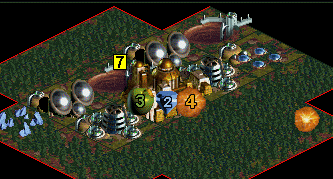
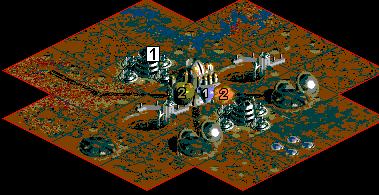
I've been trying 1 space cityspam lately, seems to work alright.
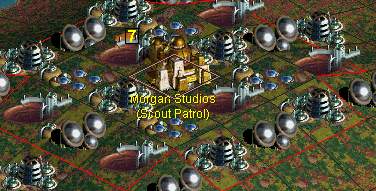
The setup I use requires 7 workers and works every square in a tessellation (sp?), so crawlers aren't needed, excepting rushing and habcomplexes aren't needed except for specialists or morgan.
E = Mirror + Road
S = Solar
B = Borehole
X = Base + Sensor
C = Condenser + Farm (+ Enricher)
code:
 BE
CXCS
 BE
Noting that SMAC has the iso tiles that are painful to draw in ASCII art.
Morgan could probly get by with 4 workers (2 on boreholes, 2 on mirrors) and crawler the nuts and solar.
Could someone try this out and see if it is any good? (I do alright with this setup, but I want to see if it's lack of skill on my part holding it back.)
I also beeline for restrictions, rather than IA, since I don't really need crawlers that urgently.
Morgan:
cent eco
biogenetics
social psych
industrial eco
ethical calculus
gene splicing - 3+ Nuts
eco eng - 3+ Mins
env eco - 3+ Eng
Zak for some reason has to have a "Null Tech" (i.e. one not on the beeline due to the way research options are handled by the game). Either SotHB and hope for another free tech, or get planetary nets and you have all you need to boom.
Zak 1:
Earlier restriction lifting
cent eco
biogenetics
social psych
ethical calculus
gene splicing 3+ Nuts
eco eng - 3+ Mins
Null tech
ind base
ind eco
env eco
Zak 2:
Earlier Null Tech - Hope to get SotHB
cent eco
biogenetics
ind base
ind eco
social psych
Null
ethical calculus
gene splicing - 3+ Nuts
eco eng - 3+ Mins
env eco - 3+ Eng
For those who actually try this, could you post some stats about how fast you grow, when you get each tech, etc.
Thanks in advance.
#endgame.
Thanks in advance.
|
|
| |
|
|
|
Blake
|
 |
Brainfallocatione
Oct 2000
time: 17:36
|
|
While original I have a hunch this wont work well compared to plain forest/borehole or condensor/borehole, mainly because the extreme suckiness of echlon mirrors, but lets see anyway:
I figured out the block of 8 tiles that comprises each base+terraforming:
20 Food
17 Minerals
37 Energy
(I raised the solar panels to 3500, which also raised the echlons to 2000+, more investment in raiseland seems unlikely, also 3 rolling, 2 flat tiles)
Compare to straight forest w/ Hybrid Forest:
18 Food
24 Minerals
32 Energy
Both are running FM.
As suspected the forests produce (significantly) more minerals, a little less energy and food, while costing WAY less terraforming. But ofcourse a treefarm and hybrid forest are required for forests - but these facilities do carry +50% econ, +50% pysch.
With soil enrichers the dynamics change, with +7 more food for the echlons.... good for specialists, requiring more infrastructure development.
Because the solar/echlon doesn't give much more energy than hybrid forest, the commerce argument wont hold much weight. So that leaves specialist income, and that will definitely be better going straight condensor/borehole, even going down to 1 borehole per base, allowing twice as many size7 bases per 8 tiles...
Original anyway, I might try it in a real game, but the analysis suggests that it wont do much better than straight forest/borehole, while requiring heaps more terraforming.
|
|
| |
|
|
|
Blake
|
|
Brainfallocatione
Oct 2000
time: 17:36
|
|
To get the WP, you want to rush rec.tank, rec commons in a base with a nut special in the radius, pod-boom this base to size4 and have it work on the WP as soon as the rec commons are done. It'll be too late by the time the eco.eng arrives.
IMO it's not worth using dense base spacing, instead aim for each base to work 4 boreholes and ~7 forest tiles, don't use strict base spacing either, 2-tile spacing works fine. Before hybrid forests build condensors to cover the borehole food decifict, but theres little point in having them around post-hybrid forest. Each big base will produce 50+ minerals w/genejacks, this is enough to produce entire clean shard infantry, or shard choppers/rovers in 1 turn.
This is where the crawerless strategy excels, extracting as much minerals from the ground as possible and putting them through amplifying facilities. Trying to play crawlerless but with packed bases & condensors is just deliberately hurting your play because it's obviously going to be better to crawl the nuts.
In contrast it is difficult to say where exactly crawlers will significantly improve the forest/borehole/mega mineral strategy (other than for rushing SP's), it's not as if the crawlers will allow more mineral production, and they wont help energy or food production significantly, because all the tiles are balanced. You need to say "well replace the forests with condensors and increase the base density" but by doing that your changing the strategy and reducing it's main strength - concentration of infrastructure allowing rapid production of entire high-tech military units! Thats the cool thing about megaminerals, it's not just playing without crawlers by choice, it's a strategy where crawlers arent even useful.
|
|
| |
|
|
|
Blake
|
|
Brainfallocatione
Oct 2000
time: 17:36
|
|
Using every trick in the book?
Refuse to trade tech, unless it gets you to env.eco faster. If you grab optical computers, non-linear mathematics, secrets of the human brain etc etc from the AI's, then suddenly your techs are taking 20 turns apiece.
If your Morgan or Lal - get Ind.Econ early, and run FM. Problem solved.
If your Dee or Yang - Get Plan.Nets at some point, get a base to size 6 and create 3 libarians, this should keep the techs down below about 8 turns apiece (assuming no rampant trades). It's better if you can trade for plan.nets, inf.nets is okay too, because the netnodes will help.
Rivers can also help if your REALLY starved, drill them everywhere (obviously only for non-freemarketeers)
One of the biggest benefits of using unorthodox beelines is it develops the flexibility nessecary for blind research games.
I played a game as Yang, huge map, 30-50land/flat/standard life/dense rain.
It took me until 2167 to get Eco.Eng, then 2198 to get Env.Eco - but in the meantime I'd also got inf.nets and plan.nets. This was all with 0 AI contact, meaning no tech trades or commerce income. Yang is probably the slowest research faction, I'd think a freemarketeer or Dee would do it about 20-30 turns faster. But anyway in that Yang game I was down to 4 turns per tech, which is pretty good for the yangster, by 2208 I had Planetary Economincs and that vital AV - bear in mind this being SMAC the tech to planetary economics is different to SMAX.
|
|
| |
|
|
|
Santiago_Claus
|
|
Echelon Mirrors and solars are anti-ICS because their efficiency is a function of their density.
Boreholes, on the other hand, have a maximum density, incidentally the same maximum density as bases: 1 per 4 squares. This density limit makes close base placement cost nothing, since the bases are taking up space that's unusable anyway.
... thus the popularity of Swiss Cheese ICS ...
|
|
| |
|
|
|
Blake
|
|
Brainfallocatione
Oct 2000
time: 17:36
|
|
Morgan is a faction that benefits very little from crawling resources (rushing SPs with crawlers is an entirely different matter). Morgan gains big by packing in bases close, the extremely dense and rapid base expansion combined with poor support for formers means Morgan can easily run out of tiles to work - let alone crawl! A tech to env.eco does seem to work well, you borehole at one base to cause a pop, and build treefarms everywhere, when every tile worked is 2-2-2 you can positively pump out colony pods while getting scads of energy for rushing and tech and raising land to reclaim sea if you run out of space (treefarms are also +50% econ, meaning you can delay building energy banks for a bit...).
The main reason morgan mass expansion works, is that a Morgan base - producing ~7 energy, is one of the few better investments than a crawler. In fact Morgan bases are even generally better than formers, past a token number (prehaps a dozen) to road and forest everything. As Morgan you shouldn't bother with the WP, instead get the HGP (save up, and rush the last half for ~400 credits). Later, with the advent of clean reactors, you can start doing heavy terraforming, but until then stick with the roads and forests (other than for the >pop< base), because more bases is a far better investment than more formers to do heavy terraforming. Still I think that for morgan, you shouldn't found bases inside existing bases radius - that spacing is so close that it reduces the effect of expensive infrastructure a bit too much.
|
|
| |
|
|
|
Sikander
|
 |
Boulder, Colorado, United Snakes of America
Jan 2000
time: 22:36
|
|
quote:
Originally posted by #endgame
Thanks for the tips, Blake. I've always liked Morgan.
The HGP first? I'll try it. I also believe that spacing bases as densely as I like them means that i will really want the PEG.
Also, the pattern I use means that:
r= radius
x= base
code:
    X
   r r
  r r r
 r r r r
X r X r X
 r r r r
  r r r
   r r
    X
The non-iso version:
code:
XrrrX
rrrrr
rrXrr
rrrrr
XrrrX
Means that each base is outside the radius. Is that what you mean? Or is it too close to be useful? |
That looks like "2 on the diagonal" spacing, ie every base is two tiles (one intervening tile) from every other base to the NSEW. Bases in the center of the pattern have a total of 8 tiles (7 workable tiles and the base tile). With maximum boreholes every base has two boreholes minimally, though a lot of bases will be on the periphery and will have 3. This is a little tighter than Blake spaces his bases most of the time, though it does meet his critereon of having no bases within the production radius of another base.
IIRC Blake tends to prefer having 8-10 workable tiles for his bases, which puts him into a position to max out or nearly max out his base populations with hybrid forests and an all forest forming style. Boreholes cut into nutrient production considerably though (minus 25% not including base tile production), and to make up for that Blake either waits for nutrient satellites or builds a few condensor / farms (which don't need to be in the base radius if you use crawlers), or simply does without the extra population.
One advantage of the condensor / farms is that they are prime candidates to be crawled, with the worker becoming a specialist. This is of course more of an investment in former time than one would like to make (in comparison with forest only forming), but there is a time and a place where it makes sense, particularly as your bases are heavy in infrastructure and any little gain in raw productivity is magnified by all of the base facilities, while your formers are plentiful enough (clean reactors are nice) and your forming mature enough to make the investment in former time worthwhile. The slower your research / tech accrual rate the more likely intense forming will pay off for you, as you are that much further from satellites etc., more vulnerable to limitations on "horizontal growth", and have that much more time for your formers to do their magic.
|
|
| |
|
|
|
CEO Aaron
|
 |
Everything has its price. Even you.
Aug 2002
time: 05:36
|
|
Endgame: Start drilling your boreholes in a candidate base as soon as you research Ecological Engineering (raises mineral restrictions). Tree farms are one tech away, along with the rasing of energy restrictions, making boreholes the undisputed FOP king until you get satellites.
Sik: I utterly agree, all my recent ventures into my game have involved adapting your condenser/borehole/specialist strategy to Morganite play. Which is not to say that I've been entirely successful. For one thing, Morgan's standard jump to Biogenics for tanks makes early terraforming a bit dicey, as it winds up being your second tech, possibly even later. I don't worry so much about the support hit for extra formers early on, I'm convinced they pay for themselves quickly, and the extra energy Morgan gets compensates for somewhat curtailed mineral production. The biggest impediment I find to my strategy is fixations on base placement. I play on large maps with abundant native life, so very frequently I have trouble clearing out base sites as fast as my bases can produce colony pods. As a result, I've adopted a more haphazard placement scheme, depending primarily on which sites can be most readily prepared.
I am curious to learn if you have any guidelines as to what ratio of formers are devoted to roading and base placement as opposed to those devoted to improving tiles, whether you use former gangs, and if you road everywhere or just create a grid of connected bases.
|
|
| |
|
|
|
Sikander
|
|
Boulder, Colorado, United Snakes of America
Jan 2000
time: 22:36
|
|
quote:
Originally posted by CEO Aaron
Sik: I utterly agree, all my recent ventures into my game have involved adapting your condenser/borehole/specialist strategy to Morganite play. Which is not to say that I've been entirely successful. For one thing, Morgan's standard jump to Biogenics for tanks makes early terraforming a bit dicey, as it winds up being your second tech, possibly even later. I don't worry so much about the support hit for extra formers early on, I'm convinced they pay for themselves quickly, and the extra energy Morgan gets compensates for somewhat curtailed mineral production. The biggest impediment I find to my strategy is fixations on base placement. I play on large maps with abundant native life, so very frequently I have trouble clearing out base sites as fast as my bases can produce colony pods. As a result, I've adopted a more haphazard placement scheme, depending primarily on which sites can be most readily prepared.
I am curious to learn if you have any guidelines as to what ratio of formers are devoted to roading and base placement as opposed to those devoted to improving tiles, whether you use former gangs, and if you road everywhere or just create a grid of connected bases. |
I know what you mean about finding suitable base spots in a rigid pattern, but you should generally be able to find a suitable tile next to the rigid style base tile which will work just fine, as the overlap in base radii is pretty forgiving. Abundant native life can make even this somewhat taxing admittedly, but it can be a problem for anyone as those fungus fields can be pretty big.
I tend to choose formers as my first tech, which gives me a leg up on the road network, and I tend to stress roads over forest early on in order to speed my colony pods to their destinations as well as reducing the time needed to put in the road (over puting it in later on a forest tile). I also don't gang form all that much early on, and simply build forests on my road net for the most part. But this is Zach based strategy where I pick formers as my first tech, and I haven't recently compared a Morgan game to see which works better. Going for the tanks first offsets the support penalty and obviates the need for a 2 nutrient tile, which is a pretty big advantage.
That said, I'm not all that dogmatic about my forming in the early game. If I need nutrients I build farms, if I need minerals I build forests, and I almost always build roads before I further improve a tile, and I try to improve tiles which link bases to one another over tiles that don't.
I'd probably go with forest and eventually boreholes with Morgan honestly for a couple of reasons. Firstly, he gets that extra energy so easily that workers pay off better (in comparison to other factions) in almost any SE setting. He has the choice of FM alone, Wealth alone or a Golden Age, which can also be used to pop-boom with Democracy and Creches. Secondly, he also has that support hit to limit his early former spamming somewhat, and forests are cheap in former time and high in minerals. Finally, he has to GA pop boom if he is going to pop boom at all, and this is easier / more productive with your population working Hybrid forests vs condensor farms.
Once you have clean reactors the choice becomes more difficult. On the one hand there is no question that you will eventually produce more energy equivalents with the boreholes and crawled condensor farms and the specialists they support. On the other hand the benefits will be more marginal because of your own hab limits and the need to GA in order to pop boom. The crux of the question is whether the extra former time is worth the trouble, and if so when is it worth the trouble? A lot depends on your style of play as well.
For instance if you are spamming bases like mad you might prefer to use more specialists in order to control B-drones by limiting your workers per base to 2-3. If orbital nutrients are at hand then the extra nutrient that a condensor / farm gives you over a hybrid forested tile might not be worth the effort, even if you are crawling it. Conversely if space is at a premium or you can add soil enrichers to condensor farms then you might prefer to do so. If you have the cloning vats, worries about getting GAs in order to pop-boom are laid to rest.
A quick look at the numbers. Assuming an interior base with 2 on the diagonal spacing, recycling tanks, no specials or rivers and +2 econ. =
7 workable tiles + the base tile
Case 1
All forest with a Tree Farm produces 17 nuts, 16 mins, and 16 raw energy (not counting the base tile for energy as it can really vary accoring to SE, and also obviously ommitting any commerce income). This allows a population of 8, with one specialist producing another 3 energy equivalents assuming he isn't a doctor.
Case 2
With a hybrid forest: 24 nuts, 16 mins, 24 raw energy, allowing a population of 12 (one more than had complex limit without the AV), with 4 specialists (assumes the hab limit is in force) producing another 12 energy equivalents, or 15 if you pod boom or have the AV.
Case 3
Condensor farms & boreholes: 23 nuts (from 5 crawled condensor / farms + the base tile), 14 mins, 14 raw energy (plus the base tile production and any commerce of course). Enough nutrients for 11 population with 9 specialists producing another 27 energy equivalents. A substantial advantage also accrues in that you only have 2 workers, making drones a minor problem at worst, while this setup makes GA pop booming more difficult as even if you work the condensor / farm tiles temporarily your raw energy production is lower.
Case 4
Hybrid forest & boreholes, crawling the forest tiles: 18 nuts, 14 mins, 14 raw energy. Enough nutrients to support 9 population, with 7 specialists producing another 21 energy equivalents.
Total energy production (minus base tiles & any commerce, and assuming population limits are relaxed by pod booming or AV or both, and also not taking into account any energy lost to inefficiency)
Case 5
Hybrid forest and boreholes, working all tiles: 18 nuts, 24 mins, 29 raw energy. Enough nuts to support a population of 9, with 2 specialists adding another 6 energy equivalents.
Case 1: 19
Case 2: 39
Case 3: 41
Case 4: 35
Case 5: 35
As you can see, minerals are about the same in each of the configurations listed above except for a considerable mineral bonus in case 5, and the energy equivalents are pretty close in all of the last four cases. The difficulty in the worker heavy schemes is in keeping the drones at bay, which will suck up some energy and minerals in the form of doctors, facilities, police and / or SPs. Another factor not accounted for is inefficiency losses, though one could perhaps roughly balance this against commerce losses for specialist heavy schemes. The best producer in terms of former time is probably Case 2. Case 3 might suffer from difficulty GA pop-booming as well as a considerable amount of extra former time to put in those 5 condensor farms.
Of course I typically lay forest first, build tree-farms and sometimes do a short pop boom early in order to boost production. With Morgan I would certainly consider driving straight to Hybrid Forests (get the Energy Guild along the way to reinforce your money advantage) after restrictions are lifted and then booming from there, using Case 2, 4 or 5 above as my forming / production paradigm.
I'm curious what your game is like. Do you pop boom, and if so when? How many bases to you build before hand assuming that you do pop boom? Do you pod boom at all?
|
|
| |
|
|
|
Blake
|
|
Brainfallocatione
Oct 2000
time: 17:36
|
|
I feel I should go into further depth on my preferred terraforming style, in the perfect world, each base uses a total of 12 tiles, 3 of which will be boreholes, 8 forests and 1 basetile (the basetile produces the same resources as a forest)
The total minerals is 36, once pumped through a genejack that comes to 54. 50 is the "magic number" at shard technology, because it allows clean shard infantry and non-clean shard chopper/rovers to be produced in 1 turn. The 4 extra minerals act as a support buffer for the non-clean stuff - once a base drops to 50, it just builds clean stuff.
Total food is 27, enough to get a base to size 13.5 - in reality some bases could work 1 extra forest for size 15 (or stable at 14), others one less for size 12 - there is flexibility.
Bases will also have a few specialists, that may be doctors, empaths or thinkers if 10% pysch doesn't provide enough drone control.
Total energy will be 36 (48 with +2 econ), and additional commerce - which can be very significant under the right diplomatic conditions - definitely somewhat offsetting effeciency losses.
In practise because of loose base spacing, I end up with bases in 3 production ballparks -
30 minerals - cramped bases, suitable for units like probes and new colony pods - may be half full of specialists too.
50 minerals - interior bases, for the shard troopers.
80 minerals - frontier bases working 6 holes, capable of pumping out some very fancy units in 1 turn, stuff like 1-6-2*2,AAA,Drop. Also 4 turn planetbusters are nice.
With the 2nd mineral booster facility, some bases get moved up a bracket, although many are left with just genejacks, because 30 mineral bases ARE useful.
The ability to outright build anything I need for a warmachine somewhat offsets the fairly low energy, no cash is needed for shell upgrades. Also all (or most) my formers get pulled off infrastructure efforts to build landbridges and magtubes, delivering the freshly produced troopers to the (rapidly advancing) frontline. Tech will remain at 3-4 turns per tech, but I don't feel this is a huge problem, as there is such a huge void in weapons technology after shard and magtube - for example, challenge games (won with military) almost always end at shard weapons.
So it's very much safe to say, that my strategy is designed to create a truly fearsome warmachine at shard technology, that is the climax in strength. It would quite definitely be a considerably slower transcend than specialist strategies - but remains more than sufficent to transcend in any challenge game - and the investment also relfects the transcend time, the bases are not densely packed, dramatically reducing investment in facilities, the forest isn't replaced with farm/condensor/enricher, there is no need to build legions of crawlers. For the investment it's a pretty darn good way to maximize your minerals, and thus capacity to build military.
|
|
| |
All times are GMT. The time now is 05:36.
Apolyton Time is 00:36. |
top of page
|
|
|
Forum Rules:
You may not post new threads
You may not post replies
You may not post attachments
You may not edit your posts
|
HTML code is ON
vB code is ON
Smilies are ON
[IMG] code is ON
|
|
|
|
|
|





 10-06-2004 05:57


 Attachment:
  Attachment:


 |
|