|
| |
|

|
nbarclay
|
 |
Huntsville, Alabama
Dec 1999
time: 23:33
|
|
When you're ahead of other civs, you can reduce your GNP, Mfg. Goods, and Productivity by taking laborers off tiles. (Just remember to put them back before you finish your turn!) The changes in rankings can tell you where the other civs are, although not which civ is in which place.
If I'm still in first place in GNP if I reduce my GNP to 120, but I'm in second if I reduce it to 119, I know my closest rival has a GNP of 120 (at which point we are tied for first). Similarly, if I'm fifth in Productivity at 108 but sixth at 107, I know the civ that's in sixth place in Productivity has a Productivity of 108. Fiddling around to pinpoint exactly where the changes occur is somewhat time-consuming, but in PBEM games, I like to do it to get an idea where I stand. And I've been known to do it occasionally in SP games too, although I don't do it anywhere near as much.
In some cases, you can also find out where civs that are just a little ahead of you are by seeing what happens with laborer assignments that get as much gold as possible or that get as much production as possible. But there's a limit to how mcuh can be done with that, so if another civ is very far ahead, there is no way to pin down exactly how far. (When Theseus entered his golden age, I found myself in that position, trailing but unable to tell by how much.)
One of the big puzzles is trying to figure out which civ is which. Normally, there isn't really a good way to do that. But when a civ is in anarchy, its Mfg. Goods drop to zero and its Productivity is clobbered by the need for a lot more entertainers (since military police and the luxury slider are both useless in anarchy).
Based on that, I know Theseus could not possibly have been in the top three in Mfg. Goods or Productivity while he was in anarchy. For Theseus to be second or third in those categories with his anarchy over, one of the other civs would have had to drop a huge amount at exactly the time Theseus came out of anarchy. That makes it highly improbable that he's second or third in Productivity, and essentially impossible that he's second or third in Mfg. Goods.
The GNP situation is a lot tricker because in anarchy, a civ does get its base GNP but does not get bonuses for libraries, marketplaces, etc. Further, Theseus has lots of libraries but probably no marketplaces, so his GNP would be a lot higher if he sets his science rate high than if he sets it lower. (Yes, buildings do affect the GNP figure on F11.) Nonetheless, it seems more likely to me that the second place civ went up from 114 to 120 than that it went down from 114 to 105. On the other hand, for Theseus to be below fourth, an AI would have had to jump from 88 or below to 103 or above. Thus, Theseus's being third or fourth in GNP seems like the most likely possibility, not that I'd bet my life on it or anything like that.
By the way, I wasn't paying attention in my original analysis but Egypt, Babylon, the Celts, and Carthage were in Republic while Theseus and I both chose Monarchy (thanks to how seriously nerfed Republic is in the AU Mod and how important military forces are going to be when and assuming we start sicking AIs on each other). That difference in governments gives those AIs relatively high GNPs compared with the size and level of development of their empires.
|
|
| |
|
|
|
nbarclay
|
|
Huntsville, Alabama
Dec 1999
time: 23:33
|
|
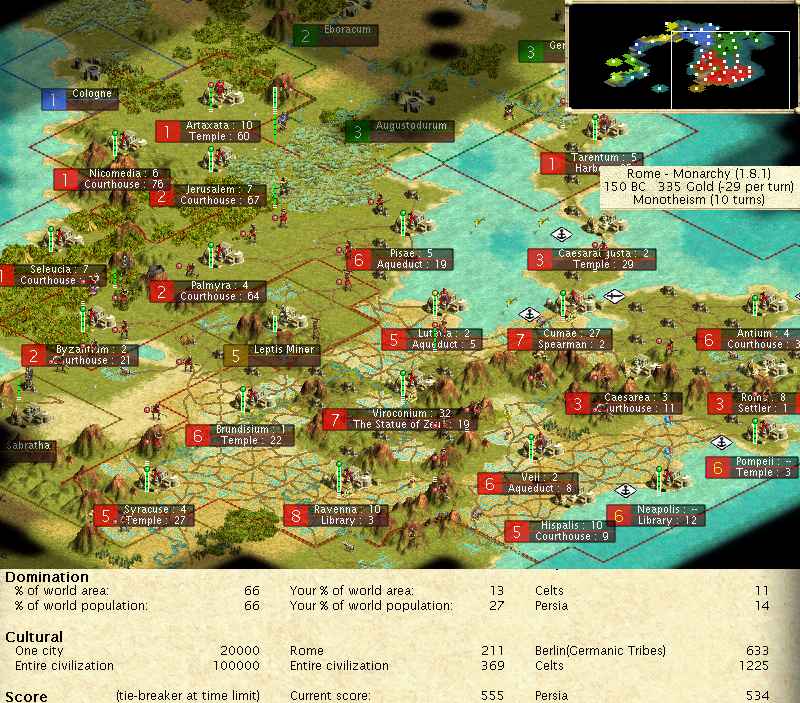
The Romans continued to send forth settlers to build new cities, but the world was starting to get crowded. In 250 BC, the Germans founded the city of Cologne, blocking off the sites of what were intended most likely to be the two northernmost Roman cities. Rome responded by immediately founding Nicomedia a lot closer to Jerusalem than was originally intended. The city of Seleucia followed in 210 BC with the goal of crowding the Carthaginian city of Oea, which Hannibal had founded 7-7-4 from Byzantium.
That left one more settler in the northern area looking for a place to call home, but that band of settlers had to wait for some Celtic and German forces to march through and get out of the way. Finally, in 150 BC, the city of Artaxata was founded. That completed the settling of Rome's homeland, aside from the plans to move the capital in a few turns. Until something changed as a result of war, cultural conversion, or settling islands, Rome would be an empire of twenty-two cities.
 Attachment: bc 150 rex complete.jpg Attachment: bc 150 rex complete.jpg
This has been downloaded 113 time(s).
|
|
| |
|
| |
|
|
|
nbarclay
|
|
Huntsville, Alabama
Dec 1999
time: 23:33
|
|
When the year 10 BC rolled around, and with it the end of the agreement for Rome and Greece not to enlist allies against each other, Caesar got really nervous. But the time passed and the Greek leader showed no interest in starting an immediate war.
In AD 50, Caesar's researchers pulled a coup by being first in the world to discover Monotheism. A trade to Egypt brought the Romans knowledge of Feudalism and Engineering, taking the Romans from being one technology behind the Greeks to being two technologies ahead. (As suspected, Greece got Engineering as its free technology.)
With research into Monotheism completed, Caesar ordered research suspended (aside from a couple scientists) in order to rush the completion of three libraries to help in the culture war with Carthage. Leptis Minor's cultural borders had recently expanded, and Caesar wanted to shift the cultural balance in that area in his favor. Two libraries were rushed in AD 70, and a third in AD 90. Then Caesar started saving gold for a sprint in researhing either Theology or Chivalry; he hadn't entirely made up his mind yet as to which.
Also in AD 70, the Romans sold Monotheism to Germany for winse, 55 gold, and three gold per turn and Feudalism to Carthage for gems and three gold. The addition of a fourth and fifth luxury allowed Rome to reduce the luxury slider from ten percent to zero. (That situation was helped by military police and by having a couple cities or so use specialists.)
In the meantime, Son of Grog, the great warrior who had discovered Egypt, Babylon, Greece, and Persia, was poking around inside Persia thanks to a Right of Passage agreement. And the entire Roman Navy - consisting of a single galley - was out circumnavigating the Pangea and. after having started off on a northerly course, was approaching Babylonian waters.
|
|
| |
|
|
|
nbarclay
|
|
Huntsville, Alabama
Dec 1999
time: 23:33
|
|
quote:
Originally posted by Arrian
Good diplomacy, getting Theseus to agree to play your game, essentially. The more time you have to build up, the worse it's gonna be for him.
If I ever was silly enough to take you on in MP/PBEM, I'd think my only shot was hitting you early and disrupting your buildup. |
The catch is, when Theseus and I first met, I was in a better situation to disrupt him than he was to disrupt me. The only one of my neighbors he'd met was the Germanic Tribes, and (1) they were already at war with Egypt, and so probably would not have sent any troops to attack me at least initially even if he'd made an alliance with them, and (2) for all he knew, the Celts or Carthaginians (neither of which he had met yet) might have been between the Germanic Tribes and me. In contrast, I would have had a clear shot at arranging for Babylon to attack him. And he might not have known I hadn't met Persia yet, in which case he would have had even more to fear in regard to what I could potentially do if we started arranging alliances against each other.
Thus, while enlisting allies against me early to disrupt my REX would certainly have been the right move all else being equal (especially considering that I was weak compared with him militarily at the time), Theseus had to contend with the problem that all else was not equal. That probably gave me a little extra leverage in arranging the diplomatic truce. (I'll be interested to read his DAR and see how close I am to right about that.)
From my perspective, the truce was more of a long-term investment. I had lots of land to expand into if I could do my expanding without having to worry about maintaining a strong military, and especially if I could get the AIs to waste some energy fighting each other. And I had a pretty good REXing machine set up to expand with.
Theseus's next problem came when he got in his scuffle with Persia and triggered a despotic GA. At that point, his best chance was if he could leverage his GA to pull ahead of me for the period between when he had his GA and when I would have mine. The right move would probably have been to focus on granaries in any core cities that didn't have them yet and on courthouses farther out. That would have helped him catch up in population and REXing and helped set up relatively strong future production.
In contrast, the strategy Theseus seems to have actually followed was centered around building lots and lots of libraries. That ceded me the advantages of a bigger empire and a larger population base, while Theseus's advantages were a stronger culture and a greater ability to leverage income from the population he did have for research. Given the nature of this particular game, I was able to leverage my advantages to gain additional advantages later on, while Theseus's advantages had relatively little investment value (at least in the absence of sufficient population to leverage libraries for a tech lead). As a result, when Theseus's GA ended, I had the advantage in size and economic strength and still had my GA in front of me.
At that point, none of the options Theseus had available was particularly attractive. If he enlisted AIs to attack me, he would have triggered my GA and I might well have used the attack as an opportunity to expand my territory still further by claiming a city or two from one or more of the AIs he sent against me. (Not to mention the fact that whoever declares war gives the other a happiness boost.) On the other hand, letting me trigger my GA at a time of my own choosing could cause even bigger problems for him.
Basically, the way I see it, Theseus has two options at this point. He can try to come up with some trick to take me by surprise and hope he can clobber me before I can react, or he can play a waiting game and hope I do something that gives him an opening. Time will tell which approach he'll choose.
|
|
| |
|
|
|
nbarclay
|
|
Huntsville, Alabama
Dec 1999
time: 23:33
|
|
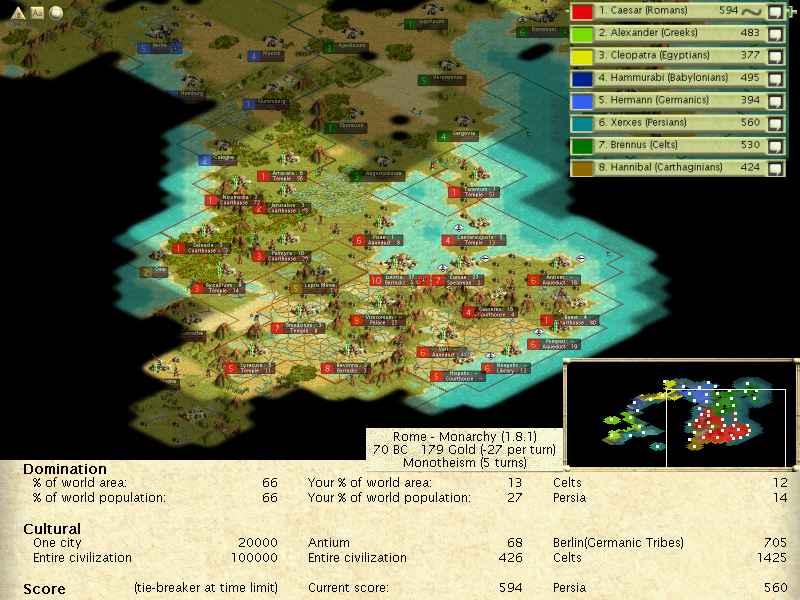
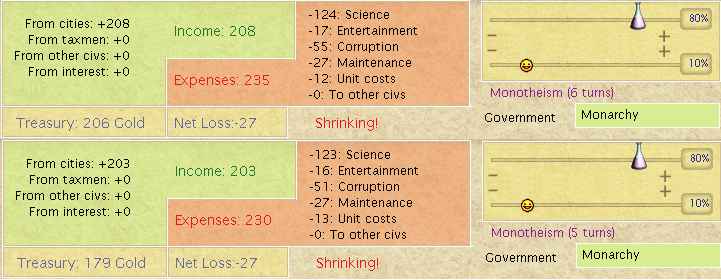
Greetings, mighty Caesar. The Praetorian Intelligence Agency has once again compiled a report on how Rome's economy compares with the economies of the world's other nations. Note that for our mighty empire, we have included three Gross National Product figures, the first representing our GNP if we use none of our income for science, the second at our current science rate of 90%, and the third if we would use all our income for science. Keep in mind that at our current 90% rate, we are running a deficit of thirty gold each decade.
GNP:
Rome: 277/324/330 million
Second: 257 million (Almost certainly Persia)
Third: 197 million
Fourth: 170 million
Fifth: 163 million
Sixth: 157 million
Seventh: 154 million
Eighth: 114 million
Mfg. Goods:
Rome: 150 megatons
Second: 93 megatons
Third: 83 megatons
Fourth: 69 megatons
Fifth: 65 megatons
Sixth: 61 megatons
Seventh: 52 megatons
Eighth: 45 megatons
Productivity:
Rome: 446
Second: 317 (Almost certainly Persia)
Third: 274
Fourth: 239
Fifth: 225
Sixth: 206
Seventh: 185
Eighth: 152
We are uncertain as to how well our advantage in GNP translates into actual income. On one hand, your wise investment in courthouses is helping hold down the level of corruption in most outlying areas. But on the other, our empire is so vast that corruption in outlying regions is still considerable. In any event, we look forward to the time about sixty years in the future when our Forbidden Palace will be complete and can contribute to reducing corruption.
Given Persia's size and the republican nature of its government, we have little doubt that it is second in GNP and Productivity. We strongly suspect that Greece is second in Mfg. Goods since they have the world's second largest population and their king is probably a better manager than the other foreign rulers, but we are reluctant to claim certainty. In GNP, it seems slightly more likely that Greece is fourth or below than that it is third, but there are too many variables involved for that to be more than an educated guess.
Your faithful servant,
Informius Maximus
|
|
| |
|
|
|
nbarclay
|
|
Huntsville, Alabama
Dec 1999
time: 23:33
|
|
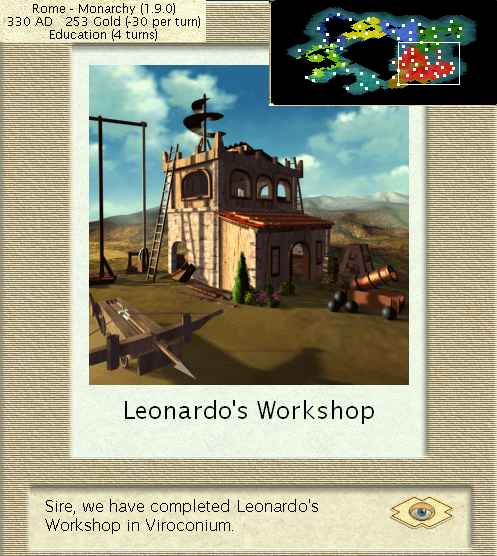
In AD 330, Rome completed Leonardo's Workshop. With the considerable number of warriors and legionaries the nation had built, it seemed like a good investment, although whether to get Leo's or Sistine was a close call. Leo's was the first wonder that either Greece or Rome had built.
Also that year, Caesar got word of an alliance between Greece and Persia against Carthage. Since Caesar himself had been tempted to start such a war until Rome started getting a nice income from Persia, he couldn't be too upset about the situation.
By that point, the the Dusk Treader, Rome's exploring galley, had circumnavigated the northern edge and much of the western edge of the land mass and was getting ready to round the southwestern corner and head home.
Attachment: ad 330 leos built.jpg
This has been downloaded 50 time(s).
Last edited by nbarclay on 31-07-2004 at 01:44
|
|
| |
|
|
|
nbarclay
|
|
Huntsville, Alabama
Dec 1999
time: 23:33
|
|
The first volume of the Chronicles of Rome under the leadership of Nbarclius Caesar concludes with the discovery of Education and trades for Printing Press and Gunpowder in AD 360. The discovery of Education was deliberately timed to coincide with the end of luxury deals with Germany and Carthage, thereby ensuring that Education could be used to renew the deals if another nation did not research it first. With the new discovery, Rome traded Education to Carthage for Gunpowder, Printing Press, and gems. The Empire then traded Printing Press to Germany for wines, 2 gpt, and 18 gold and Education to Egypt for 28 gpt and a handful of gold. (Egypt and Persia had Chemistry, but buying that would have been too expensive even with Education to trade to start the deal.) With Egypt having Education, the Great Library’s usefulness to the Egyptians was at an end.
The fact that someone other than Greece had researched Printing Press provided an unexpected boon to Rome: Greece was blocked from getting it first and trading it around without Rome’s having to go out of its way to research it. If Rome handled things properly, and with a little luck, the only technologies Greece would ever get would be ones it researched itself.
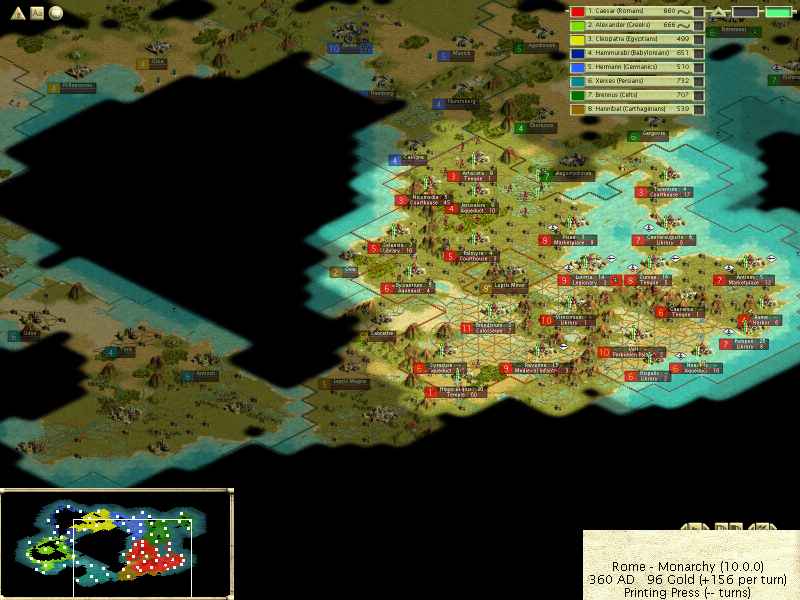
The year AD 360 also saw one other interesting event: the founding of another Roman city. Rome’s culture had more or less caught up with Carthage’s, and after looking at the map a bit, Caesar realized that there was room for another city along the Carthaginian border southeast of Syracuse (and built on the corner of Syracuse’s radius). Judging from Carthage’s tile improvements, it was even likely that the new city would not overlap any Carthaginian cities once its border expanded (which a rush-built temple could take care of easily enough). So Caesar decided to seize the day and build the city of Hippo Regia.
Note that the screenshot below was taken after the founding of Hippo Regia but before the tech trades were conducted, since a screenshot after the trade for Gunpowder would be out of scope for DAR 1.
Attachment: ad 369 hippo regia founded.jpg
This has been downloaded 51 time(s).
Last edited by nbarclay on 08-08-2004 at 11:14
|
|
| |
|
| |
All times are GMT. The time now is 05:33.
Apolyton Time is 00:33. |
top of page
|
|
|
Forum Rules:
You may not post new threads
You may not post replies
You may not post attachments
You may not edit your posts
|
HTML code is ON
vB code is ON
Smilies are ON
[IMG] code is ON
|
|
|
|
|
|






 28-07-2004 00:02






 |
|