|
| |
|
| |
|

|
nbarclay
|
 |
Huntsville, Alabama
Dec 1999
time: 23:33
|
|
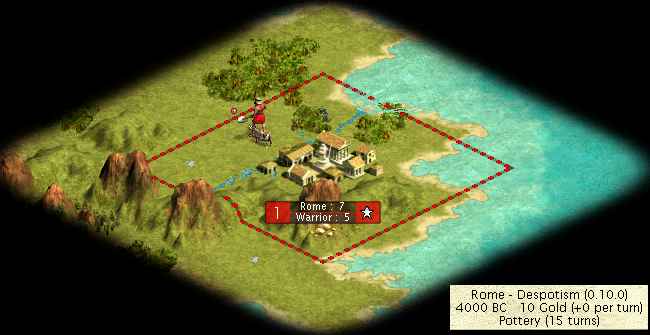
In the year 4000 BC, the brothers Romulus and Remus led a band of nomads to a forest along the Tiber River. Looking across the river, they saw a vast herd of cattle grazing contentedly. The area looked like a good location to build a city, so the two brothers laid the foundations for Rome. In the meantime, they sent workers across the river to begin irrigating the cattle's range.
The brothers were warned by a prophet that if they tried to rule the city themselves, hatred and bloodshed would arise between them. Rather than risk the prophecy's coming true, they handed control of their new city to their friend Nbarclius Caesar who would guide the city and the empire it would spawn. The prophet also warned of the existence of an evil tribe called the Greeks on the other side of the world, a tribe ruled by a warlord who believes that there is no greater joy in life than grinding one's enemies into dust. [Check Theseus's tag line if you don't believe me.  ] So Roman policies would have to be designed to thwart the plans of the evil Greeks and their sadistic ruler. ] So Roman policies would have to be designed to thwart the plans of the evil Greeks and their sadistic ruler.
As soon as the city's new government was established, the Senate took up two important issues. The first was what orders to give Rome's researchers, and the second was what to plan on having Rome build. Since the Roman government was despotic, the Senate could do nothing more than debate and offer suggestions. But Nbarclius Caesar was willing to tolerate debate and even open dissent as long as his orders were ultimately obeyed.
The research debate was split into two factions: the Literacy Faction and the Food Faction. The Literacy Faction advocated that a system of Writing be developed as quickly as possible in an effort to establish embassies and form alliances against the Greeks. The Food Faction, on the other hand, felt that learning how to manufacture Pottery and build granaries must be the nation's first priority. The Literacy Faction argued that knowledge of Pottery could almost certainly be obtained from other nations, but the Food Faction pointed out that serious timing problems could arise if a trade could not be arranged in a timely manner.
The debate regarding build priorities also fell into two factions: the Exploration Faction and (once again) the Food Faction. After some initial debate, two main concepts emerged. The Exploration Faction wanted to build two warriors and then a worker before starting work on a granary. The Food Faction wanted to settle for only one warrior for initial exploration.
After listening to the Senate's debates, Caesar formed a tentative plan. With no really good prebuild for a granary available (since a barracks is only 20 shields for a Militaristic civ) and with forest chops an integral part of the plan for building a granary, he decided to focus Rome's initial research on Pottery rather than risk having a granary's timing fall apart if the tech could not be obtained in time. And Rome would probably start with two warriors before building a worker and granary, although the final decision between one and two warriors could be deferred until a bit later.
 Attachment: bc 4000 first turn.jpg Attachment: bc 4000 first turn.jpg
This has been downloaded 216 time(s).
|
|
| |
|
|
|
nbarclay
|
|
Huntsville, Alabama
Dec 1999
time: 23:33
|
|
Caesar's first warrior, named Grog in honor of the great hero of Gathering Storm, headed out to explore in 3750 BC with orders to head a little west and then north and west. Rome grew to size two the following turn, and with a new laborer first appearing on forest and then moving to bonus grassland, Grog's son came of age three turns later.
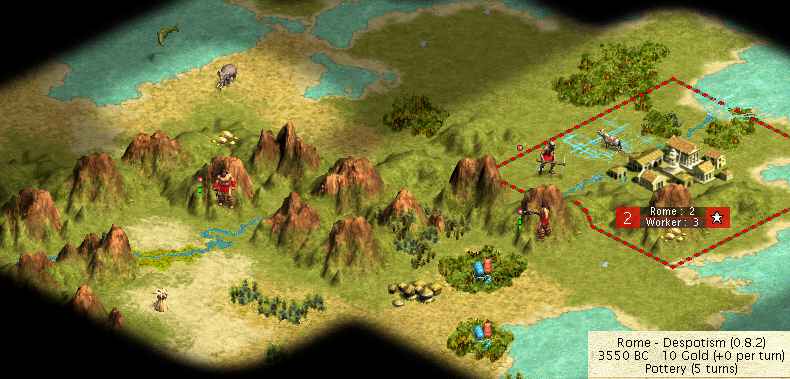
In 3550, Son of Grog spotted a hut near the capital and Caesar decided to embark on the First Great Gamble. Grog was ordered to head back toward the capital, and Son of Grog to open the hut. Chances were that the hut would have little value, and it might very likely even yield hostile barbarians. But the slim chance that there might be friendly settlers there seemed worth taking, because if there were, they could break the game wide open.
In the meantime, Grog had spotted Ivory to the northwest of the capital, and Son of Grog silks to the southwest. So the luxury situation looked fairly promising.
Attachment: bc 3550 hut spotted.jpg
This has been downloaded 206 time(s).
|
|
| |
|
|
|
nbarclay
|
|
Huntsville, Alabama
Dec 1999
time: 23:33
|
|
When the hut was opened a century later, all that its people had to offer were essentially useless maps. That was better than being attacked by barbarians, but the loss of six turns from Grog's explorations and a turn from Son of Grog's still stung a bit. That same year, Rome completed a second worker unit and started work on a prebuild for a granary. The new band of workers was sent "9" to chop a forest and then mine and road the underlying grassland. In the meantime, the original workers had finished irrigating and roading the cattle tile and started mining and roading the grassland with shield next to it.
In 3350, the Romans cut science back to ten percent for the final turn of research into Pottery. Grog, continuing his scouting, spotted a hut to the northwest.
With a hut only two turns away, Caesar decided that once his Pottery research was completed, he would shift research to Ceremonial Burual for a turn with a zero research rate. That would improve the chances of getting a more valuable tech if one was popped from the hut, and with a granary planned, a gold stockpile could be depleted in future research. With a river by the starting position, a settler pump, and two nearby luxuries, it seemed sensible to push a rapid research pace instead of trying to do 50-turn research.
Unfortunately, the hut turned out to have barbarians in it. Witht the hut popped, Caesar ordered his scholars to start developing a system of writing as quickly as they could.
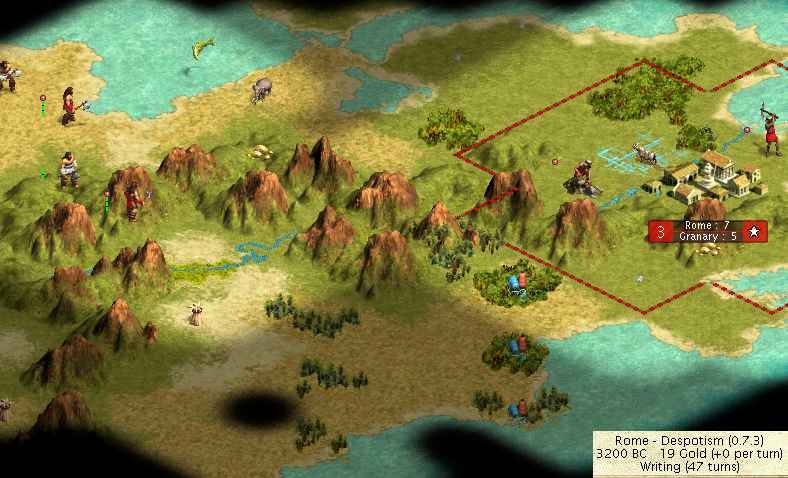
Rome grew to size three in 3200 BC, presenting Caesar with an interesting micromanagement decision. If Rome continued growing at its maximum rate, it would finish a granary a turn after growing to size four. Or it could complete the granary in five turns instead of six by working a forest tile all five turns, which would delay the city's growth to size four by two turns but have the granary ready when the city grew. On close examination, the decision was an easy one: the city would end up in the same place on its growth curve either way, but would be a turn ahead on production if it focused on production instead of growth.
There was, however, a very dangerous wild card involved. One of the barbarians was in a position to beat Son of Grog to Rome if he chose to do so, with results that would be nothing less than disastrous for Rome's plans. Caesar prayed to the High Firaxians that the warrior would either be killed attacking Son of Grog or fortify rather than moving on to attack Rome. Fortunately, Caesar's prayers were answered, and while Son of Grog was seriously wounded, he saved Rome from its hour of peril.
(Son of Grog is the warrior on the mountain.)
Attachment: bc 3200 barbarian peril.jpg
This has been downloaded 200 time(s).
|
|
| |
|
|
|
nbarclay
|
|
Huntsville, Alabama
Dec 1999
time: 23:33
|
|
The Romans suffered a significant setback in 3000 BC when Grog was killed by a barbarian warrior in spite of being located on a mountain at the time. All of the city mourned the great loss.
But sorrow gave way to joy a mere fifty years later as the Eternal City's massive new granary was completed. Caesar ordered that an impending forest chop be used to build a settler in three turns, although the settler would need to wait two additional turns for a warrior escort before it could safely leave the city.
In 2850, the Romans finally made contact with another civilization: Carthage. Unfortunately, Carthage already had all of the technologies that Rome did, which left no useful trading possibilities. Rome's first settler was completed in 2800, and its escorting warrior in 2710. At long last, the Roman nation was on its way to found its second city.
In 2510 BC, while the settler and escorting warrior were on their way to their planned city site, Son of Grog encountered the Celts. Rome traded its knowledge of Alphebet for the Celtic knowledge of Bronze Working and ten gold.
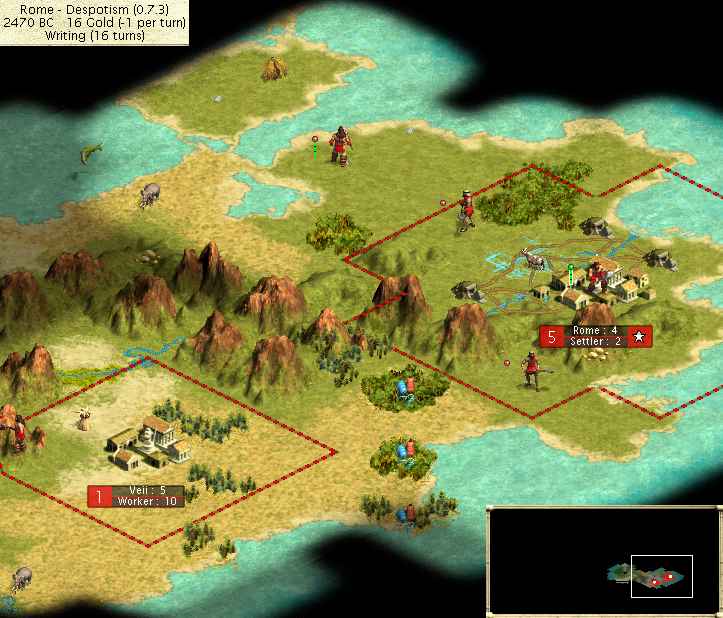
The Roman nation finally founded Veii, its second city, in 2470 BC. I realized after I sent the 2510 turn that I'd probably made a mistake: I probably should have founded Veii a tile closer to Rome. Building the city on desert instead of plains will save a food in the long term, but building the city a turn later, with an extra tile of distance corruption, probably wasn't a good trade.
Attachment: bc 2470 veii founded.jpg
This has been downloaded 195 time(s).
|
|
| |
|
|
|
nbarclay
|
|
Huntsville, Alabama
Dec 1999
time: 23:33
|
|
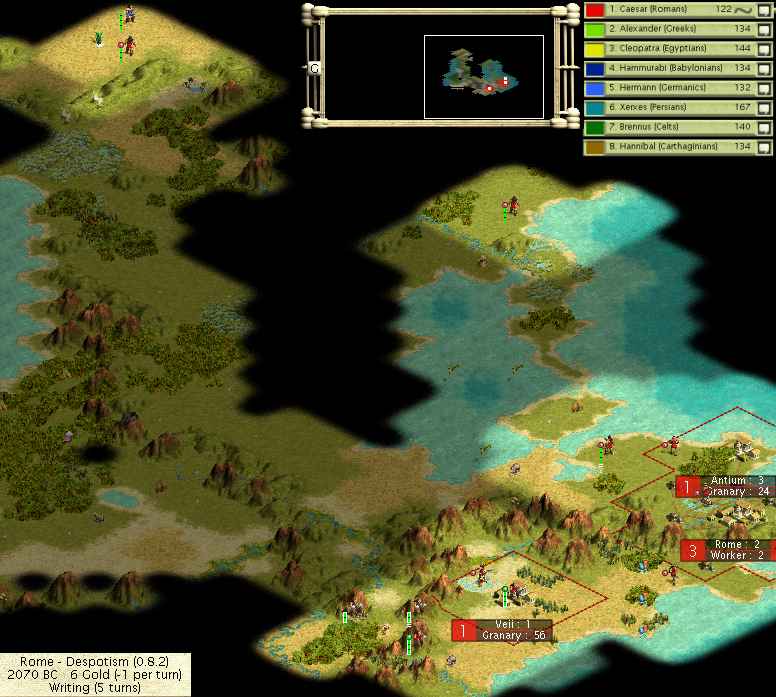
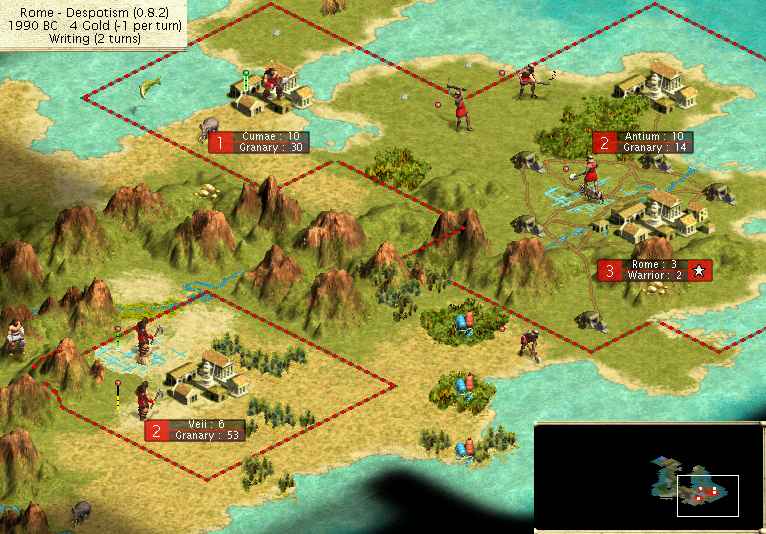
With a settler pump going, the Roman Empire started expanding more quickly. Antium was founded in 2310, and by 2070 BC, another settler was two turns away from building the Empire's fourth city. Veii had built a worker a few turns before as its first project before starting a granary, and with a newly completed worker in Rome, the Empire was up to a total of four workers. Caesar ordered one more worker completed in his capital before resuming warrior and settler construction because tile improvements were starting to lag behind.
The Empire's growth was looking respectable, but the exploration situation was a bit ugly. The two warriors that had explored the farthest were both sidetracked in the North, while the westernmost land identified thus far was in the South. Worse, the warrior that Caesar had wanted to send to resume exploration in the South was distracted trying to bait barbarians from a camp near Veii. So while the Germans had recently become the third civilization known to the Romans, the prospects for finding the remaining four civilizations in the near future were not nearly as promising as would have been desired.
[I stopped the DAR for the moment at this point beceause that's where a marathon rapid-fire session with Theseus ended.]
Attachment: bc 2070 end of first marathon.jpg
This has been downloaded 192 time(s).
|
|
| |
|
|
|
nbarclay
|
|
Huntsville, Alabama
Dec 1999
time: 23:33
|
|
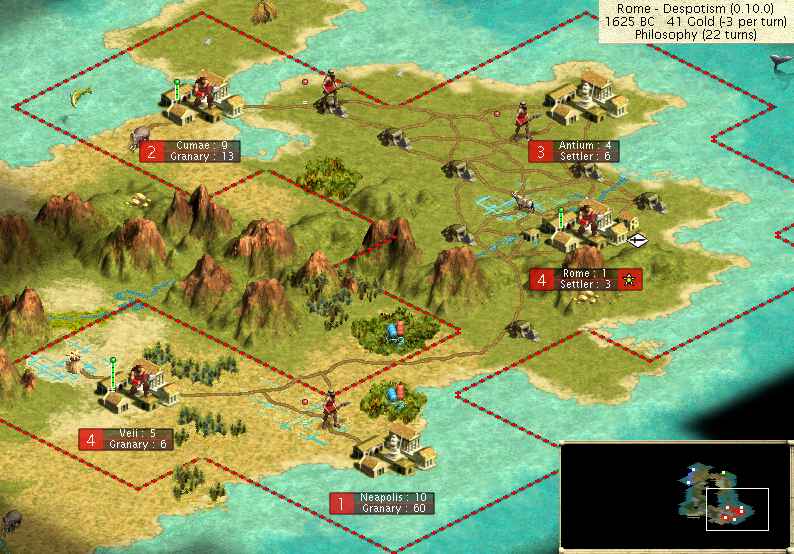
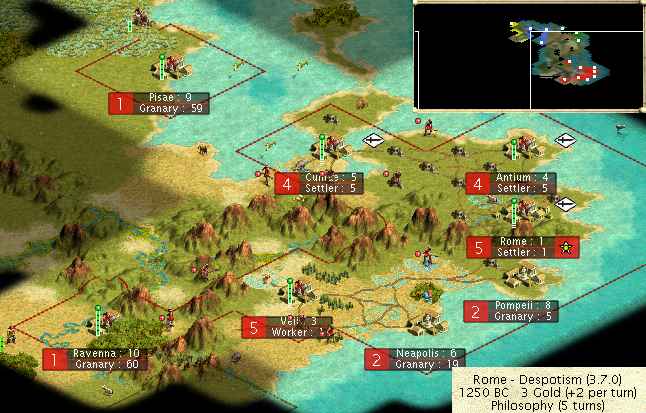
After Rome completed its second scheduled worker, it built a warrior, then a barracks, and then a settler. Antium's laborers were hard at work as well, finally finishing the Empire's second granary. A worker connected the ivory supply, giving the Romans their first luxury. And in 1625, the Roman Empire built the city of Neapolis, adding a second luxury to its trade network.
With the new city complete, Caesar ordered his Praetorian Intelligence Agency (PIA) to investigate how Rome's status compared with that of the world's other nations. Here's what the PIA discovered (and keep in mind that Rome is a turn ahead of everyone else at this point):
GNP:
1st & Rome: 26 million
Third: 24 million
Fourth: 19 million
5th & 6th 17 million
Seventh: 12 million
Eighth: 11 million
Mfg. Goods:
Rome: 19 megatons
Second: 15 megatons
Third: 14 megatons
4th & 5th: 13 megatons:
Sixth : 12 megatons
7th & 8th: 10 megatons
Productivity:
Rome: 54
Second: 53
Third: 44
Fourth: 37
5th & 6th: 36
Seventh: 32
Eighth: 31
The big question is, where does Greece fit into all this? Are they the civ that's essentially dead even with me, or is it someone else (most likely Persia, since they're the AI with the highest score) that's essentially dead even?
In other statistics, Rome is now first in population (with one fifth of the world's total population according to F8), third in land area and second in annual income.
In other news, the warriors that had explored up the northeast coast stumbled into two barbarian horse units and a barbarian warrior unit while heading back down south. Since odds against horsemen are better attacking than defending, they attacked the first horse unit, killing it with out getting injured and winning a promotion to veteran in the process. The Legend of Grog (as the warriors call themselves) may not survive, but at the very least, they'll go down fighting.
Attachment: bc 1625 neapolis founded.jpg
This has been downloaded 176 time(s).
|
|
| |
|
| |
|
|
|
nbarclay
|
|
Huntsville, Alabama
Dec 1999
time: 23:33
|
|
The Legand of Grog warrior company survived its close encounter with a barbarian horse unit - barely. The barb warrior didn't attack, so Legend of Grog withdrew to heal before heading back south.
Son of Grog decided to intrude through the northernmost part of German territory where only two tiles would be required to get through. The first turn, the Germans asked him to leave but did not demand that he leave or declare war. The second, the Germans did threaten hostilities, but that got Son of Grog through to the other side. Egyptian territory proved to be nearby.
In the meantime, the city of Pompeii was founded in 1550 BC, filling in a low-corruption spot near the capital. Veii completed its granary, the empire's third, in 1475 BC and was preparing to become a worker pump able to build workers in three turns part of the time and two part of the time. (Growth was high enough for a two-turn pump, but getting adequate production for a steady two-turn pace at the same time would have been impossible.)
Egypt made contact at the very beginning of 1450 BC, offering to trade Ceremonial Burial for Writing. Caesar made a counter-offer obtaining The Wheel and two of Egypt's 13 gold.
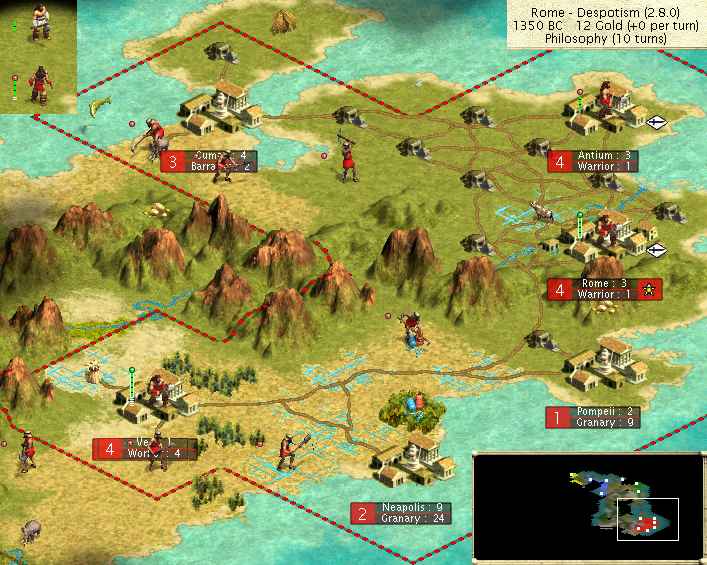
Cumae completed the Roman Empire's fourth granary in the year 1425. A quarter century later, the mighty Roman Empire finally caught up with the Greeks in score. Antium completed Rome's second barracks, and Cumae was working on its third.
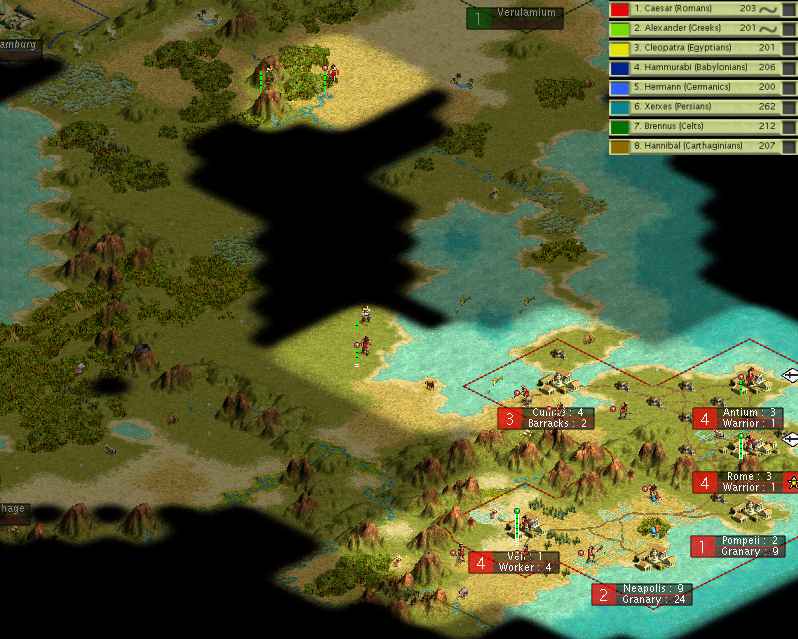
The first settler unit from Antium, escorted by a regular warrior unit, was heading up the coast toward the middle of the eastern subcontinent. Caesar's theory was that maybe, if he got lucky, a luxury would be identified in the area. In 1350 AD, the warrior/settler combination encountered a barbarian warrior unit intent on making life interesting.
[And that's where Theseus and I left off for the night.]
Attachment: bc 1350 end of day.jpg
This has been downloaded 158 time(s).
|
|
| |
|
|
|
nbarclay
|
|
Huntsville, Alabama
Dec 1999
time: 23:33
|
|
The warrior group Legend of Grog died in 1200 BC attacking the barbarian camp north of Pisae, but Pisae's city guards moved in and destroyed the camp. In 1175 BC, the Romans got bad news in the form of a Carthaginian city in the middle of what was intended to be Roman territory. Also that year, the Romans were one turn away from Philosophy and checked the research situation to determine what it might make sense to take as a free tech (assuming Rome won the race as expected). Both Egypt and the Germanic Tribes had Literature, indicating that the Greeks had probably researched that recently.
The year 1150 AD was a landmark year in two ways. First, Son of Grog reported that two Greek Hoplite units had moved into his range of vision, bringing in-game contact with Theseus's empire at last. And second, Roman researchers discovered Philosophy and, through it, Code of Laws, enabling a series of trades that finally made Rome a first-tier technological power.
First came a trade of Philosophy and seven gold to Germany for Map Making, Ceremonial Burial, and Iron Working. Then came the sale of Philosophy to Egypt for Literature, Mysticism, and 6 gold. And finally, Rome traded Philosophy to the Celts for Polytheism, Horseback Riding, and four gold.
At that point, Rome's technological lead over its Greek rivals was enormous: Iron Working, Philosophy, Code of Laws, Map Making, and Horseback Riding. Rome was ahead of the Germanic Tribes by Horseback Riding; of Egypt by Iron Working, Code of Laws, and Map Making; of the Celts by those three techs plus Literature; and of Carthage by Philosophy, Code of Laws, Literature, and Map Making. The Romans still had not met Persia or the Babylonians.
Not everything was coming up roses. Greece was way, way ahead on the power graph, indicating that they had built a relatively large military. But on the plus side, Rome had twenty-one percent of the world's population, while Greece was in second among the known civs with twelve percent. (Persia was almost certainly ahead of Greece in population, since otherwise, the variation from highest to lowest would have to be implausibly small.)
Given the new situation, the Praetorian Intelligence Agency began a new analysis of the relative strength of the world's civilizations:
GNP:
Rome: 43 million
Second: 39 million
Third: 29 million
Fourth: 28 million
Fifth: 23 million
Sixth: 21 million
Seventh: 18 million
Eighth: 16 million
Mfg. Goods:
Rome: 32 megatons
Second: 22 megatons
3rd & 4th: 21 megatons
Fifth: 19 megatons
Sixth: 17 megatons
Seventh: 16 megatons
Eighth: 15 megatons
Productivity:
Rome: 86
Second: 75
Third: 57
Fourth: 51
Fifth: 48
Sixth: 46
Seventh: 43
Eighth: 41
The big question was, was the civ in second place in GNP and Productivity Greece or Persia? On one hand, even with a probable library in Athens (size 5), Greece would have needed some pretty impressive wealth-generating capacity to get 39 million GNP out of a probable population size of 14 and a probable six or at most seven cities. (Rome's population was 24, and Greece's was about 12/21 of that, which comes to 13.714. Rome had eight cities, and the score situation indicated that Greece was behind in building cities.) But on the other hand, if Persia was second in GNP and Productivity, they would have had almost one and a half times the productivity of the closest other AIs, and Persia's score situation wasn't enough stronger than that of the other AIs to make that seem likely. It also seemed highly improbable that the high GNP figure for one of the civs was a result of a golden age, because a civ in a golden age would have been expected to have a correspondingly high Mfg. Goods figure.
In the end, the PIA's analysts could not come to a consensus. Too little was known about Persia (which the Romans had not yet even met) to get a clear picture. Caesar hoped that it was Persia that was his closest rival, but feared that it might very well be Greece.
|
|
| |
|
|
|
nbarclay
|
|
Huntsville, Alabama
Dec 1999
time: 23:33
|
|
After Greece and Rome met, Caesar suggested to the Greek leader that their two nations agree to a period in which neither nation would enlist other nations to attack the other, thereby giving both nations the freedom to expand. Negotiations ensued, and the two nations agreed not to engage in alliances against each other until 250 BC. They also agreed not to bring more than one nation at a time into alliances against each other once the truce ended, thereby avoiding the danger that one nation might enlist the entire world against the other in a single blow once the truce ended.
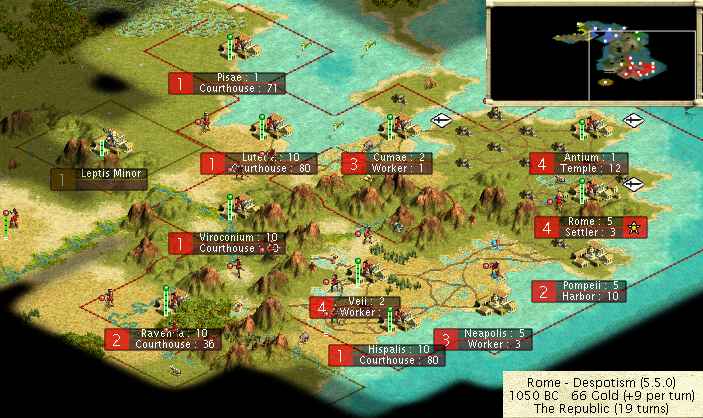
In the meantime, almost immediately after meeting the Greeks, Rome lost much of its lead in population completing three settlers in the same turn. It also temporarily lost its lead in GNP and productivity. But the settlers paid off in 1050 BC with the founding of Hispalis, Virconium, and Lutetia in a single turn. The new cities allowed Rome to reclaim its leadership position. Later that year, Greece established an embassy with the Romans.
In 1025 BC, the Romans started their first great diplomatic maneuver against their AI neighbors. Caesar had already established an embassy with Carthage, and went on to establish one with the Celts and one with the Germanic Tribes to determine the status of the Tribes' war with Egypt. The war was still in progress, so Caesar declared war on Germany, traded Philosophy to Carthage to involve them in the war, and traded Iron Working to the Celts for their participation plus 67 gold.
The goal of the war was to try to divert Carthage, the Celts, and the Germanic Tribes from peaceful to military endeavors in the hope that the distraction would help Rome claim more territory and gain a stronger cultural position. With any luck, Germanic forces would be too busy with the Egyptians, the Celts, and eventually the Carthaginians ever to threaten Roman lands, in which case Rome could continue to expand and let its allies do the fighting and dying.
Rome's great explorer went on to contact the Babylonians in 1000 BC, leaving Persia as the only civ not yet contacted. In 950 BC, Rome fell into second place in Mfg. Goods, GNP, and Productivity, implying that one of the other civs had almost certainly entered a golden age.
Attachment: bc 1050 three cities founded.jpg
This has been downloaded 128 time(s).
|
|
| |
|
|
|
nbarclay
|
|
Huntsville, Alabama
Dec 1999
time: 23:33
|
|
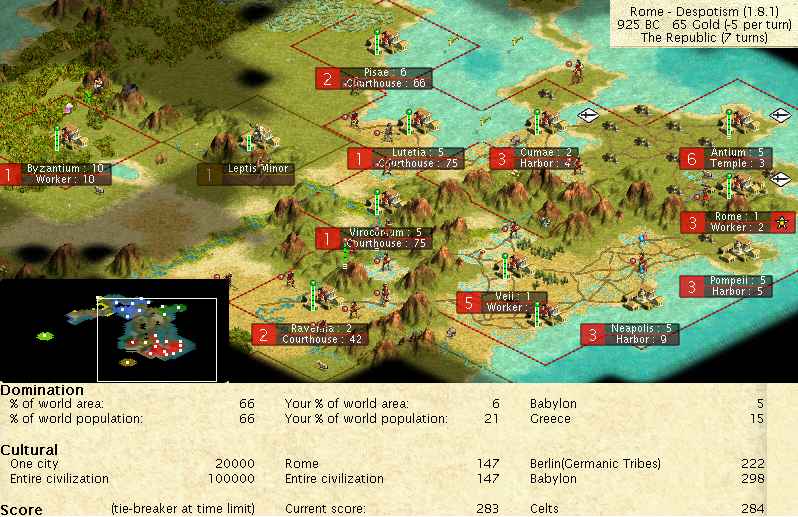
Sometime around 850 BC, Caesar's diplomats noticed that Egypt had Monarchy. The Egyptians were unwilling to trade Code of Laws for it, so the Romans started tracking the technology's progress in the hope that it would become available. In the meantime, Rome was researching Republic in case that might be needed as something to trade. That project was completed around 775 BC.
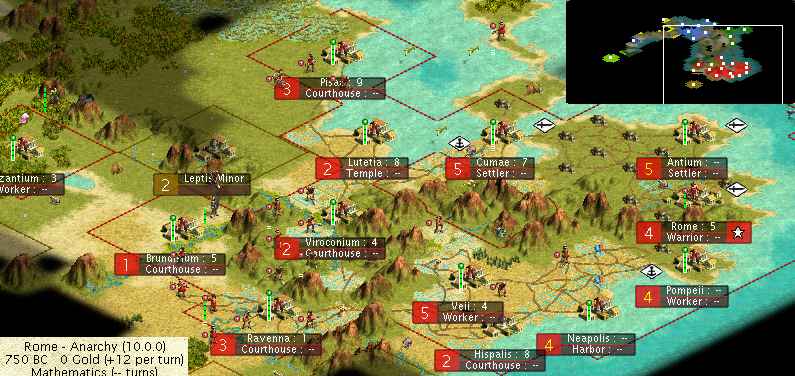
Carthage and Babylon were the next two nations to get Monarchy, but neither was willing to trade on terms Caesar could live with. Finally, in 750 BC, Roman diplomats reported that the Celts had discovered the secrets of Monarchy and were willing to make a deal. It took Code of Laws, Literature Map Making, and the entire Roman treasury of 79 gold to make the deal work, but Caesar was finally ready to give up his role as a despot and begin ruling as a monarch. The revolution started, and Caesar's domestic advisor reported that it was expected to take five turns.
At that point, Caesar had another decision to make: how best to use the six specialists he had working for him. They would have more raw value as scientists, but with Mathematics the only technology available to research, and with the possibility that Code of Laws could be traded for that, there was a serious risk that their scientific work would be wasted. So for the first turn, Caesar ordered his specialists to collect taxes But in 730 BC, when it Code of Laws had been traded around widely, Caesar changed his mind and ordered his specialists to start researching Mathematics.
In the meantime, Caesar's mechanation to get his enemies to fight each other was not going particularly well. The Celts had made peace with Germany, meaning that if Germany and Egypt had also made peace, German troops might be heading for Roman cities. With luck, they would not arrive until after Rome's alliance with Carthage expired, but Caesar was concerned about what might happen if his luck did not hold.
Attachment: bc 750 changing to monarchy.jpg
This has been downloaded 118 time(s).
|
|
| |
|
| |
|
|
|
nbarclay
|
|
Huntsville, Alabama
Dec 1999
time: 23:33
|
|
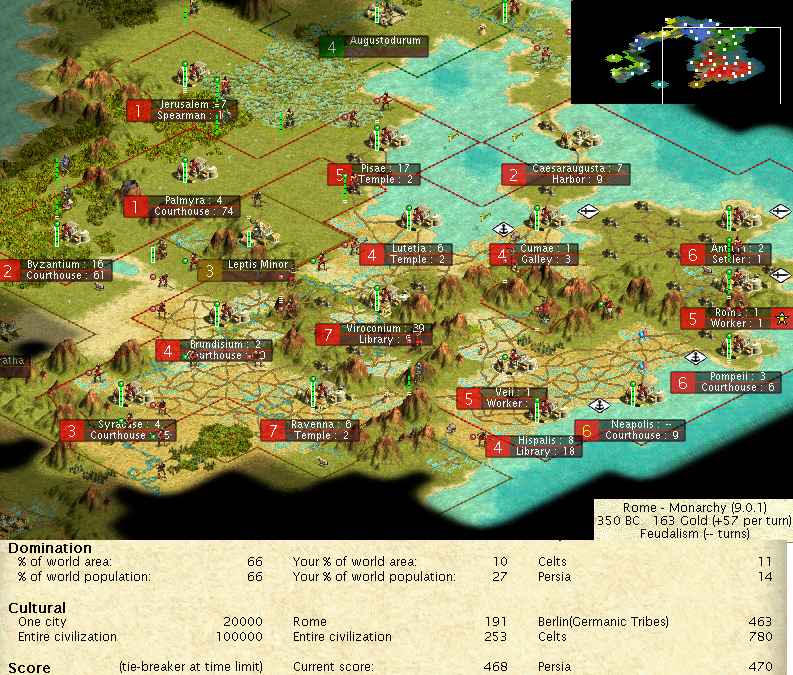
Once the period of anarchy ended, Rome rejected a Greek offer to sell Rome Mathematics and researched the technology themselves. Fortunately, the Greek leader had been in no hurry to sell the technology, so Caesar undercut the Greek plans by selling it himself. Caesar then negotiated an arrangement through which Rome would research Construction and trade it to Greece for Currency plus a bit of gold to make up the difference in values. That deal was completed in 350 BC, making Greece and Rome the first two nations to reach the medieval era. According to the Praetorian Intelligence Agency, it appeared that Greece had received Engineering as its free medieval technology.
The Roman Empire continued to expand with the founding of Syracuse in 690 BC, Caesaraugusta in 550 BC, Palmyra in 470 BC, and Jerusaolem in 410 BC. The Celts were growing more quickly than Rome in land area thanks to their cheap temples and more widely spaced cities, but the Romans were far ahead in number of cities.
In 370 BC, the Romans received reports that Greece had finally entered a period of anarchy. Greece was far behind Rome in population, but the number of libraries it had apparently built (probably including some rush builds taking advantage of Greece's longer period in Despotism) was downright frightening.
Attachment: bc 350 entered medieval.jpg
This has been downloaded 96 time(s).
|
|
| |
|
|
|
nbarclay
|
|
Huntsville, Alabama
Dec 1999
time: 23:33
|
|
For several millennia, Caesar had two long-range plans. One was to build a city on the hill 4-4 from Rome. The other was to move the capital to a location toward the middle of the continent, which would require disbanding and rebuilding Rome.
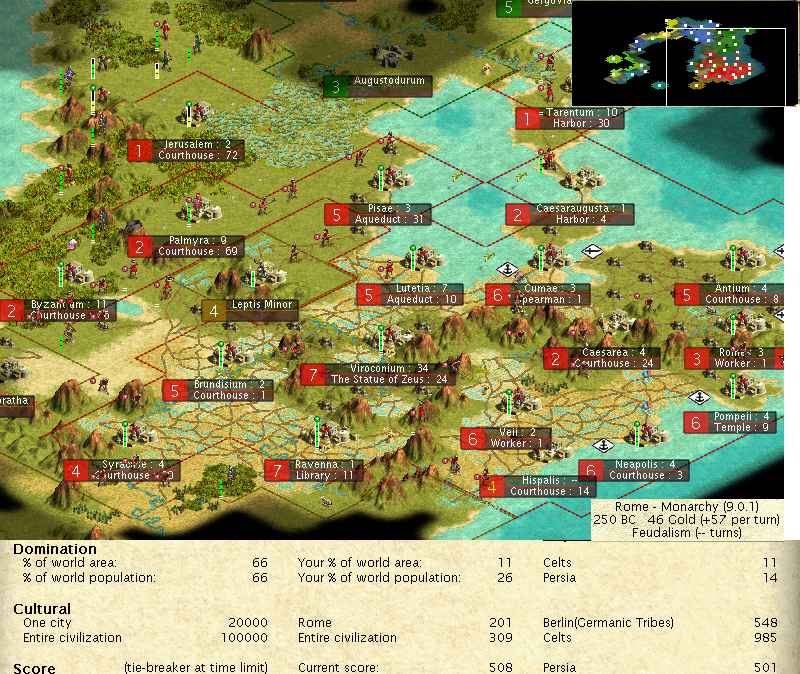
As territory available to expand into started to become scarce, the Roman Emperor finally started putting those plans into action. Caesarea was founded in 330 BC, taking over the cattle tile to speed its growth, while Rome started building down in size.
In 290 BC, Caesar upgraded a fifth warrior unit to a legionary, bringing his military up to average compared with the Greeks for the first time. On seeing that Greece was not particularly better prepared than Rome for active hostilities, Caesar proposed an extension of the two nations' diplomatic truce. The Greek leader agreed to extend the truce until 10 BC.
The Roman Empire built another city, Tarentum, in 250 BC. Caesar also ordered the completion of the courthouse in Brundisium expedited at a cost of about sixty gold in order to speed up the project of surrounding the Carthaginian city of Leptis Minor with Roman culture. Viroconium completed work on a courthouse and started building the Statue of Zeus, with the Great Wall and a Forbidden Palace as possible fallback positions. Additional courthouse rushes were planned for Syracuse and Byzantium once preliminary chops were completed and enough gold was available.
Also in 250 BC, the Romans got word that Greece had emerged from anarchy and a monarch had taken control of the reins of government. Caesar ordered the Praetorian Intelligence Agency to conduct an analysis of Greece's economic strength, as best it could be determined from available information, but the report would take a while to complete.
Attachment: bc 250 rex near finished.jpg
This has been downloaded 82 time(s).
|
|
| |
|
| |
All times are GMT. The time now is 05:33.
Apolyton Time is 00:33. |
top of page
|
|
|
Forum Rules:
You may not post new threads
You may not post replies
You may not post attachments
You may not edit your posts
|
HTML code is ON
vB code is ON
Smilies are ON
[IMG] code is ON
|
|
|
|
|
|





 15-07-2004 12:43



 Not good for T. But this is worse:

 ), but with 3 "food free" workers for mountains. I'm still not sure the lure of the river wouldn't have been too much for me, but I can see your logic. Thanks.
 |
|