|

|
Standup
|
|
I'm hoping they improve the strategy map side or simplify it and get rid of features that didn't really add anything to the game.
|
|
| |
|
| |
|
| |
|
| |
|
|
|
laurentius
|
 |
Helsinki, Finland
Jun 2001
time: 07:33
|
|
To those interested; from RTW forums,quote from the official faq:
Q. So is this an RTS. Is there still a turn based campaign map? Has it really evolved much from Medieval: Total War?
A. Total War games are in genre of their own. If you love strategy games, you will love RTW, but this isn't an RTS, it's much, much more. You can tailor how you play the game to appeal more to your tastes. If you want a perfect balance of politics, micro management and real time epic sized battles you've got it. If you want to spend more time in the senate than on blood stained battle field you've got it. If you want to prove your might purely on how you master the art of war then you've got it.
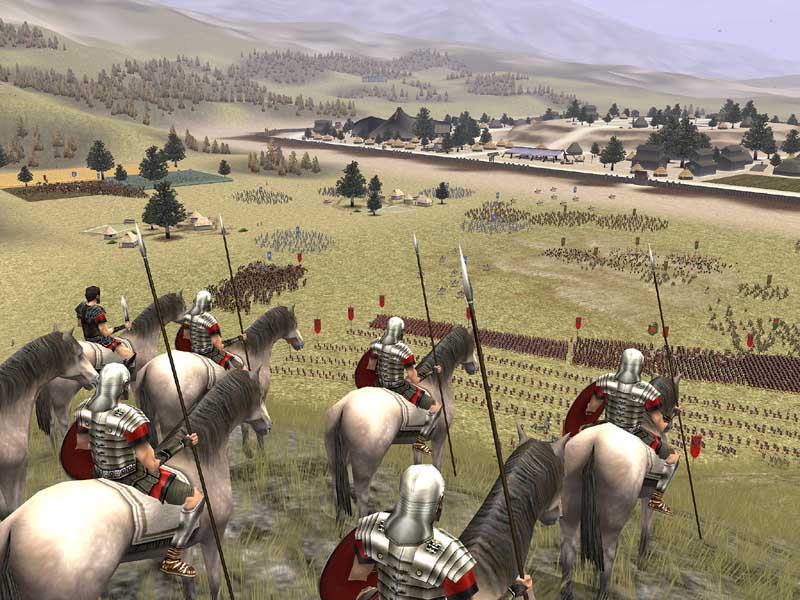
The biggest change you'll notice is on the campaign map. The 'Risk-style' provinces have disappeared to be replaced by point-to-point movement for armies, and settlements with their own regions (hinterlands) that they draw on depending on the size of the settlement. A big, advanced city will have more influence on its surrounds than a small town. Armies and characters on this map are now fully animated and march (or sneak, in the case of spies!) to fulfil your orders.
Cities generate income and train new troops, drawing on local resources. Each city can be assigned a governor, who will do his best (well, probably) to manage the place and keep order.
What is cool and new is that when you fight a battle to control the city, every building that's in a city on the campaign map is there on the battlefield. Destroy a building in a siege, and it's gone on the campaign map. Storm a city and take it with siege towers, batterings rams or artillery and you'll find that you can use any buildings still standing to further your plans of conquest. Better still, the buildings in a town even show who made them, as each culture has its own style of architecture!
Q. Are maps fully dynamic i.e. what happens on the battle map has a physical effect on the strategy map and vis versa?
A. Rome: Total War features a continuous 3D map covering the whole of Europe, North Africa and the Middle East, and any point on this map could be a battlefield. The Campaign map is comprised of thousands of 'battle maps'. This means that you could fight on approximately 10,000 battlefields, each of which can change according to your actions in the game.
Every mountain, hill, forest, farm, volcano, city and Wonder of the World that you see on the campaign map is right there on a battlefield. As the map changes with roads, forts and farms being built it is reflected on the relevant battlefields. As the seasons change you see snow on the north of the campaign map and on northern battlefields. This continuity between the two levels of the game opens up all sorts of strategic options. You can build forts to guard mountain passes, set ambushes in forests, make beach landings, launch fast raids into enemy territory, move your armies through allied territory to co-ordinate campaigns, capture Wonders of the World, ford rivers and generally try to out-manoeuvre your enemies. It all helps to make you feel like you are in one epic, continuous world.
MORE: http://p223.ezboard.com/fshoguntota...icID=2341.topic
|
|
| |
|
|
|
asleepathewheel
|
|
listening too long to one song
Mar 2002
time: 00:33
|
|
good god that sounds awesome
|
|
| |
|
|
|
quantum_mechani
|
 |
Alaska
Nov 2002
time: 20:33
|
|
quote:
Originally posted by laurentius
Q. So is this an RTS. Is there still a turn based campaign map? Has it really evolved much from Medieval: Total War?
A. Total War games are in genre of their own. If you love strategy games, you will love RTW, but this isn't an RTS, it's much, much more. You can tailor how you play the game to appeal more to your tastes. If you want a perfect balance of politics, micro management and real time epic sized battles you've got it. If you want to spend more time in the senate than on blood stained battle field you've got it. If you want to prove your might purely on how you master the art of war then you've got it.
The biggest change you'll notice is on the campaign map. The 'Risk-style' provinces have disappeared to be replaced by point-to-point movement for armies, and settlements with their own regions (hinterlands) that they draw on depending on the size of the settlement. A big, advanced city will have more influence on its surrounds than a small town. Armies and characters on this map are now fully animated and march (or sneak, in the case of spies!) to fulfil your orders.
Cities generate income and train new troops, drawing on local resources. Each city can be assigned a governor, who will do his best (well, probably) to manage the place and keep order.
What is cool and new is that when you fight a battle to control the city, every building that's in a city on the campaign map is there on the battlefield. Destroy a building in a siege, and it's gone on the campaign map. Storm a city and take it with siege towers, batterings rams or artillery and you'll find that you can use any buildings still standing to further your plans of conquest. Better still, the buildings in a town even show who made them, as each culture has its own style of architecture!
MORE: http://p223.ezboard.com/fshoguntota...icID=2341.topic |
They still didn't answer the question!
|
|
| |
|
|
|
laurentius
|
|
Helsinki, Finland
Jun 2001
time: 07:33
|
|
Reds; yes
EDIT: maybe, possibly not R:TW engine
Last edited by laurentius on 03-08-2004 at 01:52
|
|
| |
All times are GMT. The time now is 05:33.
Apolyton Time is 00:33. |
top of page
|
|
|
Forum Rules:
You may not post new threads
You may not post replies
You may not post attachments
You may not edit your posts
|
HTML code is ON
vB code is ON
Smilies are ON
[IMG] code is ON
|
|
|
|
|
|





 31-07-2004 15:40


 Attachment:









 |
|