|
| |
|

|
nbarclay
|
 |
Huntsville, Alabama
Dec 1999
time: 23:33
|
|
Rome entered the modern era in AD 1325 with a lead of six mandatory technologies: Electronics, and Refining and its descendent technologies. However, Persia had Fascism and some of the others had Espionage, neither of which Rome had bothered to acquire. Rome had very briefly gotten its technological pace down to four turns per technology, but Computers would take six. The discovery of Motorized Transportation had brought a scientific great leader, Rome's first of the game, who was waiting to be put to work - probably to build the SETI program in a city with relatively high income potential but relatively low production.
In the war Rome had started to provide a military distraction for its rivals, Persia captured the five Carthaginian cities previously held by the Germans. The Celts were making major inroads in northern Germany, having captured three of Germany's eight core cities.
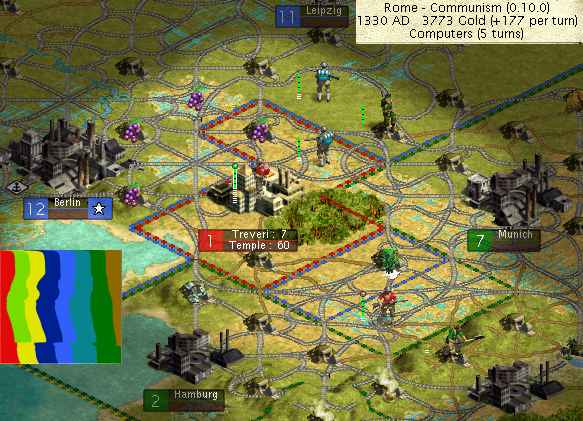
At that point, Caesar saw the light: in vino veritas. Rome couuld build a city next to Berlin, see to it that Germany fell (or at least that its capital did), and take over Germany's role as the world's leading supplier of wines. Rome arranged a Right of Passage agreement with the Celts and dispatched a settler with a heavy escort of infantry and guerillas and, in 1330, founded the city of Treveri. Rome's culture was gaining ground rapidly, so Caesar hoped his new town could fend off foreign cultural influences
[At that point, I ran into a quirk of game mechanics that I've never seen before. Note how Berlin's cultural radius creates an isolated two-tile pocket of German culture southeast of Treveri even though the pocket is surrounded by Roman and Celtic territory. I've always wondered whether that could happen.]
 Attachment: ad 1330 in vino veritas.jpg Attachment: ad 1330 in vino veritas.jpg
This has been downloaded 49 time(s).
|
|
| |
|
| |
|
|
|
nbarclay
|
|
Huntsville, Alabama
Dec 1999
time: 23:33
|
|
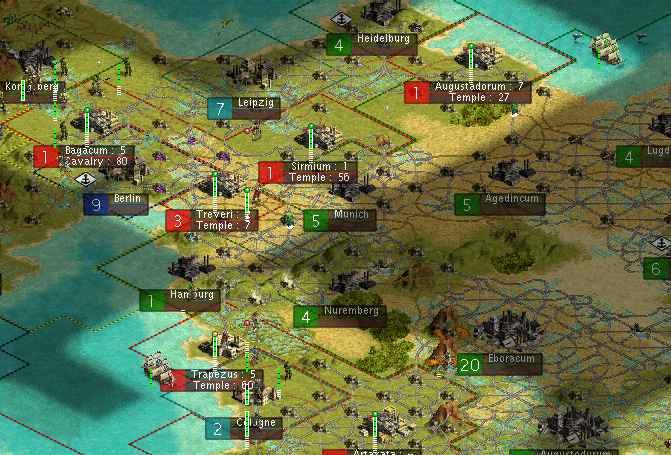
The Germanic Tribes were finished off around 1370. Persia claimed two of the northern Germanic cities and Babylon, which Caesar had added to his alliance along with Egypt when he decided to settle in Germanic territory, ended up with Berlin. One Germanic city was razed, and the rest were claimed by the Celts.
Rome mostly stayed out of the fighting after Persia finished conquering the former Carthaginian lands, but Caesar could not resist the opportunity to claim a little more territory. A total of five new Roman cities were settled in the former Germanic lands. Each was heavily garrisoned to remind its residents that whatever the culture of others living around them, they were Romans.
The harder part for Caesar was the question of who could build cultural improvements more quickly, the Roman settlers or their new neighbors. Back when Rome was a Monarchy, standard operating procedure would have been to use gold to rush temples. But in Communism, that is not an option. On the plus side, Rome has Longevity, so growing the population enough to have decent production isn't as difficult as it would be under other circumstances. Longevity also makes the possibility of pop rushing a lot less painful.
Attachment: ad 1375 after german war.jpg
This has been downloaded 42 time(s).
|
|
| |
|
| |
|
| |
All times are GMT. The time now is 05:33.
Apolyton Time is 00:33. |
top of page
|
|
|
Forum Rules:
You may not post new threads
You may not post replies
You may not post attachments
You may not edit your posts
|
HTML code is ON
vB code is ON
Smilies are ON
[IMG] code is ON
|
|
|
|
|
|





 19-08-2004 03:55






 |
|
 |
|