|
| |
|
| |
|

|
nbarclay
|
 |
Huntsville, Alabama
Dec 1999
time: 23:33
|
|
When Rome discovered Steam Power in AD 730, Caesar learned that he had two sources of coal within his borders. There was even a potential Iron Works site, but Rome's cities were not placed properly to take advantage of it.
On the foreign affairs front, Persia and Babylon ended up not trading techs after all, so for the time being, Babylon would have a monopoly on Nationalism. Rome made peace with Carthage, and by AD 750, Babylon was the only nation still at war with the two-city Carthaginian "empire".
After still more thought about unit mix, Caesar ordered his cities to build a mixture of knights and medieval infantry based on what it was most cost-effective to build. The initial cavalry force used to attack Greece would be more than fifty units strong, but the exact number of units that would be involved remained to be determined. If the Greeks did not figure out what was being planned and enlist Persia in a preemptive alliance, there was reason to hope that Persian cavalry would also be involved in the assault on Greece.
|
|
| |
|
|
|
nbarclay
|
|
Huntsville, Alabama
Dec 1999
time: 23:33
|
|
In AD 790, the Romans learned how to harness Electricity. Caesar had hoped to (1) trade Steam Power plus gold per turn to the Babylonians for Nationalism, (2) sell Babylon Electricity in order to get the gold per turn back, and (3) trade Nationalism and/or Electricity to Persia for Military Tradition. But Hammurabi wanted far over four hundred gold per turn for Nationalism, and it seemed unlikely that he would be willing to give that much back for Electricity. So Rome decided to suspend research spending for a couple decades or so and build up gold for upgrades while waiting for another civilization to discover Nationalism. Also, Caesar ordered an additional eleven horse units upgraded to knights, leaving only five of the older-style mounted units in the Empire.
In the year 800, Hannibal made what might prove to be a disastrous mistake for him. Up until that point, Caesar had been ordering what few Babylonian troops tried to move through Roman territory in an effort to attack Carthage to leave. But Caesar wanted to move some slow-movers to Londinium to replace the knights that made up much of the city’s garrison, and Hannibal refused to agree to a Right of Passage agreement to allow the troops through the narrow band of Carthaginian territory that separated Londinium from the rest of the Empire. With about half a dozen Babylonian longbowmen and two Ancient Cavalry on Rome’s northern border, Caesar decided to sign a Right of Passage agreement with Babylon in the hope that Babylon could capture one of Carthage’s cities and open up the needed land route (as well as reducing the Carthaginian cultural pressure on Londinium).
In the larger picture, the new agreement presented both an opportunity and a danger. The opportunity was that Rome now had the Right of Passage agreements it would need to go through Germanic, Egyptian, and Babylonian territory and attack Greece from the north. The danger was that Greece might recognize that possibility and arrange a preemptive alliance against Rome, starting the war between the two nations before Rome was as ready as it wanted to be.
Also that year, Rome completed the process of upgrading its horsemen to knights. Caesar started contemplating the possibility of going ahead and stationing workers to reconnect Rome’s saltpeter supply and then, if the Babylonians was still the only nation with Nationalism, going ahead and trading Electricity for Military Tradition once the road was built without trying to get Nationalism in the process in order to have the attack on Greece ready a little sooner. But with luck, Nationalism would be more readily available by the time the road was finished.
|
|
| |
|
|
|
nbarclay
|
|
Huntsville, Alabama
Dec 1999
time: 23:33
|
|
In AD 810, an investigation of the diplomatic situation indicated that Military Tradition had been traded around heavily. The Celts still did not have Steam Power, so Rome traded that to the Celts for Military Tradition. With adequate gold in the bank, Caesar ordered that research into Replaceable Parts be restarted at the fastest pace possible, with an estimated completion time of sixty years.
A decade later, workers hooked up Rome's saltpeter supply and fifty-three of the nation's fifty-six knights were upgraded to cavalry, the only three left out being the three that remained part of Londinium's garrison (since that city did not have a barracks). In addition, the nation's seventeen trebuchets were upgraded to cannons. With saltpeter once again available, production priorities shifted from longbowmen and medieval infantry to musketmen.
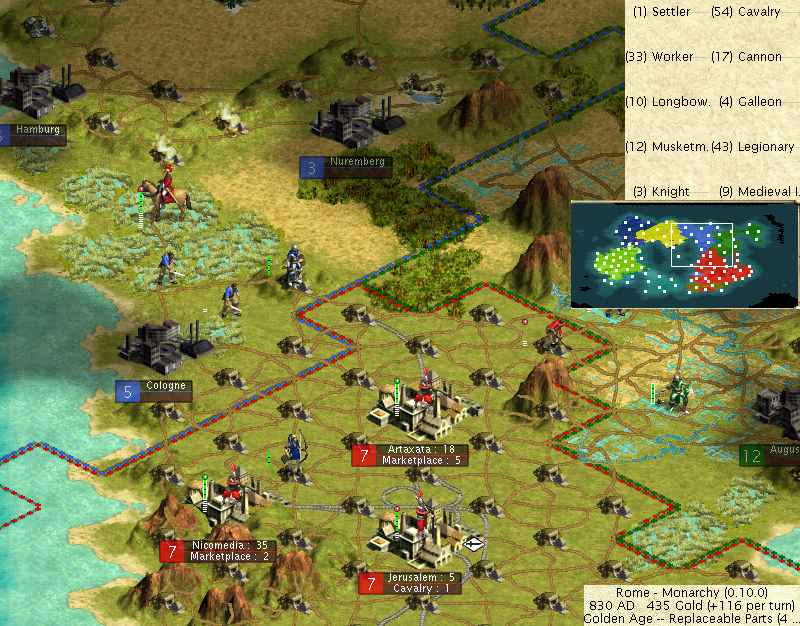
In AD 830, fifty-four Roman cavalry units (including one newly built one) departed for Greece, planning to march around the northern perimeter. If the timing could be arranged properly, Roman cavalry would attack from the north and, at the same time, an alliance with Persia would produce a southern threat. Caesar could only hope that the Greek leader would not anticipate the threat and preempt it by declaring war and forming alliances against Rome while Rome's largest force was en route. On the other hand, even without its cavalry, Rome probably had one of the largest and most powerful militaries in the world.
 Attachment: ad 830 marching to greece.jpg Attachment: ad 830 marching to greece.jpg
This has been downloaded 182 time(s).
Last edited by nbarclay on 06-08-2004 at 09:59
|
|
| |
|
|
|
nbarclay
|
|
Huntsville, Alabama
Dec 1999
time: 23:33
|
|
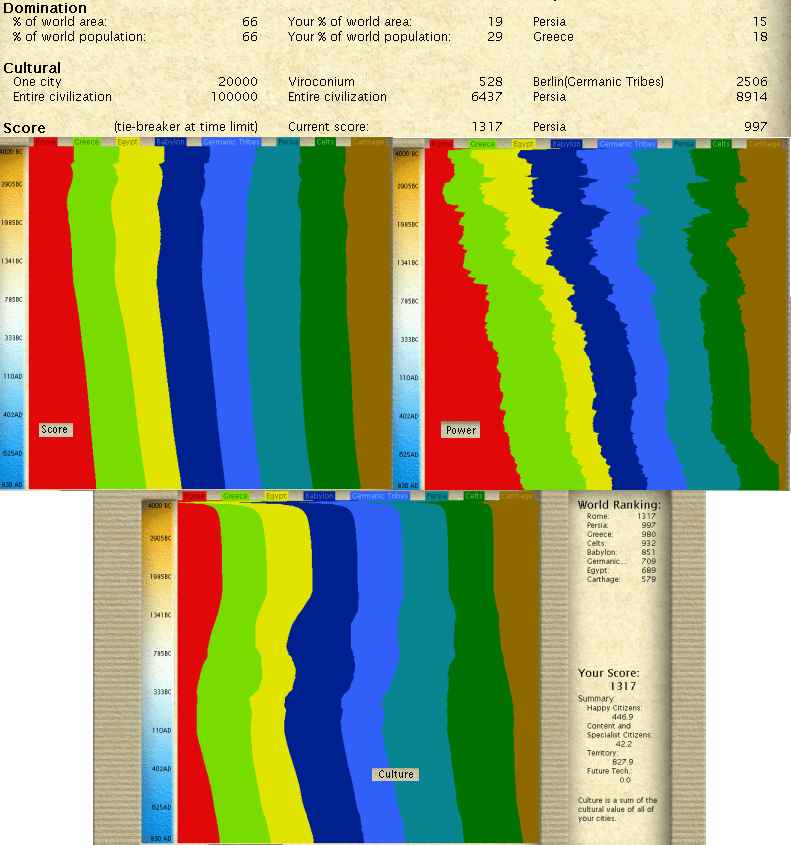
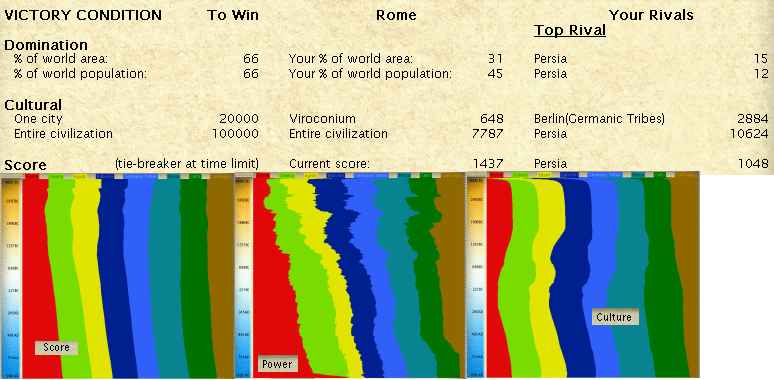
Greetings, mighty Caesar. As war with Greece approaches, the Praetorian Intelligence Agency has once again conducted an analysis of how the Roman economy compares with the economies of the world’s other nations. Keep in mind that we are in the midst of our golden age, and are therefore producing far more than we would under other circumstances. Also keep in mind that the figures for Rome are estimated because exact information regarding current labor assignments was not available when this report was compiled. Data for Carthage has been omitted as uninteresting, since they have only two cities.
GNP:
Rome: 957 Million (est.)
Second: 548 million
Third: 390 million
Fourth: 370 million
Fifth: 357 million
Sixth: 328 million
Seventh: 215 million
Mfg. Goods:
Mfg. Goods:
Rome: 404 megatons (est.)
Second: 183 megatons
Third: 134 megatons
Fourth: 108 megatons
Fifth: 105 megatons
Sixth: 99 megatons
Seventh: 86 megatons
Productivity:
Rome: 1242 (est.)
Second: 688
Third: 471
Fourth: 459
Fifth: 446
Sixth: 415
Seventh: 293
Based on the size of the Greek empire, the skill of its ruler, and the fact that the world’s productivity figures seem most consistent with the same nation’s being in second place in both GNP and Mfg. Goods, our best guess is that Greece is second in all areas. However, we do not claim complete certainty in that analysis.
If, in fact, Greece is second in GNP, that implies that they have almost certainly been engaged in a serious university building program. Our graph of world culture does not provide truly clear confirmation of that hypothesis, but it does suggest a strong likelihood since Greece’s culture share seems to be holding steady while our own rate of gain in culture is slowing dramatically.
I talked to General Hadrian before he left with the cavalry forces, and he was ecstatic at the possibility that Greece might be investing a large part of its production for economic rather than military purposes. But then he got more serious and made it clear that he does not plan to make any assumptions that might get his men killed unnecessarily if he turns out to be wrong. I feel that he has the potential to become a great leader someday, although only time will tell us for certain.
In any case, the Roman Empire is clearly still the greatest civilization in the world and can reasonably be expected to remain so even after our golden age ends. Granted, our culture leaves something to be desired, but that situation can be rectified once Greece is defeated.
Your faithful servant,
Informius Maximus
Attachment: ad 830 f8.jpg
This has been downloaded 171 time(s).
|
|
| |
|
|
|
nbarclay
|
|
Huntsville, Alabama
Dec 1999
time: 23:33
|
|
In AD 840, the Romans learned that Persia had acquired Nationalism (probably by trading Steam Power, Military Tradition, and gold per turn to Babylon). Rome responded by selling Electricity to Babylon for Nationalism plus a bit of gold per turn, selling Electricity to Persia, and selling Nationalism to Germany. Some of those deals might very well collapse when the war with Greece started, depending on who allied with whom, but they would at least provide some income in the meantime. (With all the military upgrade expenses Rome was facing once they learned the proper use of Replaceable Parts, Caesar wanted all the gold he could get.) Roman cavalry continued their march toward Greece but were slowed down a bit having to move off the road network to go around Babylonian forces headed for Carthage.
A decade later, as the century reached its midpoint, millennia of uneasy peace between Rome and Greece ended with a Greek declaration of war. Oddly, the Greeks neither attacked nor arranged an alliance against Rome. So the Romans got a happiness boost with no immediate cost of any kind.
Better, the Greek declaration of war played into Rome’s military plans perfectly. Caesar had already decided to arrange for Persia to attack Greece before his own cavalry struck in the hope of maneuvering the Greek forces out of position. However, that plan carried a risk of giving the Greeks a good chance to guess that Roman forces were on their way to attack. With the Greeks having just declared war, Caesar could hope that the Greeks would interpret the attack by Persia as purely a response to Greek maneuvering and not even guess that Roman cavalry were already in eastern Egypt on their way to Greece.
In considering why Greece might have declared war, Caesar’s advisors were able to come up with three possibilities. The first was that Greece might have intended to form an alliance against Rome but found themselves unable to reach a suitable agreement. A second, more intriguing possibility, since Greece had just discovered Metallurgy, was that the Greeks might have been hoping Rome would enlist allies and intended to use Rome’s attack as an excuse to capture territory from those allies. If so, that could play into Rome’s hands by helping to move Greek troops out of position as Roman cavalry got ready to strike. And the third possibility was that Greece was just playing some kind of mind game trying to divert Rome’s attention away from peaceful building. Caesar himself was leaning toward the second possibility as the most likely, with the first and third progressively less likely.
[Remember that under the rules Theseus and I adopted, if one of us enlists an AI in an alliance against the other, the victim of the alliance is allowed to capture up to two cities.]
|
|
| |
|
|
|
nbarclay
|
|
Huntsville, Alabama
Dec 1999
time: 23:33
|
|
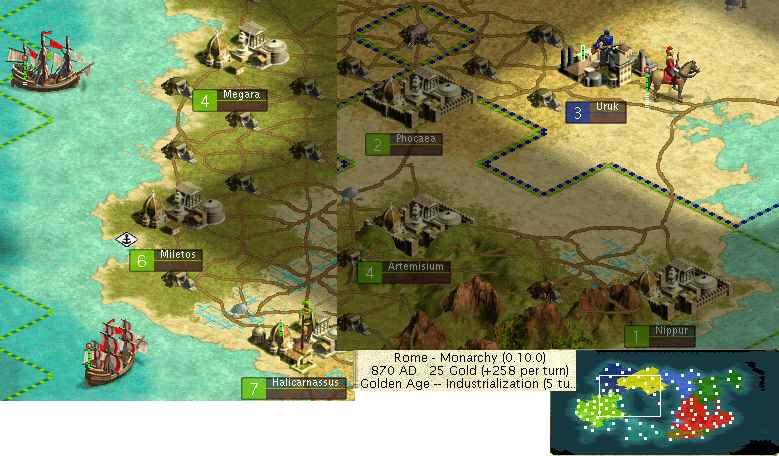
In AD 860, Rome bought Germany into its alliance against Greece with a luxury. Egypt followed in the year 870, agreeing to the alliance plus some gold and gold per turn in exchange for Rome's only saltpeter supply. (After all, Rome discovered Replaceable Parts that year, and with infantry, guerillas, and artillery available to build, saltpeter was no longer regarded as especially important.)
The fifty-four cavalry of Rome's First Strike Force moved into position two tiles away from the Greek cities of Nippur and Phocaea, just out of Greece's line of sight. In the meantime, Rome's three exploring galleons showed up off Greece's western coast in order to give the Greek generals an additional something to think about. Caesar and his advisors guessed that the Greek leaders would probably figure out that the move was a feint, but the possibility of an amphibious landing would be difficult to ignore entirely. The biggest danger was that the feint might cause the Greek generals to prepare more thoroughly for a real attack elsewhere than they would otherwise, and that they would focus at least part of their preparations in the correct direction.
Attachment: ad 870 ready to attack.jpg
This has been downloaded 143 time(s).
|
|
| |
|
|
|
nbarclay
|
|
Huntsville, Alabama
Dec 1999
time: 23:33
|
|
Greetings, Mighty Caesar,
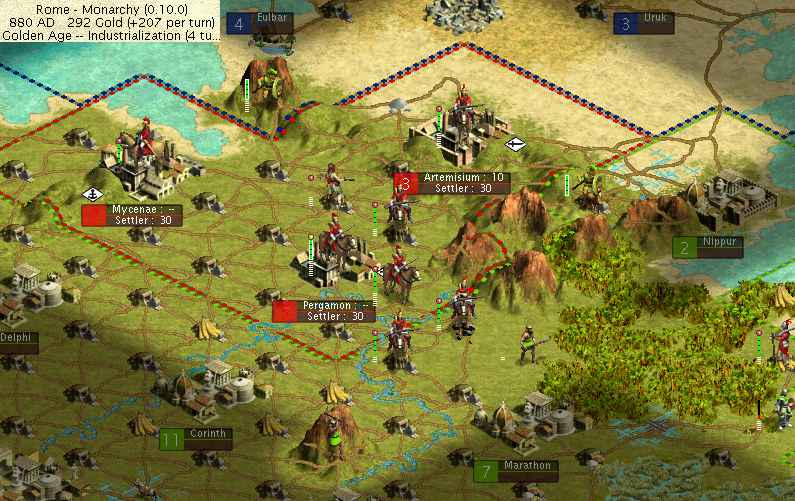
Your valiant cavalry forces have succeeded in capturing the Greek cities of Phocaea, Artemisium, Pergamon, and Mycenae, killing numerous Greek units and capturing seven bands of Greek workers and two of previously enslaved Babylonians in the process. As per your orders, we abandoned Phocaea after our forces finished marching through and bypassed Nippur, leaving it for our new Babylonian allies or perhaps one of our other allies to capture if they can. We killed the hoplites within what are now our borders, but left three hoplites located adjacent to our new territory alone since they pose no real threat in their current locations.
We took some risk in capturing workers in locations that left our cavalry open to counterattack, but with seven bands of workers in striking distance, the risk seemed worthwhile. Against less intelligent foes, we might have waited for an opportunity to capture the workers inside cities later on, but we had no guarantee that the Greek leader would not disband his workers rather than risk their being captured. That was especially true of the three bands of workers within the borders of Pergamon.
Our three musket units and regular legionary that have been sailing across the Central Sea landed just outside where the Persian city of Hamadan used to be, but the Greeks have just destroyed that city. We are seriously considering an attack on Marathon in the hope of striking at the Greek units that participated in that battle before they can heal, and would appreciate your advice as to whether those units or the Greek capital should be regarded as a higher priority target. With ten of our fifty-four cavalry units dead and a majority of the remainder injured, we will not be able to strike everywhere we would like to at once in the next phase of our offensive.
A detailed report on the battles will follow.
Your faithful servant,
Hadrian
General of the First Strike Force
[Edit: One note about the screenshot: four of the units at Pergamon 3 are workers captured at Pergamon 3-2 and Pergamon 3-3. The three units each at Pergamon 3-2 and Pergamon 3-3 are all cavalry.]
Attachment: ad 880 greek attack turn 1.jpg
This has been downloaded 109 time(s).
Last edited by nbarclay on 15-08-2004 at 04:35
|
|
| |
|
|
|
nbarclay
|
|
Huntsville, Alabama
Dec 1999
time: 23:33
|
|
I’m going to be giving blow-by-blow reports of my war with Theseus, and in doing so, I’ll be using the following format:
4/4 Cavalry v. 4/4 Musketman, AW, 2/5 (promotion)
The first unit is the attacker and the second the defender, with current and total hit points for each. AW means “Attacker Wins” and DW means “Defender Wins,” followed by the health of the victorious unit at the end of the battle. If appropriate, “promotion” or “leader” will follow in parentheses.
If a retreat occurs, AR or DR will be used and hit points after the battle for the attacker and defender, respectively, will be given, for example,
4/4 Cavalry v. 4/4 Musketman, AR, 1/4, 2/4
The Battle of Phocaea:
4/4 Cavalry v. 4/4 Musketmen, AR, 1/4, 3/4
4/4 Cavalry v. 4/4 Hoplite, DW, 3/4
4/4 Cavalry v. 4/4 Hoplite, AW, 2/4
4/4 Cavalry v. 3/4 Musketman, AR, 1/4, 3/4
4/4 Cavalry v. 3/4 Musketman, DW, 2/4
4/4 Cavalry v. 5/5 Swordsman, DW, 1/4
4/4 Cavalry v. 3/4 Hoplite, AR, 1/4, 2/4
4/4 Cavalry v. 2/4 Musketman, AW, 4/4
4/4 Cavalry v. 4/4 MedInf, AW, 3/5 (promotion)
4/4 Cavalry v. 2/4 Hoplite. AW, 2/5 (promotion)
4/4 Cavalry v. 4/4 Longbowman, AW, 3/4
4/4 Cavalry v. 1/5 Swordsman, AW, 4/4, City Captured
The Battle of Artemisium 8:
4/4 Cavalry v. 4/4 Musketmen, DW, 2/5 (promotion)
4/4 Cavalry v. 4/4 Musketman, AW, 1/4
4/4 Cavalry v. 2/5 Musketman, DW, 1/5
4/4 Cavalry v. 1/5 Misketman, AW, 2/4
The Battle of Artemisium
4/4 Cavalry v. 4/4 Musketman, AR, 1/4, 4/4
4/4 Cavalry v. 4/4 Musketman, AR, 1/4, 4/4
4/4 Cavalry v. 4/4 Musketman, AR, 1/4, 2/4
4/4 Cavalry v. 4/4 Musketman, AR, 1/4, 2/4
4/4 Cavalry v. 5/5 Swordsman, AW, 2/4
4/4 Cavalry v. 2/4 Musketman, AR, 1/4, 2/4
4/4 Cavalry v. 2/4 Musketman, AW, 3/4
4/4 Cavalry v. 2/4 Musketman, AW, 4/4
4/4 Cavalry v. 4/4 MedInf, AR, 1/4, 3/4
4/4 Cavalry v. 4/4 MedInf, AR, 1/4, 4/4
4/4 Cavalry v. 4/4 MedInf, AR, 1/4, 4/4
4/4 Cavalry v. 4/4 MedInf, AW, 4/5 (promotion)
4/4 Cavalry v. 3/4 MedInf, DW, 1/4
4/4 Cavalry v. 4/4 Longbowman, AW, 4/4
4/4 Cavalry v. 1/4 MedInf, AW, 4/4, City Captured, cannon captured
Cavalry captures worker at Artemisium 2
The Battle of Pergamon:
4/4 Cavalry v. 3/3 Hoplite, DW, 2/3
4/4 Cavalry v. 2/3 Hoplite, AR, 1/4, 2/3
4/4 Cavalry v. 2/3 Hoplite, AW, 3/5 (promotion), City Captured
The Battle of Artemisium 4:
Captured cannon fires, hits.
4/4 Cavalry v. 3/4 Hoplite, DW, 1/4
4/4 Cavalry v. 1/4 Hoplite, DW, 2/5 (promotion)
4/4 Cavalry v. 2/5 Hoplite, AW, 3/5 (promotion)
The Battle of Mycenae
4/4 Cavalry v. 3/3 Archer, AW, 4/4
The Battle of Artemisium 1:
4/4 Cavalry v. 4/4 Hoplite, AW, 2/4
The Battle of Artemisium 3:
4/4 Cavalry v. 4/4 Hoplite, AR, 1/4, 2/4
4/4 Cavalry v. 2/4 Hoplite, DW, 1/4
4/4 Cavalry v. 1/4 Hoplite, AW, 3/4
Workers captured at Pergamon 3, 3-3, and 3-2
Phocaea Abandoned
|
|
| |
|
|
|
nbarclay
|
|
Huntsville, Alabama
Dec 1999
time: 23:33
|
|
Greetings, Mighty Caesar,
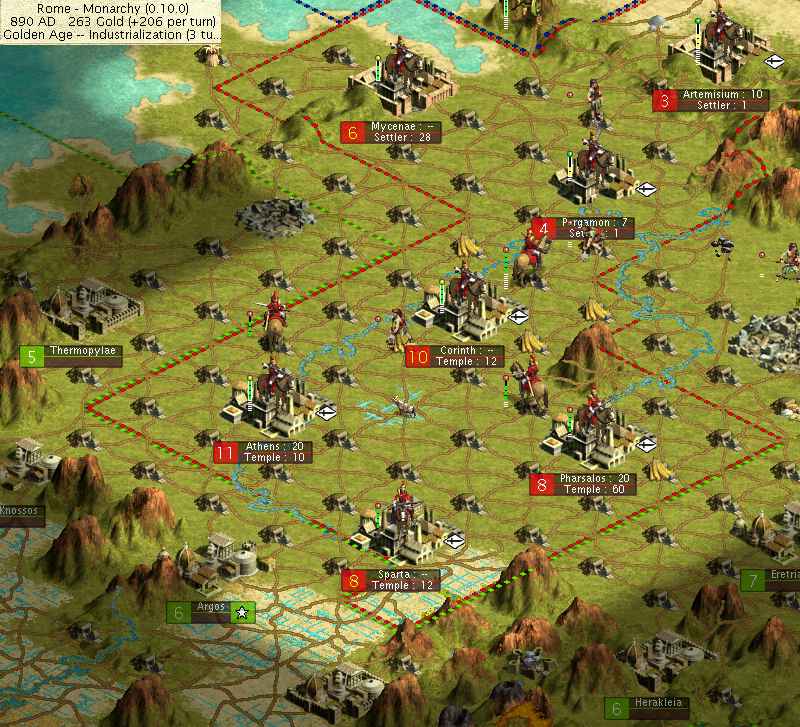
Our campaign against the evil Greeks continues to go well. Indeed, we have penetrated even more deeply into Greek territory than I had hoped for. The Greek generals hoped to cause us problems using a scorched earth strategy, destroying their own cities of Delphi and Marathon in order to force us to move through the heavily defended city of Corinth. But luck was with us, and while we lost two cavalry regiments against a Greek army consisting of Hoplite, Sword, and Medieval Infantry units, and a third regiment against a force of Musketmen, we overcame the defenders and captured the city.
With Corinth in our hands, our glorious cavalry fanned out to capture Athens, Pharsalos, and Sparta (to which the Greeks had moved their capital after Athens fell). Greece's capital and its three largest other cities are now in Roman hands. None of our forces were killed capturing Athens or Sparta, but two cavalry regiments died in the battle of Pharsalos. Alas, one of them was an elite force that I had sent into battle against regular warriors in spite of its having lost forty percent of its strength in earlier fighting. I had hoped that its leader’s enthusiasm to charge into battle in spite of his casualties was an indication that he had the potential for greatness, but any such potential died with him.
Out of the fifty-four cavalry regiments that originally made up the First Strike Force, thirty-nine survive to press on toward victory. The largest single body, consisting of seventeen units, is located in Artemisium far from the front, but I have slaves working on a rail line to help them reach the front quickly once they heal in the city’s barracks. I have also used some of the gold you sent with me to convince some of the residents of Artemisium and Pergamon to leave those cities and settle some of the land the Greeks are abandoning. It will take them a little while to prepare, but once they do, we will have additional settlers. Better, the people who leave to settle elsewhere will not be formenting revolution in those cities.
The Greeks left a wounded Medieval Infantry force guarding two bands of Persian slaves where the Persian city of Hamadan once stood. (The slaves were too exhausted to flee after having helped build a road there – which, ironically, their badly wounded Medieval Infantry then had to pillage in order to slow our forces down.) Our regular legionary force that landed with the musketmen dispatched the enemy unit in a very bloody battle and captured the slaves, gaining veteran status in the process. Our second galleon on the Central Sea handed its contents over to the first, which then landed two rifle units and two bands of settlers at that site, and a new Roman city will take Hamadan’s place shortly. Then most of the units we landed can move out to help garrison our captured Greek cities, although if all goes well, the war may be almost over by the time they can reach the cities they are intended to garrison.
In response to your query as to whether or not Rome needs to continue building additional military units, my opinion is that you can now safely shift priorities back entirely to civilian infrastructure. Ten of the twenty-four cities the Greeks had at the start of the war have been either captured or abandoned, and our ratio of cavalry to surviving Greek cities has increased from 2.25:1 at the start of the invasion to 2.79:1 today. It is my hope that additional military forces will not be needed, and even if they are, diverting some guerillas, infantry and artillery from the Homeland Defense Force should provide ample firepower.
As per your orders, a detailed report on the battles will follow.
Your faithful servant,
Hadrian
General of the First Strike Force
Attachment: ad 890 greek invasion turn 2.jpg
This has been downloaded 91 time(s).
|
|
| |
|
|
|
nbarclay
|
|
Huntsville, Alabama
Dec 1999
time: 23:33
|
|
The Battle of Hamadan’s Ruins:
3/3 Legionary v. 1/4 MedInf, AW, 2/4 (promotion), two workers captured.
The Battle of Corinth:
4/4 Cavalry v. 11/11 Hoplite/Swordsman/MedInf Army, DW, 10/12 (promotion)
4/4 Cavalry v. 10/12 Hoplite/Swordsman/MedInf Army, DW, 8/12
4/4 Cavalry v. 8/12 Hoplite/Swordsman/MedInf Army, AW, 1/4
4/4 Cavalry v. 4/4 Musketman, AR, 1/4, 2/4
4/4 Cavalry v. 3/3 Hoplite, AW, 4/4
4/4 Cavalry v. 2/4 Musketman. DW, 1/4
4/4 Cavalry v. 4/4 MedInf, AW, 3/4
4/4 Cavalry v. 1/4 Musketman. AW, 4/5 (promotion)
3/4 Cavalry v. 3/3 Warrior, AW, 2/4
4/5 Cavalry v. 3/3 Longbowman, AW, 3/5, City Captured
The Battle of Athens 6:
4/4 Cavalry v. 4/4 MedInf, AR, 1/4, 4/4
4/4 Cavalry v. 3/4 MedInf, AW, 3/5 (promotion)
The Battle of Athens:
4/4 Cavalry v. 3/3 MedInf, AW, 3/4
3/4 Cavalry v. 3/3 Warrior, AW. 3/5 (promotion), City Captured
The Battle of Pharsalos
4/4 Cavalry v. 4/4 Musketman, AW, 3/4
4/4 Cavalry v. 3/3 MedInf, DW, 1/3
3/5 Cavalry v. 4/4 Horseman, AW, 3/5
3/5 Cavalry v. 3/3 Warrior, DW, 2/4 (promotion)
4/4 Cavalry v. 2/4 Warrior, AW, 1/4
4/4 Cavalry v. 1/4 MedInf, AW, 4/4, City Captured
The Battle of Sparta:
4/4 Cavalry v. 3/3 Warrior, AW, 4/4, City Captured
Workers captured by 4/4 Cavalry at Corinth 6-6-9 and Pharsalos 8
|
|
| |
|
|
|
nbarclay
|
|
Huntsville, Alabama
Dec 1999
time: 23:33
|
|
[I’m playing both sides in the war now, but it’s still interesting.]
Greetings, Mighty Caesar,
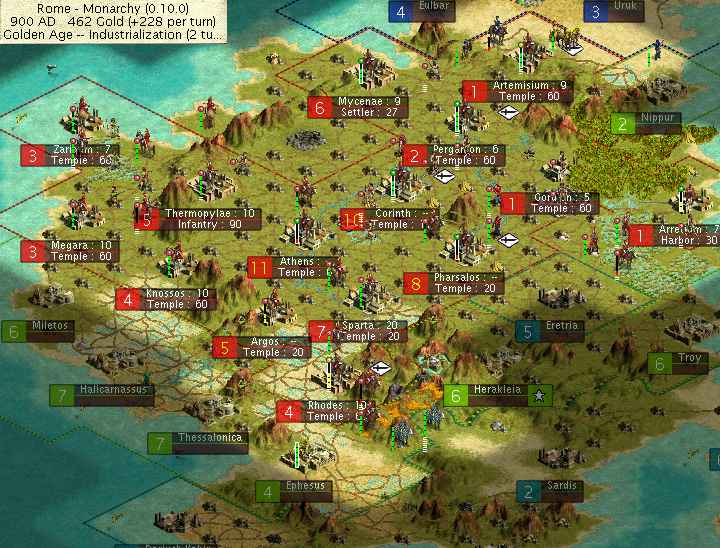
I fear that I have two minor setbacks to report. Greek forces temporarily recaptured the city of Sparta, although we were able to reclaim it quickly. Also, Persia now controls the former Greek city of Eretria, ending our hope that we might capture the entire Greek empire completely intact.
As my officers and I prepared to continue our offensive, we realized that Babylonian cavalry had wounded the hoplites guarding the Greek workers on the mountain in northern Greece. Rather than risk the Greek workers there falling into Babylonian hands, we decided to attack. The artillery unit just upgraded from captured a battery Greek cannons performed flawlessly, and we were able to capture the workers with no more than moderate injuries in spite of the two wounded defending hoplites’ best efforts.
In addition to retaking Sparta, we also captured six additional Greek cities: Thermopylae, Rhodes, Argos, Knossos, Megara, and the formerly Babylonian city of Zariqum. And we captured several additional Greek workers.
In other news, a band of the Greek settlers we hired founded the city of Gordion near the spice fields, while our own settlers built Arretium on the former site of the Perisan city of Hamadan.
As is customary, a detailed battle report will follow.
Your faithful servant,
Hadrian
General, First Strike Force
Attachment: ad 900 greek invasion turn 3.jpg
This has been downloaded 77 time(s).
|
|
| |
|
|
|
nbarclay
|
|
Huntsville, Alabama
Dec 1999
time: 23:33
|
|
The Battle of Mycenae 9-9
Artillery bombards 3/4 Hoplite (wounded from a Babylonian cavalry attack), 2 HP damage
4/4 Cavalry v. 2/3 Hoplite, AW, 2/4
4/4 Cavalry v. 1/4 Hoplite, AW, 3/4, four workers captured.
The Battle of Thermopylae:
4/4 Cavalry v. 3/3 Hoplite, DW, 1/3
5/5 Cavalry v. 1/3 Hoplite, AW, 2/5, City Captured
The Battle of Megara:
4/4 Cavalry v. 3/3 Musketman, AR, 1/4,2/3
4/4 Cavalry v. 3/3 Hoplite, AR, 1/4, 2/3
4/4 Cavalry v. 2/3 Musketman, DW, 2/4 (promotion)
4/4 Cavalry v. 2/3 Musketman, AW, 1/4
4/4 Cavalry v. 2/3 Hoplite, AW, 3/4, City Captured
The Battle of Sparta:
4/4 Cavalry v. 3/5 Horseman, AW, 5/5 (promotion), City Captured
The Battle of Argos:
4/4 Cavalry v. 3/3 Warrior, AW, City Captured
4/4 Cavalry walks into Knossos, which is undefended.
The Battle of Rhodes:
3/5 Cavalry v. 3/3 Warrior, DW, 1/3
3/5 Cavalry v. 1/3 Warrior, AW, 1/5, City Captured
The Battle of Zariqum:
4/4 Cavalry v. 3/3 Musketman, AR, 1/4, 2/3
4/4 Cavalry v. 2/3 Musketman, DW, 1/3
4/4 Cavalry v. 4/4 Swordsman, AR, 1/4, 3/4
4/4 Cavalry v. 3/4 Swordsman, AW, 4/4
4/4 Cavalry v. 1/3 Musketman, AW, 3/4, City Captured
Workers captured by 4/4 Cavalry at Rhodes 2-3, Thermopylae 8, 8-8, and 7-7
Workers captured by 1/4 Cavalry at Rhodes 3.and Eretria 9-9.
|
|
| |
|
|
|
nbarclay
|
|
Huntsville, Alabama
Dec 1999
time: 23:33
|
|
The Battle of Ephesus:
4/4 Cavalry v. 4/4 Hoplite, AR, 1/4, 3/4
4/4 Cavalry v. 3/4 Hoplite, AW, 3/5 (promotion)
5/5 Cavalry v. 4/4 Swordsman, AW, 3/5
5/5 Cavalry v. 4/4 Archer, AW, 5/5, City Captured
The Battle of Miletos:
4/4 Cavalry v. 3/3 Hoplite, AR, 1/4, 2/3
5/5 Cavalry v. 3/3 Hoplite, AW, 4/5
5/5 Cavalry v. 2/3 Hoplite, AW, 4/5, City Captured
The Battle of Halicarnassus
4/4 Cavalry v. 3/3 Hoplite, AR, 1/4, 2/3
4/4 Cavalry v. 3/3 Hoplite, AW, 4/5 (promotion)
4/4 Cavalry v. 3/3 Hoplite, AW, 4/5 (promotion), City Captured
The Battle of Thessalonica
4/4 Cavalry v. 4/4 Musketman, AW, 2/4
4/4 Cavalry v. 3/3 Hoplite, AR, 1/4, 2/3
4/4 Cavalry v. 2/3 Hoplite, AW, 1/4
Several workers captured by cavalry units.
|
|
| |
|
|
|
nbarclay
|
|
Huntsville, Alabama
Dec 1999
time: 23:33
|
|
The Battle of Keraklea
4/4 Cavalry v. 5/5 Hoplite, AR, 1/4, 4/5
4/4 Cavalry v. 4/4 Hoplite, AW, 4/4
4/4 Cavalry v. 4/5 Hoplite, AR, 1/4, 3/5
4/4 Cavalry v. 3/5 Hoplite, DW, 2/5
4/4 Cavalry v. 4/4 MedInf, AW, 3/4
5/5 Cavalry v. 2/5 Hoplite, DW, 2/5
5/5 Cavalry v. 2/5 Hoplite, AW, 1/5
5/5 Cavalry v. 4/4 Horseman, AW, 4/5
The Battle to Retake Rhodes
5/5 Cavalry v. 3/3 Hoplite, AW, 3/5
The Battle to Retake Pharsalos:
5/5 Cavalry v. 3/3 Hoplite, AW, 2/5
The Battle of Nippur:
5/5 Cavalry v. 4/4 Hoplite, AW, 3/5
5/5 Cavalry v. 3/3 Hoplite, AW, 3/5
5/5 Cavalry v. 4/4 Swordsman, AW, 2/5
4/4 Cavalry v. 4/4 Longbowman, AW, 2/4
|
|
| |
|
|
|
nbarclay
|
|
Huntsville, Alabama
Dec 1999
time: 23:33
|
|
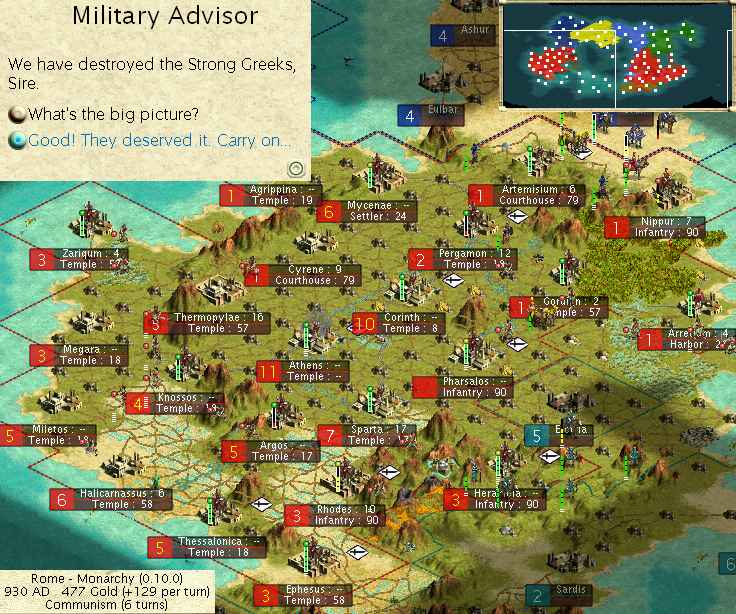
Out of fifty-four cavalry that participated in the attack on Greece, twenty-eight, or just barely over half, survived the fighting. The war also cost the life of one infantry unit that was lost in a culture flip.
Rome's biggest problem at that point was that it had let civililian infrastructure lag, with not a single university or bank in the entire Empire (except, ironically, for one bank captured in Athens). That also carried over into Rome's cultural situation: plenty of temples, but no cathedrals and almost no colosseums.
But with the prophecy that Greece or Rome must destroy the other fulfilled, and with the Roman military the strongest in the world, the Empire could turn its full attention to civilian pursuits. Once the nation's new factories could be brought online, catching up in infrastructure - at least on the Roman side of the Empire - would presumably not be a problem. Catching up on the Greek side would, of course, take far longer.
Attachment: ad 930 f8.jpg
This has been downloaded 71 time(s).
|
|
| |
|
|
|
nbarclay
|
|
Huntsville, Alabama
Dec 1999
time: 23:33
|
|
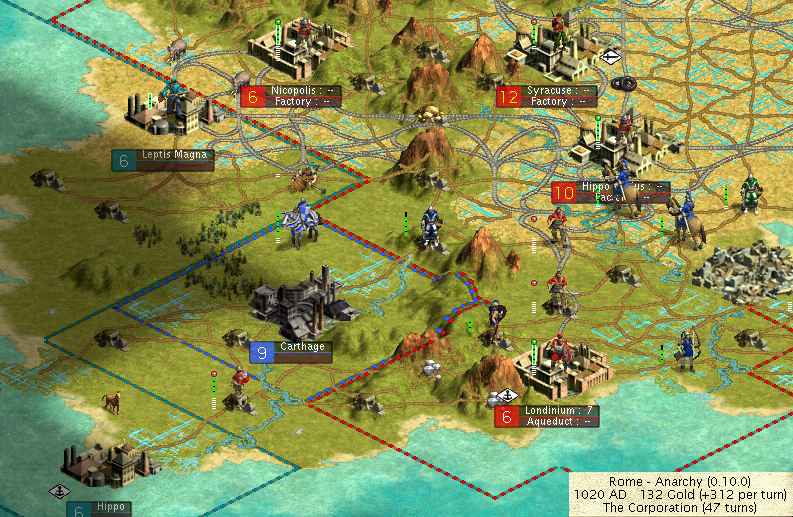
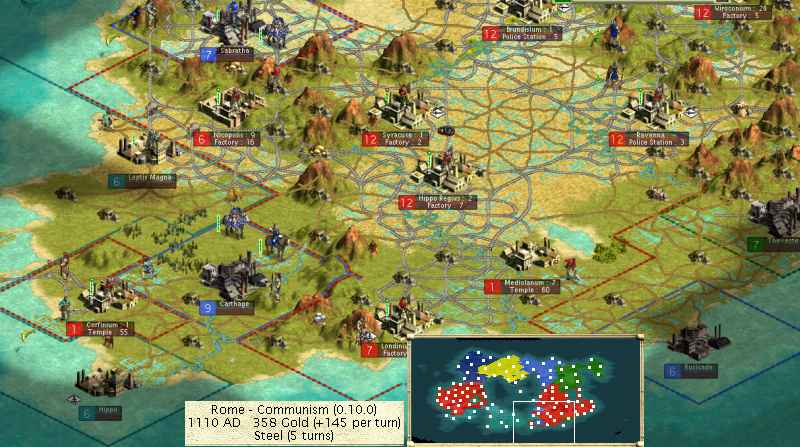
In AD 1050, Caesar squeezed the city of Corfinium in between German and Persian territory. The down side to the new communist government was that using cash to rush temples was not an option, so it will probably be necessary to pop rush part of it when the city gets big enough. (The city can't grow very big without a temple to claim more tiles.  ) In AD 1110, Rome completed its resettlement of Carthage (at least for the moment) by building the city of Mediolanum using a Greek settler from Mycenae. Caesar didn't really like where that Greek town was located, but had decided to try to get some settlers out of it before ordering it abandoned. ) In AD 1110, Rome completed its resettlement of Carthage (at least for the moment) by building the city of Mediolanum using a Greek settler from Mycenae. Caesar didn't really like where that Greek town was located, but had decided to try to get some settlers out of it before ordering it abandoned.
In regard to the research situation, Rome lost much of its technological lead during the eighty years of anarchy necessary to persuade people of the Roman homeland that a new form of government was needed to make the conquered Greek lands productive. But once the new government was firmly in place, research into Corporation (which was started by scientists while in anarchy) could be completed in forty years. Caesar had hoped that the new, rapid technological pace could last, but with no universities in the homeland and not even libraries in Greek lands, Steel is taking sixty years to research and Refining would have taken seventy. At the moment, after having just traded Industrialization to the Celts for Sanitation, Corporation is the only technology that Rome has all to itself.
[This brings up a very strange feeling to this game. Normally, in a game where I've done some conquering, I have AI cities that need hospitals. But Theseus's empire had cities packed together even more closely than mine did, so I have relatively few places where hospitals would serve any useful purpose.]
Rome had also built two additional cities in the former Greek area: Tyrus adjacent to the former location of Troy and Verona on some cleared marshland in southeastern Greece. Additional settlers would be built in case an opportunity to claim more land might present itself, but for the moment, Caesar was happy with the shape of his empire.
One last point that might be of interest was that Caesar took advantage of Rome's period of anarchy to send twenty of the nation's thirty-three bands of native workers to Greece by ship without losing as much productivity as would be lost during normal times. That would play havoc with the timetable for railroading the mountains in Roman territory, but catching the former Greek lands up in flatland railroads seemed more important.
Attachment: ad 1110 carthage resettled.jpg
This has been downloaded 56 time(s).
|
|
| |
|
|
|
nbarclay
|
|
Huntsville, Alabama
Dec 1999
time: 23:33
|
|
By AD 1240, Caesar was getting nervous. His military was the most powerful in the world, but but the area it had to protect was the largest. Persia was of special concern because it bordered Roman territory on both ends, making Rome an obvious target if Xerxes decided to get aggressive - and the forces defending the former Greek lands were not as strong as those defending native Roman soil.
So Caesar decided to do something. He declared war on the Germanic Tribes and bribed Persia and the Celts into joining an alliance, with a Right of Passage agreement with Persia as part of the deal. Persia would almost certainly be strengthened economically by the arrangement since it would presumably seize the former Carthaginian lands held by the Germanics, but with any luck, its offensive forces would be bled down to a point where they would no longer pose any meaningful danger. There was also at least some possibility that Xerxes would be kind enough to raze a city or two instead of capturing, especiallly where Rome's cultural borders were strongest, in which case the Romans might be the ones with an opportunity to gain territory. (And there might also be an opportunity to sneak a settler or two into lands the Celts or Persians would capture in the Germanic core.)
In the opening stages of the battle, Roman forces killed numerous Germanic cavalry that were sitting along the border. They also captured eight Carthaginian slaves that the Germanics had previously taken, adding significantly to the work force available in the Roman homeland.
|
|
| |
|
| |
All times are GMT. The time now is 05:33.
Apolyton Time is 00:33. |
top of page
|
|
|
Forum Rules:
You may not post new threads
You may not post replies
You may not post attachments
You may not edit your posts
|
HTML code is ON
vB code is ON
Smilies are ON
[IMG] code is ON
|
|
|
|
|
|





 03-08-2004 09:38



 |
|