|
| |
|

|
DRoseDARs

|
 |
"My god, it's full of peas..."
Jul 2002
time: 21:24
|
|
...Maybe, maybe not. You know how fickle these things can be. 
http://story.news.yahoo.com/news?tm...pace_signals_dc
quote:
Could Space Signal Be Alien Contact?
Thu Sep 2, 8:32 AM ET
LONDON (Reuters) - An unexplained radio signal from deep space could -- just might be -- contact from an alien civilization, New Scientist magazine reported on Thursday.
The signal, coming from a point between the Pisces and Aries constellations, has been picked up three times by a telescope in Puerto Rico.
New Scientist said the signal could be generated by a previously unknown astronomical phenomenon or even be a by-product from the telescope itself.
But the mystery beam has excited astronomers across the world.
"If they can see it four, five or six times it really begins to get exciting," Jocelyn Bell Burnell of the University of Bath in western England told the magazine.
It was broadcast on the main frequency at which the universe's most common element, hydrogen, absorbs and emits energy, and which astronomers say is the most likely means by which aliens would advertise their presence.
The potentially extraterrestrial signals were picked up through the SETI@home project, which uses programs running as screensavers on millions of personal computers worldwide to sift through the huge amount of data picked up by the telescope. |
If true:   & SETI@Home = & SETI@Home = 
If not: Oh well. Onward we compile... 
*********
Update:
 Straight from the horse's mouth: Straight from the horse's mouth:
Reports of SETI@home Extraterrestrial Signal Highly Exaggerated
quote:
September 2, 2004:
A rash of reports in recent days that SETI@home has discovered a likely signal from an alien civilization are highly exaggerated, says SETI@home Chief Scientist Dan Werthimer of U.C. Berkeley.
The storm was initiated by an article in New Scientist magazine, which reported about SETI@home’s most promising candidate signal to date, and speculated about its possible origins. Like all of SETI@home’s 5 billion potential signals, this candidate, labeled SHGb02+14a, was assigned a numerical score representing the statistical likelihood that it is indeed an intelligent extraterrestrial signal. Its relatively high score placed it among the 200 “top candidates” selected for the targeted reobservation sessions that took place in March of 2003 at the Arecibo Radio Observaotry. Of all the candidates targeted in the sessions, however, SHGb02+14a was one of the very few to be confirmed during the reobservations, and the only one whose score following the sessions actually went up.
While this makes SHGb02+14a interesting, the chances that it actually represents an intelligent signal from beyond remain extremely slim. Random chance alone would make it probable that at least one of the billions of candidates detected by SETI@home would be observed on three separate occasions, as was the case for this candidate. Furthermore, as we reported in the SETI@home Update of May 17, 2004, the fact that this candidate’s frequency drifts rapidly makes it extremely improbable that it is a transmission from extraterrestrials. Because of the drift, explained Werthimer, “if we had looked at the sky even a few seconds later we wouldn’t have found a match” for this candidate. A signal that drifts so quickly that it can only be heard for seconds at a time at a given frequency can only be detected by blind luck. Needless to say, such a transmission is an unlikely vehicle for message from an advanced civilization.
In addition, SETI@home Project Director David Anderson of U.C. Berkeley pointed out that SHGb02+14a is a candidate of a type known as a "barycentrically corrected gaussian." A true transmission of this type, he explained, would remain in a more or less fixed narrow-band frequency, and not drift rapidly as this signal does.
At Arecibo the giant radio telescope still scans the sky, looking for an alien transmission. Around the world, millions are still crunching SETI@home data on their personal computers. The Search for extraterrestrial intelligence continues at full speed, but as of now there is no breakthrough.
Of course, this could change at any time… We promise to keep you posted. |
Last edited by DRoseDARs on 03-09-2004 at 13:21
|
|
| |
|
| |
|
| |
|
| |
|
| |
|
| |
|
|
|
DRoseDARs
|
|
"My god, it's full of peas..."
Jul 2002
time: 21:24
|
|
Straight from the horse's mouth:
Reports of SETI@home Extraterrestrial Signal Highly Exaggerated
quote:
September 2, 2004:
A rash of reports in recent days that SETI@home has discovered a likely signal from an alien civilization are highly exaggerated, says SETI@home Chief Scientist Dan Werthimer of U.C. Berkeley.
The storm was initiated by an article in New Scientist magazine, which reported about SETI@home’s most promising candidate signal to date, and speculated about its possible origins. Like all of SETI@home’s 5 billion potential signals, this candidate, labeled SHGb02+14a, was assigned a numerical score representing the statistical likelihood that it is indeed an intelligent extraterrestrial signal. Its relatively high score placed it among the 200 “top candidates” selected for the targeted reobservation sessions that took place in March of 2003 at the Arecibo Radio Observaotry. Of all the candidates targeted in the sessions, however, SHGb02+14a was one of the very few to be confirmed during the reobservations, and the only one whose score following the sessions actually went up.
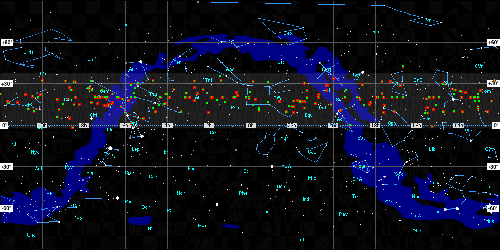
...Image w/caption posted below...
While this makes SHGb02+14a interesting, the chances that it actually represents an intelligent signal from beyond remain extremely slim. Random chance alone would make it probable that at least one of the billions of candidates detected by SETI@home would be observed on three separate occasions, as was the case for this candidate. Furthermore, as we reported in the SETI@home Update of May 17, 2004, the fact that this candidate’s frequency drifts rapidly makes it extremely improbable that it is a transmission from extraterrestrials. Because of the drift, explained Werthimer, “if we had looked at the sky even a few seconds later we wouldn’t have found a match” for this candidate. A signal that drifts so quickly that it can only be heard for seconds at a time at a given frequency can only be detected by blind luck. Needless to say, such a transmission is an unlikely vehicle for message from an advanced civilization.
In addition, SETI@home Project Director David Anderson of U.C. Berkeley pointed out that SHGb02+14a is a candidate of a type known as a "barycentrically corrected gaussian." A true transmission of this type, he explained, would remain in a more or less fixed narrow-band frequency, and not drift rapidly as this signal does.
At Arecibo the giant radio telescope still scans the sky, looking for an alien transmission. Around the world, millions are still crunching SETI@home data on their personal computers. The Search for extraterrestrial intelligence continues at full speed, but as of now there is no breakthrough.
Of course, this could change at any time… We promise to keep you posted. |
Caption:
quote:
A sky map of the reobservations that took place at Arecibo in March of 2003. The blue areas represent the plane of the Milky Way, the gray strip the band of sky seen from Arecibo. The squares mark the locations of the signal candidates revisited during the reobservation sessions.
Image: University of California/SETI@home |
 Attachment: skymap_small.gif Attachment: skymap_small.gif
This has been downloaded 255 time(s).
|
|
| |
|
|
|
problem_child
|
 |
State of the Animal
Mar 2000
time: 05:24
|
|
quote:
Originally posted by Asher
Modern computers expend much more energy while under load than idle, and a computer with SETI is never idle.
That's not my point though, my point was opportunity cost. If you want to run a computational program as a screensaver, consider something genuinely useful to mankind like Folding@Home (protein folding for cancer research).
As far as I'm concerned, people should conserve energy (allow their computers to "sleep"), or they should use the spare cycles constructively with programs like Folding@Home. SETI@home is a waste of resources because it uses additional electricity as the computer never sleeps, and it doesn't do anything useful. |
This seems a fairly intelligent analysis to me. 
I absolutely believe there is other life in the universe, we would be impossibly freakish if not. Perhaps of every 40 billion planets only one has 'plant-like life', perhaps of every 80 billion worlds bearing plant-like life, only one has 'basic animal-life', perhaps of every 160 billion planets bearing basic animal-life only one has advanced animal life, and of every 320 billion of those, only one has intelligent life, and of every 640 billion of those, only one has technologically advanced life, and of every 1280 billion of them... only one planet is populated by beings that have the slightest interest in space exploration, and has developed radio technology, and has the economy to support space-mission one, and the luck not to have succumbed to some sort of planet-voiding war/apocalypse/crash-back... let alone to have managed to put out enough deep space missions to eventually stumble across us.
In short, I very much doubt we'll ever meet or hear from other intelligent beings in the universe, though I'm sure they exist. We might one day get to meet a Titanian germ or something though... that'll be really exciting!!!!
Last edited by problem_child on 03-09-2004 at 16:23
|
|
| |
All times are GMT. The time now is 05:24.
Apolyton Time is 00:24. |
top of page
|
| archivepost |
|
Forum Rules:
You may not post new threads
You may not post replies
You may not post attachments
You may not edit your posts
|
HTML code is ON
vB code is ON
Smilies are ON
[IMG] code is ON
|
|
|
|
|
|





 03-09-2004 11:14











 |
|