|
| |
|

|
Exile
|
 |
of the Benighted Realms
Sep 2000
time: 23:16
|
|
Some historical commentary;
1.) Textual geneology indicates that the first few biblical books were written much later than the period written about. One can expect anachronisms like the mention of cavalry long before they were actually used in the middle east. Anachronisms like this are how textual criticism proceeds to identify the actual period during which the books were written.
2.) The various city-states that dotted the levant during this period are all identified as Caananite. In this context, "Caananite" is a broad category, but does have some identifying features. They spoke a semitic language, had been on site for centuries, but had been affected by the Amorite migrations some time before, which probably created these states by an amalgamation of Amorites and prior occupiers, the Caananites. I've been suspicious that the "Hebrew" attack and occupation of the southern levant, as related in Exodus, was a garbled record of the Aramean migrations, which would have produced a similar record of events. Keep in mind; there is tremendous conflation of actual events and complete fiction in the biblical text. The various authors, at various times, mixed Sumerian mythology, the history of other peoples, archetypal tales (Moses' abandonment as an infant is an example of these), and actual events to weave the biblical narrative.
3.) Most historians question or dismiss the idea of the sojourn in Egypt for the biblical 400 years. The current interpretation is that the Apiru (Hebrews) entered Egypt during the Hyksos domination, when presumably semitic peoples were more welcome than usual. When the Hyksos regime collapsed, the other semitic groups (including the Apiru), left Egypt.
4.) The Hyksos are, at present, unidentifiable. There have been quite a few crackpot theories, though. Very entertaining sometimes. The Hyksos did speak a semitic language, used and introduced chariots into Egypt, and came from the north. Other than those scant facts, not much is definitively known. In grad school, I proposed a project to identify the Hyksos. It's a mystery, and I wanted to solve it. The dept head, who was also my advisor at the time, told me that the other projects I proposed were much more do-able and that the origin of the Hyksos was one of those un-answerable historical questions. Moral; be VERY suspicious when anyone announces that they know who the Hyksos really were. The crackpot mad scientist Immanuel Velikovsky identified the Hyksos as the Amalakites, but there have been others.
|
|
| |
|
|
|
beingofone
|
|
U.S.A.
Apr 2003
time: 05:16
|
|
Hello Exile- I have enjoyed your scenarios sir. You are a great scenario designer.
quote:
Originally posted by Exile
Some historical commentary;
1.) Textual geneology indicates that the first few biblical books were written much later than the period written about. One can expect anachronisms like the mention of cavalry long before they were actually used in the middle east. Anachronisms like this are how textual criticism proceeds to identify the actual period during which the books were written. |
The story of David is not in the first few books of the bible. The first mention of David is in the book of Ruth, the 8th book. The record in question is in 1 and 2 Samuel and later books. Of course they were written after the fact- so are newspapers as are all current events.
I find that older records and texts other then scripture are accepted without hesitation. Exile I respect your knowledge but we should apply the same textual criticisms to all ancient texts, including the scripture.
There are scenarios in abundance based on other ancient manuscripts. Rome, Greece, Persia even Troy. None seem to question these. Why is that?
quote:
2.) The various city-states that dotted the levant during this period are all identified as Caananite. In this context, "Caananite" is a broad category, but does have some identifying features. They spoke a semitic language, had been on site for centuries, but had been affected by the Amorite migrations some time before, which probably created these states by an amalgamation of Amorites and prior occupiers, the Caananites. I've been suspicious that the "Hebrew" attack and occupation of the southern levant, as related in Exodus, was a garbled record of the Aramean migrations, which would have produced a similar record of events. Keep in mind; there is tremendous conflation of actual events and complete fiction in the biblical text. The various authors, at various times, mixed Sumerian mythology, the history of other peoples, archetypal tales (Moses' abandonment as an infant is an example of these), and actual events to weave the biblical narrative. |
I agree as far as the Caananites go.
A number of clay tablets, discovered at Tell-el-Amarna in Upper Egypt, are the most important historical records ever found in connection with the Bible.The tablets consist of official dispatches and letters, dating from B.C. 1480, addressed to the two Pharaohs, Amenophis III. and IV. They most fully confirm the historical statements of the Book of Joshua.There occur the names of three kings killed by Joshua, Adoni-zedec, king of Jerusalem, Japhia, king of Lachish (Josh. 10:3), and Jabin, king of Hazor (11:1).
Until this discovery the whole invasion was in question.
In fact the Hittites as a race were in question simply because they were only mentioned in "scripture" until wonder of wonders they find other mentions of Hittites and uncover some cities in digs. Now they are accepted as fact.
David`s whole existence was in question until 5 years ago when they discovered a tablet mentioning him. The more they dig the more they discover that scripture for the most part is a historical record. You cannot point to a single find that disproves the scriptural account. Yet this is just simply assumed because it is unlikely to have occured. Not impossible simply unlikely.
As far as Sumerian texts- cool this only furthers to establish the stories veracity.
quote:
3.) Most historians question or dismiss the idea of the sojourn in Egypt for the biblical 400 years. The current interpretation is that the Apiru (Hebrews) entered Egypt during the Hyksos domination, when presumably semitic peoples were more welcome than usual. When the Hyksos regime collapsed, the other semitic groups (including the Apiru), left Egypt. |
What historians? The historians that assume the story is wrong simply because it is in the scripture? Apiru is Semite- Abiri is Hebrew .
quote:
4.) The Hyksos are, at present, unidentifiable. There have been quite a few crackpot theories, though. Very entertaining sometimes. The Hyksos did speak a semitic language, used and introduced chariots into Egypt, and came from the north. Other than those scant facts, not much is definitively known. In grad school, I proposed a project to identify the Hyksos. It's a mystery, and I wanted to solve it. The dept head, who was also my advisor at the time, told me that the other projects I proposed were much more do-able and that the origin of the Hyksos was one of those un-answerable historical questions. Moral; be VERY suspicious when anyone announces that they know who the Hyksos really were. The crackpot mad scientist Immanuel Velikovsky identified the Hyksos as the Amalakites, but there have been others. |
You are the expert here sir. Ancient Egypt- I am somewhat weak in. So I thank you for the info and regard it as truth.
|
|
| |
|
|
|
beingofone
|
|
U.S.A.
Apr 2003
time: 05:16
|
|
quote:
Originally posted by fairline
Do you mind if I make the Hero/leaders foot units? Whenever single combat is mentioned in Mycenean or Biblical sources it invariably takes place on foot with the hero transported to battle in a chariot. Somehow mounted leaders for this period doesn't seem quite right. |
That would be cool Fairline.- thank you for all your hard work and research. I did not know that they were usually on foot in Mycenean literature. Cool- "I learn and become more than I am." Paul of Tarsus
quote:
I've had a more detailed look at the scenario and it plays well. I would suggest fleshing out the Events more - add some more text popups for captured cities or defeated heroes to add a bit of colour. |
All very good suggestions, I will do all of these things. If you have any particular suggestions let me know.
quote:
Why are all units given such high movement stats BTW? I know Palestine is a small place and it would have been possible to traverse the whole region on foot in 1 turn, but I would foresake accuracy for gameplay here; strong units are able to attack too many times per turn currently. |
I will slow them down some. The game engine is at it`s weak point when simulating combat in that it is a fight to the death. Do you think multiple combat for a single unit is detrimental to the gameplay?
|
|
| |
|
|
|
beingofone
|
|
U.S.A.
Apr 2003
time: 05:16
|
|
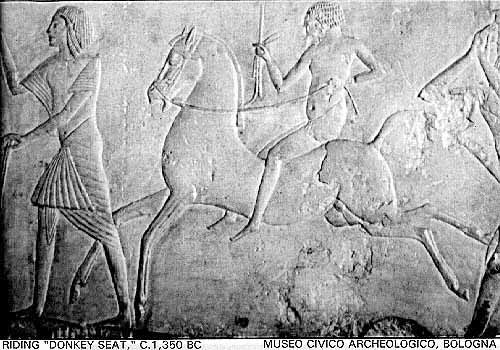
relief dated 1300 B.C.
|
|
| |
|
|
|
beingofone
|
|
U.S.A.
Apr 2003
time: 05:16
|
|
1 MORE TIME
 Attachment: r_rider.jpg Attachment: r_rider.jpg
This has been downloaded 240 time(s).
|
|
| |
|
|
|
beingofone
|
|
U.S.A.
Apr 2003
time: 05:16
|
|
quote:
Why not have a non-buildable generic high-defence/0-move 'fortification' unit for the cities you wish to be tough nuts, |
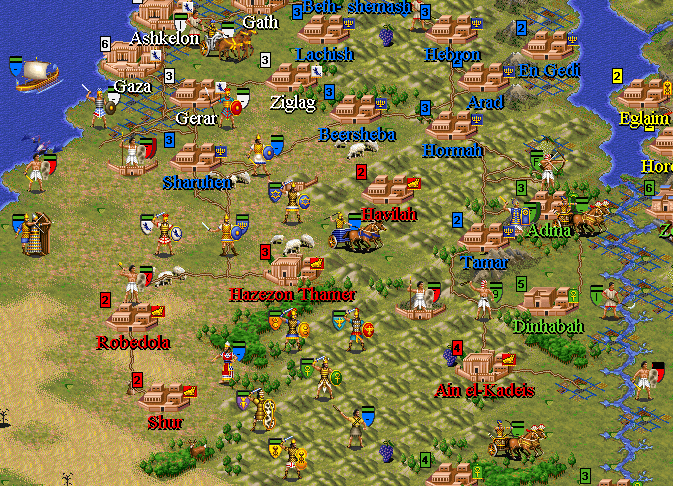
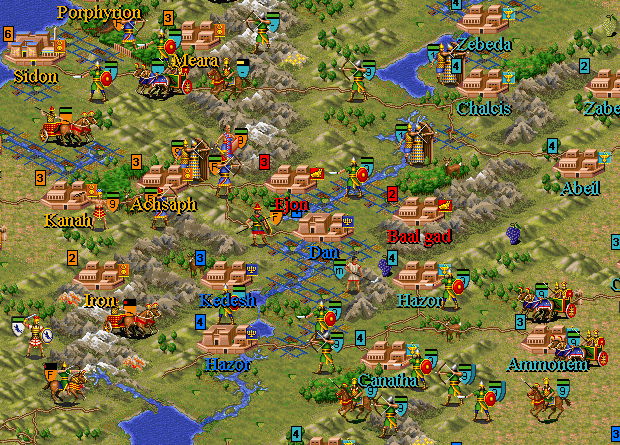
I playtested your suggestion and thought about it. It is a good solution Fairline for a practical problem solver but it just does not "feel" right to me as the cities in Palestine did not have extensive fortifications. It was almost pure manpower and outer walls. I could see how this is a useful tool for some scenarios.
You are also right in the leader aspect of Biblical accounts of mounted leadership. Since traveling on horseback was not "noble". The first king of Israel Saul did use a chariot for travel- he died in one. I am sure he was on foot for command purposes as you say for battle.
If you want feel free to take liberty in changing units altogether. Such as instead of a Caananite swordsman, they also used chariots a great deal.
|
|
| |
|
|
|
beingofone
|
|
U.S.A.
Apr 2003
time: 05:16
|
|
Fairline,
Any luck on finding pics of Ammonites, Moabites or any otherites?
I have scoured the internet I can`t find anything.
|
|
| |
|
| |
|
|
|
beingofone
|
|
U.S.A.
Apr 2003
time: 05:16
|
|
quote:
Fairline-Ended up making new terrain |
I have thought about techumseh`s original suggestion about breaking up the terrain. The addition of olives would help some. Possibly using tundra as he suggested.
quote:
the AI cannot build some civ-specific units (turn cheat mode on and check out the build lists for Philistine cities for example). |
I will use your solution and the link that Curt posted. I triple checked that. Now this is a mystery. I am not at home and all my info is on that hard drive.
|
|
| |
|
|
|
beingofone
|
|
U.S.A.
Apr 2003
time: 05:16
|
|
Fairline-quote:
the AI cannot build some civ-specific units (turn cheat mode on and check out the build lists for Philistine cities for example). |
DO`H- when I uploaded the scenario I forgot to give back the tech for civ-unique units to the Philistines and Phoenicians. I will upload the fix so everyone can get a true playtest in. Iwill post it soon.
|
|
| |
|
|
|
beingofone
|
|
U.S.A.
Apr 2003
time: 05:16
|
|
Does anyone know why the scenario editor will not work on windows XP?
|
|
| |
|
|
|
Valuk
|
|
Acres Wild
Oct 2002
time: 05:16
|
|
I can't play anyone else then the Israelites, 'cause an eventrs error appears everytime I swap the Rules file with the Singleplayer one.
|
|
| |
All times are GMT. The time now is 05:16.
Apolyton Time is 00:16. |
top of page
|
|
|
Forum Rules:
You may not post new threads
You may not post replies
You may not post attachments
You may not edit your posts
|
HTML code is ON
vB code is ON
Smilies are ON
[IMG] code is ON
|
|
|
|
|
|






 15-09-2004 00:41


 I've revised my opinion about the high movement BTW - it adds a new dimension to scenario play and it's a laugh to attack several cities in one turn.


 Attachment:
  Attachment:


 Attachment:
 ) in the Bible. I did include some Bible quotes in the notes txts.
 |
|