|
| |
|

|
germanos
|
|
behind a firm ****, Rotterdam, NL
Apr 2002
time: 06:22
|
|
Kramsib:
N35t0r showed perfectly how the cost of shields is handeled by the program.
Buying units 'per row' is often called "incremental rushbuying" and it is an old technique that is used extensively in PBEM's (and in any SP i play as well). There might be house-rules against it in some games.
Some scenario designers increase the amount of shields per row (for example Kobyashi's Battle for alpha-quadrant) which makes rushbuying much more expensive.
|
|
| |
|
|
|
DaveV
|
 |
USA - EDT (GMT-5)
Jan 1970
time: 00:22
|
|
In a nutshell, where N is the number of shields left:
Wonders and spaceship parts cost 4N to complete.
Other buildings cost 2N to complete.
Units cost N*N/20 + 2N.
In all cases, it costs twice as much if the box is completely empty.
Edit: added spaceship parts.
Last edited by DaveV on 27-09-2004 at 17:50
|
|
| |
|
|
|
debeest
|
|
Wow. Cool. I knew the numbers, but I'd never tried to derive a formula for unit rushbuying cost.
As is so often the case, DaveV has spoken, and there's really nothing left to say.
|
|
| |
|
|
|
Kramsib
|
 |
Father and protector of PROGRESSIVE GAMES, SANTANDER, Cantabria, España (Spain), Unión Europea (European Union)
Sep 2001
time: 06:22
|
|
Good analysis Nestor  
and thank you very much DaveV for the summary.
Now, the reason why I am so interested in this topic is the fact that I think I have a rule to know how much gold a shield costs.
The game has no clear relation between gold and shields, except rushbuying or capitalization.
Capitalization turns each shield into gold in a 1:1 relation, one shield costs one gold.
Rushbuying, as you have explained, means different values for shields depending on what we are building and how much we have built.
My theory about shield value is based on some economic concepts, and I think I have an interesting explanation.
Under my point of view, neither rushbuying nor capitalization reveals the real shield value:
1. Rushbuying means a penalization in shield cost, so shield value is altered over its real value.
2. Capitalization considers that one shield costs one gold, but the whole quantity of gold and shields is different in a civilization (this is because the different terrain types and their different production), consequently their values must be different according to the fact that their relative abundance is different.
So, let me explain what is my solution to this problem.
Let's consider that citizens are our "labour factor". We employ our citizens to get resources, food, shields and gold. So, all the production in our Civilization is gathered with the same quantity of citizens each turn, or better said, the same quantity of "labour force".
It is logical to think that, as the whole production has been obtained with the same "labour force", the total production of food has the same value as the total production of shields, and both have the same value as the total production of gold.
Using a mathematical form
In turn #:
Food Value = Shield Value = Gold Value.
So we can translate, food and shields into gold, just like a real monetary system (with gold pattern  ) )
How much gold does a shield cost?
Now, answer this question is very easy if we know where to get some information and what some demographics mean.
Gold Value is equal to GNP in Demographics, as it reflects the total quantity of trade rows which can be turned into gold.
Shield Value is equal to Mfg. Goods in Demographics, as it reflects the total quantity of shields which are produced in your Civilization.
So the ratio:
GNP / Mfg. Goods
gives the real quantity of gold each shield costs.

As this ratio is different for each Civ, it reflects the different prices every nation has in real world, Inflaction and Deflaction can be also simulated. If the quantity of shields grows up (industrialization), the ratio goes down, the abundance of shields makes them cheaper (deflaction). If the quantity of gold raises (massive building of commercial facilities or roads), the ratio goes up and shields become less abundant in comparison with gold, so we have inflaction. (Just like in the real world ).
In a PBEM, we can establish a real market of items, every nation will has different prices, so they can especialise and compete like a real market
Another aplication for this ratio, is that it can be also used individually for each city to compare if rushbuying or capitalization is really profitable.
If a city produces 10 shields per turn and 30 gold, the ratio will be 3 gold per shield, so if rushbuying costs less than 3 gold per shield, let's say 2 gold, rushbuying is cheaper and a profitable option. If rushbuying costs 4 gold, you will lose money. In this specific case, you can realised that Capitalization is not a good option, it will give you one gold per shield when each shield is equal to 3 gold.
What do you think?
Last edited by Kramsib on 28-09-2004 at 14:55
|
|
| |
|
|
|
Kramsib
|
|
Father and protector of PROGRESSIVE GAMES, SANTANDER, Cantabria, España (Spain), Unión Europea (European Union)
Sep 2001
time: 06:22
|
|
quote:
Originally posted by debeest
Your definition of the GNP in demographics is wrong.
In the demographics screen (F11), GNP = gold income plus 2*luxuries. (It's probably the only thing I ever discovered and posted here before anyone else, so I have a stake in making sure everyone gets it right. ) |
I see, ...
I was working with Stefan's definitions
http://stefan.winkler.net/civ2.html
GNP is undefined and I thought that it could be the same as in Civ III where GNP is defined as the sum of all the gold gathered.
I was wrong obviously, thank you debeest.
But my idea is still there, the ratio:
Total Gold / Total Shields, give the price for each shield.
Bloody Monk says:
quote:
I am much in favor of extensive micro-management, but, this makes my hair hurt. "Food value = shield value"??...not in most of my games, where controlling growth/happiness is usually a consideration. And what is the value of those demographic screens anyway?? Even if you can determine what they are measuring (thanks, debeest!!), does this info really help one play the game better??
It is an interesting article and I stand ready to be corrected, but it seems like over-thinking to me. More game playing, I say.
Monk
|
Yes I know it can sound like overthinking but I think it can help to play better.
If you know how much gold is a shield you can know the real value of any unit, any building or any Wonder without the default punishment for rushbuilding.
When trading units in your PBEM's (if you use Yaroslav's CivDip you could trade even with cities - see the Spanish Civilization Site for further details, look at my sign for a link - ) you would be able to calculate a more accurate price.
This ratio can be also useful to programme a more efficient AI for new Civilization Games becouse not only it gives the shield value, but also indicates the relation between wealthy and industrialisation.
Of course you can live without all this knowledge, but for me is really amazing, discovering new things in Civ and how it seems to reality.
|
|
| |
|
|
|
SlowThinker
|
|
homeless, Praha, Czech Republic
Jan 2000
time: 06:22
|
|
Hi guys, I was invited by Kramsib...
quote:
Originally posted by Kramsib
If you know how much gold is a shield you can know the real value of any unit, any building or any Wonder without the default punishment for rushbuilding. |
I agree, if you can find a correct ratio between food/shield/arrow then you will be able to evaluate every production and expenses by one number. Then it will be much easier to find out how to play and which production you should prefer.
quote:
Let's consider that citizens are our "labour factor". We employ our citizens to get resources, food, shields and gold. So, all the production in our Civilization is gathered with the same quantity of citizens each turn, or better said, the same quantity of "labour force".
It is logical to think that, as the whole production has been obtained with the same "labour force", the total production of food has the same value as the total production of shields, and both have the same value as the total production of gold.
Using a mathematical form
In turn #:
Food Value = Shield Value = Gold Value |
Bad idea. You forgot that labour forces are not equally effective.
In order to simplify situation imagine there are only 2 types of squares in Civ2: forest produces 2 shield only and grassland 3 food. Then you can exchange 1 shield for 1.5 food. (now we disregard the fact that shields may be traded for food also using food caravans)
You have always to consider rates you can 'trade' resources (replacing workers is also a kind of trade). Therefore rushbuy cost + capitalization cost (or improvement building and its subsequent sale) are possible methods how to compare gold and shield. Which one to use, rushbuy(RB) or capitalization? It depends on situation, shields may be used for city production, gold for bribing. If bribing is more effective then you will build improvements, sell them and bribe: you will consider 1 shield=1 gold. If city production is more effective then you will RB units and improvements: you will consider 1 shield = approx. 2 gold (a digression: gold has one big advantage: it is freely transferable over your empire. Therefore with large civ it may be 1 shield = 1 gold; but also in small empire the possibility of transfer has its value, because gold may be used immediately (in 1st city that is able to finish production with RB), in opposite cumulated shields must 'wait' 10 or 20 turns before they start to be effective).
The price of bribing is quite high in Civ2, therefore you usually prefer not to bribe but to rushbuy (not speaking about MP duel now ), and so the ratio should be about 1 shield = 2 gold (and less, because of free transfer).
quote:
the ratio:
GNP (total gold) / Mfg. Goods
gives the real quantity of gold each shield costs. |
This is a good idea if you want an 'average' price of a resource. But in a real play you shouldn't think this way, because prices are different in different cities.
Again our simplified example: imagine we have also Plains that produces 2 food. One city has only plains+forest around, another one has only grassland+forest. Of course you won't want to use a general, 'average' price food/shield but you will consider each city separately.
BTW, Civ2 is not 'analog' but 'digital', production is completed at a stroke. So in the beginning you are going for Monarchy, you know it will cost say 200 beakers. If I compare the asset of the Monarchy with 200 beakers I switch to 60% taxes. But later, when I am 20 beakers from Monarchy, I not only switch to 60% science but also replace workers to Ocean.
Similarly when the foodbox is nearly full you should switch to food-productive squares.
quote:
If a city produces 10 shields per turn and 30 gold, the ratio will be 3 gold per shield, so if rushbuying costs less than 3 gold per shield, let's say 2 gold, rushbuying is cheaper and a profitable option. If rushbuying costs 4 gold, you will lose money. In this specific case, you can realised that Capitalization is not a good option, it will give you one gold per shield when each shield is equal to 3 gold. |
Don't forget gold is transferable. But let's suppose you play OCC:
You are probably trying to think this way:
quote:
If a city can choose to produce 10 shileds OR 30 gold... |
Remember my example with 2-shield forest and 3-food grassland...
_________________________________________
quote:
Originally posted by Bloody Monk
I have seen many discussions over the years trying to nail down this idea (SlowThinker, IIRC), and it would be very nice if your idea is the accurate solution. |
I Campo's challenge thread I tried to open a debate how to mathematically evaluate different possible decisions of a player, i.e. ways of development (for example in the beginning of the game - when should you prefer shields and when food?). I indicated a possible method ... but nobody wanted to talk with me  :weeping:. But I finished an algorithm which I use in play ( debeest give me a lesson of english if this is ridiculous): I compare a level of exponential growth for each possibility: for example by building Settlers you can double your output in 15-20 turns, with caravans and shipchaining in 5-10 turns etc. :weeping:. But I finished an algorithm which I use in play ( debeest give me a lesson of english if this is ridiculous): I compare a level of exponential growth for each possibility: for example by building Settlers you can double your output in 15-20 turns, with caravans and shipchaining in 5-10 turns etc.
This algorithm could be used to write a very good AI (from economic point of view, so under peace conditions) for a very simplified Civ2. For real Civ2 it would be extremely laborious, because each rule and each exception should be taken into consideration.
Last edited by SlowThinker on 29-09-2004 at 03:07
|
|
| |
|
|
|
Ben Kenobi
|
 |
McGregornobi!
Oct 2002
time: 21:22
|
|
I did a test of this once.
I built one city with all production squares, another with all trade, and another with all food.
The reason why food is so devalued has to do with WLtD. It is always prefereable to grow your cities through WLtD rather than through the accumulation of food.
Also, as time passes, your value of food drops, as the cities get larger. Food cannot be any greater in value than 1 food = 10 shields, but for a city size 10, food cannot be greater than 1 food = 1 shield. For a city size 20, this becomes 1 shield = 2 food. The value may be less, but it cannot be greater than these numbers.
You can do very well without ever having a large surplus of food, as you will still be able to grow your cities. Production is something that you cannot live without.
|
|
| |
|
|
|
rjmatsleepers
|
|
If we knew how to compare the value of gold, shields, beakers and food, this would help analyse a lot of the crucial decisions in the game. For example, during the silly rules game, I had a discussion with La Fayette concerning the relative benefit of a high tax rate and using the money to rush caravans compared with a high research rate.
It seems to me that one of the things that makes this game so interesting is that the strategic decisions are very difficult to analyse. Part of the reason for this being that the value of shields etc varies from game to game and from time to time (and perhaps from city to city!)
In the early landing games, it can be worth sacrificing shields and food in order to obtain a single extra beaker - the one that enables you to discover monarchy in time to revolt 4 years earlier! In this case, 2 food + 2 shields is worth less than 1 gold and one beaker.
RJM at Sleeper's
|
|
| |
|
|
|
Kramsib
|
|
Father and protector of PROGRESSIVE GAMES, SANTANDER, Cantabria, España (Spain), Unión Europea (European Union)
Sep 2001
time: 06:22
|
|
First of all, I want to thank SlowThinker to be here, let's see if we can reach a solution altogether.
Secondly I want to clarify a concept. When I use "gold" I mean trade arrows.
As we all know, trade arrows are turned into "science", "luxuries" and "taxes", I assume that the percentage for science is "gold" expended in technology, and "luxuries" is "gold" expended in goods for people. So I consider trade arrows as a global amount of gold which is used in several expenses.
quote:
Originally posted by SlowThinker
-- Talking about considering citizens as "labour force" --
Bad idea. You forgot that labour forces are not equally effective.
In order to simplify situation imagine there are only 2 types of squares in Civ2: forest produces 2 shield only and grassland 3 food. Then you can exchange 1 shield for 1.5 food. (now we disregard the fact that shields may be traded for food also using food caravans)
You have always to consider rates you can 'trade' resources (replacing workers is also a kind of trade).
|
I don't think is totally bad. Of course, each terrain type has different productions, but once you have placed your citizens, the production in that turn determines three quantities ( food / shields / gold) as they were produced by the same quantity of citizens in one turn, their values would be the same.
Of course, if you replace your workers next turn, the quantities would be different, in addition if new citizens spring up, quantities would be different too. We can see this like prices continually fluctuating up and down and changing depending on where you are focusing your production.
quote:
Therefore rushbuy cost + capitalization cost (or improvement building and its subsequent sale) are possible methods how to compare gold and shield. Which one to use, rushbuy(RB) or capitalization? It depends on situation, shields may be used for city production, gold for bribing. If bribing is more effective then you will build improvements, sell them and bribe: you will consider 1 shield=1 gold. If city production is more effective then you will RB units and improvements: you will consider 1 shield = approx. 2 gold.
|
I agree with you, there are other ways of comparison, but they include a penalty to avoid game exploits, so real values are altered. Someone can think that when you can only choose among penalty based alternatives, real value is quite irrelevant. But when trade is quite free like in PBEM's, the situation is pretty different.
quote:
(a digression: gold has one big advantage: it is freely transferable over your empire. Therefore with large civ it may be 1 shield = 1 gold; but also in small empire the possibility of transfer has its value, because gold may be used immediately (in 1st city that is able to finish production with RB), in opposite cumulated shields must 'wait' 10 or 20 turns before they start to be effective).
The price of bribing is quite high in Civ2, therefore you usually prefer not to bribe but to rushbuy (not speaking about MP duel now ), and so the ratio should be about 1 shield = 2 gold (and less, because of free transfer).
|
Gold from treasure is freely transferable, but "trade arrows" aren't (although caravans can create more). I am sorry for this misunderstanding.
Gold in treasure is out of my analysis as it is a stock variable and it cannot be studied in the same way as a flow variable.
When I speak of gold I mean "trade arrows", which can be considered as gold.
quote:
-- Speaking about the ratio --
This is a good idea if you want an 'average' price of a resource. But in a real play you shouldn't think this way, because prices are different in different cities.
Again our simplified example: imagine we have also Plains that produces 2 food. One city has only plains+forest around, another one has only grassland+forest. Of course you won't want to use a general, 'average' price food/shield but you will consider each city separately.
|
This is exactly what I mean when I said the ratio can be used individually for each city. The fact that each city is surrounded by different terrain types makes them have different ratios (different prices for shields).
You can use individual ratios or the average ratio whenever you consider is better to use.
------------------------------------------------------------
What I am more interested in , is to know if we are following a good track using this ratio. Once the idea seems to be acceptable, let's study each case specifically.
|
|
| |
|
|
|
SlowThinker
|
|
homeless, Praha, Czech Republic
Jan 2000
time: 06:22
|
|
quote:
Originally posted by Bloody Monk
Gold does equate to trade arrows. Now, if you want to state some unprovable proposition and call it a "constant", to act as a shortcut in making complex calculations, ala Richard Feynman, then maybe some general agreement can be reached. But saying gold = trade arrows will not suffice as a proof of anything. |
Also for me arrows=gold.
If you want to think about problems like Civ2 you should simplify it first. Only when you understand the simplified problem you may continue by adding new items.
You can simplify it by different ways - e.g. beakers are freely transferable in gold and back, or there is no science and no luxuries in the game... But for our existing debate it is not important which kind of simplification is applied, and so IMO there is no need to articulate it.
quote:
Originally posted by Kramsib
I don't think is totally bad. Of course, each terrain type has different productions, but once you have placed your citizens, the production in that turn determines three quantities ( food / shields / gold) as they were produced by the same quantity of citizens in one turn, their values would be the same.
Of course, if you replace your workers next turn, the quantities would be different, in addition if new citizens spring up, quantities would be different too. ... |
But you don't place workers deliberately. First compare price of a resource with an asset of this resource, and only after this comparison you place your workers.
quote:
...We can see this like prices continually fluctuating up and down and changing depending on where you are focusing your production. |
Again, price cannot depend on where you put workers...
quote:
Gold in treasure is out of my analysis as it is a stock variable and it cannot be studied in the same way as a flow variable. |
I do not understand. What is a flow variable and so can be studied?
|
|
| |
|
|
|
Kramsib
|
|
Father and protector of PROGRESSIVE GAMES, SANTANDER, Cantabria, España (Spain), Unión Europea (European Union)
Sep 2001
time: 06:22
|
|
quote:
Originally posted by Bloody Monk
Maybe there is a language thing going on here, but I just do not understand how you can equate gold with trade arrows.
This entire discussion has been replete with references to "buying" or "rush buying" units or improvements or WoW. There is no way in the game I play to buy anything with trade arrows. This is becoming very artificial and theoretical, and the theory fails on bad initial assumptions.
Gold does equate to trade arrows. Now, if you want to state some unprovable proposition and call it a "constant", to act as a shortcut in making complex calculations, ala Richard Feynman, then maybe some general agreement can be reached. But saying gold = trade arrows will not suffice as a proof of anything.
Monk |
Ok, I will explain.
Let's say, we have 1000 trade arrows, and we are using 50 % in science, 20 % in luxuries and the 30 % left are taxes which turn into "gold", this gold is expended in paying buildings cost and the rest is thrown into your treasure.
What I say is that the whole amount of trade arrows is gold, money (just a change on the name, nothing else), and 50 % of that money is expended on scientific investigation, 20 % is money expended on luxuries and the rest, after paying buildings cost, is gold for your treasure.
You can make it easier, think that taxes are 100%, then all trade arrow = gold , that's it, 1000 trade arrows = 1000 gold coins.
It does not matter where do you employ your trade arrows, they can be turned into gold.
quote:
Originally posted by SlowThinker
But you don't place workers deliberately. First compare price of a resource with an asset of this resource, and only after this comparison you place your workers.
|
No, I place my workers where I believe they produce more, or they will produce what I consider is better, then the price comes as a result of my decisions.
Let's say, one of my cities is producing, 20 food, 10 shields and 25 trade arrows. Shield price would be 2.5 , but if I replace my workers and I get 22 food, 11 shields and 23 trade arrows , shield price would be 23/11=2.09 .
First alternative means less food, less shields and more trade arrows.
Second alternative means more food, more shields and less trade arrows.
As shields become more abundant under the second alternative they are logically more expensive.
Price is given by my decisions.
But then, after seeing this price I can realise I need more gold (trade arrows) or more shields and that fact can help me to take future decisions.
quote:
Again, price cannot depend on where you put workers...
|
Prices depends on production (shortage or abundancy of sources), and production depends on where I put my workers.
quote:
I do not understand. What is a flow variable and so can be studied?
|
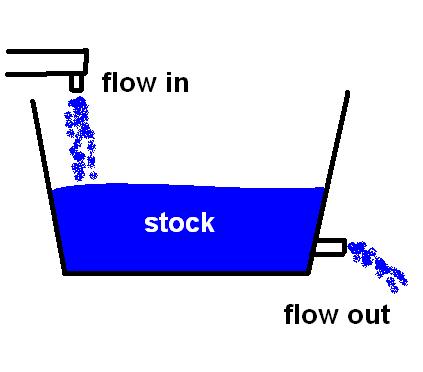
Trade arrows are a flow variable (perhaps this is a bad translation of what I mean, but I haven't found a better word), they are produced and expended every turn, like a cash flow.
In real life a cash flow means money input and money output, what remains in the middle is a stock, whereas what enters and goes is the flow.
Trade arrows are produced every turn and expended (in science, luxuries, ...), the rest which is not expended are acumulated into the treasure.
In Economics we must be careful not to mix stock with flows because they don't have the same features.
( I  this game. ) this game. )
|
|
| |
|
|
|
SlowThinker
|
|
homeless, Praha, Czech Republic
Jan 2000
time: 06:22
|
|
quote:
Originally posted by N35t0r
And remember that Capitalization yelds 1:1 only when the city has neither market, bank, or stock exchange... in those cases, it yelds 1:1.5, 1:2 and up to 1:2.5 |
I never used it... how does it work with a factory? Is the output doubled?
|
|
| |
|
|
|
rjmatsleepers
|
|
quote:
Originally posted by Kramsib
Ok, I will explain.
Let's say, we have 1000 trade arrows, and we are using 50 % in science, 20 % in luxuries and the 30 % left are taxes which turn into "gold", this gold is expended in paying buildings cost and the rest is thrown into your treasure.
What I say is that the whole amount of trade arrows is gold, money (just a change on the name, nothing else), and 50 % of that money is expended on scientific investigation, 20 % is money expended on luxuries and the rest, after paying buildings cost, is gold for your treasure.
You can make it easier, think that taxes are 100%, then all trade arrow = gold , that's it, 1000 trade arrows = 1000 gold coins.
|
OK - at the margin we have a relationship between gold, luxuries and beakers. (Although in governments other than a democracy, there is a limited on the total amount in each category.) So for our first city with 3 trade arrows we can choose 2 gold and 1 beaker or 2 beakers and 1 gold (ignoring luxuries). So the "price" of a beaker is 1 trade arrow. But as we build infrastructure this ratio changes. With a library and a university, but no market, the "price of a beaker has dropped to half a trade arrow. I think I've got it. (Of course when you have a market and a bank, 1 trade arrow becomes 2 gold, but maybe that doesn't matter.)
So how do we use this in the game? Among the important decisions in the game are:
a) what should I "spend" my shields on? (For example should I build a market or a caravan)
b) should I allocate my workers to grass in order to boost city growth or to forest in order to boost production?
Can you give us an example of how we can use your ideas to analyse either of these questions.
RJM at Sleeper's
|
|
| |
|
|
|
SlowThinker
|
|
homeless, Praha, Czech Republic
Jan 2000
time: 06:22
|
|
quote:
Originally posted by rjmatsleepers
OK - at the margin we have a relationship between gold, luxuries and beakers. (Although in governments other than a democracy, there is a limited on the total amount in each category.) So for our first city with 3 trade arrows we can choose 2 gold and 1 beaker or 2 beakers and 1 gold (ignoring luxuries). So the "price" of a beaker is 1 trade arrow. But as we build infrastructure this ratio changes. With a library and a university, but no market, the "price of a beaker has dropped to half a trade arrow. |
Yes, this is 'my' view on price. A good example, more clear than with replaced workers.
But in Kramsib's theory it is different:
quote:
Originally posted by Kramsib
Price is given by my decisions.
...
Prices depends on production (shortage or abundancy of sources), and production depends on where I put my workers.
|
In other words if Kramsib sets 90% science + 10% taxes then price of 1 beaker is 0.11 gold. If he sets 10% science + 90% taxes then price of 1 beaker is 9 gold.
But such a conception of price is completely useless IMHO.
Kramsib, IMO you are thinking about one situation and speaking about a diferent one: If you can choose between 90% of science (and no taxes) or 10% taxes (and no science) then the price of 1 beaker is 0.11 gold.
But in our case you can have both science and taxes.
|
|
| |
|
|
|
SlowThinker
|
|
homeless, Praha, Czech Republic
Jan 2000
time: 06:22
|
|
Preface: next reasoning supposes you can trade resources deliberately, which is not completely true...
quote:
Originally posted by rjmatsleepers
So how do we use this in the game? |
Let us say we have a simple price system: 1food = 1shield = 2beakers = 2gold
(For example 1food = 1shield supposes we can switch between shielded grassland and forest, but this is not always so simple: for example if there is a road on the grassland).
Let us say in the beginning of the game we are deciding how to set taxes: to go to monarchy as fast as possible or to use gold for rushbuys of Settlers?
1) taxes up, Settlers
A new city costs 20 food + 40 shields = 120 gold (I disregard facts that the city may need a warrior for martial law and the settler must walk before building a new settler). New city is built on grassland with shielded grasssland and forest around, so it is producing a 9-gold output each turn (3 shields + 1 food surplus + 1 arrow).
120 / 9 = 13.3
In 13.3 turns we have our investment back.
2) science up, Monarchy
Monarchy costs you ... say 10+20+30+40+50 beakers, so 150 beakers.
Now we must imagine status of our empire when Monarchy is completed: suppose 5 cities...one is whale on grassland... then monarchy gives me 1 arrow + 1 food ... summing ... let us say there is an aditional 10-gold output.
150 / 10 = 15
In 15 turns we have our investment back.
A sidenote: Also you should take into account gold works faster than beakers. Imagine a game where you can build Settlers or Engineers. Engineer cost is doubled, but a city build by Engineer has a doubled production. Will you build 1 Engineer or two Settlers in a row?
Edited: sequence of paragraphs
Last edited by SlowThinker on 04-10-2004 at 03:57
|
|
| |
|
|
|
Kramsib
|
|
Father and protector of PROGRESSIVE GAMES, SANTANDER, Cantabria, España (Spain), Unión Europea (European Union)
Sep 2001
time: 06:22
|
|
quote:
Originally posted by SlowThinker
I understand price as a ratio between resources that expresses how easily/arduously I can get them.
I need price because it helps me to place workers most effectively (I compare prices and revenues and then choose resource that has the highest revenue/price ratio).
If you place workers first ... then what is the price for?
Let us forget food so that things are more simple. We have only shields (S) and arrows (A). You can place workers only two ways: so that the output is
a) 2 A + 3 S
or replace them so that you get
b) 5 A + 2 S.
You are saying you have two prices of shields, 0.66 and 2.5 . What are these two prices good for? Can you explain it on this example?
I will tell you how 'my' price works:
In the example you get always 2A and 2S. This part of the output cannot be changed. Additionaly you may decide between a) 1 S or b) 3 A. So the price of 1 shield is 3 arrows.
|
Oh my God !, you have discovered the MARGINALIST THEORY you will be an economist pretty soon
"Your" price is the price of the unit in the margin .
Ok, I will explain.
I suppose you are asking me to select the best alternative between a) or b) using price as an indicator.
Someone can think that the best alternative is that one which means the highest output. Let's calculate the outputs.
Option a) 2A + 3S
2A = 2 gold
3S = 2 gold ( 3 * 0.66)
Total output = 4 gold.
Option b) 5A + 2S
5A = 5 gold
2S = 5 gold ( 2 * 2.5)
Total output = 10 gold
Option b) is better than a).
But this is an ERROR,
, the correct way to select among alternatives comes through MARGINALIST THEORY, that's what you have applied, involuntarily I suppose.
Passing from a) to b), means changing 1 shield for 3 gold.
Under option a), shield price is 0.66, changing option a) for option b), means to sell one shield for 3 arrows, as 3 > 0.66, you earn money and become more efficient.
Now, under option b), there are less shields and their price is higher, 2.5.
Now, imagine you can change option b) for a new option c) which means:
c) 8A + 1S
Passing from b) to c), means changing a shield which costs 2.5 gold, for 3 arrows. You are still earning money so the change is good.
Now, imagine that you cannot change option b) for option c), you can change b) for d), and d) is:
d) 7A + 1S.
Passing from b) to d), means changing a shield which costs 2.5, for 2 arrows. 2 < 2.5 and you are losing money, changing b) for d) is not worthwhile.
Now, let's assume that we can always exchange shields for arrows at a constant rate, 1 shield for 1 arrow. That is to say, we have a wide range of alternatives like the following:
a) 4A + 6S
b) 5A + 5S
c) 6A + 4S
d) 7A + 3S
In case a), each shield costs 4/6 = 0.66 gold.
passing from a) to b) means changing a 0.66 gold shield for 1 gold (1 > 0.66, we earn money  ). Shield cost raises to 1 gold. ). Shield cost raises to 1 gold.
Passing from b) to c) means changing a 1 gold shield for 1 gold (1 = 1, we are indiferent  ). Shield cost raises to 1.5 ). Shield cost raises to 1.5
Passing from c) to d) means changing a 1.5 shield for 1 gold (1 < 1.5, we are losing money ). Passing from c) to d) is not worthwhile.
This analysis is using prices in the margin, the marginal cost of exchanging 1 shield for a determined quantity of arrows.
As you can see, when choosing among different alternatives, price gives you the clue.
So, my ratio is the real price of the shields under the current production. "Your" price is the exchange rate for the new alternative. If the exchange rate is higher than the real price, changing is good, if lower is bad.
quote:
Flow/stock:
I am not familiar with economics, but I understand that 'stock' is a freezed, not working (and so not growing) item.
But what are shields? They 'flow' in each turn, then they represent a 'stock', and they 'flow' out when production is finished. |
Shields flow, they are produced every turn and expedended every turn to maintain units (entrance and exit of shields), the unexpended remaining shields are acumulated in a stock to construct buildings, units or wonders. That is to say, you can exchange a fix quantity of X shields for a building a unit or a Wonder. 
There is a classical drawing to show what is flow and what is stock, I hope it can help:
 Attachment: flow.jpg Attachment: flow.jpg
This has been downloaded 100 time(s).
|
|
| |
|
|
|
Kramsib
|
|
Father and protector of PROGRESSIVE GAMES, SANTANDER, Cantabria, España (Spain), Unión Europea (European Union)
Sep 2001
time: 06:22
|
|
quote:
Originally posted by rjmatsleepers
OK - at the margin we have a relationship between gold, luxuries and beakers. (Although in governments other than a democracy, there is a limited on the total amount in each category.) So for our first city with 3 trade arrows we can choose 2 gold and 1 beaker or 2 beakers and 1 gold (ignoring luxuries). So the "price" of a beaker is 1 trade arrow. But as we build infrastructure this ratio changes. With a library and a university, but no market, the "price of a beaker has dropped to half a trade arrow. I think I've got it. (Of course when you have a market and a bank, 1 trade arrow becomes 2 gold, but maybe that doesn't matter.)
So how do we use this in the game? Among the important decisions in the game are:
a) what should I "spend" my shields on? (For example should I build a market or a caravan)
b) should I allocate my workers to grass in order to boost city growth or to forest in order to boost production?
Can you give us an example of how we can use your ideas to analyse either of these questions.
RJM at Sleeper's |
Very good appreciation, that is what I mean when I said the idea has to be improved.
Let's work a bit more without marketplaces nor libraries and then I will introduce them in the analysis once we get a strong base.
Thank you
Last edited by Kramsib on 30-09-2004 at 18:30
|
|
| |
|
|
|
Kramsib
|
|
Father and protector of PROGRESSIVE GAMES, SANTANDER, Cantabria, España (Spain), Unión Europea (European Union)
Sep 2001
time: 06:22
|
|
quote:
Originally posted by SlowThinker
But in Kramsib's theory it is different:
In other words if Kramsib sets 90% science + 10% taxes then price of 1 beaker is 0.11 gold. If he sets 10% science + 90% taxes then price of 1 beaker is 9 gold.
But such a conception of price is completely useless IMHO.
Kramsib, IMO you are thinking about one situation and speaking about a diferent one: If you can choose between 90% of science (and no taxes) or 10% taxes (and no science) then the price of 1 beaker is 0.11 gold.
But in our case you can have both science and taxes. |
That is not correct.
Asuming there is no marketplaces nor libraries, 1 beaker is equal to one gold, as the beaker is obtained from only 1 trade arrow.
Prices are not altered with a different distribution of trade arrows, as the quantity of arrows stays the same. You can expend your trade arrows wherever you want, science, luxuries or "cash" in your treasure, prices remain the same. Only changes in production (more/less arrows, food or shields) can alter prices.
|
|
| |
|
| |
All times are GMT. The time now is 05:22.
Apolyton Time is 00:22. |
top of page
|
|
|
Forum Rules:
You may not post new threads
You may not post replies
You may not post attachments
You may not edit your posts
|
HTML code is ON
vB code is ON
Smilies are ON
[IMG] code is ON
|
|
|
|
|
|





 27-09-2004 02:48








 |
|