|
| |
|

|
Oerdin
|
 |
of Internet Music.
Sep 2001
time: 21:17
|
|
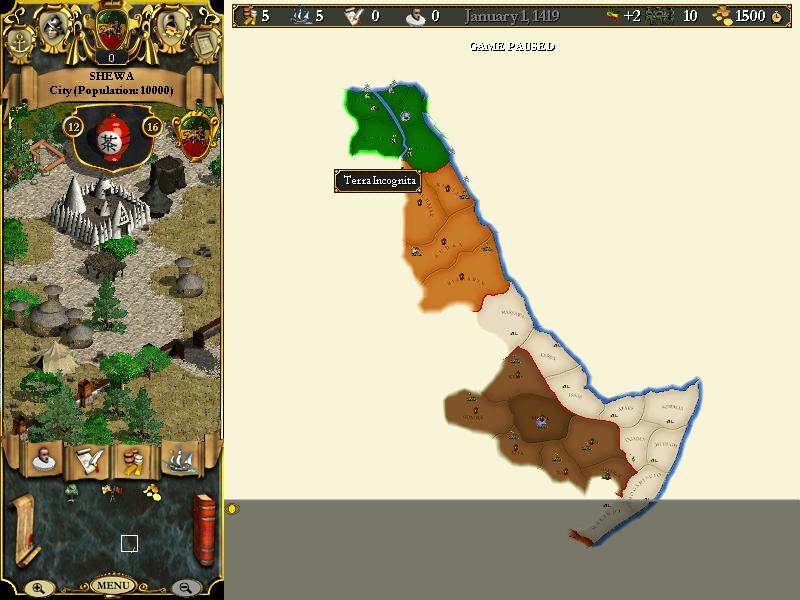
The year was January 1, 1419 and King Yeshak of Ethiopia was a middle aged man of medium height and a slight build whose hair was just beginning to turn gray around his temples. He’s complexion was that of a people who were part black and part Semitic. Ethiopia was an ancient Kingdom which kept the Orthoxed Christian faith which Roman Monks had brought to the land more then one thousand years ago. Back in those days the Romans ruled Egypt and the two countries had traded extensively by sailing boats filled with goods up and down the Nile. Those were the golden days before the Muslim Armies had conquered Egypt in 641…
Now all of Lower Egypt was controlled by the Mameluks with the upper Nile was controlled by our Orthodoxed brothers in Nubia while Ethiopia rested in the mountainous highlands whose life giving rains and snows gave birth to the White Nile. King Yeshak’s Ethiopia was a land rich in resources but thinly populated & poor in educated people and even poorer when it came to money. Other then the equally poor Orthodoxed Kingdom of Nubia, Ethiopia was totally cut off from the rest of the Christian world and surrounded in a sea of hostile Muslim states. But this was not always so…
King Yeshak was proud of his country’s history and this pride was made more so by the fact that Ethiopia had little else besides its history but what a long and sometimes glorious history it was. The recorded history of Ethiopia began in 1000BC when the land was known as Sheba. The ancient Israelites considered Sheba to be a rich land filled with strange people and when it came time for Israeli’s King Solomon to marry he had chosen the legendary Queen of Sheba to be his wife. That union had created the beginning of the royal line which had ruled in Ethiopia from that time all the way up to Yeshak himself.
The city of Axum had been found during the 3rd century BC and Axum was an offshoot of the Semitic Sabeam kingdoms of southern Arabia, it became the greatest ivory market in the north east of Africa. Ethiopia influenced the state of Meroe in Sudan. Over the next few centuries, Axum encroached more and more on Meroe until, when Christianity became the state religion in the 4th century AD, Ethiopia conquered the kingdom. Christianity was brought to Ethiopia by a Syrian youth named Frumentius who grew up in Axum and converted the King; the youth was later made the first Bishop of Axum in 330 AD.
In the days before Islam Axum conquered parts of Yemen and southern Arabia and remained a great power until the death of the Prophet Mohammed when the Muslim hordes had over run Ethiopia’s Arabian holdings and the Kingdom was forced back onto the African mainland. As Islam expanded it cut off Ethiopia from its former Mediterranean trading partners and allies, Muslims replaced the Egyptians in the Red Sea ports. Ethiopians were forced to consecrate their Bishops in Cairo instead of in Constantinople but pilgrams were allowed to travel to Jerusalem.
In the 11th century the lands along the horn of Africa were conquered by tribes which had converted to Islam and they set up independent trading kingdoms whose wealth was based upon the sale of slaves, Ivory, and gold. By the 12th century the Ethiopian kings had once again forced the Somalis to become vassals but the Somali kingdoms retained their Muslim religion and by the beginning of the 13th century they once again became independent of Ethiopia.
King Yeshak could not help feeling his once mighty kingdom was deep in decline having lost its former holdings in Sudan, Somalia, and southern Arabia. His blood burned with the desire to reconquor those lands and to reestablish trade on the Mediterranean Sea. Perhaphs even seeking help from the mighty Romans.
But for now that was all just a dream. Yeshak looked out upon the dirty and squalid city of Axum which some 8000 people called home. The streets were dirt and when it rained they turned to thick mud, most of the houses were made of mud brick with only a few stone buildings such as the royal palace. There was no sewer system so fetid waste water pooled in the low spots spreading disease and becoming a home to vermin of all kinds. Yes, this was not the most promising place to build a great Empire but it would have to do.
|
|
| |
|
|
|
Oerdin
|
|
of Internet Music.
Sep 2001
time: 21:17
|
|
The first order of business for Yeshak is to strengthen the power of the state so the bureaucrats are appointed to conduct a census (Centralization +1). Next Yeshak wanted to begin the process of regaining control of the petty kingdom’s of Somalia but where was he to find the people to populate these lands and the armies to quell the unavoidable uprisings? Slowly, plan begun to take form in his mind.
The life of an Ethiopian peasant was one of crushing poverty and the feudal lords whom they worked for had the power of life and death over them. Yeshak would offer any peasant who wishes to become a colonist to be granted their freedom and a large plot of land in the newly colonized lands. Naturally, the lords opposed this as it would mean they would lose many of their serfs but King Yeshak found a way to over come their concerns. Each peasant who left to be a colonist must serve in the army and must send back to their master three new slaves captured in Somalia so that their lord would still have people to work his estates. So it was that Yeshak was able to find the needed colonists to populate the new colonies to the east.
Mogodiscio seemed like the logical first choice since the natives were only moderately war like where as all the other provinces of the horn of Africa were filled with extremely war like natives. Luck was with the Ethiopians as the natives of Mogodiscio agreed to convert and swore loyalty to the Ethiopian nation (city built without the natives rebelling), but in Afar and Issas Arab slave traders captured or killed every living native leaving the entire land virtually depopulated so colonies were started there to prevent Arab squatters from taking the land that rightfully belonged to Ethiopia. Lastly an army of 11,000 infantry was raised so that war could be waged and the natives killed or captured.
The next five years are spent destroying and enslaving the natives of the rest of Somalia. Village after village is raised and the captured men become slave laborers who are forced to build the colonies for the arriving Ethiopian settlers while the native women and children are sent back to Ethiopia proper. The point was to destroy the native societies so that only cultural Ethiopians remained and by 1427 cities are founded in Afar and Issas while the provinces of Messawa, Keran, Somalia, Mudugh, Ogden, and Malindi see colonies constructed.
GAME NOTE: This is the part where I used cheats I used Pocahontas to get settlers and gave myself 3000 gold to pay for it. In the story line I explain it as serfs being given their freedom in exchange for becoming colonists and the population of the original provinces doesn’t go down because the eliminated natives are brought back as slaves.
In 1426 we finish researching trade level 1 and merchants are dispatched to Alexandria which is the only Cot we see on our world map and almost immediately our merchants are harassed giving us a casus belli against the Mameluks. Fortunately, the Mameluks & the Hajj are in the middle of a war versus Ak Koyunlu and Dulkadir. Two loans are taken out and additional infantry are raised. After a right of passage is signed with Nubia the infantry is moved into northern Nubia where the invasion of Egypt can begin. Yeshak waited until he saw rebels popping up in Egypt and then, in December of 1427, declares war against the Mameluks with both Nubia and the Hajji joining in. The war lasts for 5 years.
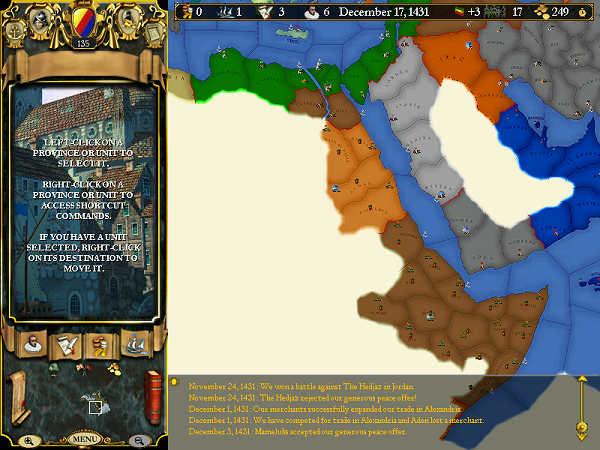
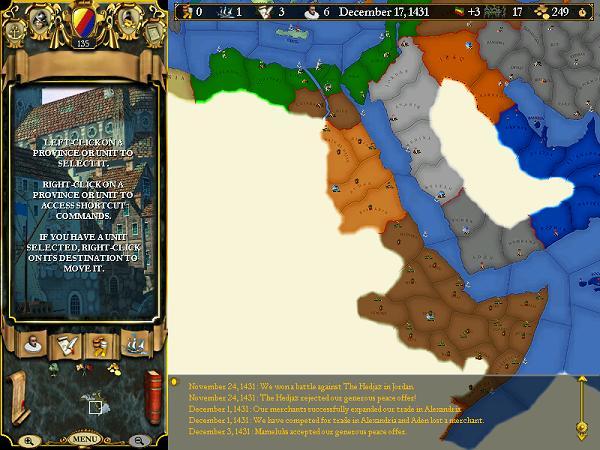
To prevent my meager Armies from being destroyed I have to make use of the diffuses cheat. King Yeshak remains at his palace in Axum and instead his brother Taqla Miryam leads the Armies at the front. The Ethiopians avoid large Mameluk armies and rebels, instead they attack newly created armies and attack the rebels only when they are about to take a city. Doing this they take Cairo, Nile, and Cataract while one 4k army is sent to Mekkah to siege that city. The Army in Mekkah is reduced to 2k and the siege stops but luckily Aden declares war on the Hajj and the Mameluks and they send a 20k Army which does all the hard work of the siege but leaves Ethiopia in control of the city. Several more months are spent pillaging Hajj’s provinces and destroy their new armies as they are created and in 1431 the Hajj agrees to a separate peace paying us 200 gold.
In August of 1429 King Yeshak dies in Axum of food poisoning and since his two sons are still relatively young Yeshak’s brother Duke Taqla Miryam becomes regent. Unfortunately, the Duke is killed in 1430 while sieging Alexandria and so Yeshak’s eldest son Endreyas becomes the King of Ethiopia. Endreyas survives long enough to sign a peace treaty with the Mameluks in 1432 giving Ethiopia the provinces of Nile and Cataract plus 300 gold which is just enough to repay the loans Ethiopia owed before Endreyas is stabbed to death by his ambitious younger brother Anda Iyasus.
 Attachment: ethiopia_1432.bmp Attachment: ethiopia_1432.bmp
This has been downloaded 9 time(s).
|
|
| |
|
|
|
Oerdin
|
|
of Internet Music.
Sep 2001
time: 21:17
|
|
The war with the Mameluks left the national treasury empty and most of the Army had to be disbanded because the state could not afford to pay their salaries. Clearly, something needed to be done to improve the national economy. To this end all of the state’s resources were dedicated to researching improvements in infrastructure with only a small amount used to raise taxes to pay for the much reduced army.
Mean while, ambassadors are dispatched throughout the Christian world in an attempt to end Ethiopia’s long isolation. Most of the national’s of Europe prove themselves to be indifferent to our remote Kingdom but special attention is paid to Byzantium. The Eastern Roman Empire is truly a shadow of its former glory with the Ottomans capturing everything except for Thrace itself. Even the Emperor has been forced to bend his knee and become the Sultan’s vassal. It is degrading to see the seat of Orthodoxy power reduced to such a state but perhaps this will prevent Byzantium from being completely conquered by the Turks.
Knowing how far behind Ethiopia is compared to the rest of the world Young King Endreyas repeatedly sends gifts to the Byzantine Emperor and finally the Greek’s agree to share the secrets of their learning with us. From the mighty city of Constantinople come maps which allow us to learn of the far northern parts of Europe, we also gratefully receive copies of ancient Greek plays & philosophy, treatise on mathematics & engineering, and most valuably great works of history and poetry. A marriage between Endreyas and the youngest niece of the Byzantine Emperor is also arranged but all people are not happy with the young Endreyas’s rule.
May of the nobles are restless at the reductions in the army and many feel that the money spent on gifts to the far off Greeks would have been better spent at home. King Endreyas is especially challenged by his uncle Zar’a Yaqob Quastantin. Endreyas does his best to maintain power but every time he turns around his scheming uncle has convinced more and more of the nobles to back his bid on the throne. Finally when his uncle leads a mob of rebellious nobles into the royal palace Endreyas has no choice but to abdicate in favor of his uncle and Endreyas, along with his Greek wife, retire to a life of religious reflection at a monastery in the Ethiopian highlands.
Once Quastantin seized power he immediately began drawing up plans for military expansion but first he would need money. Quastantin began appointing tax collectors in every province of the Empire; this took several years to complete and he was repeatedly distracted by rebellions in Cataract and Nile but eventually every province was upgraded. Next he began work on a small navy and began increasing the size of the army and to appease the nobles he changed government policy to greater favor the noblemen who had put him in power (Nobility +1). Once everything was ready Quastantin used the excuse of a diplomatic insult sent by the King of Oman to declare war upon Oman.
Oman’s trading posts in Socotra, Bahrain, Qatar, and Dammon were burned and the Omani capital of Mascate was besieged. Finally when Muscate was taken the navy was carefully routed (so as to avoid the superior and more numerous Omani navy) to the island of Zanzibar. Eventually peace is made with Oman in exchange for Zanzibar and 100 gold pieces. Ethiopia had conquered its first center of trade!
Next trading posts were constructed in Socotra, Dammon and Bahrain (but the Omanis beat us to Qatar) and the colonies on the horn of Africa were upgraded to cities. While that was going on the Army, minus a small garrison force kept in Zanzibar, was once again moved into Egypt. When all was ready Quastantin launched an unprovoked invasion of the Mameluks. The war lasted for five years most of which were spent avoiding the larger Mameluk armies and attacking the inexperienced newly constructed armies. Several times the provinces of Nile and Cataract were taken by the Mameluks but each time we were able to retake them with the help of our loyal Nubian allies. Eventually the Mameluks agree to peace with Ethiopia in exchange for Alexandria. Ethiopia had taken a second CoT and Alexandria’s port on the Mediterranean would act is Ethiopia’s window upon the rest of the Christian world.
Soon after the end of the war gifts and letters were sent to the court of the Nubian king and eventually Quastantin’s diplomatic efforts paid off and the Nubia’s agreed to even deeper ties to Ethiopia in the form of vassalation. It was during this time period that the secret to constructing brewing manufactories was completed but Ethiopia lacked the money needed to construct such a manufactory. The rest of Quastantin’s reign was spent attempting to integrate his conquests into the rest of the Kingdom as the state was frequently forced to spend all the money it had maintaining armies to fight the frequent rebellions in Egypt and Zanzibar. In 1468 King Quastantin died alone and unwed in the royal palace but history will likely record him as one of the greatest conquerors in Ethiopian history.
|
|
| |
|
|
|
Oerdin
|
|
of Internet Music.
Sep 2001
time: 21:17
|
|
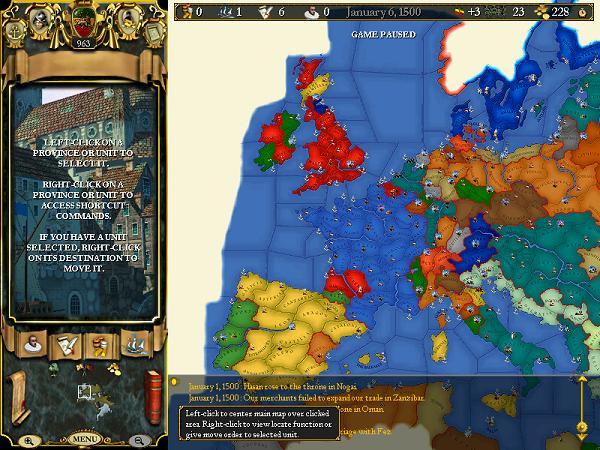
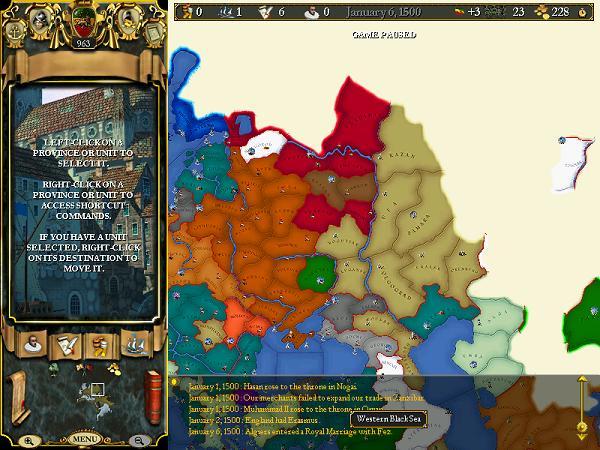
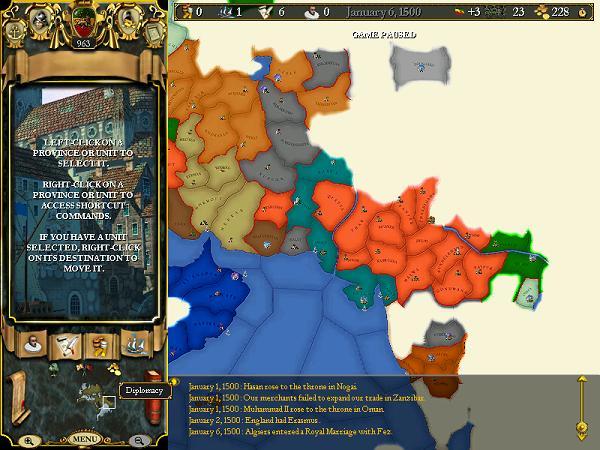
Before I write the AAR I thought I would show you all a preview of what the world looks like in 1500. France is more or less unified, England has captured half of Scotland while Spain(!) took part of Scotland, Ireland has declared independence from England and has it's capital in Dublin. Spain is unified except for revolters in Catalonia. Hungery and Bavaria have teamed up to destroy Austria! While Venice is expanding in the Balkans.
Here is western Europe.
 Attachment: westerneurope_1500.jpg Attachment: westerneurope_1500.jpg
This has been downloaded 43 time(s).
Last edited by Oerdin on 14-12-2004 at 18:01
|
|
| |
|
|
|
tombom
|
|
Pining for the fjords
Oct 2004
time: 05:17
|
|
Why do you have difrules cheat on at one point?
|
|
| |
All times are GMT. The time now is 05:17.
Apolyton Time is 00:17. |
top of page
|
|
|
Forum Rules:
You may not post new threads
You may not post replies
You may not post attachments
You may not edit your posts
|
HTML code is ON
vB code is ON
Smilies are ON
[IMG] code is ON
|
|
|
|
|
|





 13-12-2004 18:59


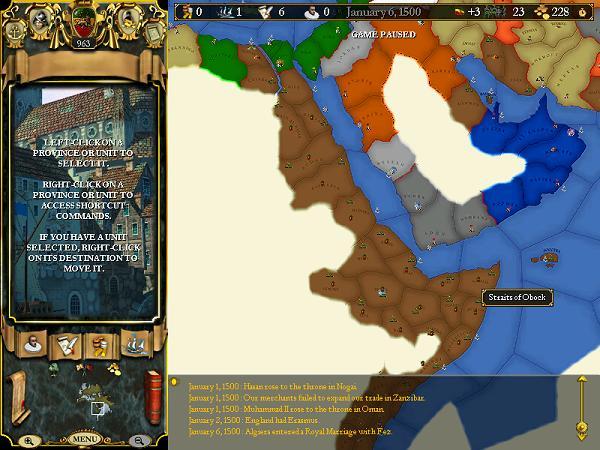
 Dehli remains the big kid on the block, The Persians have revolted and the Tamerids are a shadow of their former self. Gujarat keeps growing much to my consternation; I'd love to see them reduced to a one province minor so I could pick up their CoT.
 o
o |
|