|

|
Dominae
|
|
quote:
Originally posted by Theseus
Dominae, I (think) I am just now realizing what you did: First new town at Thebes22?
|
Yup! Sorry for the lack of a screenshot; I'll see what I can do about it (I'll probably have to go through the whole 40 turns again using my notes).
By the way, Kloreep also opted for a city at Thebes22, so he too deserves the credit for that move.
|
|
| |
|
|
|
Modo44
|
 |
in western Poland
Jul 2004
time: 06:34
|
|
@Commy. The mines are by Niessuh, and I don't remember who did the borders - found both somewhere on poly. I'm using Rhye's Terrain, which is based on SnOOpy's work. Download is here:
http://forums.civfanatics.com/showt...&threadid=85016
@Theseus. This is Emperor, and it's stock rules. I currently play Demigod, more often with the AU mod, than without (the difference at this level is huge, btw.), and I even win some of those. So this game was a relaxing and easy one - no need to sqeeze things out.
Personally, I'd go with Thebes 32 as the camp/pump, to get the Irrigation to the Cows faster. But I didn't need it for a win, so I just covered all available tiles, not bothering to do very tight spacing. Also, the resources available made me change plans to that wide pattern (all the Whales west from Thebes).
Not settling north is a wrong impression, given by the early stages in which the first pic was made. I did go north, leaving many of the red spots for later. Dominae is right - the first cities (Thebes, Memphis, Heliopolis) were designed to pump Settlers/Workers, so I wanted them ready ASAP. Note that terrain was being improved even before my main Settler pump (Mamphis) was settled.
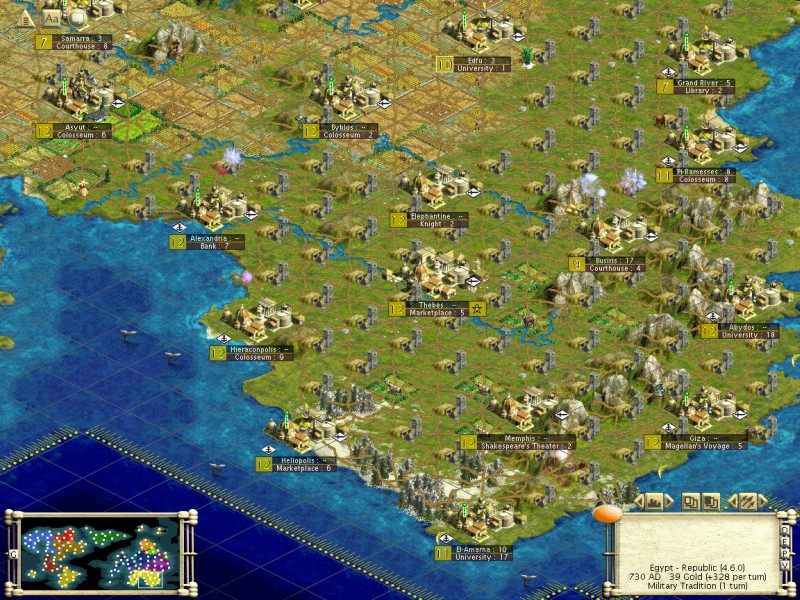
Here's a pic of the core, 730 AD, when I dropped the game (too easy!). Peace with everyone, almost all improvements built, a commanding tech lead. Grand River used to be Iroquis, but they couldn't help our grand culture. Samarra was Babylonian, but it flipped as well. Byblos has built the Egyptian FP. Heliopolis and Giza use very few water tiles. As you can see, Memphis will change that soon.
 Attachment: egypt, 730 ad.jpg Attachment: egypt, 730 ad.jpg
This has been downloaded 103 time(s).
Last edited by Modo44 on 09-01-2005 at 15:07
|
|
| |
|
| |
|
|
|
Yosho
|
|
It is very situation dependent. In my current game, I played an expansionist civ on emperor level and when I got lucky and got a settler from a hut early on, I built the pyramids right away as my capital city; my order was basically "warrior, warrior, pyramids." I think I finished them before anyone else had even started them. Of course, without the free settler, I wouldn't have even tried to build the pyramids without building a settler first, but as it was it did work for me.
|
|
| |
|
|
|
cumi
|
 |
Austria
Jul 2002
time: 06:34
|
|
I would like to go a bit deeper into further phase of the game, namely, when building the city improvement start.
When do you actualy start with building Libraries, Marketplaces, etc (in the core cities)? Building Granaries and Baracks can be done in early stages of the game, because of the expansion and the military plans (rush, defence...).
I do not even think about building these improvements, until:
1. the number of cities, the border of my empire doesn't reach what I planed, including the building of the second core city zone around the Forbidden Palace. Simply, I want to grab as much as useful territory possible.
2. I don't have the number of workers I think would handle the terrain improvement. It makes no sense to start building city improvements, wonders when terrain stays unimproved and the few number of workers don't know where to start with the lot of tasks.
3. I don't secure millitarly my empire.
Until these issues are not done, all of my cities has to concentrate on this. Maybe, a few wonders, what i think would bring a lot for the further growth.
|
|
| |
|
|
|
punkbass2000
|
 |
Waterloo, ON, Canada
Feb 2002
time: 00:34
|
|
Marketplaces should start getting built immediately upon availablity in any city that can make use of one (you'll need to determine that case by case, though generally you can always use one in your capital and first "ring" of cities). Assuming you're not Scientific, Libraries are more needed if you're planning to research for yourself. If you have a high Science rate then Libs(and eventually Unis) are a must. If you have a low Science rate then they're not worth building, except in certain circumstances for culture.
1. If your empire isn't as large as you want it by the end of the REX phase, it's time to build Barracks and troops and take what you want. As for the FP, I'll need to know what version of civ you're playing before I can go into my lengthy dissertation of where to put it 
2.Glad you figured this out yourself  I've only rarely met players who don't need to be beaten over the head about making more Workers I've only rarely met players who don't need to be beaten over the head about making more Workers  A good rule of thumb is at least one Native Worker per city, and as many as two per city, ideally. In the game I'm documenting in the AU forum, I had so many Workers that I started adding them back to cities because they had nothing to do and I hadn't even left the Ancient Age yet. That game had special circumstances to a degree, but the principle holds true. A good rule of thumb is at least one Native Worker per city, and as many as two per city, ideally. In the game I'm documenting in the AU forum, I had so many Workers that I started adding them back to cities because they had nothing to do and I hadn't even left the Ancient Age yet. That game had special circumstances to a degree, but the principle holds true.
3. Barracks are key for this. Generally, I sort cities into one of a couple categories. Cities with high food and shield production get a Granary and are for Settlers. Cities with high food but low shields also get a Granary but are Worker pumps instead. Cities with low food but high shields get a Barracks and are unit pumps. City specialization is very important. Oh, and don't forget to use all those Workers you should have by now to chop down forests to speed up those Granaries and Barracks (particularly Granaries, though, as their effect is exponential). Oh, and cities with low food and low shields are usually done case by case. They tend to build Warriors for either exploration or MP, or slowly build Workers (like if they produce 2fpt ans 1 spt they can spit out a Worker every ten turns). If they're coastal they will probably do Curraghs, if you're Expansionist they will probably do Scouts. If the city is a border city it will probably pop-rush a Temple.
|
|
| |
|
|
|
cumi
|
|
Austria
Jul 2002
time: 06:34
|
|
quote:
Originally posted by punkbass2000
1. ...As for the FP, I'll need to know what version of civ you're playing before I can go into my lengthy dissertation of where to put it
|
Conquest 1.00, I think. Why? What's the difference?
quote:
3. Oh, and don't forget to use all those Workers you should have by now to chop down forests to speed up those Granaries and Barracks (particularly Granaries, though, as their effect is exponential). Oh, and cities with low food and low shields are usually done case by case.
|
I rearly build granaries. When my cities grow "normally" - this means, it is not on tundra, desert or other low-food terrain - my cities are building a settler, when they are above size 2. This way, you can also get the exponential growth:
- 2 cities -> bulid 2 settlers
- 4 cities -> 4 settlers
- 8 cities -> 8 settlers
few more steps, and you're done...
|
|
| |
|
|
|
Dominae
|
|
quote:
Originally posted by cumi
- 2 cities -> bulid 2 settlers
- 4 cities -> 4 settlers
- 8 cities -> 8 settlers
|
What is missing here is the number of turns it is taking your cities to produce those Settlers.
A city with a Granary grows twice as fast and therefore typically produces Settlers twice as fast. My 2 cities with Granaries therefore produce 4 Settlers just as fast as your 4 cities produce 4 Settlers.
The exponential growth you describe still applies if you build Granaries, it just takes a larger cost up front to get going. Once you do, though, it does not take long for the "Granary" plan to out-REX (i.e. expand faster) the "Settler-only" plan.
Another factor is Corruption: when rely on your core cities to fuel your expansion (with Granaries), you produce Settlers much more quickly than if you hand some of this responsibiliy to your border towns, because of Shield waste. For this reason, I would guess that 2-3 cities with Granaries produce 8 Settlers faster than 8 cities without.
|
|
| |
|
|
|
Dominae
|
|
Incidentally, one of the things I find interesting about Demigod and Deity is that in some circumstances building a Granary to REX is not the right play, despite the method's efficiency: on those higher difficulties, where the AI gets free Settlers, the startup cost of the Granary plan (which slows down your REX initially) is high enough that you will lose land that would easily have been yours on Emperor and below.
All the efficiency in the world is not that important when you find yourself boxed in by 3 AIs before your third Settler is even ready. Producing some quick Settlers without a Granary allows you to claim land that you desperately need.
Knowing when to build Granaries and when not to is a skill particular to beyond-Emperor play. It's not really necessary, though, if you're the type to restart until you an acceptable start (here, one with enough breathing room).
|
|
| |
All times are GMT. The time now is 05:34.
Apolyton Time is 00:34. |
top of page
|
|
|
Forum Rules:
You may not post new threads
You may not post replies
You may not post attachments
You may not edit your posts
|
HTML code is ON
vB code is ON
Smilies are ON
[IMG] code is ON
|
|
|
|
|
|







 09-01-2005 11:23




 |
|