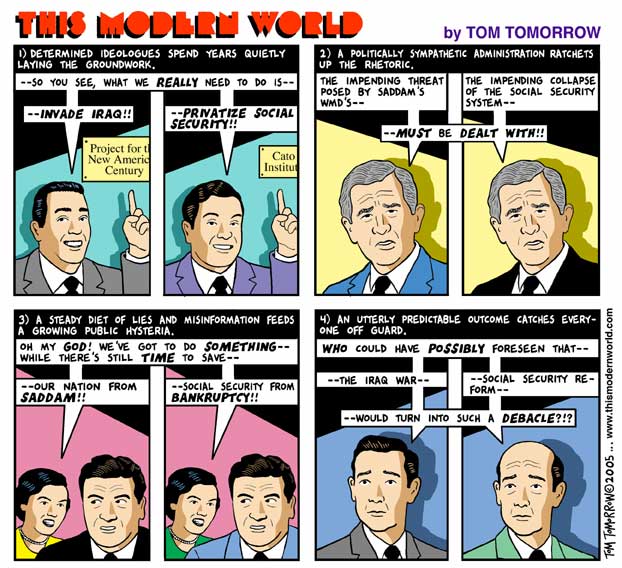
|
| |
|

|
Rufus T. Firefly
|
 |
is one way of saying it, though I prefer "mensch"
Sep 2000
time: 07:32
|
|
The problem with Social Security, pure and simple, is that you get to collect it at 65, or 62, or even in some cases 60.
It shouldn't work like that. Social Security isn't a pension scheme, nor was it meant to be. It's an insurance scheme, designed to insure that if you don't have much money and are so old that you can't work anymore, you'll get some dough from Uncle Sam. You pay every year, regardless; if you make it to 65, you get to collect, and if you don't you're SOL.
The problem is that, when Social Security was started, making it to 65 -- especially if you were working-class -- was a bet that favored the house. So few men did it that it made SS make sense -- somewhat like fire insurance for homes. Two generations on, however, you have to be deeply unlucky or actively self-destructive not to make it to 65. The bet no longer favors the house. Nobody issues insurance under those conditions.
The solution is to return SS to what it was: insurance against getting old. But "old" needs to be redefined; the definition from the 30's is no longer adequate, and that's what's killing the system.
And if you don't want to work until you're 70 or 75? Then don't buy the SUV, the big-screen TV, the lotto ticket every day, and start saving instead.
|
|
| |
|
|
|
Rufus T. Firefly
|
|
is one way of saying it, though I prefer "mensch"
Sep 2000
time: 07:32
|
|
quote:
Originally posted by JohnT
quote:
As it happens, the UC census bureau has posted a comparison of the 1930 and 2000 censuses (censi?), which shows that average life expectancy in 1930 was 59.7 years, while in 2000 it was 77.1 years... |
What that essentially tells everyone who thinks about it is that Social Security was set up to collect taxes, not to pay benefits... or else why set up a retirement plan when the benefits kick in 6 years after you're dead? |
Because it's not a retirement plan!!!
It's an insurance plan. All insurance plans work on one (or both) of two assumptions:
1) Even if an insurance plan pays out more than was put into it, more people will buy insurance than will ever need it (the logic of fire insurance); or
2) People will pay for the insurance, year after year, and by the time they really need it the company will have profited from investing the interim payments (the logic of term life insurance)
Social Security started as scheme #1. Because it was allowed to mutate into scheme #2, the discussion has long been about how best to grow the money being held until the policy pays off. If it were to return to being a version of scheme #1, that discussion would be moot.
|
|
| |
|
| |
|
|
|
PLATO

|
 |
Of the occupied South
Dec 2002
time: 23:32
|
|
quote:
Originally posted by DanS
Yes. And let's consider the math you did. Right now, the increase needed for long-term solvency would be about $50 billion per annum. But consider that at least roughly half of the income you quoted is not subject to payroll taxes at all, since payroll taxes top out at $90,000 in income. $50 billion on $2.5 trillion is in the 2% range, not the 1% range that you quoted. Since social security payroll taxes are 12.4% of the first $90,000 in income, a 2 percentage point increase represents a 15% increase in the payroll taxes.
Then consider that this assumes that we fix the problem right now and start pre-paying 2 percentage points additional in payroll taxes in order to just stay above water (i.e., nobody's going to be getting any additional benefit). If we put off fixing social security, and end up with the same system that we have now, we will have to pay very roughly 4 percentage points in additional taxes starting in 35 years -- a 30% increase in the payroll taxes. (Even if you pre-payed the 2 percentage point increase, in 70 years people still would be paying 4 percentage points extra).
Then let's discuss the extra $1.5 trillion that is shown as "funded." Let's face it, this money has been spent by the congress (or more accurately, it already offsets money that has been spent by the congress). It's not coming back. So in addition to the 4 percentage point increase, you have a 1.5 percentage point increase to make this program sustainable.
Adding it all up, we're talking about a 45% increase in payroll taxes, to a total of 18%.
Increasing payroll taxes is a bad idea. It's a regressive tax. Progressives should be apalled at the prospect of an increase in this tax. Further, research shows that a smaller portion of our population will choose to work as taxes increase. This will just exaccerbate the problem of fewer people supporting more retirees. |
This is compelling to me.
quote:
It's an insurance plan. All insurance plans work on one (or both) of two assumptions:
1) Even if an insurance plan pays out more than was put into it, more people will buy insurance than will ever need it (the logic of fire insurance) |
I'm not working until I'm 83...period.
quote:
2) People will pay for the insurance, year after year, and by the time they really need it the company will have profited from investing the interim payments (the logic of term life insurance) |
With the stock market showing an average yearly return of nearly 12% for the last 70 years and with the security of investing in Government backed bonds, The privitization is beginning to sound pretty good.
|
|
| |
|
|
|
GePap
|
 |
of the Big Apple
Nov 2001
time: 23:32
|
|
Social Security was meant to, and still does, mean assuring an income to people once paychekcs no longer come in, an assurance citizens did NOT have prior to its inception. For 60 years it has worked, and the complaints against it are primarilly ideological.
It is a social entitlement- it is society saying, even when old, we will give you enough not to starve or drop dead. Its not about making people rich at the end of life- you won't be rich of Social Security, but you will have something.
People are free, always have been, to save the income they do get however they wanted- each and every American making above 30,000 coupld probably afford to sneak away $100 a month in a money market account- no one has stopped the American people. The fact people DONT, the fact so many live of social security should be more than opbvious that most people will not get involved in stock speculation.
This board has a few great falings, few women, few elderly, so a bunch of young or middle aged white men (cause non-whites here too are a minority) go off shooting their mouths, and for all the intellect present (cause this group is very smart), it can still be filled with so much nonsense.
|
|
| |
|
|
|
Rufus T. Firefly
|
|
is one way of saying it, though I prefer "mensch"
Sep 2000
time: 07:32
|
|
The fact remains that we've turned social security into a right without ever having a conversation about that. And it leads to some pretty questionable scenarios.
Consider: if all goes as plans, I'll be retiring in 23 years. I'll be getting a government pension (appox. 1/3 of the highest of my last 3 annual salaries) and should have $750,000-$1,000,000 (in current $) salted away in my government and TIAA retirement accounts. In short, I'll be fine.
So why on earth should I collect social security? Why on earth should hard-working taxpayers contribute to my greens fees? They shouldn't -- yet they will, because neither pensions nor investment income are taken into account when considering reduction of a SS recipient's "income."
So one problem is that people like me will end up collecting social security. A second, related problem is that there are too few people like me -- that is, people saving for retirement -- precisely because everybody's counting on social security. (We're the richest country in the world, and we have one of the lowest savings rates. That's the crisis.)
We'd all be best off is social security was returned to being what it was sopposed to be: a last-ditch source of support for the very old who have no other means. But I suppose that genie's long fled his bottle.
|
|
| |
|
|
|
GePap
|
|
of the Big Apple
Nov 2001
time: 23:32
|
|
The New York Times Magazine had an excellent article today, which will be online tommorrow and I will post a link to tommorrow that deals with a LOT of these issues, and also gives a history of the politics.
SS was supposed to be a RIGHT- it was a social pensions scheme, after all, and has done great wonders in ending senior poverty.
Interestingly enough, SS actuaries have always had to look 75 years ahead to look at the solvency of the system- you guys know what? In 1934, at a time that the % of Americans over 65 was around 5% (these are figures from the article which wI will link to tommorrow), Social Security actuaries forcast that in 2000 12.65% of the population would be over 65 years. They were abit above, since the actual figure was
12.49%. The men who put this program together KNEW what was coming, it was no surprise to them. That they made a system that lasted that long and whethered all storms and the same endless and constant bull from its ideological enemies (and every arguement made today was made 65 years ago, the tune has never changed) is incredible.
|
|
| |
|
|
|
GePap
|
|
of the Big Apple
Nov 2001
time: 23:32
|
|
quote:
Originally posted by Rufus T. Firefly
So one problem is that people like me will end up collecting social security. A second, related problem is that there are too few people like me -- that is, people saving for retirement -- precisely because everybody's counting on social security. (We're the richest country in the world, and we have one of the lowest savings rates. That's the crisis.)
We'd all be best off is social security was returned to being what it was sopposed to be: a last-ditch source of support for the very old who have no other means. But I suppose that genie's long fled his bottle. |
SS was never a "last resort" as you mention.
States in Europe and Japan do have public pensions, AND higher rates of savings than the US. Our miniscule savings rate has nothing to do with SS- without social security, many elderly, (heck, a good portion) would be on welfare programs-that Americans don't save is a cultural issue- we encourage spending and consuming, not saving. Fast, cheap, easy credit has far more to do with our palrty savings rate than Social Security.
|
|
| |
|
| |
|
| |
All times are GMT. The time now is 05:32.
Apolyton Time is 00:32. |
top of page
|
|
|
Forum Rules:
You may not post new threads
You may not post replies
You may not post attachments
You may not edit your posts
|
HTML code is ON
vB code is ON
Smilies are ON
[IMG] code is ON
|
|
|
|
|
|





 15-01-2005 03:46


 Attachment:


 |
|