 |
| |
|

|
Spiffor
|
 |
CPA - Evil Clone brigade
Nov 2001
time: 06:28
|
|
Looks like there's another interesting new item coming from space this month. ESA's first Moon Mission SMART-1 has arrived in the Moons's orbiter after a one year journey.
SMART-1 intends to map the Moon's surface in detail, with a particular emphasis at finding spots that can have frozen water. It used a new "ion engine" that is apparently much less gas-guzzling than other engines, and was light enough to be launched along ordinary satellites by an Ariane-5 launcher.
That's the kind of missions that can be seriously helpful for progresses of space-exploration IMHO. Not only is it pretty cheap (and thus shows the viability of cheap cartography missions), it also could be instrumental in locating water on the moon, which is a prerequisite for a base there. Such findings would help for the science bit (by locating a good place for that Moon observatory), but also for the exploitation bit, since water would mean a source of fuel to go back to Earth that wouldn't have to be imported.
Besides, if SMART-1 is successful at what it intends to do, that would mean there is a working and affordable technology to map celestial objects and look for raw materials. I can only imagine the new gold rush as plenty of such probes are sent 
From the ESA:
quote:
SMART-1's first images from the Moon
26 January 2005
ESA's SMART-1 captured its first close-range images of the Moon this January, during a sequence of test lunar observations from an altitude between 1000 and 5000 kilometres above the lunar surface.
SMART-1 entered its first orbit around the Moon on 15 November 2004. It has spent the two months following spiralling down to the Moon and testing its array of instruments.
The first four days after being captured by the lunar gravity were very critical. There had been the risk, being in an 'unstable' trajectory, of escaping the Moon's orbit or crashing onto the surface. Because of this, the electric propulsion system (or 'ion engine') started a thrust to stabilise the capture.
The ion engine was switched on until 29 December, allowing SMART-1 to make ever-decreasing loops around the Moon. The engine was switched off between 29 December and 3 January 2005 to allow scientists to start observations. At this point, the AMIE camera took the close-up lunar images. The engine was switched off again to optimise fuel consumption on 12 January, and SMART-1 will spend until 9 February making a medium resolution survey of the Moon, taking advantage of the favourable illumination conditions.
ESA's SMART-1 Project Scientist Bernard Foing said "A sequence of test lunar observations was done in January at distances between 1000 and 5000 kilometres altitude, when the electric propulsion was paused. We are conducting more survey test observations until the electric propulsion resumes from 9 February to spiral down further towards the Moon. SMART-1 will arrive on 28 February at the initial orbit with altitudes between 300 and 3000 kilometres to perform the first phase of nominal science observations for five months."
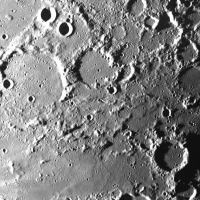
The first close-up image shows an area at lunar latitude 75° North with impact craters of different sizes. The largest crater shown here, in the middle left of the image, is Brianchon. The second largest, at the bottom of the image, is called Pascal.
At low illumination angles, the crater shadows allow scientists to derive the height of crater rims.
"This image was the first proof that the AMIE camera is still working well in lunar orbit," says AMIE Principal Investigator Jean-Luc Josset of Space-X.
The composite images shown here were created to show larger-scale features. The first mosaic shows the complex impact crater Pythagoras and the strip of images (bottom) was produced from images taken consecutively along one orbit.
Starting with this mosaic, SMART-1 scientists expect to build up a global medium-resolution context map, where high-resolution images later observed from lower altitude can be integrated. |
Last edited by Spiffor on 30-01-2005 at 00:44
|
|
| |
|
| |
|
|
|
MRT144
|
|
Seattle Washington
Oct 2002
time: 21:28
|
|
haha, man so many funny replies.
i think pythagoras' wreckage looks liek a fallen man
|
|
| |
|
|
|
DanS
|
 |
Kickball Capital of the World
Jan 1970
time: 00:28
|
|
Deep Space 1's engine ran for 1 or 2 years. They ran Deep Space 1's spare engine on terra firma for about 5 years.
Last edited by DanS on 30-01-2005 at 05:47
|
|
| |
|
|
|
Spiffor
|
|
CPA - Evil Clone brigade
Nov 2001
time: 06:28
|
|
quote:
Originally posted by DanS
I think the ion engines are really cool and we're getting a lot of good experience with them nowadays. Ion engines have specific impulses (i.e., fuel efficiency) that are about 3x of any competing propellant, even though accelleration -- and decelleration, if needed -- is extremely slow. |
Yup, 0.2 millimetre per second per second. It would take 38 hours to accelerate by 100 km/h, which takes 5.5 seconds to the new Porsche car 
quote:
One thing to note is that it takes the same energy to get from the Earth to the moon as it does to get from Earth to Mars, so ion engines have now been proven for bulk material travel to Mars as well.
As long as you aren't sending human cargo, chemical propulsion to Low Earth Orbit and ion propulsion to your destination is definitely the way to go for many applications.  |
I don't know if ion engines are adapted to the transportation of heavy cargo (SMART-1 is only 370 kg heavy), but they're a winner for light scientific missions. ESA has already two planned missions that use ion engines, to Mercury and to the Sun, and is considering using ion-engines for the NASA/ESA joint ambitious project known as LISA (three satellites sent to orbit the sun at a 50 Mkm distance, in order to have precise measurements of gravity and potential disturbances)
Overall, it bodes quite well for hardcore scientific missions.
|
|
| |
|
|
|
DanS
|
|
Kickball Capital of the World
Jan 1970
time: 00:28
|
|
For it to make sense for cargo, you would need a fission reactor on board. I don't know the power output for SMART-1, but Deep Space 1's power was 2.5 kilowatts. In comparison, Project Prometheus will have output of 100 kilowatts. (Project Prometheus will cost $1 - $2 billion over the next several years, maybe more later.) A ship using a reactor would also make a round trip to pick up more cargo from Earth.
Last edited by DanS on 30-01-2005 at 12:55
|
|
| |
|
|
|
Spiffor
|
|
CPA - Evil Clone brigade
Nov 2001
time: 06:28
|
|
quote:
Originally posted by Urban Ranger
It makes sense for NASA to use ion engine for the deep space probe, but using it for SMART-I is kinda strange. I reckon the ESA is using this chance as a live trial for the technology. |
That's a likely explanation, considering that two probes are in the making, that will go much farther than SMART-1 (Sun and Mercury). I think SMART-1 was mostly a test on the technologies used for future probe missions (not only the ion Engine), especially future SMART missions. If anything, SMART-1 has proven that the ESA can pack a serious payload on very light interplanetary craft, and thus it seriously reduces the launching costs.
Edit: By re-reading the ESA's website, it really seems the ion Engine was the star of the show - four instruments in the payload were designed to measure the ion engien's behaviour alone. Two other technologies were tested in this mission (laser communicationand automated piloting). Less than half the payload was designed to study the Moon.
Last edited by Spiffor on 31-01-2005 at 10:40
|
|
| |
|
|
|
DanS
|
|
Kickball Capital of the World
Jan 1970
time: 00:28
|
|
I've been noodling things and doing some online research and it looks like Hall thrusters have much more potential for the stuff we want to do than ion engines. This is a shame, since Hall thrusters are mostly Soviet technology built on the original American invention while ion engines are mostly American technology build on the orginal American invention. 
Hall thrusters are similar to ion engines in that they are both electric propulsion, but the engines are smaller, they scale up well, and have higher specific power (thrust). Currently, the Hall thruster specific impulse (fuel efficiency) is a little more than half the ion engine specific impulse, but NASA is working on improving efficiency. In any event, both methods are light years ahead of chemical propulsion with regard to efficiency (if they hit their targets, Hall thrusters will have 10x the fuel efficiency of chemical rockets). Hall thrusters are used frequently in commercial satellites.
NASA has a couple of test 50 kilowatt hall thrusters built under Project Prometheus. I guess they'll scale it up to 100 kilowatts, once they hit their efficiency, operational, and reliability targets.
http://www.grc.nasa.gov/WWW/hall/
Last edited by DanS on 05-02-2005 at 10:53
|
|
| |
|
| |
All times are GMT. The time now is 05:28.
Apolyton Time is 00:28. |
top of page
|
|
|
Forum Rules:
You may not post new threads
You may not post replies
You may not post attachments
You may not edit your posts
|
HTML code is ON
vB code is ON
Smilies are ON
[IMG] code is ON
|
|
|
|
|
|






 30-01-2005 00:32











 |
|