|
| |
|

|
molly bloom
|
 |
Lundenwic
Oct 2001
time: 15:26
|
|
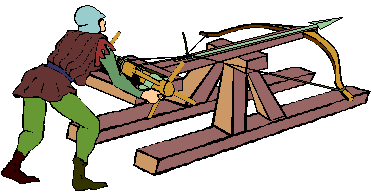
As I was rereading a book entitled 'The Roman War Machine' the other day (and prompted again by an excellent series on BBC 2 called 'What the Romans Did For Us) it occurred to me that it used to be a matter of faith, or at least taken for granted, that Europe did not see a crossbow until the early Middle Ages, with it frequently being attributed to Arab transmission.
Now having looked at a demonstration of a ballista, and the holes left from ballista bolts and an arrowhead lodged in skeletal remains of Celts found at Maiden (Mai Dun) Castle in Dorset, I wondered why people would assume that the ever practical Romans hadn't used a smaller version of a ballista?
After all, these were the people who changed the way their armour was formed when confronted with the Dacian sword/pick which inflicted such horrendous wounds when the Romans first besieged Dacian strongholds, and whose army was run on the fox, rather than hedgehog, approach to tactics.
Any of the 'Poly Roman enthusiasts shed some light on this?
Last edited by molly bloom on 08-02-2005 at 16:43
|
|
| |
|
|
|
Proteus_MST
|
|
They already had a big advantage.
Their size and strength combined with their base meant,
that you could throw arrows and stones at a much larger range and with a greater accuracy than you could with a bow (and still being able to pierce shield with it at the end of the fligth)
Here´s a nice site with a Palintona,
which probably is more of the original size the romans used in sieges 
http://www.legionxxiv.org/ballistacatapulta/
Last edited by Proteus_MST on 08-02-2005 at 22:21
|
|
| |
|
| |
|
|
|
Dry
|
 |
Brussels
Sep 2000
time: 06:26
|
|
quote:
Originally posted by molly bloom
Any of the 'Poly Roman enthusiasts shed some light on this? |
I remember something in the Rome: Total War comments about the difference between X-bow and balista.
And because I could not copy-paste their comments, I made a small google search:
http://xenophongroup.com/montjoie/ngp_arty.htm
quote:
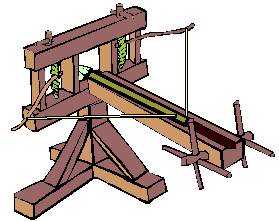
The large, carriage or post-mounted crossbow had two distinct forms, even in ancient times. One configuration, arbalète à tour, was of a single bow, aligned horizontally; its energy was from tension (as with the normal hand-bow), due to the spanning of the wood or steel bow. The second configuration, baliste [ballista], was two horizontally-aligned arms, each under torsion when the common chord at the far ends was spanned. |
IIRC the bow of the x-bow need to be composite.
(and I don't know when the composite bow was discovered).
|
|
| |
|
| |
|
|
|
molly bloom
|
|
Lundenwic
Oct 2001
time: 15:26
|
|
quote:
Originally posted by Dry
I remember something in the Rome: Total War comments about the difference between X-bow and balista.
And because I could not copy-paste their comments, I made a small google search:
http://xenophongroup.com/montjoie/ngp_arty.htm
quote:
The large, carriage or post-mounted crossbow had two distinct forms, even in ancient times. One configuration, arbalète à tour, was of a single bow, aligned horizontally; its energy was from tension (as with the normal hand-bow), due to the spanning of the wood or steel bow. The second configuration, baliste [ballista], was two horizontally-aligned arms, each under torsion when the common chord at the far ends was spanned. |
IIRC the bow of the x-bow need to be composite.
(and I don't know when the composite bow was discovered). |
Many thanks. I believe that the steppe peoples and Parthians had composite bows, but not crossbows.
|
|
| |
|
| |
All times are GMT. The time now is 05:26.
Apolyton Time is 00:26. |
top of page
|
|
|
Forum Rules:
You may not post new threads
You may not post replies
You may not post attachments
You may not edit your posts
|
HTML code is ON
vB code is ON
Smilies are ON
[IMG] code is ON
|
|
|
|
|
|





 08-02-2005 16:34


 Attachment:
  |
|
 |
|