|
| |
|

|
QuestGAV
|
|
Connecticut
Mar 2004
time: 05:19
|
|
Mahatma Gav and the Holy Buddhist Spaceship
I started this game for two reasons: for starters, I wanted to get practice playing in a more peaceful manner. More importantly, I wanted to create a game that would allow me to illustrate some of the great pointers I've picked off Apolyton. Hopefully with screenshots and game situations I can show the applications of some of the more common themes you'll hear in this forum. I would love to see other people expand on the ideas I put out there and point out things that are important to see that I missed. My goal, and I'm not sure I'll have the stamina to entirely reach it, is to create an archive of tips and tricks that aren't immediately obvious that will help people pick up the nuances of Civ3.
About the game setup: The game is a standard map, 8 civs, 60% continents, 5 billion years old on Emperor level. I hand selected the other 7 civilizations to avoid playing against Agricultural, Expansionist, Religious, and Scientific opponents, though the Byzantines are in because you can't pick 7 civs which include none of those traits. As you may have guessed from the title, I'm playing as the Indians, though I modified them. The Indians now possess all of the Civ traits. Because I'm challenging myself to play a more peaceful style that's going to handicap me, I wanted the extra oomph. Obviously, taking all the traits is quite a bit of oomph. Having all the traits lets me go further with my primary goal in the game though, in that I can show applications of each of the traits. I don't have much experience with some of the traits so perhaps others will chip in when you see places a trait can be better utilized to strengthen the Civ as a whole.
Tips:
City Placement
-City squares will normally have 2 food and 1 production regardless of the square underneath. Food and shield bonuses are ignored. Commerce bonuses are applied as will as bonuses from Civ traits.
-Defensive bonuses from city placements still apply, so founding cities on a hill can be helpful in that respect.
-It is almost always beneficial to build your cities in a CxxC pattern very close together. Your cities grow more quickly and use your land more efficiently, allowing you to grab more land in total.
Workers
-Build more workers! And then build some more. You want at least 2 workers per city.
-Any time a city is working unimproved tiles, build more workers.
-Any time a settler/unit has to pass through unroaded tiles, build more workers.
REXing Tips:
-If you find a spot that can generate +5 food and 7.5 shields, you can create a 4 turn settler pump that greatly increases your ability to out-expand the AI. Read below for details, or better yet read the following threads which do the concept greater justice:
The Case For Food
Ducki Does C3C at Emperor
Trade
-Become the global tech broker early
-Take tech for tech when it's available and their gold as well
-As economies grow, get what you can from them in terms of gold per turn (GPT) deals. You get richer, they get poorer.
-Check trade possibilities every turn. You never know when they've researched a new tech (or traded for one from another AI you couldn't get it from yet) or if they have a Worker in their capital to buy.
Combat
-Have clear goals when you start a war and make sure the forces you are devoting are suitable for it. If you do better than expected, feel free to take it further or contract your plans if you hit a stumbling block.
-Mobile armies tend to be easier use - make use of their extra speed to keep them alive
-If a mobile force isn't an option, consider creating a SOD (Stack of Death) with strong foot soldiers backed by strong defenders and Catapult-type unit. Bombarding will help you minimize your losses for a more efficient offensive.
-"Pruning" the AI by taking a few cities and maybe a resource or two from them early on in the game can make them a much easier target later on. Pruning all your neighbors a bit in the ancient age sets you up to be dominant in the Middle Ages.
Happiness
-In the early game the luxury slider can be very efficient when losing even a single laborer hurts.
-Don't always create entertainers, sometimes you can get away with making a Tax Collector or Scientist instead.
Corruption
-Having your cities placed more closely together mitigates corruption.
Goody Huts
-A Goody Hut can only give you a Settler if you have none currently on the map or in production. If you are Expansionist and are popping a goody hut, switch your cities off of settler production first. Just don't forget to switch them back!
Traits
-Expansionist
---Scouts can pop goody huts with no fear of spawning barbarians, this can lead to a significant early tech lead.
---The trait's advantages peter out quickly so maximise them early on.
-Seafaring
--Helps grab the early tech lead
--Build your first curragh very early!
--AI does not understand this trait
Basic rules of thumb for worker management:
Mine all grasslands in despotism, unless they have a bonus food tile.
Sugar is the only bonus food tile not worth irrigating.
Plains should generally be irrigated, but there are exceptions (such as a city blessed with Flood Plains as well)
Stacking workers can be efficient, but have Workers make roads individually. One full turn is wasted per unit moving into the non-roaded tile. This waste adds up.
Forests are just as good as mountains until you're out of Despotism.
Chopping forests early can significantly speed up production of early improvements.
Last edited by QuestGAV on 16-03-2005 at 00:37
|
|
| |
|
|
|
QuestGAV
|
|
Connecticut
Mar 2004
time: 05:19
|
|
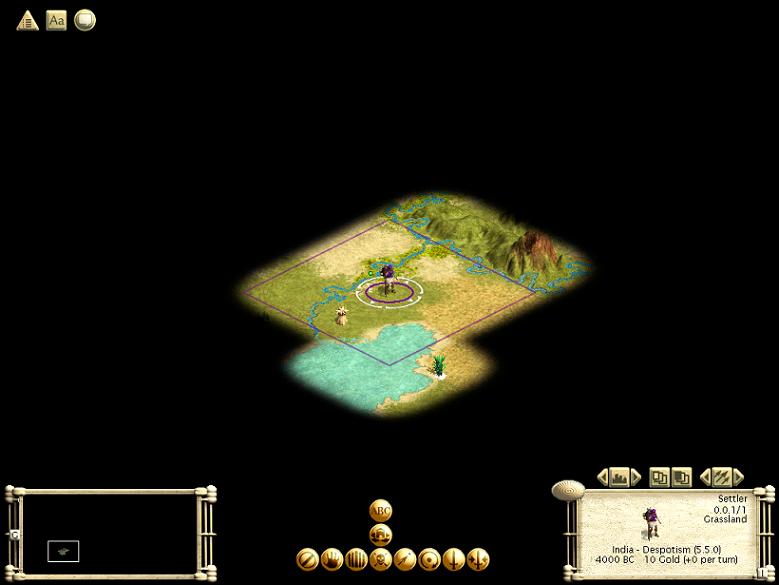
There are a few important things to note when placing cities. Perhaps most important is that a city square produces 2 food, 1 shield, and 1 commerce per turn regardless of the tile underneath. So, placing a city on a shielded grassland or most other bonus tiles is a waste of the resource as you'll still get 2/1/1 from the city square. The exception to this rule is commerce bonus tiles, as you still get the bonus. You can take advantage of this by placing a city on a hill with gold as you'll get the commerce bonus and the defensive bonus of being on a hill.
Our starting position here seems pretty sweet, so I'll found the city. Note that this city actually produces 3/1/4 since we're agricultural, commercial, seafaring, and on a river.
 Attachment: 4000bcb.jpg Attachment: 4000bcb.jpg
This has been downloaded 159 time(s).
|
|
| |
|
| |
|
|
|
QuestGAV
|
|
Connecticut
Mar 2004
time: 05:19
|
|
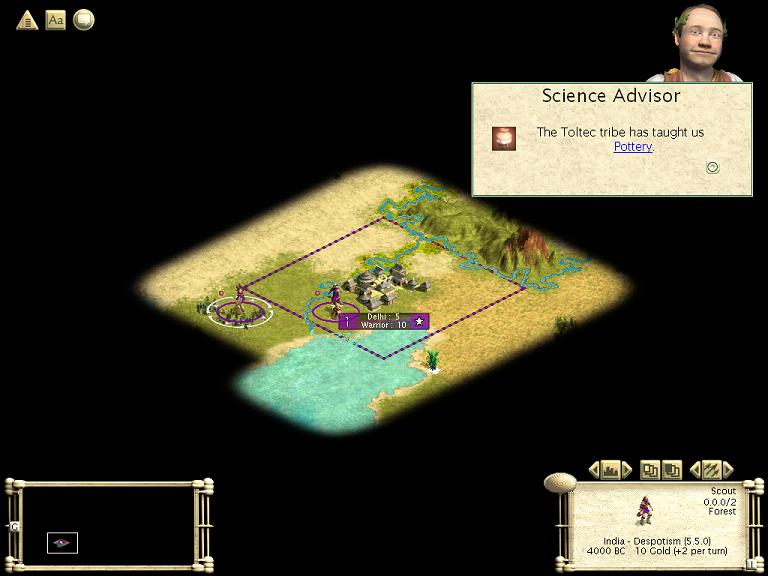
The Expansionist trait can be dominant in the early going. Your free Scout can pop goody huts with no chance of barbarians. Here our scout gets us Pottery, so we can switch to a Granary early on and get that economy pumping! The tech lead created by Expansionist can peter out quickly, so be sure to get in touch with the other civs early on and start trading to maximise your advantage.
Attachment: 4000bcc.jpg
This has been downloaded 154 time(s).
|
|
| |
|
|
|
QuestGAV
|
|
Connecticut
Mar 2004
time: 05:19
|
|
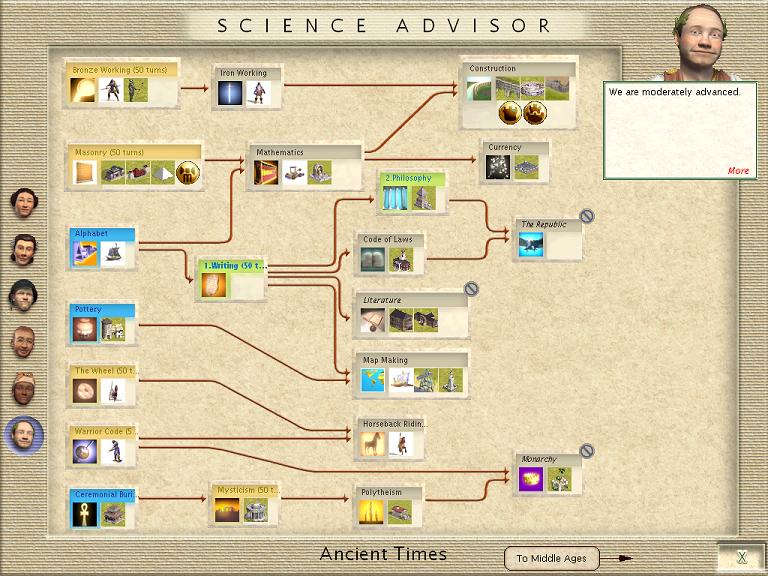
Deciding what to research early can be tough. Because you start with a few of the basic techs and so do each of the AI civs, it can be smart to skip researching the first row of techs and head directly into the second row. Writing is a common choice here as it leads to Philosophy and the free extra tech it awards you. Making a beeline for Philosophy and using the free tech to bring you closer to The Republic (and out of Despotism) can get you a very strong advantage early in the game.
At higher difficulty levels, it can be advantageous to set your research level down to 10%. The 2nd level techs will almost always start off at 50 turns regardless of whether your research is set at 10% or 100%. So, build your treasury and you'll have something to offer the AIs for the first tier techs that they'll be researching early on.
Attachment: 4000bcd.jpg
This has been downloaded 153 time(s).
|
|
| |
|
|
|
QuestGAV
|
|
Connecticut
Mar 2004
time: 05:19
|
|
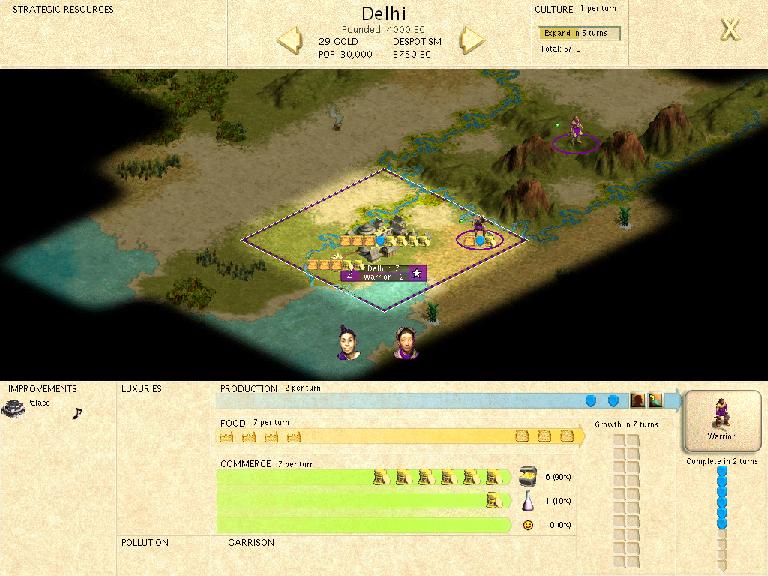
Hmm, we have a slight problem here. Our food production is so high that we grew before our Warrior was done. Not a huge problem on earlier levels, but at Emperor the second citizen in any city is unhappy. There are a few ways to deal with this. One would have been to work a Plains square instead of the Wheat Grasslands square a few turns beforehand, then the city would grow and produce a warrior in 3650. Or, you could grow here and turn the citizen into an Entertainer. That makes the other citizen happy, but with such a small city that doesn't help a whole lot. With only one city, the luxury slider is reasonably efficient too - keeping our +5 surplus and on track for growth to 3 in 7 turns and completing the Warrior in two.
Finally, the second citizen in the city can be changed into a tax collector. This works because all specialists count as content citizens. We don't get the happy citizen, but we do get an extra 2 gold for smart micromanaging.
The luxury slider is probably the best option here, but be careful with it. As your empire grows larger you may have better luck by creating specialists in the cities that need happiness control rather than taking a bite out of your economy across the board.
Attachment: 3750bc.jpg
This has been downloaded 153 time(s).
|
|
| |
|
| |
|
|
|
QuestGAV
|
|
Connecticut
Mar 2004
time: 05:19
|
|
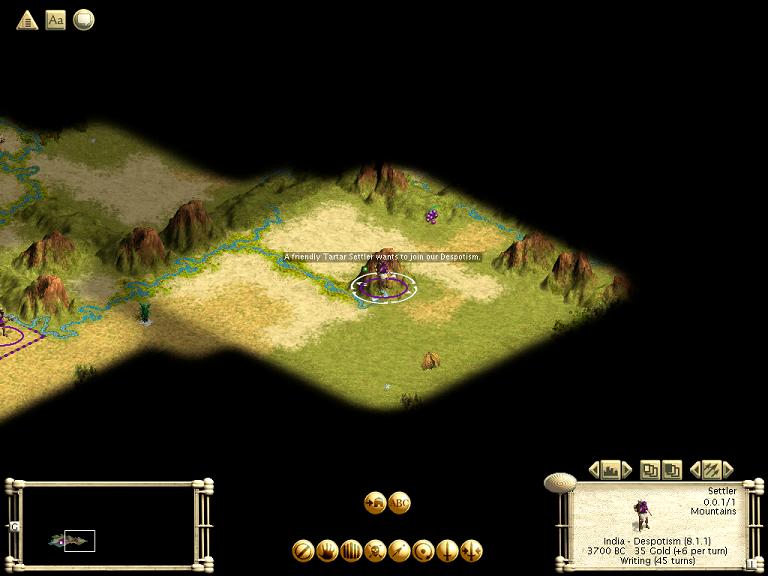
Expansionist pays off again as a Settler pops out of the goody hut like a stripper in a birthday cake. Note that you can only get a Settler out of a goody hut if you are not creating one already and do not have one in the field. So if you are an Expansionist, switch all of your cities off of Settler production before popping goody huts!
The question here is where should my second city go? Civ3's corruption model strongly rewards players for placing their cities close together. As your empire grows, it will be much more productive if the cities are spaced tightly and you will make more efficient use of your land. It may seem better to place your cities loosely to maximise their growth, but many of those tiles won't be used until Hospitals are available later in the game. Creating more (but smaller) cities allows you to maximize your territory and grow more quickly.
Generally, as you go up in levels it becomes more important to place your cities closer together such as CxxC, where the Cs are city squares and the x's signify the tiles between them. This is known as ICS as you expand outwardly in what is known as Infinite City Syndrome. The AI, and some players, prefer CxxxC or CxxxxC spacing, known as OCS for Optimal City Spacing.
I'll send this Settler over to the Flood Plains tile just northwest of the Sugar bonus resource and only two tiles away from Delhi. I'll lose the extra food from that Flood Plains tile, but I'm Agricultural so the possibility of eventually mining all those mountains and hills along with solid food production from the other nearby Flood Plains is making me drool. This placement is certainly debatable and I'd love to hear other opinions.
Attachment: 3700bc.jpg
This has been downloaded 154 time(s).
|
|
| |
|
|
|
QuestGAV
|
|
Connecticut
Mar 2004
time: 05:19
|
|
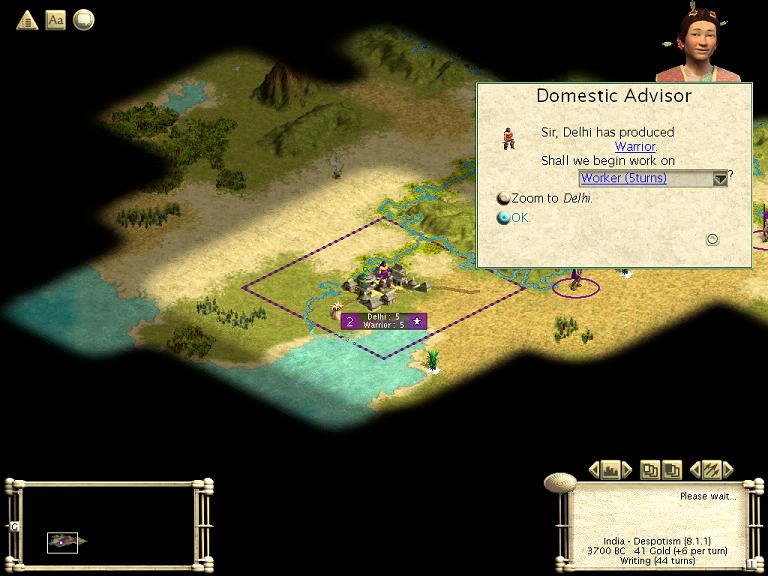
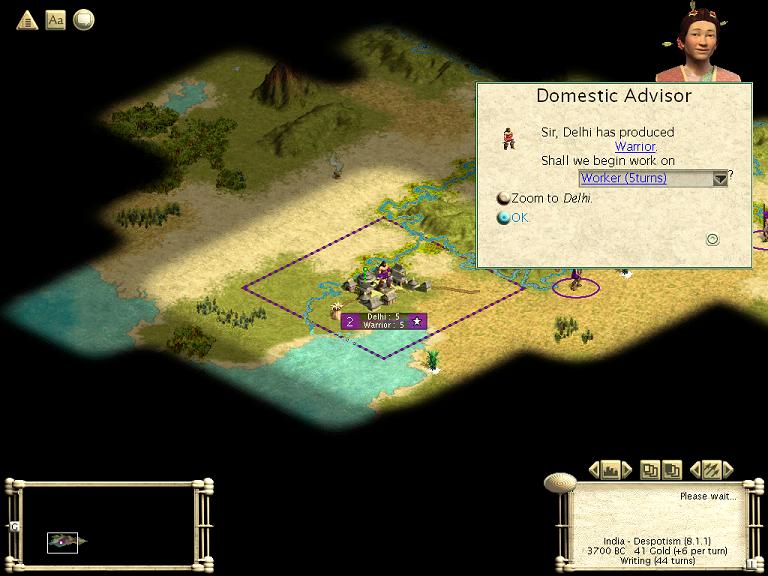
Our Warrior finishes and next in the queue should be a second Worker. Not building enough Workers may be the single most common impediment to succeeding in Civ3. I still have trouble building enough to keep up with the growth of my cities. Any time a city is working an unimproved tile you're playing at a subpar level. So start pumping out your workers early and keep them coming. Seriously, this can't be stressed enough. With a non-Industrious Civ you want to reach and maintain a ratio of about 2 workers per city as soon as possible, and any time your cities start working tiles that aren't improved then you may need to up that ratio further.
This worker will also finish at the time Delhi is ready to grow to 3, which means it will stay at size 2 and out of disorder. Building workers and settlers is another way of handling disorder.
Since our Warrior is done, we can fortify him in Delhi and drop our luxury rate back to 0% to pick up the extra 2 gpt.
Attachment: 3650bc.jpg
This has been downloaded 151 time(s).
|
|
| |
|
|
|
QuestGAV
|
|
Connecticut
Mar 2004
time: 05:19
|
|
Worker Management
Along with building more workers, it's hugely important to manage your workers well. Setting them to auto simply doesn't cut it. And sometimes, you have to go against your instincts.
For example, it's tempting to me to irrigate every plain. However, the plain this worker is on needs to be mined, at least while we're still in Despotism. The sugar resource gives the plain one extra food. Irrigating this plain would put it at 3 food (which would of course get knocked down to 2 with the Despotism penalty).
Basic rules of thumb for worker management:
Mine all grasslands in despotism, unless they have a bonus food tile.
Sugar is the only bonus food tile not worth irrigating.
Plains should generally be irrigated, but there are exceptions (such as a city blessed with Flood Plains as well)
Stacking workers can be efficient, but have Workers make roads individually. One full turn is wasted per unit moving into the non-roaded tile. This waste adds up.
Forests are just as good as mountains until you're out of Despotism.
Chopping forests early can significantly speed up production of early improvements.
I'm sure there are dozens more of these that people can come up with.
Attachment: 3650bc.jpg
This has been downloaded 149 time(s).
|
|
| |
|
|
|
QuestGAV
|
|
Connecticut
Mar 2004
time: 05:19
|
|
And so it begins...
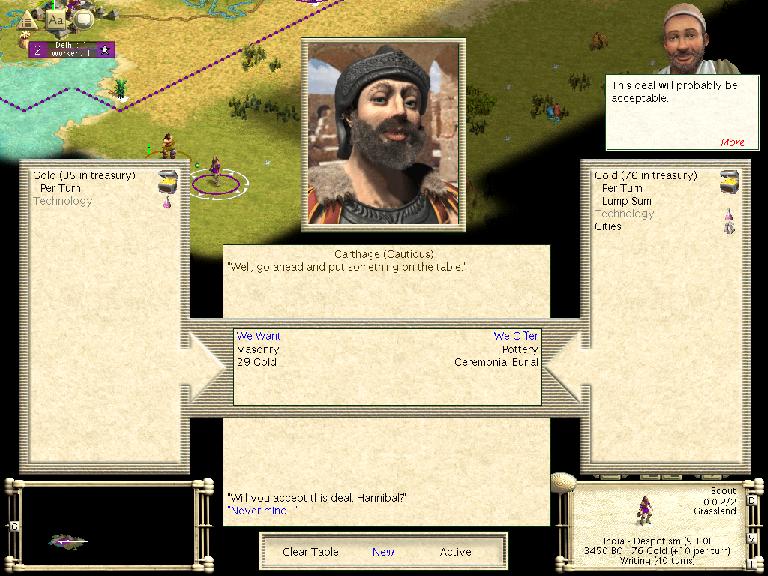
Becoming the global tech broker is the key to winning the tech race, at least at higher levels. You can't go it alone and hope to outresearch the rest of the globe. Be proactive about trading and take whatever you can, because if they don't get the tech from you they'll get it from someone else. You might as well get paid for it. Making money off every other Civ's research efforts will eventually let your economy outstrip your opponents.
Early on expect mostly tech for tech trades. As the game goes on and the AI economies go, make gold per turn (GPT) trades to suck the life out of said AI economies. If they don't have cash and you do, they're in a world of trouble.
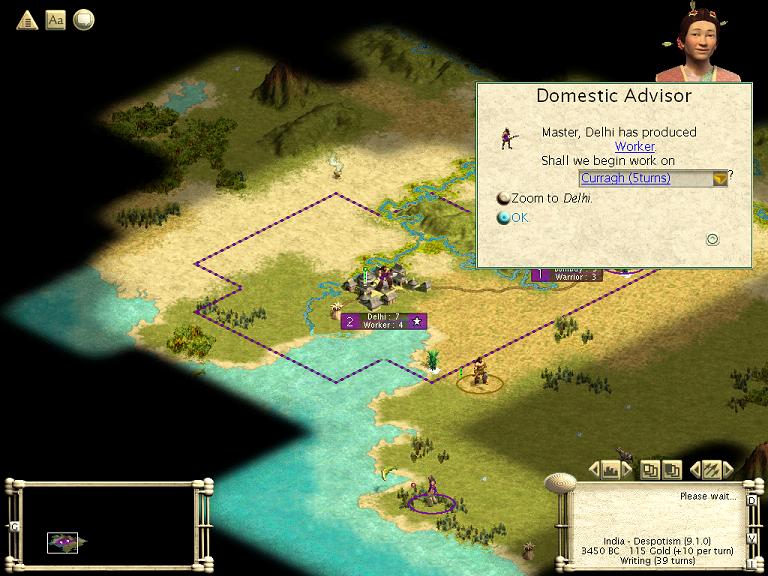
Once you've made contact with other Civs, it's important to check the trade screen with each of them every turn. Especially if you have a decent amount of cash on hand, you can buy workers from them. Not only do you now have maintenance free workers that you didn't have to pay shields or population for, you are hurting their economy by hampering their ability to grow.
Attachment: 3450bc.jpg
This has been downloaded 148 time(s).
|
|
| |
|
|
|
QuestGAV
|
|
Connecticut
Mar 2004
time: 05:19
|
|
Seafaring
Our Scout already worked some magic for us in the form of an extra tech, a Settler, and contact with the Carthaginians. It's time to put the Seafaring trait to use.
I'll admit that Seafaring is something I've never tried before, but it seems to be a heavy favorite among the most experienced Civ3 players. It's main use is similar to Expansionist as it lets you get a Curragh out early in order to meet Civs on other land masses. The AI does not understand the value of early sea exploration, so getting yourself out there early with a Curragh lets you become an intercontinental tech broker and the AI just can't hang with that. If you don't find land immediately off your own coast, it's worth sending curraghs to their death in the hope of finding those other Civs. Being the tech leader is certainly important enough to sacrifice a 15 shield unit a few times, don't you think?
The other possibility here with the 2nd Worker completed is to build a Granary. With Seafaring on our side and a Settler already headed for a solid second city site the Curragh seems to be the better bet.
Attachment: 3400bc.jpg
This has been downloaded 145 time(s).
|
|
| |
|
|
|
QuestGAV
|
|
Connecticut
Mar 2004
time: 05:19
|
|
It's C3C 1.22 @ Emperor level, though the level is a bit deceiving given that I gave myself all of the Civ traits so it should play significantly easier than your average Emp game.
Your placement advice for that settler there turned out to be pretty good... I waited a bit longer to move out towards those Wines and the Chinese grabbed them. I'll post some of the other screenshots that I nabbed last night when I get home from work. I definitely had an eye towards making Delhi a Settler Pump from the beginning, you'll see that in the next set.
|
|
| |
|
| |
|
|
|
lebensraum
|
|
quote:
Originally posted by Trip
I would build a Granary before any Workers and certainly not before my city was size 4+. |
geez !!
ya just can't please some people .. 
he's right, as usual. and deal with the wheat square first !!
three words for you mahatmo;
luxuries, Luxuries, LUXURIES ... especially if one of them happens to be wines
with so much gold in the bank, i'd be cranking the slider too, more efficient than building warriors. me, i'd have used those shields to get another scout out & about. like you said, expansionist is an early game thing, so work it!
oh and did i mention, ... dwr
(to me the game seems hopelessly skewed in your favour already, but hey, to each his own)
anyhoo good on you for having a go . 
Last edited by lebensraum on 13-03-2005 at 22:46
|
|
| |
|
|
|
lebensraum
|
|
quote:
Originally posted by lebensraum (to me the game seems hopelessly skewed in your favour already, but hey, to each his own) |
umm, let me rephrase that,
1) fact is, i just don't get it. i love the whole 'discovering a brand new world' thing. it's like being an alien just landed on some strange new planet. i know that every action i take is a gamble and half the decisions i make will be wrong.
hand-picking civs and attributes goes against the grain for me. in fact, the very idea of starting a game and saying, 'ok i want to play peacefully this time' just doesn't make sense. i like to hit the ground running and see if there's something out there big an' bad enough to shatter all my well made plans.
deciding on a victory condition strikes me as bizarre, cos heck, i never said i wanted to *win in the first place. that's not necessarily my intention... it just happens a lot 
this is probably just a temporary thing and maybe you can change my mind 
2) dominae  commented in an earlier thread about the value of picking random civ, random map; and...hell, what can i say ? ... commented in an earlier thread about the value of picking random civ, random map; and...hell, what can i say ? ...
oh dear, what's that strange square-looking spaceship doing there and why is it targeting our warp-core?
|
|
| |
|
|
|
QuestGAV
|
|
Connecticut
Mar 2004
time: 05:19
|
|
Bah, the intention here isn't to win, that's why it's skewed in my favor. It's intended to show some of the key decision making points in the game and why you might opt that way (and as you're seeing, why other players might go in a different direction). It's more about thought process than me saying "doing it my way is best".
The "peace" idea is to force me to make some different decisions and prevent me from simply steamrolling the AI, which wouldn't teach anyone anything, least of all me.
|
|
| |
|
|
|
QuestGAV
|
|
Connecticut
Mar 2004
time: 05:19
|
|
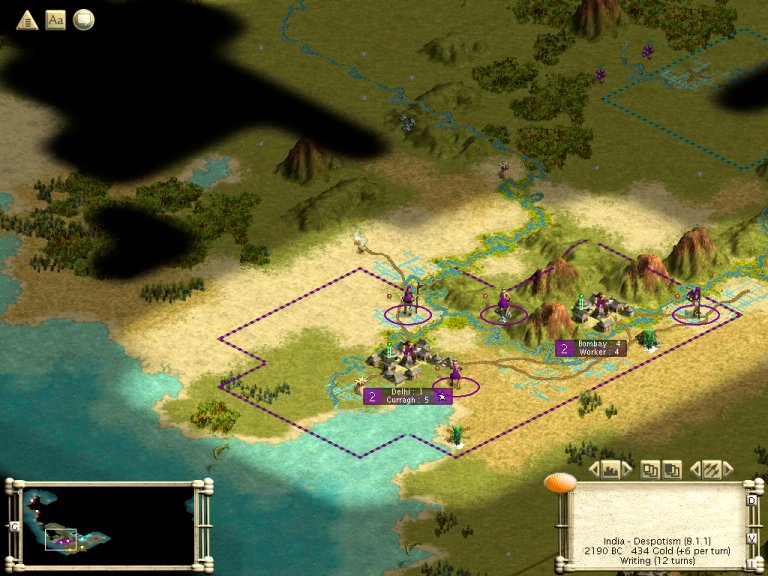
Time flies when you're having fun! We're up to 2190 BC now and Delhi and Bombay have each completed a Granary and Settler. We've found the Romans with our Curragh and Chinese with our Scout and have all of the first tier techs as well as Iron Working. And lucky us, that looks suspiciously like an Iron deposit right next to Bombay.
Attachment: 2190bc.jpg
This has been downloaded 78 time(s).
|
|
| |
|
|
|
QuestGAV
|
|
Connecticut
Mar 2004
time: 05:19
|
|
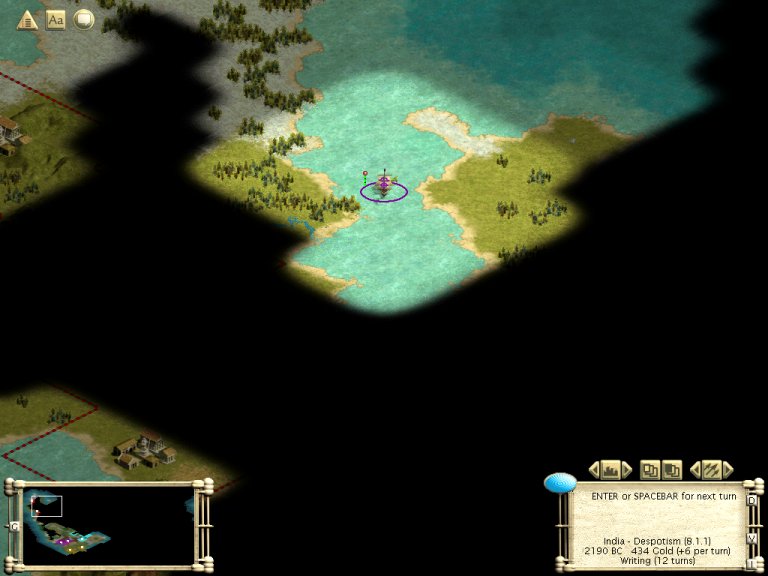
Meanwhile, is that a new landmass to the east of our Curragh? Could we be about to make a Great Leap Forward? Or is it a big tease?
Attachment: 2190bcb.jpg
This has been downloaded 76 time(s).
|
|
| |
|
|
|
QuestGAV
|
|
Connecticut
Mar 2004
time: 05:19
|
|
Here's the 2190bc game file if you feel like playing it out a bit.
 Attachment: gav of the indians, 2190 bc.sav Attachment: gav of the indians, 2190 bc.sav
This has been downloaded 0 time(s).
|
|
| |
|
|
|
QuestGAV
|
|
Connecticut
Mar 2004
time: 05:19
|
|
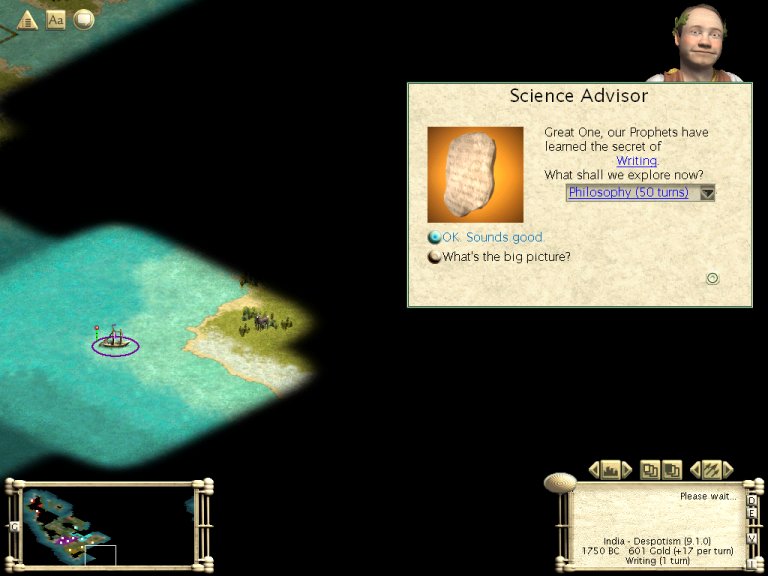
Writing is finally done! That's 50 turns in the books, and it's time to turn on the jets and burn through Philosophy for our free tech.
Perhaps more importantly, our second Curragh has found what appears to be a more interesting landmass. The first was indeed just a tease, but this one could be an actual continent, holding secrets that we can buy with that 601 gold we stashed while researching Writing.
With Writing in the rearview mirror you can crank your research rate up in order to get a better shot at being first to Philosophy. Obviously, not all Civs start with Alphabet so this strategy is not foolproof to say the least.
Also, use some of your stockpiled cash to create embassies. It makes the AIs a bit more warm and cuddly while you devise ways of making them disappear from the face of the earth.
Though I intend to remain largely peaceful, the Chinese being all up in my business already bodes ill for our future relations. They may have to be "resettled".
Attachment: 1725bc.jpg
This has been downloaded 73 time(s).
|
|
| |
|
|
|
QuestGAV
|
|
Connecticut
Mar 2004
time: 05:19
|
|
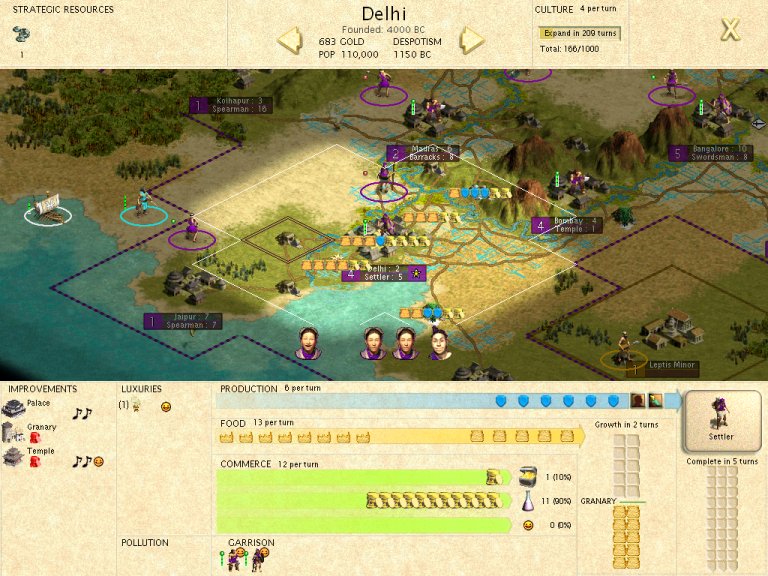
Delhi has developed into what is known as a "Settler Pump". It's possible to develop cities that can reliably produce a Settler every four turns. The city musthave a granary and be able to produce +5 food and +6 shields (and then have the food surplus stay the same while the shields per turn grows with the city on the 2nd turn).
Having a true settler pump like this has obvious advantages. You're able to REX far faster and more reliably while other cities are able to concentrate on units and/or improvements.
Settler pumps can be a bit tough to recognize and for the most part require quite a bit of micromanagement. They'll often look like it will take 5 turns to produce the settler. When the city grows, the game doesn't always choose the best tile in order to put the city on a 4-turn path. In this case, what you want is to keep the same 5 fpt surplus so you need 2 food from the new worked tile. At the same time, you need an extra shield.
Finally, you'll have to take advantage of how Civ3 handles growth in a city. When a new citizen is "born", the food from the tile he is placed on is not counted for that turn. The shields from that tile are counted however! So you want to manage your city so that when it grows there is a high shield tile for the new worker to be placed on. In this case, with the 5 fpt surplus, the game will usually pick a decent shield tile, giving you the last 2 shields you need in order to make your Settler on that fourth turn.
This is extremely hard to describe in words or with static pictures. Your best bet is to create a Settler pump or two of your own, or play with one long enough to generate a few Settlers in a row. I'll post the game file below. This is a topic that's been well-covered here on Apolyton recently and I highly recommend you check out these threads, as they go into the topic at a depth I can't match:
The Case For Food
Ducki Does C3C at Emperor
Attachment: 1150bc.jpg
This has been downloaded 77 time(s).
|
|
| |
|
|
|
QuestGAV
|
|
Connecticut
Mar 2004
time: 05:19
|
|
I'm almost out of room for contiguous REXing but there's quite a bit of room left on my continent. The Chinese apparently thought they could box me in. I'm not too fond of that idea, plus they have a few resources that I'm willing to fight for, most notably the Wines near Canton and the Horses near the city just north of that that can't be seen. Those cities, along with Xinjian and Tatung all have to be mine in order for this war to be successful.
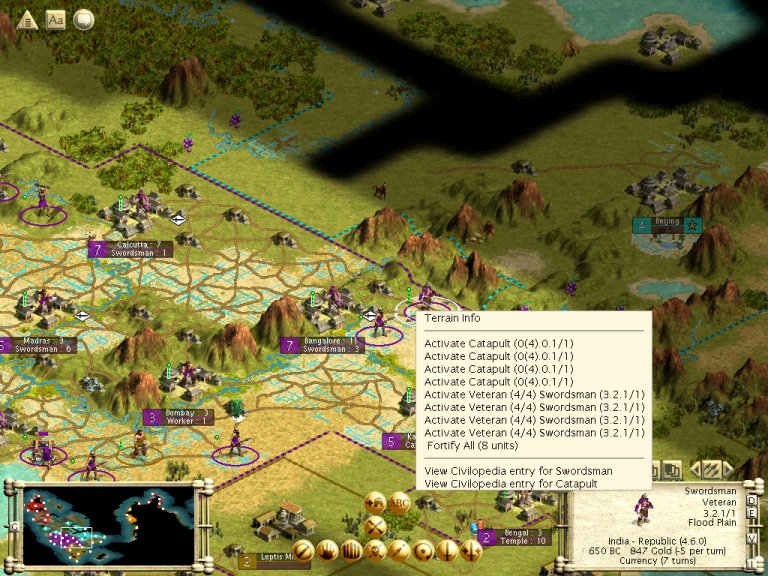
Normally I prefer mobile armies backed by Horsemen/Knights/Cavalry and their UU equivalents, but part of the reason for this war is to get those horses. So, I'll have to go with a slower army backed by Swordsman. When using a slower army like this, you want to have them supplemented by units that can bombard the enemy, like the Catapults you see in the screenshot. They'll soften up the defense prior to the assault to minimize the number of units I lose.
Strong foot soldiers backed by strong defenders and lots of artillery type units are referred to as a Stack of Death, or SOD. This may be the most foolproof way of taking a single city or a handful of them, but the slow moving stack is less likely to overrun the defenses of an entire civilization than a mounted assault.
To set up for an early war like this, you only need a few cities with Barracks, as the maintenance cost of building Barracks in each of your cities early in the game can be prohibitive. At this point I only had 3 Barracks and a fourth in production. Since artillery units are not affected by Barracks, you can have your other cities chip in with Catapults early on
Attachment: 650bc.jpg
This has been downloaded 81 time(s).
|
|
| |
|
|
|
QuestGAV
|
|
Connecticut
Mar 2004
time: 05:19
|
|
The 650 bc save if you want to prune the Chinese on your own.
Attachment: gav of the indians, 650 bc.sav
This has been downloaded 0 time(s).
|
|
| |
|
|
|
Cort Haus
|
 |
London
Apr 2002
time: 05:19
|
|
If playing with all the civtraits on is the way you like to use the game then good luck to you However, change the rules, and you change the game. This forum, you will probably find, is primarily concerned with discussion of the civ universe with standard rules.
The average game doesn't normally have cheap buildings all-round, free techs, easy govt-switching options, extra commerce, scouts, and extended sea movement. All these freebies combined distort the decisions that a player must normally make to maximise their civ traits.
There seems to be some sound advice in the DAR, but I think the best way to develop peace strats is stock Monarch. You get the freedom to breath, can play faster, and have many more options. Once mastered, translate to stock Emperor for a challenge. Notching down the AI aggression on Emp helps for a more relaxed peace-play game at that level without changing the rules.
|
|
| |
|
| |
All times are GMT. The time now is 05:19.
Apolyton Time is 00:19. |
top of page
|
|
|
Forum Rules:
You may not post new threads
You may not post replies
You may not post attachments
You may not edit your posts
|
HTML code is ON
vB code is ON
Smilies are ON
[IMG] code is ON
|
|
|
|
|
|





 11-03-2005 06:33


 ) I'm intending to follow this AAR pretty close to pick up some good tactics.


 |
|