|
| |
|

|
Lancer
|
|
Oregon Coast, USA! or Bohol, Philippines!
Apr 1999
time: 05:36
|
|
We have a hard time telling others to get rid of the things when we have so many. Why would the nuke nations want to keep the things now? The US has no more threat of massive first stike from Russia, Russia has no hope of winning an arms race with the US... China has to be able to see the folly of what the US and Sovs did in the cold war building so many nukes that nobody could use. If the great powers got rid of the things and made an agreement to attack anyone developing them, nobody would develope them. So, why don't we just get rid of the damn things?
Hmm. I just remembered India and Pakistan.
|
|
| |
|
|
|
Lancer
|
|
Oregon Coast, USA! or Bohol, Philippines!
Apr 1999
time: 05:36
|
|
Yes and there is little chance of putting the genie back and nobody seems to be trying. It just seems like a better time to try than any I can recall.
|
|
| |
|
|
|
Geronimo
|
|
st cloud USA
Jan 1970
time: 05:36
|
|
You should go back to your old Fallout avatars diss.
|
|
| |
|
|
|
Dis
|
 |
Las Vegas, Nevada
Feb 2000
time: 21:36
|
|
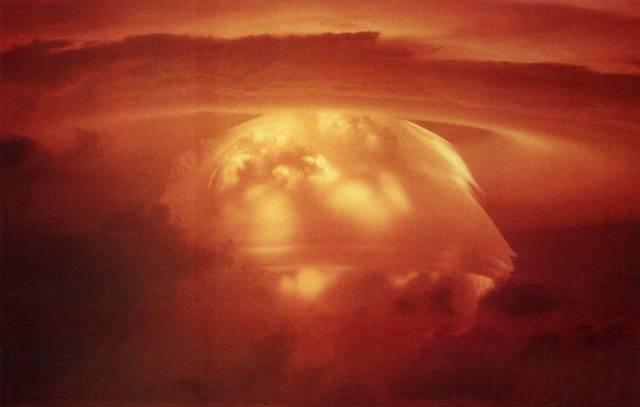
a little more about opeation: castle
quote:
The Shrimp test device was basically a scaled down version of the Runt device tested in Castle Romeo, but with partially enriched lithium as fuel. Its weight was a comparatively light 23,500 lb, and it was 179.5 in long and 53.9 in wide. The fuel consisted of 37-40% enriched lithium-6 deuteride encased in a natural uranium tamper. 10 Mt of the yield was from fast fission of the tamper. The Shrimp also tested light case design, substituting an aluminium exterior case for the steel used in the Sausage (tested in Ivy Mike). It used a RACER IV fusion boosted primary.
The reason for the unexpectedly high yield was due to the "tritium bonus" provided by the lithium-7 isotope which made up most of the lithium. This isotope was expected to be essentially inert, but in fact it had a substantial reaction cross section with the high energy neutrons produced by tritium-deuterium fusion. When one of these high energy neutrons collided with a lithium-7 atom, it could fragement it into a tritium and a helium atom. Tritium was the most valuable fusion fuel, being both highly reactive and causing extremely energetic fusion, so this extra source of tritium greatly increased the weapon yield.
The Bravo crater in the atoll reef had a diameter of 6510 ft, with a depth of 250 ft. Within one minute the mushroom cloud had reached 50,000 feet (15 km), breaking 100,000 feet (30 km) two minutes later. The cloud top rose and peaked at 130,000 feet (almost 40 km) after only six minutes. Eight minutes after the test the cloud had reached its full dimensions with a diameter of 100 km, a stem 7 km thick, and a cloud bottom rising above 55,000 feet (16.5 km).
The Bravo test created the worst radiological disaster in US history. Due to failure to postpone the test following unfavorable changes in the weather, combined with the unexpectedly high yield and the failure to conduct pre-test evacuations as a precaution, the Marshallese Islanders on Rongerik, Rongelap, Ailinginae, and Utirik atolls were blanketed with the fallout plume. They were evacuated on March 3 but 64 Marshallese received doses of 175 R. In addition, the Japanese fishing vessel Daigo Fukuryu Maru (Fifth Lucky Dragon) was also heavily contaminated, with the 23 crewmen receiving exposures of 300 R (one later died - apparently from complications). The entire Bikini Atoll was contaminated to varying degrees, and many operation Castle personnel were subsequently over-exposed as a result. Personnel in the firing bunker on Nan Island were trapped for a time when external radiation levels reached 250 roentgens/hr an hour after the shot. After this test the exclusion zone around the Castle tests was increased to 570,000 square miles, a circle 850 miles across (for comparison this is equal to about 1% of the entire Earth's land area). |
sorry for the slight threadjack. go back to your previous discussion 
Too many countries have nukes. While I agree we can drastically scale back the number of nukes we have. I can't see getting rid of them completely.
Last edited by Dis on 15-04-2005 at 11:19
|
|
| |
|
|
|
Proteus_MST
|
|
quote:
Originally posted by Dissident
genie is out of the bottle |
Sad but true.
Sadly we don´t have the Nano-Disassembler of CtP 2
which renders all nuclear weapons on earth harmless.
|
|
| |
|
|
|
Lul Thyme
|
|
Quebec, Canada
Aug 2000
time: 05:36
|
|
There is still no denying that nukes in much smaller number, specially from US and Russia, would still serve their actual purpose just as well, wheter that be deterrence or whatever....
|
|
| |
|
|
|
Kontiki
|
|
Canada
Aug 2001
time: 00:36
|
|
quote:
Originally posted by Frankychan
I think Russia wins. Didn't they make that bomb that cracked the Earth's crust? I know the Russians made the biggest nuke ever...but I can't remember the name of the bomb. Remember reading about it and saying how the shockwaves from the blast went on for MILES. |
Bit of an understatement.
quote:
Highest - yield nuclear bomb ever developed. Designer: Andrey Sakharov, Victor Adamskii, Yuri Babaev, Yuri Trunev, and Yuri Smirnov; developed and constructed in only 14 weeks; maximum yield 100 Mt; delivery method: modified Tu-95 strategic bomber, parachute; tested on Oct. 30, 1961 over Novaya Zemlya, USSR. Dropped in 50 Mt configuration from 10,500 m with a parachute by a Tu-95 piloted by Maj. Andrey Durnovtsev; detonated at 4,000 m; shock wave circled the globe three times; resulted in 1-hour radio communications blackout; mushroom cloud rose to 64 km into the atmosphere; radioactively cleanest thermonuclear bomb ever tested with 97% of energy coming from nuclear fusion; |
|
|
| |
|
|
|
Admiral
|
 |
of the peace and coexistance movement
Feb 2001
time: 00:36
|
|
Actually, it seems that we are more in danger of nuclear conflict now than we were in during the cold war. At that point, nukes were essentially only the property of a binary system, both sides of which recognized that nuclear conflict was unacceptable. Bear in mind that during the Cuban Missile Crisis, both Kennedy and Khrushchev were more concerned with giving their allies the appearance of readiness for nuclear conflict that they were of giving each other that appearance.
But now, with the fall of that system, we can no longer have the easiest form of nuclear deterrence. When you have three or more powers confronting each other with said weapons, it might suddenly be in the best interest of one state to provoke a nuclear war between other states, etc, and the chance of the weapons being used goes up considerably. Also, to make sure that deterrence worked during the cold war, both sides maintained a launch on warning policy. Given that nuclear strikes would assuredly wipe out the ability to retaliate, this made sure that the advantage of the first strike was negated. Now, however, that is impossible. If we use the example of India/Pakistan, neither state would have the time to react to a strike before it hit, and the first strike becomes a much more acceptable option. And finally, the proliferation of nuclear weapons makes it easier for terrorists to acquire them. Given that terrorists are stateless entities, they cannot be stopped by deterrence, and if a terrorist acquires a nuclear weapon, that weapon will be used.
So, the idea that nuclear deterrence currently keeping the piece no longer really makes sense. As has been said, the genie is out of the bottle, but the genie isn't the bomb itself, but the knowledge of the bomb. In addition to the nine current nuclear powers, basically every industrial nation has the capacity to built the bomb, they have just chosen to abstain, for whatever reason. If all the nations of the world got rid of their nuclear weapons, they couldn't get rid of the knowledge of them, with the result that effectively, nuclear deterrence is still in effect. This would both prevent the war system from the 19th and early 20th centuries from continuing now, with the maximization of violence, and it would serve as a deterent for any nation that keeps nuclear weapons and tries to use them. Nuclear weapons could always be rebuilt, they just don't have to be.
Really, this system would be calling the proponents of deterrence's bluff. If we assume that the goal of deterrerence is peace, this system would only make it more effective. Deterrence is based upon both the tradition of non-use, and also the threatening to use. And if we reframe the threatening to use in the sense of, if anyone uses nuclear weapons, we will launch all of ours, and obliterate the world, then instead of an aggressive system, we promote a system where people accept that the use of nuclear weapons is annihilation. In essence, we could see this as an extraction of violence from the twentieth century, and putting it all into one world-destroying device.
The only problem with this is that threat of complete annihilation. By getting rid of the weapons themselves, and just keeping the knowledge, we continue to limit interstate violence (at least among the developed powers), but we lessen the threat of elimination of the human species.
And in this context, the idea of nuclear monopoly doesn't lead to the global hegemony that many consider it to lead to. Between 1945 and 1949, the US had a nuclear monopoly, and we still suffered major setbacks. Eastern Europe was incorporated into the comintern, Berlin was blockaded, China fell to the communists, etc. In various other circumstances, nuclear power was also ineffective. During the Suez crisis, nuclear weapons did not help Britain and France. During Korea and Vietnam, nuclear weapons didn't help the US. Nuclear weapons also didn't help the USSR in Afghanistan nor China in Vietnam. In this context, thinking that one nuclear power could act with impunity is foolish. And given both the numbers of the non-nuclear powers and the emnity towards nuclear weapons that would arise from this system, the inevitable result of a unilateral seizure of nuclear weapons would be the fall of that state, or at least the rapid decline in power of that state.
And finally, this is really the time to build such a system. There are no nuclear standoffs at the moment complicating the situation. India and Pakistan almost went to war over Kashmir anyways, so nuclear deterrence isn't necessarily that effective there. China, while possessing nuclear weapons, is not the great ideological rival the USSR was, given that China is too busy repressing its peasants to be actively imperialist (and if Taiwan hasn't already surrendered in the face nuclear weapons, its unlikely that it will do so in the future).
|
|
| |
All times are GMT. The time now is 05:36.
Apolyton Time is 00:36. |
top of page
|
|
|
Forum Rules:
You may not post new threads
You may not post replies
You may not post attachments
You may not edit your posts
|
HTML code is ON
vB code is ON
Smilies are ON
[IMG] code is ON
|
|
|
|
|
|





 15-04-2005 10:40


 Attachment:







 |
|