|
| |
|

|
beingofone
|
|
U.S.A.
Apr 2003
time: 05:35
|
|
quote:
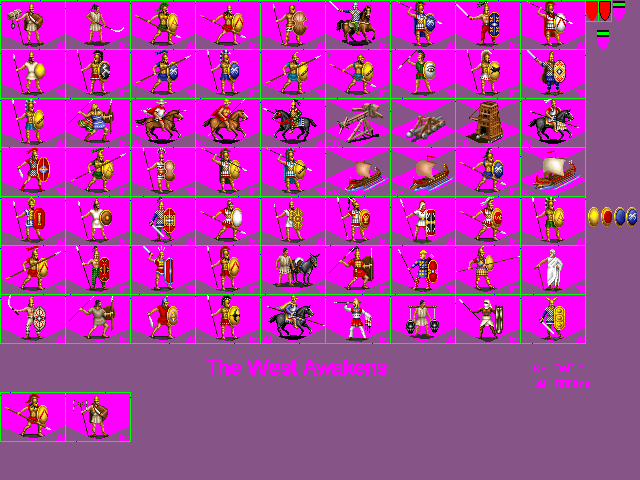
what ship graphics shall you be using? |
That would be up to Fairline. He is meticulous in his historical accuracy as well as very good at creating units, when he isn`t altering units someone else created. Maybe that was just an ornery rumor started by a 10 year old newbie LOL.
I am almost done with the unit manifest Fairline, should give you lots of breathing room as I still have alott of tweaking to do.
Erika - I can`t remember meeting a girl as young as you with your passion for history. Where were you when I was a teenager? All the girls I knew in High School were all interested in dating and oh yeah chocolate. They for the most part thought I was a nerd for my passion for history.
Good to see a young bright mind out there in the world.
|
|
| |
|
| |
|
|
|
beingofone
|
|
U.S.A.
Apr 2003
time: 05:35
|
|
Quick update
Each unit in the game will simulate an entire small army.
Hit point = 1000 men
Attack strength = shock and morale
Defense strength = adjustable because of game engine but basically elan and discipline
Firepower = training and equipment
Increased stats = improved tactics (such as the Theban crescent phalanx)
Many of the Greek stats will be similar with subtle variations such as more firepower for early Spartans.
I am using board wargame combat factors to put together the armies. So my calculator is getting a good workout.
Hardly any terrain modifiers because almost all battles of this time period were on a flat or rolling field. The system seems to be working for the historical desired effect.
Should be finishing beta soon, I still have to plug in world wonders and clean up the tech tree.
Fairline, cool new units and thanks for the correction on the Macedonian phalanx, I had the name of the Diodachi period DO`H.
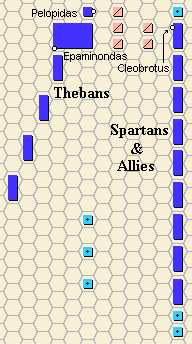
SCREENSHOT -
The Battle at Leuctra, 371 B.C. the Spartans get crushed
Sparta Thebes
Hoplites 10000 6500
Peltasts 1100 1000
Cavalry 1000 1500
 Attachment: leuctra.png Attachment: leuctra.png
This has been downloaded 157 time(s).
|
|
| |
|
|
|
beingofone
|
|
U.S.A.
Apr 2003
time: 05:35
|
|
Hello fellow grognards and uber - geeks LOL.
Exile and Fairline, I might have guessed - hex heads just like me.
Yup Exile is right, it is now called Great Battles and made by GMT games GMT
I miss the days of pushing cardboard counters on a map. I am still learning with PC.
I was lucky and we had a group of 15 that played everything from WW2 and modern back to ancients.
We once played War in Europe and War in the Pacific at the same time, linking the two games together. It was a two year game  . .
It would be fun to sit down at a big table with everyone here and play a monster again. Alas , I am getting old.
Last edited by beingofone on 11-05-2005 at 13:23
|
|
| |
|
| |
|
| |
|
|
|
fairline
|
 |
of the wing
Sep 2002
time: 05:35
|
|
quote:
Originally posted by Boco
Most of the set piece battles were indeed fought on clear terrain, but there were a lot of examples of mobile light troops holding off heavier troops in broken terrain. If it fits your theme, it'd be fun to have to choose between mobile (even alpine) but weak light troops and heavy slowpokes. |
Exactly - the general movement to ditching armour by Greek armies in the late 5th/early 4th Centuries was almost certainly a result of the success of peltasts of the Thracian model. The Lakedaimonians took note of the success of peltasts against their supply columns and probably as a direct result implemented radical changes to their army: they adopted the mora or combined-arms division and got rid of hoplite body armour. The Athenian general Iphicrates was a key figure in the general trend in the later Classical period for hoplites to become lighter-armed and peltasts to become heavier.
The theory is this trend was reversed somewhat by the heavier-armoured Theban phalanx of the 4th-Century which was copied and developed by Philip of Macedon.
You should definitely attempt to reflect the usefulness of peltasts, Beingofone; alpine movement and rough-terrain defensive modifiers are a must in my view. Some jiggery-pokey with movement values should help with the desired effect - move-1 for hoplites, high movement modifiers for roads, poor movement for non-alpine troops on rough terrain should ensure the hoplites and phalangites are kept on the planes and roads and make peltasts and psiloi worth building.
Last edited by fairline on 12-05-2005 at 11:20
|
|
| |
|
| |
|
| |
|
|
|
beingofone
|
|
U.S.A.
Apr 2003
time: 05:35
|
|
quote:
Contest: what's your oldest S&T ish still in your possession. |
I think mine is Stonewall Jackson`s battle at Kernstown so techumseh has me beat.
quote:
Most of the set piece battles were indeed fought on clear terrain, but there were a lot of examples of mobile light troops holding off heavier troops in broken terrain. If it fits your theme, it'd be fun to have to choose between mobile (even alpine) but weak light troops and heavy slowpokes. |
I am not debating with you guys, help me out, I am looking for solutions to try and make the scenario enjoyable and yet realistic. I appreciate the feedback.
I thought about this question.
I know you all know this, wargames can be simulated at three levels tactical, operational, and strategic. Sometimes you can mix and match say tactical and operational but given the design limits of Civ, you could not mix tactical with strategic.
If we were talking about a tactical battle, I would agree with all three of you. In a tactical situation skirmishers and light armed troops would be paramount. Possibly even at an operational level. But at a strategic level the peltast and light infantry formations stayed with the main body. The one exception would be cav formations. They fought on the same field and participated in the same battles as the hoplites. In other words they were non- existent at the strategic level.
The one exception for the Greeks that I know of is when the Athenians destroyed a Spartan unit of hoplites with peltasts of about battalion strength (600). The Thracians and Dacians had units composed almost entirely of peltast type units, I think this is where Iphicrates learned it.
I am designing a scenario at strategic level, I tried mixing operational, tactical, and strategic units in my last scenario King David. You remember Fairline, I had slingers and skirmishers in it. I was never really happy with the results, it just did not simulate warfare of the period.
I wish the game engine allowed for detachments and reattachment, then it would be problem solved.
My solution at this point ( unless someone comes up with a better idea), is to show skirmish tactics by improving the "army units" by increased stats.
I am open to new ideas.
I never could stand the ridiculous moving 1 hex a year game system of Civ, it was the first thing I altered in the rules text many moons ago. It was and still is in my opinion the most unrealistic thing about the Civ games and scenarios. In fact in Chariots of War and Legion it drives me batty to.
As far as roads go, they (as far as my studies go) were virtually non- existent in Greece. The reason was the Polis city States independance, as the same roads that make it easy to travel are good access roads for your enemies. Same goes for Italy.
My attempted solution to this overall dilemma is to make it really, really tough to build units and maintain them. At the same time making the units an "army" worth building. Each City can field its own army and this is a very good simulation to do that.
I know I don`t sound like it but I really am open to everyones imput, just explaining what my thoughts on this are.
|
|
| |
|
| |
|
|
|
Exile
|
 |
of the Benighted Realms
Sep 2000
time: 23:35
|
|
My oldest S & T is the one with the Destruction of Army Group Center in it. I actually have a few issues of The General too.
Brian, I have near 200 HO scale vehicles, German & Allied, fully painted, (except the roco/minitank allied stuff), organized into divisions, and near 1000 fully-painted troops. In addition, rather than encyclopedias, I own a wide range of trees, buildings, and even mockup, contoured hills. When we used this stuff, which was years ago, I owned two large plywood slats that were painted green. We used masking tape as roads. I devised a set of rules on my own which we playtested and worked. All this stuff is still in big boxes in one of my closets. My kid saw this stuff last time he came to visit and his eyes went wide. "Well, it might be fun to play with soldiers, dad."
Ok, ontopic;
The issue of tactical vs. strategic is a primary one for scenario designers. It was the reason I almost eliminated the machine gun unit from Imp1870. Too often, spiffy new unit graphics are thrown into a scenario without realizing that, in strategic terms, these units did not play a decisive role. The same can't be said for items like the t-34 or the P-51. Those WERE decisive in a strategic sense.
I have the same problem with most ancient/medieval scenarios. In the interest of "color," many designers use graphics of light troops that, by themselves, simply didn't make a strategic contribution to warfare. My own test is this; picture the unit in question by itself. Could it effect real conquest over a large area? If so, use it. If not, don't. Unit slots are usually at a premium anyway, so this is also a way to conserve valuable slots.
|
|
| |
|
|
|
Boco
|
 |
who was once King for a week.
Jan 2001
time: 00:35
|
|
Well, techumseh wins the Ex-hex prize.
techumseh #2
Boco #16
Exile #36
beingofone #67
The poster prize!

Honorable mention for Exile!

And to fantasize! 

You guys make good arguments about the balance of strategic vs tactical units. In fact, don't tell Fairline but I've been in the midst of dropping some of the more colorful artillery units from EA2 in favor of integrating them in with the infantry. Civ2 simply doesn't handle artillery or missile units very well, and there are compelling strategic arguments to use the freed slots for infantry to show the development of that arm during the campaign. I still have a slew of dedicated 'funny' tactical-sounding units that fill unique strategic niches, though.
Beingofone, take these as ideas aired with no knowledge of the context. A strategic argument may yet stand for a slot that fits an 'irregular' or 'light' troops description. Provinces in regions that were largely broken terrain often tended to field troops that did not fair well in pitched battles on open fields. They did, however, prevent the Greeks from controlling the more remote parts of Alexander's empire. The vision is yours, though. You've obviously given it serious thought, and I'd prefer that you come up with an approach that satisfies your goals. 'Course that won't stop me from throwing out ideas that don't fit your context. 
Units with mf=1 are usually not used for the reasons you cite. If you want to enforce one attack per turn with no post-battle movement, as well as the effects of force marches, then mf=1 coupled with a high road bonus and/or terrain costs that are <1 (i.e. taking advantage of quirky integer math) can be useful. The downside of high road bonuses are low max mf values.
quote:
Some jiggery-pokey with movement values should help with the desired effect - move-1 for hoplites |
Am I wrong in interpreting this suggestion as hoplites having an mf that is one less than other units (i.e. move minus 1)?
Last edited by Boco on 13-05-2005 at 07:18
|
|
| |
|
| |
|
| |
|
|
|
beingofone
|
|
U.S.A.
Apr 2003
time: 05:35
|
|
I have playtested every civ in this scenario and no matter who I play I end up way ahead of history.
So my conclusion is - it is balanced for single player as the cities cannot hold out against a determined siege.
Fairline if you still feel it is imbalanced please send me your adjustments to the defense and I will playtest those.
If not I will post the final version.
|
|
| |
All times are GMT. The time now is 05:35.
Apolyton Time is 00:35. |
top of page
|
|
|
Forum Rules:
You may not post new threads
You may not post replies
You may not post attachments
You may not edit your posts
|
HTML code is ON
vB code is ON
Smilies are ON
[IMG] code is ON
|
|
|
|
|
|






 04-05-2005 15:09


 ,I love the shield on that guy, what ship graphics shall you be using?


 Nice to see another hex-head. What was the board game? - IIRC there was an Avalon Hill (?) Greek wargame, whose name escapes me.


 Can't decide whether my next project will be based on Alesia or Khalkin-Gol.
 Attachment:
  Is that still on the cards Boco?

 ) civ time is dedicated to finishing my own scen...

 Attachment:
 |
|