|
| |
|

|
Kramsib
|
 |
Father and protector of PROGRESSIVE GAMES, SANTANDER, Cantabria, España (Spain), Unión Europea (European Union)
Sep 2001
time: 06:36
|
|
Although I want to participate in the Theory Contest, my lack of time prevents me from following that thread as often as I wish. So I have opened this thread to discuss my theory point by point til we reach an agreement or even other theory.
Firstly, I want to discuss the theoretical bases of the theory before passing to practical examples.
Let's start:
First Statement: an approach based on economic theory.
In real world, producers combine productive factors to transform resources into final production.
So we have:
Productive Factors: There are three kind of productive factors.
N Nature: where raw materials are (ground, forests, hills, ...)
L Labour force: workers or number of worked hours per year depending on some authors.
K Capital: machines, buildings, ... anything which improves production.
Resources
Raw materials, or other products used in the middle of the productive process.
Final Output
Final Production, products which don't need no further transformation to be used.
-------------------------------------------------------------------------
Once we have the basic concepts, let's see where we can find them in Civ.
Cities are the only productive units in the game, they use the following productive factors to transform resources in final production:
Productive Factors:
N: Terrain Tiles
L: Citizens
K: City and tile improvements.
Resources
Cities get resources (food/shields/trade arrows) from terrain tiles which are worked by citizens. These production can be improved by capital investments on city or tile improvements.
The quantity of food / shields / trade arrows depends on the number of tiles worked by citizens and the presence of city or tile improvements.
Final Output
Food is used to get more citizens.
Shields are accumulated to build city improvements, units or wonders.
Trade arrows are used to get science, luxuries or gold for our treasure.
That is to say, terrain Tiles, Citizens and Capital investments are used to get food / shields and trade arrows which are used to get more citizens, more terrain tiles (by building new cities -settlers- or conquering -military units-), and more capital investments (buildings, terrain improvments), and the cycle goes on.
--------------------------------------------------------------------------
¿Do you agree?. Let's discuss it before the second statement. 
Last edited by Kramsib on 30-04-2005 at 18:35
|
|
| |
|
|
|
Kramsib
|
|
Father and protector of PROGRESSIVE GAMES, SANTANDER, Cantabria, España (Spain), Unión Europea (European Union)
Sep 2001
time: 06:36
|
|
quote:
Originally posted by Peaster
If you are talking about real Civ2 rather than our contest, you should include gains from huts, tribute, trade bonuses and so on.
|
Huts give extraordinary "stock" of gold, science advances and units. They mean extra final production which don't affect on value (as we will see during this exposition).
Caravans give extra "flood" of trade arrows. Their effect is similar to building a road, and can be included in capital investments.
quote:
But you will never get a practical set of Civ2 formulas this way. I can't take your approach seriously if you can't handle the highly simplified position in the theory contest. |
I don't think so, if you remember my past exposition I had several formulas, but I think I need to establish a strong theoretical base to be understood. In fact, my future examples can be arranged in not a such simplified position, my theory applies whatever the situation, so I can apply from the beginning of a standard game, and this is one of the aims of this thread. Once the theoretical statements are discussed, I will start a practical example to show how this theroy works and how powerful it is.
|
|
| |
|
|
|
Kramsib
|
|
Father and protector of PROGRESSIVE GAMES, SANTANDER, Cantabria, España (Spain), Unión Europea (European Union)
Sep 2001
time: 06:36
|
|
quote:
Originally posted by Grigor
Also in the Kapital category: gold on hand for rushbuying. |
Gold on treasure is not a productive factor, it doesn't affect production directly.
Rushbuying doesn't affect value directly or at least, present value, but it affects on timing.
The cost of shields under rushbuying was a first approach to shield value, but we must think, that such a value has a penalty for "bringing" production from the future. So this value is distorted. It is more related with value through time and consequently with "interest rates", than present value.
All these interesting questions will be answered in the future as the theory develops.
|
|
| |
|
|
|
Kramsib
|
|
Father and protector of PROGRESSIVE GAMES, SANTANDER, Cantabria, España (Spain), Unión Europea (European Union)
Sep 2001
time: 06:36
|
|
quote:
Originally posted by rjmatsleepers
I'm not sure whether it is relevant to the discussion, but there may be a fourth factor of production. It is somewhat similar to the economic idea of entrepreneurship or enterprise. (Perhaps it is somewhat old fashioned to consider this a factor of production these days ) Anyway, it has to do with the tactical skill and micro-management ability of the player - for example manipulating your workers to gain that extra shield that completes a build even though it means a short term food deficit.
I regularly observe that some players get more out of the game's raw materials, labour and capital than others do. But as I said at the begining - I'm not sure how relevant this observation is.
RJM at Sleeper's |
Very interesting observation, I think it was Schumpeter who stated the relevance of the entrepeneurship as one of the most important factors for surviying among economic cycles.
But, as far as we are describing mechanic aspects of the game, personal features of the players are out of the model.
|
|
| |
|
|
|
Kramsib
|
|
Father and protector of PROGRESSIVE GAMES, SANTANDER, Cantabria, España (Spain), Unión Europea (European Union)
Sep 2001
time: 06:36
|
|
Production factors have costs.
In real world:
N: The cost of natural resources are related to the cost you pay for purchasing them or the rent you pay for ground.
L: Salaries and wages per unit of time worked.
K: The cost of capital is related to amortisations, depreciation and rent depending on the cases.
In civilization, tiles has no cost except cost of oportunity (the cost of choosing one option and no other):
Example:
Let's imagine we have 2 tiles to place 1 citizen to work.
Tile A) produces: 2 food, 1 shield and 1 trade arrow.
Tile B) produces: 1 food, 2 shields and 1 trade arrow.
Choosing Tile A) has a cost of 1 shield per turn, but it gives 1 extra food in exchange.
Choosing Tile B) has a cost of 1 food per turn, but it gives 1 extra shield in exchange.
Depending what is more valuable 1s or 1f, Tile A) is cheaper than B) or viceversa.
In civilization there is no salaries nor wages, but there is a "cost of time" for citizens. According to Adam Smith, every worker should receive a salary in proportion of the hours worked. As in civ time is divided into turns, the salary for one citizen per turn is the same for every citizen wherever he works.
Note: citizens become unhappy by working on glaciers, it seems salary is unable to compensate for working in such extreme conditions.
Finally, city improvements has a very clear cost, maintenance. But tile improvements have a different cost, the cost of maintaining a settler during the turns a tile improvement is built. That comes from 1 to 2 food per turn, and 0 or 1 shield.
The sum of all these costs (opportunity cost / salaries / maintenance) determines an internal cost of production for our civilization in game.
In other words, the cost of transforming food, shields and trade arrows in final production, is determined by the sum of costs of opportunity, salaries and maintenance.
|
|
| |
|
|
|
Kramsib
|
|
Father and protector of PROGRESSIVE GAMES, SANTANDER, Cantabria, España (Spain), Unión Europea (European Union)
Sep 2001
time: 06:36
|
|
Trade arrows turn into three different outputs.
1. Taxes which increases treasure (stock of gold).
2. Science.
3. Luxuries.
It is obvious that taxes means money. Liquid money on your stock of gold.
We can consider science as money invested on science. So scientifical researching is a purchase of technology.
Luxuries can be considered money returned to people under the form of government expenditure, charity, etc., ...
Conseqently, trade arrows can be considered as money, that is to say, 1 trade arrow is equal to 1 gold.
(In fact, in CivIII there aren't trade arrows, there are coins and they are used in the same way as trade arrows in Civ II).
|
|
| |
|
|
|
Kramsib
|
|
Father and protector of PROGRESSIVE GAMES, SANTANDER, Cantabria, España (Spain), Unión Europea (European Union)
Sep 2001
time: 06:36
|
|
And the most controversial statement.
As a consequence of what I have stated before.
In one turn, a city exploits its squares, its citizens and its buildings to transform food, shields and trade arrows into final production.
To transform food, a city employs X citizens, Y squares and Z buildings.
To transform shields, a city employs the same quantity of citizens (X), the same (Y) squares and the same number of buildings.
To transform trade arrows, a tity employs the same quantity of citizens, squares and buildings again.
Consequently, in one turn, the transformation of every element uses the same productive factors.
As productive factors has a cost, the cost of employing those productive factors is the cost of transforming the three elements (food/shields/trade arrows) into final production.
So, the cost of transforming food is the same as the cost of transforming shields and the same as the cost of transforming trade arrows, as three of them were transformed by the same quantity of productive factors during that specific turn.
That is to say:
fc = sc = ac
(food cost) = (shield cost) = (trade arrows cost)
Sixth Statement
According to 4th and 5th statements:
food cost = shield cost = trade arrow cost = money
As trade arrows are directly convertible into money we can quantify how much gold the cost of each element is.
Dividing the number of trade arrows directly convertible into gold by the number of other item we get the unitary cost of that element.
An example:
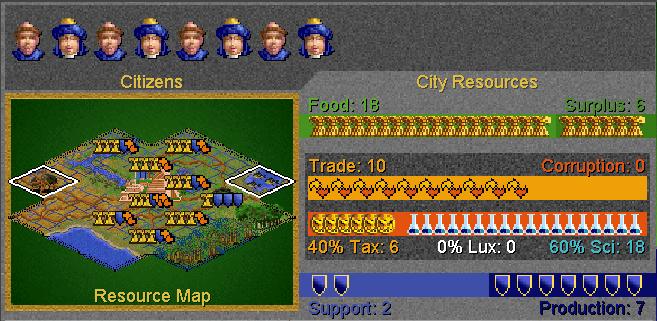
Here is Berlin City, it is transforming 24 f / 9 s / 10 a (one trade arrow comes from trade by caravan).
It is employing 8 citizens in 8 tiles.
Those tiles are technically efficient as they produce 4 items minimum, and there is no other tile with more than 4 items without a citizen on it.
The cost of transforming a trade arrow is:
10 / 10 = 1 gold per trade arrow
The cost of transforming a shield is:
10 / 9 = 1,11 gold per shield.
The cost of transforming a unit of food is:
10 / 24 = 0,41 gold per unit of food.
IMPORTANT NOTE: This is cost, and not the real value yet, but it is the minimum "price" for each item.
 Attachment: berlin.jpg Attachment: berlin.jpg
This has been downloaded 66 time(s).
Last edited by Kramsib on 15-05-2005 at 04:05
|
|
| |
|
|
|
rjmatsleepers
|
|
quote:
Originally posted by Kramsib
Conseqently, trade arrows can be considered as money, that is to say, 1 trade arrow is equal to 1 gold.
|
But until you reach democracy you cannot get 10 gold from 10 arrows, unless the roundings are working in your favour. And with a market (bank, etc) you get more than 10 gold from 10 arrows. My conclusion is that the "value" of a trade arrow depends on the form of government and the infrastructure that you have built, but it is very rarely 1 arrow = 1 gold.
RJM at Sleeper's
|
|
| |
|
|
|
rjmatsleepers
|
|
quote:
Originally posted by Kramsib
Those tiles are technically efficient as they produce 4 items minimum, and there is no other tile with more than 4 items without a citizen on it.
|
I'm not sure what you mean by "technically efficient". If you move 1 of the workers that is producing no shields on to the forest and another on to a plain, you would get a 10 shield surplus which is much more efficient for producing units. These 3 additional shields would be at the cost of 3 food and 1 arrow, but would eliminate any shield waste in the final row of a unit build - great for rushing vans.
RJM at Sleeper's
|
|
| |
|
|
|
rjmatsleepers
|
|
quote:
Originally posted by rah
There are hundreds of situations where your not going to be using that perfect combination. It depends on whats going on in the game around you. So you can all waste your time argueing over theoritical things (especially the vague nature of this one). I'll spend my time playing MP games by the seat of my pants. And I bet my results will be better than yours.
It's always about what is most important to you for that turn. And you don't need a complicated formula to figure out. |
If I'm the I'm the person you're betting against, you'll win your bet easily.
But thanks to Solo investigating "theoretical things" we now know about which trade goods a city will supply and how to keep it supplying them. There are a lot of other examples I could choose. You yourself mentioned an Oedo year - another example of investigating "theoretical things". Progress comes from a combination of good practical play and good theoretical analysis.
RJM at Sleeper's
|
|
| |
|
|
|
Kramsib
|
|
Father and protector of PROGRESSIVE GAMES, SANTANDER, Cantabria, España (Spain), Unión Europea (European Union)
Sep 2001
time: 06:36
|
|
Sorry I wasn't able to answer till today, I had a lot of work to do.
quote:
Originally posted by rjmatsleepers
I'm not sure what you mean by "technically efficient". If you move 1 of the workers that is producing no shields on to the forest and another on to a plain, you would get a 10 shield surplus which is much more efficient for producing units. These 3 additional shields would be at the cost of 3 food and 1 arrow, but would eliminate any shield waste in the final row of a unit build - great for rushing vans.
RJM at Sleeper's |
When I speak about "technical efficiency" I mean a kind of "absolute advantage".
Grassland 2 f / 0 s / 0 a = 2 items
Bonus Grassland 2 f / 1 s / 0 a = 3 items
Plain 1 f / 1 s / 0 a = 2 items
A bonus grassland is more efficient than a grassland or a plain as it produces 1 extra shield compared to simple grassland or 1 food compared to plains.
But a square with grassland has the same technical efficiency as a square with plains. Which is better?, it depends on the "value" of 1 f against 1 s. If 1s = 1f, both are equally efficient, if 1s>1f, plains are more efficient and viceversa.
Under technical point of view, squares with the same number of items are equally efficient. Different values for each kind of item make efficience varies. So I'm talking about two concepts, technical efficiency and global efficiency. Ok?
In the example above, if you move 1 citizen from no shield grassland to a forest you are "changing" 2 f + 1a for 2 s in exchange. That is to say, 1 f + 1/2 a for 1 s.
You can change it to plains "changing" 1 f for 1s, which is a cheaper option.
The example was given intentionally to show, in the future, how my theory can be useful to maximize production or even decide were to produce to maximize "value", so be patient.
The picture shows the AI's decission, the distribution of the citizens by clicking the city square on the resource map.
|
|
| |
|
|
|
Kramsib
|
|
Father and protector of PROGRESSIVE GAMES, SANTANDER, Cantabria, España (Spain), Unión Europea (European Union)
Sep 2001
time: 06:36
|
|
I have to explain these economic concepts before continue explaining my theory for not becoming misunderstood.
Let there be a producer.
Let there be a customer.
The producer, produce output, for example chairs.
To build a chair, producer basicly needs:
wood
tools
time
...
These elements mean a cost for the producer.
Let's assume our customer needs a chair, this implies that a chair has some value for the customer.
Let C be producer's cost.
Let V be customer's value.
Let P be the price.
Producer will never ask for a price which P
Customer will never pay P>V. He wants a chair but not at any price, in that way, V is the maximum price the customer will pay.
We can say
P-C >0 is producer's profit
V-P >0 is some kind of "customer's profit" as it buys at a lower prize under the maximum he wants to pay.
So, only when V>P>C, we have negotiation between producer and customer.
Producer wants P=V becouse that is the highest price he could ask and that maximizes his profit (P=V maximizes P-C).
Customer wants P=C becouse that maximizes his "profit" V-P.
Then, producer and customer start to bargain until they come to an agreement wich determines final price.
-----------------------------------------------------------------
My theory tries to study "value", so I need to determine costs first. Then I will estudy value, and finally we can study how can a "virtual" market will work and how prices are set up.
|
|
| |
|
| |
|
|
|
rah

|
|
Apolyton Prince of Moderators, Master of Reason
|
 |
Lord of the Ferrets
Jan 1970
time: 23:36
|
|
Don't get me wrong, I do use the calculations. Thanks to Solo I know when a demand can change so I plan better. I calc rough attack percentages. I know when a caravan delivery is on the optimal path. I squeeze every beaker to get monarchy on an oedo year as early as possible.
But as I said, they're usually quick approximations. That's all you have time for. What we're doing here is way to vague and would not have many applications. As I stated earlier, there are too many times when you would want to go against the formula to maximize what you're attempting to accomplish in a turn.
As for playing SP, if you check back in the archives you'll see that I participated in earlier SP challanges. I was the third person (i think) to win at OCC. I participated in some of the early landing and highest score contests. I have also played many of the scenarios. But guess what, they still got boring and I no longer participate. I don't begrudge the people that haven't done those things completely and are still having fun doing it. I no longer do. Trying to win the scoring record is probably the most boring thing anyone could ever do. Doing it more than a couple times is enough to make you never want to play the game again. I only tried 3 time because my brother was also doing it so it became a macho thing. I finally gave up when he topped my most recent record because I couldn't face doing it again even though I knew I could top it. That was years ago.
And you're right, I am slightly MP biased  since it's the only thing that provides a challange. The AI will never be as challanging as a human opponents, even bad ones. since it's the only thing that provides a challange. The AI will never be as challanging as a human opponents, even bad ones.
No matter how good they programmed the AI, I would NEVER let it manage my cities in an MP game without oversight. At least early in the game where a difference of one beaker, shield or food could make a BIG difference. Later in the game it might be nice, but most of your opponents are dead by then. 
|
|
| |
All times are GMT. The time now is 05:36.
Apolyton Time is 00:36. |
top of page
|
|
|
Forum Rules:
You may not post new threads
You may not post replies
You may not post attachments
You may not edit your posts
|
HTML code is ON
vB code is ON
Smilies are ON
[IMG] code is ON
|
|
|
|
|
|





 30-04-2005 17:47


 |
|