|
| |
|

|
DanS
|
 |
Kickball Capital of the World
Jan 1970
time: 00:19
|
|
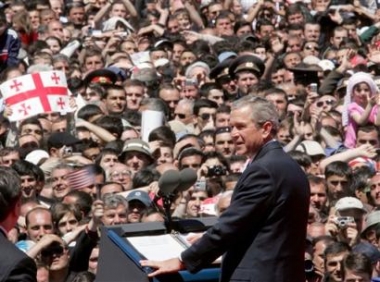
In Germany, Bush might get cold hard stares, but it's not quite the same reaction in Georgia. The differences are interesting.
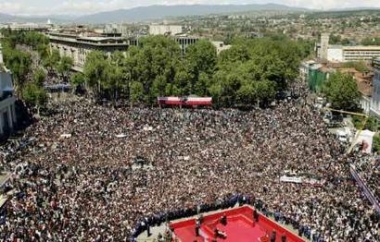
They say 150,000 were there to hear the speech. I assume that's a gross exaggeration, considering the whole country has only 5 million people or so. But let's just say it was better attended than a Putin speech in the same place.
I wonder whether this visit will break the Georgian treasury. I also wonder whether George Soros feels like he is getting his money's worth. 
 Attachment: 380,http _us.news1.yimg.com_us.yimg.com_p_rids_20050510_i_r2591861344.jpg Attachment: 380,http _us.news1.yimg.com_us.yimg.com_p_rids_20050510_i_r2591861344.jpg
This has been downloaded 119 time(s).
Last edited by DanS on 10-05-2005 at 22:39
|
|
| |
|
| |
|
|
|
DanS
|
|
Kickball Capital of the World
Jan 1970
time: 00:19
|
|
Here's a good overview article from FT on the visit. The most important person to visit Georgia in 200 years?
You would think that the EU would be all over this -- like flies on ****. Why aren't Europeans amped about it?
quote:
Bush backs Georgia as ‘beacon for democracy’
By Caroline Daniel in Tbilisi
Published: May 10 2005 09:21 | Last updated: May 10 2005 13:58
GraphicIn a huge gathering in Georgia, President George W. Bush took his message of democracy to the heart of Tbilisi’s Freedom Square, telling tens of thousands of Georgians they were “a beacon for democracy” in the world.
Mr Bush called the Rose Revolution, which 18 months ago led to the peaceful ousting of Eduard Shevardnadze as president, “one of the most powerful moments in history. It inspired others around the world who want to live in a free society.”
Mr Bush’s speech was the culmination of a four-country tour which included Latvia and Russia.
Under blue skies on a sweltering day, Mr Bush, marking the first ever visit to the country by a US president, received a boisterous welcome from between 60,000-100,00 attendees who began to descend on the square from dawn. He called for the creation of free institutions and gave his backing to Georgia’s “close cooperation with Nato.”
In a nod to the threat of instability from the separatist movements in Abkhazia and South Ossetia, he offered the caveat: “Georgian leaders know the peaceful resolution of conflict is essential to your integration into the transatlantic community.”
However, he also offered a direct warning against Russian interference with the separatist regions. “The territorial sovereignty of Georgia must be respected by all nations.”
That comment was greeted with robust applause by the audience, who fanned their faces with cardboard American flags and spent the time waiting for the two presidents by watching a staged display of Georgian dancing and singing. A choir, dressed in the colours of the Georgian and US flags, formed the backdrop to the presidential platform.
The only awkward moment of the day came when the microphone failed during Mr Saakashvili’s speech. Blithely unaware that no-one could hear him, he continued to address the crowd for several minutes.
The day’s events had been preceded by several weeks of zealous spring cleaning by the Georgian government. The main road was resurfaced, shrubs were planted along the route from the airport; houses facing the road were garishly repainted - against the will of some inhabitants - and television adverts exhorted Georgians to attend the rally, according to one World Bank employee based in Georgia.
Commenting on the welcome, Mr Saakashvili noted, “This is genuine. This is not North Korea. They don’t do this because they were told to, but because they feel like it.”
Calling Mr Bush’s visit, “an historic event,” Zurab Nogaideli, the 40-year-old prime minister of Georgia, told the FT: “In the resolution of Georgia’s territories Russia can play a positive or negative role. We hope the US will help us with these endeavours. The US is supporting our territorial integrity.”
He added, “This is a very critical time for us and the region’s future. I don’t believe there will be any direct intervention of Russia in our territory. We are now discussing dates for their withdrawal (from the two military bases they have in Georgia).”
He acknowledged the role that was being played across the region from the spread of democratic movements. “Georgia will decide the future of Georgia. Ukraine will decide the future of Ukraine and the people of Belarus will decide what they look like…when democracy movement happens in the former Soviet Union it is very close.”
“When I studied at Moscow state I never though independence would come so fast, with the civil war in Georgia at the start of the 1990s. I wouldn’t have believed two years ago the Rose Revolution would happen and three months ago, I wouldn’t believe George Bush would arrive here.”
Gela Bezhuashvili, National Security adviser to Georgia’s president, in an interview with the FT, said he had held talks with Mr Bush and his security advisers during their visit. “We raised the issue of support for our aspirations to join Nato. They said, we are on your side but this is about performance.”
He said Georgia had been “very close to agreeing a deal” with Russia for a date on a pull out of its military bases ahead of the 60th anniversary events of V-E Day in Moscow. “Internally and politically they agreed they must withdraw…But the Russians decided they did not want to combine the two as this was about victory and they did not want to look like losers again.”
In spite of the progress on the talks, he criticised the way Russia had responded to the recent revolutions on its borders. “Russia doesn’t understand how democracy works. After Georgia’s [revolution] they didn’t learn lessons. After Ukraine they didn’t learn. We are a small country and we do not pretend to impose lessons but Russia needs to exercise leadership.”
He said the US had played the most critical role in supporting democracy in Georgia. “The EU is not as proactive as the US….We are trying to wake them up in that our problems are their problems as we are the gateway of Europe today. The Black Sea is becoming their gateway. We are working with them but they are very slow. I spend more time with the US than with Europe.”
Both senior Georgian officials were confident that the experience in Georgia and the Ukraine would inspire reformers in Belarus. Mr Bush has called Belarus, which is due to hold elections in 2006, “Europe’s last dictatorship.”
“Sooner or later the people will raise their voices but I can’t say when. It will be more difficult than the Ukraine,” said Mr Bezhuashvili
Mr Bush said: “Now, across the Caucusus, in central Asia and the broader Middle East, we see the same desire for liberty burning in the hearts of young people. They are demanding their freedom and they will have it.”
If that message holds true for Belarus next year, that could provide Mr Bush with another opportunity to return to the region to reprise the speech he gave on Tuesday in Georgia’s Freedom Square.
The president’s tour took in Latvia, the Netherlands and Russia, where on Monday he joined Mr Putin and more than 50 other world leaders to mark the 60th anniversary of the defeat of Nazi Germany.
Mr Saakashvili snubbed Moscow’s lavish second worldl war commemorations in protest over Russia’s failure to agree on withdrawal of its bases, which house some 3,000 troops.
In his speech at Freedom Square, formerly known as Lenin Square, Mr Bush said Georgia’s freedom struggle had inspired peoples ranging from Ukraine to Iraq and Kyrgyzstan.
The crowd reacted ecstatically, waving banners including ”Mr. George W. Bush, you can save Georgia”.
“It is great that the president of a superpower has come to visit us,” said Nana Razmadze, a 54-year-old teacher. “We hope that things will get better for us and we can move forward. I think that from now on the world will look on us differently.”
“This is a visit that should go down in history,” said 46-year-old Merab Getsadze. “It’s been 200 years since Georgia was visited by such a high-ranking person. We hope we will be able to solve a lot of problems after this visit,” he said. |
|
|
| |
|
| |
|
|
|
Pekka
|
 |
em seu burro dos pais!
Feb 2002
time: 07:19
|
|
Ned and Tass are both right in a sense that they love someone who would be seen as the opposite of Commie. It's also a statement against the Commie.
Just like hamas flag carrying activist commies, I find it unlikely that they are pro-terrorists, but I find it likely they just want to provoke, because they don't like what they see and they disagree with it, but they just take it to the extreme. Often these activists, almost exclusively however are commie sympathizers.. some sort of socialist/greenie/etc. axis... It's typical activism, being loud and provocative, yet they just want to be heard on the issue.
But that would be my point, hamas people looking at that rally would be surprised 'look we have supporters yaay!' and it's not necessarily true.
However, I'm sure there's also lots of people who want to see US president talk, lot of people want to see him talk because he's not commie and making a statement, then some people are just curious, some people are supportive towards US policies.. it's a mixed bag.
|
|
| |
|
|
|
Riesstiu IV
|
|
Bush is actually popular in a foreign country? Well... I though I'd never see the day!
Did he bribe the audience?
|
|
| |
|
| |
All times are GMT. The time now is 05:19.
Apolyton Time is 00:19. |
top of page
|
|
|
Forum Rules:
You may not post new threads
You may not post replies
You may not post attachments
You may not edit your posts
|
HTML code is ON
vB code is ON
Smilies are ON
[IMG] code is ON
|
|
|
|
|
|






 10-05-2005 20:02


 Alright...I've been thinking long and hard about this, but have been unable to come up with an answer.




 |
|