 |
| |
|

|
Asher
|
 |
Calgary, Alberta
Nov 1999
time: 22:36
|
|
http://news.com.com/Cheers%2C+jeers...ml?tag=nefd.top
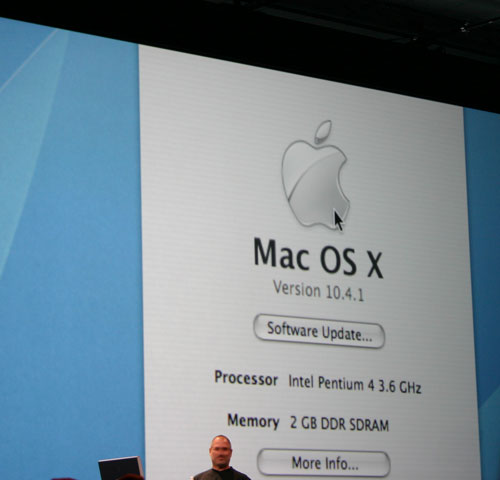
So Apple makes lots of noise about switching to x86-64 (which they and their fanbase have bashed for over a decade).
Freescale and IBM shrug:
quote:
Despite losing Apple, neither IBM nor Freescale appeared to be devastated by the news.
"It didn't come as much of a surprise to us as we've done business with Apple for more than 20 years," said Tim Doke, a vice president of communications at Freescale. "We understood that we may be reaching that point where our paths were not going in the same direction."
Apple only represents about 3 percent of Freescale's total revenue and only 2 percent of its wafer production, Doke said. The company is still committed to producing another batch of faster and low-power G4 processors for iBooks and Mac minis, Doke added.
"There is a silver lining to this, because now we are able to reinvest that R&D investment as we look at the consumer space and trade that with more of our other products.
IBM, which was also fired by Apple, said it won't lose much sleep over losing the contract to build the G5 processor.
"IBM is aggressively moving the Power Architecture beyond the PC, as shown by our recent successes with the next-generation gaming systems announced by Sony, Microsoft and Nintendo," IBM spokesman Glen Brandow said.
Both IBM and Freescale said they are looking at replacing lost Apple production and putting it into other growth areas such as telematics systems used in automobiles. Freescale said it was also particularly interested in its communications processors like those found in base stations. |
And Adobe's CEO says "What took you so long?"
If this whole thing isn't humbling for Apple, I don't know what is. 
|
|
| |
|
|
|
Asher
|
|
Calgary, Alberta
Nov 1999
time: 22:36
|
|
http://news.com.com/Apple+fails+to+..._3-5734187.html
quote:
Apple fails to meet (a columnist's) expectations
June 6, 2005, 2:43 PM PT
By Michael Kanellos
Who ever thought Apple would convert to Intel?
Not me. Eighteen months ago, I wrote that such a deal wouldn't occur because it would potentially allow clone makers to produce cheap Macs and make price comparisons easier between Macs and Windows-based PCs. (I also predicted that IBM services would begin to teeter, so I wasn't a complete bonehead.)
When news of deals began to surface last month, I wrote another article quoting several analysts downplaying any budding relationship. They say animals can sense things early, but I completely ignored the fact that two weeks ago my cat started drinking coffee and fiddling with the band saw.
Still, the predictions weren't that bad. It won't be an easy transition. Sales will likely decline between now and June 2006 when the first Intel-based Macs come out, because few will want to buy a computer out of a product line heading for the tar pits. Clever PC makers and software developers, particularly in emerging markets, will be able to figure out how to put the Mac OS on white-box PCs.
Nonetheless, many decisions are fraught with risk and difficulty. The Austro-Hungarian empire originally didn't enforce its will on the Serbians in 1914 because of the all-consuming importance of the sheep-cheese trade in the Balkans. But fear of losing prestige, worries about Russia and pressure from the Kaiser in Germany all pushed them toward a precarious course of action.
With PowerPC chips, Apple found itself grappling with an ever-widening performance gap. Although PowerPC was somewhat comparable to Intel/Advanced Micro Devices processors in the first part of the decade, those chips began to pull away. Intel and AMD also came out with new, faster, cheaper versions at a faster clip.
The troubles began to come to a head with the G5, the IBM processor that debuted in 2003. Benchmarks from Apple touting the superiority of the G5 were widely questioned.
Apple also began to include a liquid cooling system in its PCs for the processor. Apple fans claimed the cooling system underscored the company's visionary sense of engineering. Dan Hutcheson, CEO of VLSI Research, saw it differently. The liquid system added about $50 to manufacturing costs. Historically, liquid cooling is also a sign that the processor line won't be around for long.
When Apple began to publicly complain about the G5 on conference calls, the companies had entered a danger zone. IBM doesn't cotton well to criticism, particularly from allies. "We invented the cash register! We came up with fractals! We sponsor Christmas specials," is sort of IBM's attitude toward the rest of the world. Big Blue started to hang out with console makers and listen to old Springsteen records on the car stereo. Divorce suddenly loomed as a possibility.
"As we looked out toward the future, we envisioned the kind of products we'd like to build, but we didn't know how to build (them) with the future of the Power PC road map," Apple CEO Steve Jobs said at the company's developer conference.
Oddly enough, Apple has been gaining market share in the past few quarters despite the G5 issues.
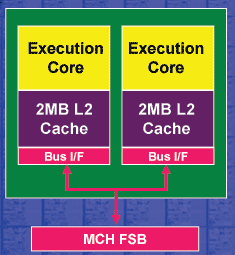
Intel has power consumption problems with the Pentium 4 too, but a shift to dual core cures some of that. Future notebook and desktop chips (Yonah, Merom, Conroe) will further reduce power consumption, which in turn will let Apple come out with sleek, small systems.
There will be other benefits too. Intel increasingly is performing more of the internal engineering work required in getting servers and other computers out the door. It makes reference designs and lines up component manufacturers to adopt certain specs. By taking advantage of some of this work, Apple can likely reduce the delta between its computers--which tends to be about $300--and a similarly configured computer from a PC company.
On the other hand, Apple will have to live with being one of many. The red carpet was unfurled Monday, but a year from now, Apple will be lumped into the same courtesy shuttle as Toshiba, Sony, Gateway and the other "not in the top five" PC makers. Acer sells more computers than Apple and therefore will likely qualify for higher volume discounts.
Apple will also lose one more aspect of its uniqueness, which the company seems to crave, so who knows what will happen next? Feeling a bit dejected, Apple may start casting about again. Look, there's Hector Ruiz of AMD, the company might say to itself. He talks quite a bit about the importance of the emerging market. They're sort of an underdog.... |

|
|
| |
|
| |
|
|
|
Asher
|
|
Calgary, Alberta
Nov 1999
time: 22:36
|
|
http://www.nytimes.com/auth/login?U...ypQ2
2Q3B
All of the chips that IBM makes Apple account for 2% of the output at just one of its fab plants (East Fishkill, NY).
Also:
quote:
For I.B.M., the end of the Apple partnership means the loss of a prestigious customer, but not one that is any longer very important to I.B.M.'s sales or profits. It further underlines how much I.B.M. and its strategy in recent years have moved away from the personal computer industry that it helped create. Last month, I.B.M. completed the sale of its personal computer business to Lenovo of China.
Even as a chip maker, I.B.M. has moved aggressively beyond the PC industry, focusing on making the processors for video game consoles from Nintendo, Microsoft and Sony, and specialized chips for other uses, like the Internet router computers made by Cisco Systems and cellphone technology by Qualcomm. I.B.M. also uses its Power microprocessors in many of its own server computers, which run corporate networks. |
quote:
For years, according to industry analysts, the work for Apple has been barely a break-even business for I.B.M. When the two companies were negotiating a new contract recently, Mr. Jobs pushed for price discounts that I.B.M. refused to offer. For I.B.M., "the economics just didn't work," said one industry executive who was briefed on the negotiations. "And Apple is not so important a customer that you would take the financial hit to hold onto the relationship." |
Last edited by Asher on 07-06-2005 at 08:46
|
|
| |
|
|
|
Gatekeeper
|
 |
United States of America
Feb 2000
time: 23:36
|
|
Bah. I don't care what chips are in my Apple. What I care about is compatibility and, frankly, help or no help, it's something Mac consumers are going to be thinking hard about when considering their next purchases.
I, for one, will likely not get an iMac G5 now. Geez. Wait for Tiger to come out, and look what I get. "Oh, hey, now we're going to switch to a different chip maker, buty, hey, don't worry, we'll think about you PPC-based Mac users. Yeah, sure we will. Yep. You betcha."
In a way, thank goodness it happened *before* I plunked down cold, hard cash. Now I can sit on it again, and let it accrue interest. (Good God, my life is boring sometimes.)
Gatekeeper
|
|
| |
|
|
|
Agathon
|
 |
Leafs 4TW!! - CPA
Dec 2002
time: 00:36
|
|
quote:
I, for one, will likely not get an iMac G5 now. Geez. Wait for Tiger to come o[ut, and look what I get. "Oh, hey, now we're going to switch to a different chip maker, buty, hey, don't worry, we'll think about you PPC-based Mac users. Yeah, sure we will. Yep. You betcha." |
It won't make much of a difference. Programs will be compiled as fat binaries for both architectures. There's no way software manufacturers could afford not to support any current new PPC mac for the next 4 years at least. There will be no compatibility problems with OS X compatible software.
But it will probably be worth waiting a year to see what the Intel ones are like. If you want to play Civ II fork out now, since the Intel machines will probably not be classic compatible (a problem for about 2% of the mac using population).
Frankly some of the comments on various sites border on the idiotic. One guy thinks that switching to Intel will mean the mac becomes vulnerable to the viruses that plague X86 PCs. I don't know what drugs that dude is on. Some Wintel users seem to think they can buy a Dell and install OS X on it. I don't consider myself as really well informed on the issue, but these people are 'tards.
It's a new processor. Big deal. In 2 years no-one will care. Frankly, it looks to be less of a hassle than the move to OS X.
|
|
| |
|
| |
|
|
|
Asher
|
|
Calgary, Alberta
Nov 1999
time: 22:36
|
|
http://news.com.com/The+Apple+deal+...ml?tag=nefd.top
"We believe the move is risky for Apple. By switching to a more mass market processor, Apple likely risks diluting its value proposition, as it has less control over the product road map."
--Steven Fortuna, Prudential Equity Group analyst
"There's more applications available for Windows than there are on Apple. All a chip change could do is probably slow that down because maybe there would be a big disruption with your ISV (independent software vendor) community...There's more training, knowledge, management on how to implement networks. What changes? I don't know."
--Steve Ballmer, Microsoft CEO
"I will never buy Apple again, ever. If this is true, I am very sad. How will I get new software for my computer?"
--John Bresnahan, CNET News.com reader
"If they actually do that, I will be surprised, amazed and concerned. I don't know that Apple's market share can survive another architecture shift. Every time they do this, they lose more customers."
--Nathan Brookwood, Insight 64 analyst
"This is kind of like if your two best friends decided to get married and you don't know what it means. You feel sort of conflicted."
--Matthew Woolrums, conference attendee
|
|
| |
|
|
|
Agathon
|
|
Leafs 4TW!! - CPA
Dec 2002
time: 00:36
|
|
I predict no-one will care in two years. Apple will still be selling computers and probably doing better than now.
I can't see why people are worried about a chip. That is not why most people use Apple: it's the software stupid.
Apparently you will be able to install and boot Windows alongside the Mac OS on the Macintels if you really want to (acc. to Phil Schiller), so I guess that people who want to game and have a mac for work, like Lord Nuclear, now have an easy solution.
As for these comments.
quote:
"We believe the move is risky for Apple. By switching to a more mass market processor, Apple likely risks diluting its value proposition, as it has less control over the product road map."
--Steven Fortuna, Prudential Equity Group analyst |
That's just daft. The whole point of changing was that they didn't have control over the product road map. In fact, Apple now has more control, since they can switch to AMD with little fuss, if Intel should fail to perform.
quote:
"There's more applications available for Windows than there are on Apple. All a chip change could do is probably slow that down because maybe there would be a big disruption with your ISV (independent software vendor) community...There's more training, knowledge, management on how to implement networks. What changes? I don't know."
--Steve Ballmer, Microsoft CEO |
It's not going to be that much of a big deal. Adobe and Microsoft have committed to the change. The others will follow. The change to Intel is less difficult than the change to OS X, so there won't be that much of a problem.
quote:
"I will never buy Apple again, ever. If this is true, I am very sad. How will I get new software for my computer?"
--John Bresnahan, CNET News.com reader |
By going to the store and buying it. In fact, if Apple is to be believed, you can now install Windows alongside the Mac OS, so you instantly have access to a whole load of games that you didn't before. Where's the problem with that?
quote:
"If they actually do that, I will be surprised, amazed and concerned. I don't know that Apple's market share can survive another architecture shift. Every time they do this, they lose more customers."
--Nathan Brookwood, Insight 64 analyst |
Chalk up another one for the Apple Death Knell counter.
quote:
"This is kind of like if your two best friends decided to get married and you don't know what it means. You feel sort of conflicted."
--Matthew Woolrums, conference attendee |
That's funny. 
|
|
| |
All times are GMT. The time now is 05:36.
Apolyton Time is 00:36. |
top of page
|
|
|
Forum Rules:
You may not post new threads
You may not post replies
You may not post attachments
You may not edit your posts
|
HTML code is ON
vB code is ON
Smilies are ON
[IMG] code is ON
|
|
|
|
|
|






 07-06-2005 01:54




 |
|