|

|
Bereta_Eder
|
|
how credible would you judge wikipedia to be? who can write there? is there any kind of check? who administers it? who's funding it? (always follow the money)
how would you rate its credibility in any case?
|
|
| |
|
|
|
Locutus

|
|
ACS CTP1/2 Manager & Civ4 Co-Manager
|
 |
Hengelo, The Netherlands
Nov 1999
time: 06:33
|
|
There are maybe a handful of (mainstream) topics for which the coverage can be described as 'excellent', it really depends on the individuals making the contribution and the ability of the rest of the users to keep their filthy little fingers off those contributions. But this happens only very rarely in my experience. Plus, even if the explanantion is excellent in quality, it still doesn't really mean anything if it's not from any kind of credible source, which wikipedia by definition isn't because anyone could've written any of it.
Again, the only truely credible part of wikipedia is the links it provides, because those can be judged in their own right and can sometimes be both credible and relevant (keyword: sometimes). But even then you have no way of knowing if all relevant sources have been listed, it's still possible to create a bias by excluding certain sources from your list of references.
So all-in-all anyone looking for serious and credible information would be wise to avoid Wikipedia. There are many knowledge bases online, both generic and specific, that provide much more credible information of typically much better quality on the same topics that Wikipedia does. Encyclopedia.com, Encyclopaedia Britannica, the Catholic Encyclopedia and even MSN Encarta are all fine examples of generic online encyclopedias that are overall much better and certainly much more credible than Wikipedia.
|
|
| |
|
| |
|
|
|
Buck Birdseed
|
 |
Khoon Ki Pyasi Dayan (1988)
Nov 2000
time: 05:33
|
|
The Wikipedia is about as reliable a source as the collective total of privately edited sites on the net is. In other words, it's hardly reliable at all, in and of itself, and you have to be very careful with the personal and ideological bias present, but it's certainly useful because of its unparallelled scope. Plus, if you know what you're doing (and know how to read history and comment pages, in this case), you can get a more balanced view from what is de facto several mutually controlling sources. As any journalist would tell you, what both sides in an issue agree on is very probably true.
That said, my own experiences with trying to edit articles in my field have been frustrating, to say the least. A lot of users just add a line or two without understanding the article structure, insert props for their favourite practitioners of an activity, or remove stuff others have written because they're biased in some way.
|
|
| |
|
|
|
DerSchwarzfalke
|
|
Wikipedia is a very handy reference, one of the best available on the internet. Citing it in a serious paper would be madness or worse though; I would fail any student I found to be using it in a works cited page if I were a prof.
|
|
| |
|
|
|
OzzyKP
|
 |
Rockville, MD
Oct 1999
time: 00:33
|
|
I think Wikipedia is quite acurate. I'd give it a 7 or 8 out of 10. Again, its not something I'd cite in a formal paper, but overall I think it is an amazing project.
Mistakes and bias gets into everything, even big professional encyclopedias. The benefit of Wikipedia though is it has tens of thousands of editors combing through everything and fixing errors.
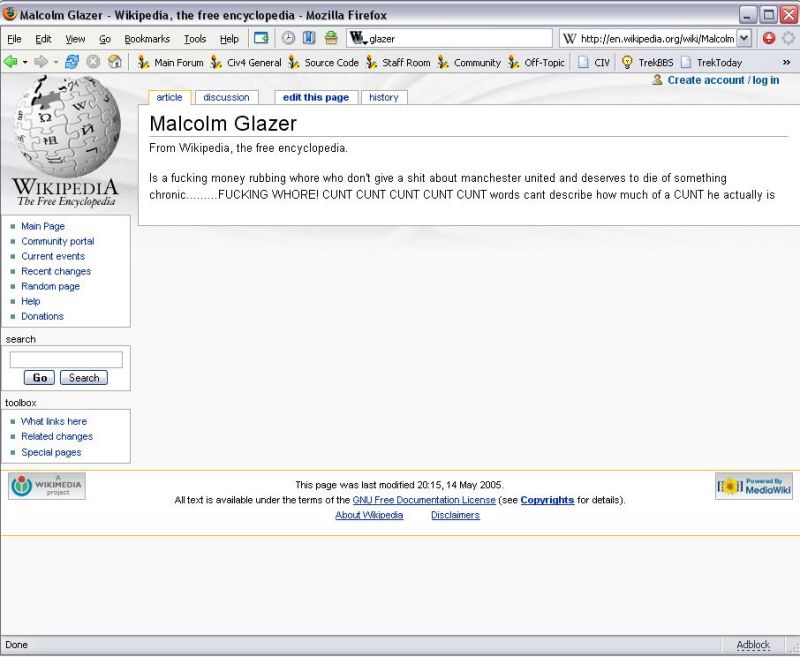
For instance, Locutus, your example 'proving' Wikipedia's innaccuracy was quite deceptive. If you go and check out that page now, it is updated and reasonably accurate: http://en.wikipedia.org/w/index.php...=Malcolm_Glazer
You went back and found an instance of the entry from a month ago. That vandalized entry lasted for exactly 2 hours and 6 minutes. Maybe if you had fixed it yourself instead of taking a screen shot in order to slander Wikipedia it would have lasted for less time. But honestly, is a vandalized entry that is public for just over 2 hours really the end of the world? Should we turn away forever from Wikipedia because some person came and vandalized an entry?
The information is all still there, and anyone (yes even you Locutus) can restore the good entry.
I think Wikipedia is an amazing resource, and I use it often.
|
|
| |
|
|
|
Bereta_Eder
|
|
Thanks for the replies, my impression from reading them is that wikipedia is most certaintly not reliable. I didn't know (and that's why I was asking) how wikipedia is written, who are its authors, what were its sources etc.
Also I'll agree that very few sources if anything is unbiased but I prefer knowing where that bias comes from so I can classify it, counter it with its opposite and maybe start to get an idea about something. Thanks again.
|
|
| |
|
|
|
Bereta_Eder
|
|
quote:
Originally posted by Urban Ranger
Then make it more reliable by adding your own expertise to it. |
From what I gather that would be useless. It can be re-written over and even if what I wrote about a subject was good, noone would know who I am what are my credentials etc so one would be justified to be suspicious of my work just as much as I of his. I'm not saying wikipedia is worthless but that it can't be trusted for serious work. Some of its articles are pretty much ok (the ones I checked and already know something about).
|
|
| |
|
|
|
Bereta_Eder
|
|
quote:
Originally posted by Urban Ranger
Anybody who's doing serious work, or not-so-serious work won't depend solely on a single source, |
Yes but you'll know which source it is each and every time. With wikipedia it can be anybody.
|
|
| |
All times are GMT. The time now is 05:33.
Apolyton Time is 00:33. |
top of page
|
|
|
Forum Rules:
You may not post new threads
You may not post replies
You may not post attachments
You may not edit your posts
|
HTML code is ON
vB code is ON
Smilies are ON
[IMG] code is ON
|
|
|
|
|
|






 11-06-2005 17:27


 Attachment:











 |
|