|
| |
|

|
Saras
|
 |
Vilnius, Lithuania
Apr 1999
time: 06:36
|
|
quote:
Originally posted by shawnmmcc
Lastly, Saras has some bad information of US corporation governance. To quote an op-ed piece in the Wall Street Journal last year, I believe, over changes in corporate governance, as close as I can remember - "What do they believe, a corporation is a democracy?"
|
I never said it's easy to oust CEO's via vote. Hey, there's always buyout firms and asset strippers around to do the ousting.
quote:
In the US corporate governance rules have for years made it both difficult and very expensive for shareholders to nominate candidates to the Board of Directors who are not approved by the current board and/or management. In addition, like Saras personal situation, many of these boards interlock, so a CEO sits on his fellow CEO's board, who sits on his board. Between that and the governance rules, the CEO does get to essentially steal from the company, i.e. get excessive compensation that is not warranted by either his job performance nor the availability of hungry upper-level managers who are both competent and would happily replace him. |
My situation is a bit different; we have no outside directors since we're a partnership (M&A boutique). For some strange reason people want me on their board.
quote:
There are some CEO’s who have earned there compensation. However, if you look at a country like Japan, and their CEO’s (and other upper level US management) compensation, and take that difference and reinvest it in the company every year – that may well be, when compounded over decades, one of the reasons Japanese corporations have routinely kicked the butt of US corporations in the global marketplace. |
Interesing point - if there aren't empirical studies of this around, there should be.
|
|
| |
|
|
|
Saras
|
|
Vilnius, Lithuania
Apr 1999
time: 06:36
|
|
quote:
Originally posted by Ted Striker
What you are referring to as "science," is often used as justification for alot of really greedy and immoral decisions.
|
What I refer to is what you referred to in the beginning, saying things like "market equilibrium" and "supply demand", which are CLEARLY scientific economic terms, hence, science. NOT a strawman.
quote:
When your greedy board buddy types use the "science" to justify things like laying off workers to justify a net loss, most accept it as gospel (which it isn't, by the way) and as a way to mask their bad decisions in the credibility of the "science." |
Laying off workers to justify a net loss  ? I think it is prettly clear that by employing less people you save costs, so, as long as you're not overfiring, that's a good management decision. You think businesses should have more people than needed to do the job that has to be done? If so, why? ? I think it is prettly clear that by employing less people you save costs, so, as long as you're not overfiring, that's a good management decision. You think businesses should have more people than needed to do the job that has to be done? If so, why?
quote:
Not all CEO and board types are bad people, |
Thank you 
quote:
but the situation exists now in a way where it is more easy to take advantage of the situation than it isn't |
[/QUOTE]
|
|
| |
|
|
|
Ted Striker
|
 |
United States of America
Jan 1970
time: 21:36
|
|
quote:
Originally posted by Kuciwalker
Yes, but I haven't seen you provide any cites either. |
5 minutes of reading brought this up. Nice try though. 
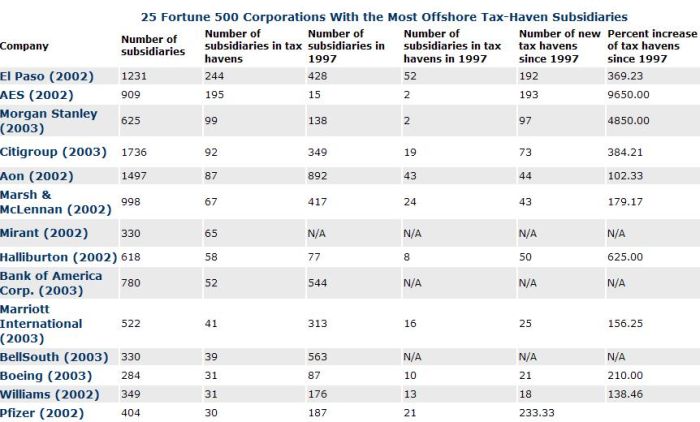
I'm confident enough on the point of decreased tax due to creative accounting, but it's common knowledge that many companies are moving operations "legally" out of America (even if they do a substantial amount of business here) for the purposes of avoiding taxes.
This all started back in 1997, and was illustrated by the famous article on News Corp (which owns the Fox Broadcasting Company) in which Rubert Murdoch would locate business offshore and avoid paying taxes.
You'll find this all over the net, it is a very famous and often cited article:
quote:
In the mid-1980s, media tycoon Rupert Murdoch abruptly renounced his Australian birthright and became an American citizen. The move allowed him to comply with U.S. law prohibiting foreign ownership of television stations -- and helped Murdoch build a global entertainment empire that now includes 22 U.S. TV stations, TV Guide magazine, the 20th Century Fox movie studio and a huge U.S. broadcast network.
Today those U.S. subsidiaries provide Murdoch's company, News Corp., with the vast majority of its revenue and profit. But through the deft use of international accounting loopholes and offshore tax havens, Murdoch has paid corporate income taxes at one-fifth the rate of his chief U.S. rivals throughout the 1990s, according to corporate documents and company officials.
There is no suggestion from U.S. authorities of any impropriety in the way the 66-year-old Murdoch has done business as he has risen from obscure press baron to the global village's de facto communications minister. The international tax and accounting strategies employed by News Corp. may, in fact, make Murdoch a model for the 21st-century entrepreneur -- a captain of industry who operates under so many flags at once that it's hard to know where his allegiances lie or how his businesses function.
News Corp., in its most recent fiscal year, reported paying $103 million in worldwide taxes on operating income of $1.32 billion, an effective tax rate of 7.8 percent, according to company documents. By contrast, American-based competitor Walt Disney Co.'s effective tax rate was 28 percent. Viacom Inc., the parent of MTV and Paramount Pictures, paid 22 percent. Time Warner Inc., a U.S. media and entertainment company that is roughly the same size as News Corp., paid taxes at a 17 percent rate. |
And to address any "carryover" issues:
quote:
That pattern has persisted through the 1990s. News Corp.'s tax rate has averaged 5.7 percent in this decade, while those of Walt Disney, Time Warner and Viacom have averaged from 27.2 percent to 32.5 percent. |
http://www.offshorebiz.com/newscorp...re-banking.html
Other companies have picked up on this trend with creative financing.
quote:
Over two dozen major U.S. corporations have reincorporated offshore, most in recent years.(7) Community, union and investor resistance to Connecticut toolmaker Stanley Works' well-publicized attempt to move offshore (the company announced it was dropping the proposal last August) may have slowed that trend.(8) But the message that these corporations and their accountants and consultants seem to be sending ordinary Americans is that "sacrifice is for suckers." Or as an Ernst & Young tax partner explained: "we are working through a lot of companies who feel that … just the improvement on earnings is powerful enough that maybe the patriotism issue needs to take a back seat." (9) |
One rough estimate at tax loss because of offshoring:
quote:
Although no one knows for sure how much offshore tax avoidance is costing the country, Senator Max Baucus (D-MT), ranking member of the Senate Finance Committee estimates that the cost of tax avoiding by both individuals and corporations through the use of offshore tax shelters to be $70 billion a year - roughly the same amount that President Bush requested to pay for the first 6 months of the war and occupation of Iraq. (10) |
The article goes into the details of different strategies companies can employ to transfer their tax liability offshore. Examples such as Enron, and Tyco are mentioned.
http://www.citizenworks.org/corp/tax/top25.php
 Attachment: havens.jpg Attachment: havens.jpg
This has been downloaded 51 time(s).
Last edited by Ted Striker on 16-06-2005 at 10:42
|
|
| |
|
|
|
Ted Striker
|
|
United States of America
Jan 1970
time: 21:36
|
|
quote:
Originally posted by Saras
What I refer to is what you referred to in the beginning, saying things like "market equilibrium" and "supply demand", which are CLEARLY scientific economic terms, hence, science. NOT a strawman. |
They are terms, and theories, but not gospel.
quote:
Laying off workers to justify a net loss ? I think it is prettly clear that by employing less people you save costs, so, as long as you're not overfiring, that's a good management decision. You think businesses should have more people than needed to do the job that has to be done? If so, why? |
I've already mentioned Pfizer as an example. Did you not read the article? Was it ethical for the CEO to take a 78% pay increase, (valued at several million dollars), yet turn around a couple of months later and announce layoffs?
Layoffs are only ethical when EVERYBODY takes a hit. Too often, the guys at the top profit while the little guys are let go.
How many jobs could have been saved with even HALF of that pay increase the CEO got?
|
|
| |
|
|
|
Flubber
|
|
With a view of the Rockies
Aug 2000
time: 22:36
|
|
Actually
The point that corps pay less tax by offshoring is commonly accepted and pretty well known. I wouldn't dispute it. But as long as there is no fraud and US tac is paid on US income and Canadian tax is paid on Canadian income , I really don't see what business it is of thiose tax authorities that the corps Cayman Islands subsidiary makes substantial income on foreign investment .If there are holes that allow avoidance of local tax on local income by these means, then the loopholes should be closed.
I actually have a lot of sympathy with people offended by high CEO payouts and in concept dislike some tax treatments but that was irrelevant to the original article here. The numbers cited as proof of things are still GARBAGE numbers and prove nothing.
The fact that the article proves nothing does NOT necessarily mean the underlying premise is untrue. Some corps undoubtedly do pay less tax than others. But I always want to know why since at the size of corp we are speaking of, they are ALL employing techniques to minimize tax
|
|
| |
All times are GMT. The time now is 05:36.
Apolyton Time is 00:36. |
top of page
|
|
|
Forum Rules:
You may not post new threads
You may not post replies
You may not post attachments
You may not edit your posts
|
HTML code is ON
vB code is ON
Smilies are ON
[IMG] code is ON
|
|
|
|
|
|






 16-06-2005 09:25


 |
|