 |
| |
|

|
Thorn
|
 |
Asheville, NC
May 1999
time: 00:37
|
|
quote:
Oil surges to $66 a barrel
Crude reaches another historic mark after demand agency forecast, refinery snags and Iran concerns.
August 11, 2005: 4:11 PM EDT
LONDON (Reuters) - Oil charged to a record $66 a barrel Thursday as Iran's nuclear work put it at odds with the United Nation's atomic watchdog, and more U.S. refinery snags threatened gasoline supplies to the world's biggest consumer.
Earlier the International Energy Agency said non-OPEC oil output growth was falling short of expectations, putting more of a burden on OPEC's stretched production capacity to meet rising demand.
Light, sweet crude for September delivery ended up at 90 cents, reaching $65.80 a barrel, after hitting a record-high of $66. London Brent was up $1.39 at $65, after touching $65.66.
"The presence of significant headline risk, most particularly from Iran's international relations, the Atlantic hurricane season and from tightness in refining, is continuing to support prices at higher levels," said Barclays Capital.
Treasury Secretary John Snow on Thursday said the question of releasing oil from U.S. emergency stockpiles to ease lofty oil prices was "off the table."
"That's really off the table for circumstances like the ones we're facing now," Snow said in an interview with CNBC.
In Vienna, the board of governors of the International Atomic Energy Agency approved a resolution demanding that Iran suspend all nuclear activities, a diplomat said.
EU diplomats said if OPEC's second biggest producer failed to comply with the resolution they would push that Iran be referred to the UN Security Council for punitive action.
Refinery strain
In the United States, where refinery problems have strained gasoline stocks during the peak demand season, BP shut several units at its Texas City refinery, the company said.
And ConocoPhillips Wood River refinery suffered a power problem that briefly forced shut some units, the company said.
The news came on the heels of U.S. stock data on Wednesday that showed another fall in gasoline inventories in the world's biggest consumer that brought inventories 3.7 percent below a year ago.
Edward Meir, of Man Energy, said oil price forecasts were running the gamut. "In markets like these, it is best to let things run their course, especially given the fact that there are no resistance signposts to guide us."
The International Energy Agency, adviser to 26 industrialized nations, earlier nudged up its world oil demand growth forecasts for this year and next, leaving already stretched OPEC to fill the supply void.
The IEA cut non-OPEC supply growth this year by 205,000 barrels per day, with production problems in the U.S. Gulf, Mexico, Norway and Britain accounting for most of the shortfall. Russia is also pumping less than expected.
"The extent to which [the IEA] felt compelled to cut its estimates of non-OPEC production is a bullish factor," said Deborah White, senior energy analyst at SG Commodities.
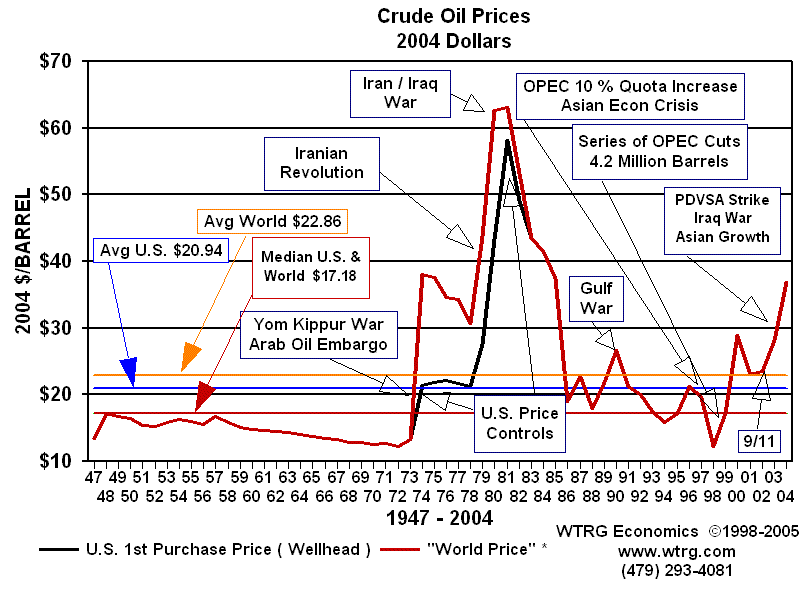
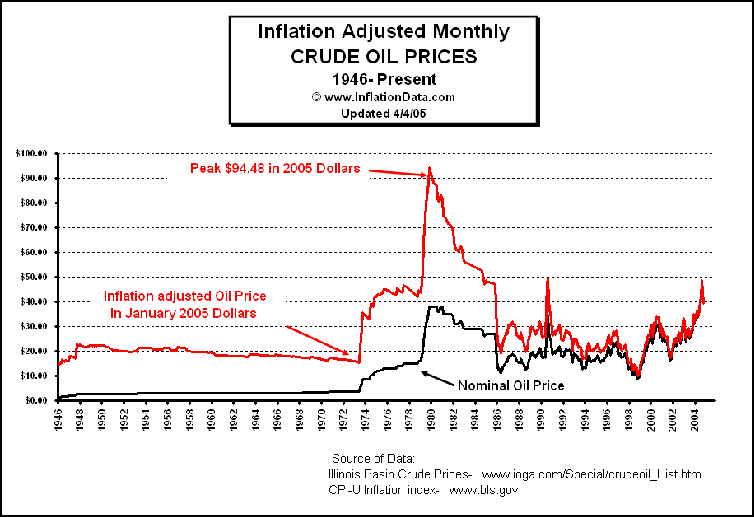
Even with U.S. crude averaging above $53 a barrel for the year to date, in real terms prices are still below the $80 a barrel average of 1980, after the Iranian revolution. |
$1.45 is the cheepest here at the pump.
|
|
| |
|
| |
|
|
|
Kontiki
|
|
Canada
Aug 2001
time: 00:37
|
|
It's just starting to crack $1.00/litre here in Toronto. I was in Vancouver a few weeks ago and saw it at $1.01. It's so odd to see triple digit prices on signs in Canada.
|
|
| |
|
|
|
Asher
|
 |
Calgary, Alberta
Nov 1999
time: 22:37
|
|
quote:
Alberta may get $7-billion surplus
Private sector foresees a booming budget as oil hovers above $65 (U.S.) a barrel
By PATRICK BRETHOUR AND KATHERINE HARDING
Monday, August 22, 2005 Page A1
CALGARY and EDMONTON -- Alberta's energy riches are propelling its surplus toward $7-billion, raising questions about how the province will use its windfall while not creating jealousy among the country's cash-strapped provinces.
Alberta's snowballing surplus will be four times bigger than the province's official number, based on calculations that use private-sector commodity price forecasts.
The province will deliver its quarterly fiscal update next Monday. Alberta is typically quick to warn that commodity prices can fall as quickly as they have risen, but Energy Minister Greg Melchin acknowledged that royalties will be higher than projected in the spring. "Clearly, there's upside off our budget," he said.
And as the money from crude and natural-gas royalties flood provincial coffers, there are concerns about how the Ralph Klein Conservatives will use the riches.
"For the last 13 years, their whole mindset has been around the politics of constraint . . . well that doesn't prepare you well for the situation we are in now," said Roger Gibbins, president of the Canada West Foundation, a western think-tank.
"It takes a real leap in imagination to get into this space. I think it's very difficult for this particular government to do this."
In the spring, Alberta Finance Minister Shirley McClellan tabled a budget with a $1.52-billion surplus for fiscal 2005-06; along with the cash diverted into the province's long-term capital account, the expected surplus tops $3-billion.
But that surplus depended upon commodity-price projections that are now out of step with the marketplace. The current oil price, $65.35 (U.S.) a barrel, is 50 per cent higher than Alberta's official estimate of $42 (U.S.) a barrel. Alberta's official number is also substantially below analysts' projections for commodity prices through to the end of the province's fiscal year.
Using data from First Energy Capital Corp. and Peters & Co. Ltd., The Globe and Mail estimated Alberta may reap an extra $3.9-billion to $4.1-billion in oil and gas royalties, on top of its budgeted $6.7-billion.
Even the more conservative figure means that Alberta would take in a total of $11.6-billion in overall non-renewable resource revenue, easily surpassing the current record of $10.5-billion in fiscal 2000-01. In that scenario, the provincial surplus would swell to at least $6.9-billion, another record.
The dramatic rise in energy prices since the spring -- with crude leaping beyond $60 (U.S.) a barrel -- has overrun the numbers in the provincial budget, and Alberta's estimates are now far lower than the consensus in the private sector.
Concerns about terrorism in the Arabian Peninsula, rising oil demand in Asia, stretched supplies and the indifference of North American consumers to high pump prices have all combined to send energy prices soaring upward.
Mr. Gibbins said Alberta has yet to decide on a long-term plan for the surplus, in part because of "indecision and uncertainty" as Mr. Klein drifts toward retirement.
He's worried that the government could give into popular public cries for more tax relief, which he warns could be disastrous nationally because the province could become a "tax haven in the federation."
Mr. Gibbins said previous provincial Conservative governments have wisely invested the money, including creating a special fund for medical research.
"It didn't expose us to serious criticism from outside the province because we were seen as using that money in a smart and thoughtful way that would have national benefits," he said.
However, if the wealth is largely hoarded by Albertans, he predicts there could be national consequences.
"That guy in downtown Toronto who is pumping $1.10 litre gas into his car is going to react quite differently," Mr. Gibbins warned. "He is going to make an argument that something is fundamentally wrong."
The projected surge in resource revenue comes even as provincial politicians contemplate changes to royalty rates. Right now, Alberta collects royalties of up to 40 per cent on oil and natural gas extracted in the province.
Mr. Melchin said the debate is more or less a formality at this point, since current rates are already giving the province an enormous income. "The total dollars are huge."
Alberta's resource income could grow even more in coming years if current prices persist. That is because the oil and gas sector is rapidly depleting investment credits that reduce its royalties and corporate taxes.
The massive oil-sands projects of northern Alberta, for instance, are quickly burning through the capital-investment credits that allow them to pay reduced royalties. Twenty-six of 55 projects already pay higher royalties -- eight to 20 times greater -- with more to join them shortly. Syncrude Canada Ltd., one of the biggest and oldest mining megaprojects, will likely begin paying the higher royalty rate in the first quarter of 2006, a year earlier than originally thought, its largest owner said last week.
The same is true on the conventional side of the oil and gas business, where the tax pools generated by exploration spending are rapidly drying up as cash flows surge. "Companies are going to feel the brunt of the corporate tax rate," said Greg Stringham, a vice-president at the Canadian Association of Petroleum Producers.
He noted that oil and gas companies will become taxable at a time when the sector is paying a higher rate than most other types of businesses.
Meanwhile, even with cash pouring into the provincial treasury, some Alberta politicians are talking about taking on debt.
Lyle Oberg, Alberta's infrastructure and transportation minister, wants his government to make the province's "infrastructure deficit" of up to $7.5-billion an immediate spending priority, plus up to another $5-billion to keep up with the demands of economic growth, including schools and roads.
But he doesn't want to tap only into the ballooning surplus, arguing that such long-term projects need stable financing.
A growing windfall
Alberta's spring budget forecast $6.7 billion in oil and natural gas royalties but soaring prices since then mean the province will take in much more. Prices since April, along with analyst forecasts through to the end of March point to a windfall of close to $4billion, a record year for royalties and a surplus nearing $7 billion. The calculation of those extra royalties combine commodity price forecasts from First Energy Capital Corp. and Peters & Co. Ltd. with price sensibilities from Alberta Finance.
First Energy Capital Corp. Peters & Co.
First fiscal quarter $659 million $599 million
Second fiscal quarter $956 million $1.02 billion
Third fiscal quarter $1.23 billion $1.07 billion
Fourth fiscal quarter $1.27 billion $1.2 billion
Total $4.12 billion $3.89 billion
COMMODITY PRICE PROJECTIONS; FIRST ENERGY CAPITAL CORP AND PETERS CO. |
$7B! Yee-haw!!
|
|
| |
|
|
|
Sava
|
 |
GO GO GO!
Mar 2001
time: 23:37
|
|
quote:
As gas prices rise, so do Big Oil’s profits
By Steven Mufson
When oil prices spiked – and oil profits soared – 26 years ago, virtually every newspaper intern in America (including me) was dispatched to gasoline stations to collect quotes from irate motorists. Big Oil was viewed as public enemy No. 1: Congress convened hearings to skewer oil industry execs, regulatory agencies investigated pricing, and some news organizations rented helicopters to scour the waters (in vain) for signs of oil tankers floating offshore just waiting for prices to climb higher.
In recent months, oil company profits have soared again as international crude oil prices hit new highs. Yet public reaction has been more muted. And that has probably emboldened Congress – which, instead of investigating oil companies, just handed them (by various estimates) $1.4 billion to $4 billion in tax breaks in the new energy bill.
Isn’t there something wrong when firms profit so richly from the misfortune of the U.S. economy and American consumers?
There’s no question that the drain on the average American’s pocketbook has been a gusher for the big oil companies. Just look at the financial statements issued at the end of July. Exxon Mobil Corp.’s second-quarter earnings climbed 35 percent from the second quarter of 2004 (after excluding special items) to $7.64 billion. BP PLC, the world’s second-largest publicly traded oil company, said its net income increased 29 percent, to $5.59 billion. At Royal Dutch Shell PLC, second-quarter profits rose 34 percent to $5.24 billion. ConocoPhillips, the third-largest U.S. oil company, reported an eye-popping 51 percent jump in earnings, to $3.14 billion.
What’s behind those numbers? When oil prices rise, petroleum companies that have long-term contracts or own oil reserves get a huge windfall. After all, they may have invested and developed those oil fields when prices were $10 to $25 a barrel. Suddenly prices spurt upward and the companies are awash in profits.
Prices for North Sea Brent crude oil averaged $51.63 a barrel in the second quarter of this year, 46 percent more than the $35.32-a-barrel average a year earlier, BP told investors last month. In the United States, crude oil prices have been running about five times as high as 1998 levels, according to Energy Department statistics.
OK, but what about the companies that refine crude oil and market gasoline? If their raw material (oil) costs more, shouldn’t that squeeze their earnings? That’s often the case, but not this year. Americans haven’t really altered their driving habits, and that has made it easier for firms to raise pump prices for consumers without worrying about losing business.
Exxon Mobil’s second-quarter earnings show how these dynamics work. More than half of the company’s profit surge came from bigger earnings on the 2.5 million barrels a day of oil and 8.7 billion cubic feet of natural gas that Exxon Mobil produces itself, the so-called upstream earnings. More surprising was Exxon Mobil’s ability to pass along those increases to consumers. Exxon Mobil (like other oil companies) was actually able to boost margins for what the industry calls “downstream” operations of retailing and refining. Profits in those operations, after excluding a special charge for the settlement of a lawsuit, were $2.2 billion, up 47 percent from 2004, even though the amount of petroleum products the company sold rose less than 3 percent.
Just how big is a company like Exxon Mobil? Its sales in the second quarter were $88.6 billion, a rate that would make its revenues larger than the gross domestic product of all but 18 or so countries – and a bit bigger than Wal-Mart’s sales. Exxon Mobil’s profits for the quarter were about 50 percent more than Citigroup’s and 2 1/2 times Microsoft’s.
The sign of a great company? Money to spend finding energy solutions? Not necessarily. Exxon Mobil upped its capital and exploration budget last quarter, but it spent nearly as much buying back its own shares, bolstering its stock price. This quarter, the company said, it will spend even more – $5 billion – repurchasing shares. If only drivers could fill their tanks with stock certificates. |
link: http://www.fortwayne.com/mld/journa...al/12358264.htm
|
|
| |
All times are GMT. The time now is 05:37.
Apolyton Time is 00:37. |
top of page
|
|
|
Forum Rules:
You may not post new threads
You may not post replies
You may not post attachments
You may not edit your posts
|
HTML code is ON
vB code is ON
Smilies are ON
[IMG] code is ON
|
|
|
|
|
|






 12-08-2005 05:53





 I'm moving to NC!
  Its a dollar more here.




 |
|