|
| |
|
| |
|

|
alf
|
 |
Bilbao de España,.... espero
May 2001
time: 05:14
|
|
Siento escribir en español, pero mi ingles solo me llaga para hacer señales de humo.
Doy y acabo, ya que creo que cada uno ha expresado sus opiniones y no habrá manera de que nadie asuma el planteamiento del otro, mi punto de vista:
- No se puede tomar como puntos de apoyo estas enciclopedias... en general ninguna enciclopedia cuando hablamos de temas tan indocumentados. Cada enciclopedia tiene criterios diferentes sobre temas historicos, yo he visto explicaciones diferentes entre Larouse y la Britanica, que me dejaron perplejo hace años. así que para mi no es un argumento estas enciclopedias, sobre todo cuando se lee "PROBABLEMENTE", probablemente destruidos por los cartagineses, probablemente identico que Tarsis en la biblia.
- Las teorias de este hombre no tienen justificación arqueológica suficiente y ninguna documental.
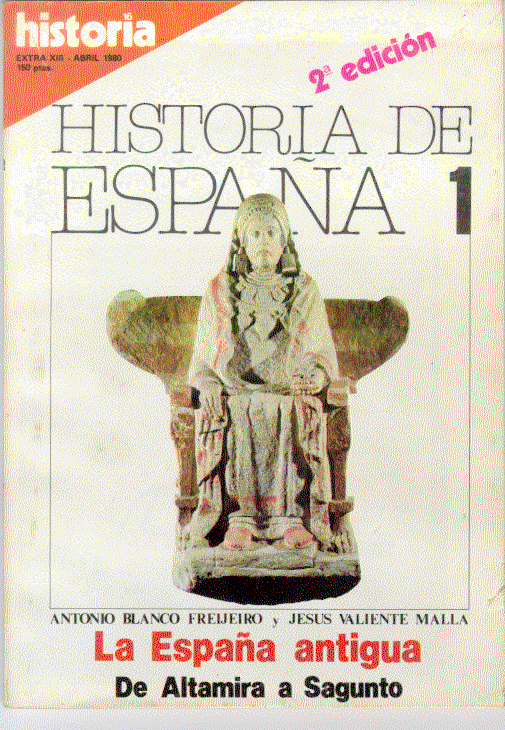
- Schulten da por cierto y de forma rotunda situaciones que no tienen ningun argumento documental y aqui hay que ser muy pero que muy cuatelosso, dubitativo... incrédulo. Dice, "no hay duda alguna de que los cartagineses fueron fueron los que aniquilaron a Tartessos". Para el profesor Antonio Blanco Frejeiro, catedratico de arqueologia en Sevilla y mas tade en Madrid, miembro de la real academis de historia y de Deutches nosequemas, creador de la revista Habis en Sevilla sobre arqueologia y filologia, autor de unos cuantos libros y mas cosas que por no extenderme no cito, ... es decir un tio de prestigio, dice referida a esa frase de Schulten, "...lo dicho no pasa de ser una especulacion tan gratuita como si atribuveramos aquellas catastrofes a a una sublevacion general de los oprimidos por las clases dominantes, o a una invasion de celtiberos y lusitanos..."
Conclusion, salvo que un dia haciendo espiritismo, hable con Argantonio, para mí Tartessos, se mueve en una nebulosa imposible de definir.
Así que siguiendo mis criterios escepticos y mi debil animo en la fe, estoy mas de acuerdo con JB... si he traducido algo bien, ja,ja,ja
T
|
|
| |
|
|
|
Fiera
|
 |
Proud Member of the Spanish Gang
Mar 2000
time: 06:14
|
|
quote:
Originally posted by Jay Bee
1) I know is purely a question of semantics but, don't wealth and prosperity precede and/or accompany might? |
Nope, today's Switzerland is a wonderful example of a wealthy, but not might, country. In the Ancient times, the Phoenician cities were incredibly rich but tiny when compared to huge land empires like the Egyptians, the Assyrians or the Persians.
quote:
you also forgot to mention that, as alf tried to explain, most scholars regard Schulten's treatise on Tartessos as little more than an adventure book. Seminal, interesting and enlightening, right, but fictional after all. |
You see, I happen to lack the books regarding Schulten's work as fantasy in my bookshelf. However, the respected historians whose books I own and have read, like García Bellido and Blanco Freijeiro, haven't written a single line regarding Schulten as a novel writer.
|
|
| |
|
|
|
Fiera
|
|
Proud Member of the Spanish Gang
Mar 2000
time: 06:14
|
|
quote:
Originally posted by Jay Bee
Really, what you posted proves nothing. |
I know. However, I decided to post it in order to show a highly respected source talking about Tartessos. However you and alf have just deemed it as nothing. 
quote:
I believe there is 99.99% agreement among scholars that Tartessos is not the biblical Tarshish. That speaks badly of the EB quote.
Abot the second, equating Tartessos with Seville... well that says it all... the biblical quotations again, the references to Schulten's theories... wonderful  |
First of all, you're wrong about that proportion. And secondly, haven't you read the words "probably" and "may have been"? That's exactly what Harlan said references to the Tartessian subject should include.
Finally, what's so bad about equating Tartessos with Seville. Even if the early Seville wasn't Tartessos, there are Tartessian archeological rests in its outskirts (Tesoro del Carambolo, in Camas), so Seville was most likely part of the Tartessian kingdom.
quote:
Don't you see now how dangerous is to spread unconfirmed data wrapped up to look like as if they were solid facts? |
Sorry, I don't think I've been doing that.
quote:
The way those excerpts read it looks as though the Tartessian kingdom was a reality beyond any doubt. Most scholars think otherwise, and I think you too. Don't you see why uncontestable, solid proofs are needed to tell the naked truth? |
The naked truth, that's a funny line: we can not even tell the naked truth about what's happening in Afghanistán today. We've gone over this dozens of times, but seriously: how can you expect mathematical theorems to back historical knowledge?
Regarding the Armada, it's too Off-Topic, however we can talk about that via email or PM (in Spanish, preferably). 
|
|
| |
|
|
|
Jay Bee
|
 |
Valladolid, CA
Jan 1970
time: 06:14
|
|
alf: 
I think it's important to translate your post (oh my God!) for Harlan and Marquis. There I go:
[quote[
quote:
Originally posted by alf
Sorry to write in Spanish, by my English is no good enough for this.
I believe everyone has expressed their opinion on the subject and that it's hard that the two parts find points in common. Thus, the following is just my particular opinion.
-I do not think encylopaedia quotes are the best source for topics as obscure as this. Each encyclopaedia has its very own criteria about history. I have already seen so many shocking divergences between Larousse and Britannica... it's especially revealing the use of 'probably' before "destroyed by the Carthaginians", and "identical to Biblical Tharsis".
-Schulten's theories lack a minimal archeological basis.
-Schulten totally accepts situations that have no documental proof at all. I think it is important to be very cautious in this matter and he wasn't. He said: "there can be no doubt that the Carthaginians destroyed Carthage". For Prof. Antonio Blanco Frejeiro (professor of Archeology and departmental chair in the University of Seville and later in Madrid, member of the Spanish Royal Academy of History, founder of the Habis journal on archeology and filology among many other things --- in a few words, a very prestigious guy) states about Schulten's comment on Tartessus vs Carthage: "what he said is just as gratuitous a speculation as if we attribute the destruction of Tartessos to a popular revolt of the lower against the upper classes, or to a Caltiberian or Lusitanian invasion"
My conclusioN; Unless one day we are able to communicate with the ghost of Argantonius (King of Tartessos, the one Herodotus talked about), Tartessos hides inside a cloud that is impossible to define.
Thus, following my skeptical tendencies and my weak trust in faith, I agree with JB... assuming of course that I have translated your posts correctly, ha, ha.
|
___________
(I have 'liberally' translated some sentences at certain parts. I did that in order to preserve Alf's original intentions. Those may easily be lost when you translate from one language toanother. Fiera, tell me if you disagree with anything I wrote and I will gladly change it).
|
|
| |
|
|
|
Jay Bee
|
|
Valladolid, CA
Jan 1970
time: 06:14
|
|
Just a few clarifications
quote:
Originally posted by Fiera
I know. However, I decided to post it in order to show a highly respected source talking about Tartessos. However you and alf have just deemed it as nothing. |
please read again our reasons
quote:
First of all, you're wrong about that proportion. |
You really think so?
quote:
And secondly, haven't you read the words "probably" and "may have been"? That's exactly what Harlan said references to the Tartessian subject should include. |
Oh please Fiera, that's clearly not enough. "Probably" suggests a somewhat high degree of certainty (at least in Spanish). I do not think Harlan was meaning that at all. The fair approach would have been "according to Greek classic texts", "legend suggests", "however archeological proof to back up those claims is still lacking", and sentences in the like.
Please acknowledge that the passages you quoted suggest a degree of certainty that is far from reality.
quote:
Finally, what's so bad about equating Tartessos with Seville. Even if the early Seville wasn't Tartessos, there are Tartessian archeological rests in its outskirts (Tesoro del Carambolo, in Camas), so Seville was most likely part of the Tartessian kingdom. |
Sevilla is clearly Not Tartessos and that's what your quote says. It's bad cos it's false. That Seville was within the Tartessian ambit, fine, I agree. But that's not what the quote says.
quote:
The naked truth, that's a funny line: we can not even tell the naked truth about what's happening in Afghanistán today. We've gone over this dozens of times, but seriously: how can you expect mathematical theorems to back historical knowledge? |
Uh, mathematical theorems? Historical knowledge? I do not follow your thoughts here.
quote:
Regarding the Armada, it's too Off-Topic, however we can talk about that via email or PM (in Spanish, preferably). |
yes it is, but I hope you understood my analogy 
|
|
| |
|
|
|
alf
|
|
Bilbao de España,.... espero
May 2001
time: 05:14
|
|
A ver Fiera... ojalá esté equivocado, pero me parece q empieza a haber aqui un poco de mal rollo... quizá me equivoque, aj alla.
mi idea es que estos debates no son hagan "picarnos"... yo valoro y muchisimo tus opiniones, tu capacidad de analisis, tus criterios, tu forma de entender este apartado de la historia.... aunque no lo comparta.
Tengo dos libros de este tio, uno, la historia de Sevilla y la cosa no es que no crea el buen mozo en Tartessos, es que hsitoriadores capaces, disienten en determinados apartados... alla cada uno... como nosotros, pero q estas diferentes valoraciones u opinionnes no nos lleven a mosquearnos.
Si en algo te ofendí con mis comentarios, perdona, eres un "tio legal" y seguramente mucho mas instruido en temas historicos (y en todos ya que yo soy muy bruto), solo que creo que no deberiamos seguir discutiendo ya que cada uno por su forma de entender la historia, por su idiosincrasia, alcanza un punto de vista para él cierto pero que no tiene que serlo forzosamente para los demas.. en fin, que no te tomes este fuerte trabajo de copiar ese articulo, que yo tambien tengo.
Vaya, ya sabemos cada uno la opinion del otro, dejemoslo estar.
Venga, cuentame cuando te vienes a Bilbao....
|
|
| |
|
|
|
alf
|
|
Bilbao de España,.... espero
May 2001
time: 05:14
|
|
Venga invito yo... soy el mas mayor, el mas alto, el mas feo.... y el mas tonto, ja,ja,ja
Ya es raro q JB esté de acuerdo conmigo en algo... o yo con él, ja,jaja, he metido el dedito en la herida???? jua,jua,jua
|
|
| |
|
|
|
Marquis de Sodaq
|
 |
... no, a Marquis.
Jul 2000
time: 23:14
|
|
JB, fret not about getting into a rollo with me, I enjoy these sorts of debates!
To clear the air (ha ha) around Manhattan: The Dutch bought Manhattan for beads. The problem was that the sellers were not the people who actually used the island. In other words, both parties got something for nothing. The inhabitants of Manhattan, of course, got nothing but trouble.
I've not read Schulten, so what I know about Tartessa comes from this thread...
I side with Fiera and Harlan, but understand completely JB and Alf's position. The problem is indeed how to define what occured in history - calling it truth implies that it is known and real. In the case of Tartessa, this does not apply. The reconstruction of history entails piecing together various clues. What cannot be refuted:
- A realm of at least some importance existed in southwestern Iberia c. 1000bc., based on archaeological finds.
- These people were known to the neighbors, i.e. Romans and Phoenecians, possibly others.
- Certain artifacts, including writing, exist that confirm some form of uniform society in this area. That is, they have a unique style or material and workmanship.
These clues tell us that a people in southwest Iberia achieved a level of culture and influence to warrant the attention of others. That is what is told by the hard evidence. This is as certain as the sun rising each day.
What I write next is not proven, but follows from the proven statement. Any peoples with uniform cultural artifacts, foreign trade, writing, and local influence had specialized workers. They thus necessarily had workers who did not produce food, but rather specialized in crafts, arts, services. This required an organized government, altho it offers no clue as to what form it might have taken.
Next we come to suppositions. This is where we enter the realm of assumptions based on the proven facts of other ancient kingdoms. They may or may not apply to Tartessa, but they come closer than anything else to a general rule. This is where the historian takes the facts, and ties them to other facts (e.g. trade with Britain) with likely connections based on the whole knowledge of the area involved and the time period. The neighbors refer to these people as Tartessans, and name them a kingdom. The nearer in time and geography the source texts are, the more reliable they are. These old historians are not the proof of existence, but simply add verification (and in this case, a name) to what is known. Foreign trade tells of either unique materials or sufficient demand to warrant difficult travel by either the Tartessans themselves or others (e.g. Phoenecians). Remember, sea travel in this era was not for the faint-hearted or unskilled.
If Schulten's work has been derided, he may have taken his suppositions too far. That is, by defining what the government form was, claiming that they traded with Britain, stating that they were powerful, or other such speculation.
Anyway, this shows how the existence of Tartessa can be accepted as proven. The name is arbitrary, what they accomplished is implied from what is left lying about on the ground, but they DID exist.
|
|
| |
|
|
|
Fiera
|
|
Proud Member of the Spanish Gang
Mar 2000
time: 06:14
|
|
quote:
Originally posted by Jay Bee
You really think so? [regarding the proportion of today scholar who support the theory of Tartessos being the byblical Tarsis] |
Yes, I do. There s more than 0.1 %, at least if as much scholars as I believe still follow García Bellido today.
Again, I can translate and quote here García Bellido's article "Tartessós, leyenda, historia y misterio". There, he clearly poins out that he's more inclined to equate Tartessos and Tarsis than to place Tarsis anywhere else.
quote:
Oh please Fiera, that's clearly not enough. "Probably" suggests a somewhat high degree of certainty (at least in Spanish). I do not think Harlan was meaning that at all. The fair approach would have been "according to Greek classic texts", "legend suggests", "however archeological proof to back up those claims is still lacking", and sentences in the like. |
A few words about this. The micropaedia is, as you probably already know, a very general reference and can only give brief and condensed definition and description. I'm quite sure that the use of "probably" has to do with this.
Furthermore, the only fact that "Tartessos" has been included in the micropaedia not regarded there as a legend or myth, it's a quite revealing feature for itself, assuming EB still bears its good reputation. At least that's what I thought
quote:
Please acknowledge that the passages you quoted suggest a degree of certainty that is far from reality. |
I think I can't, since I've been arguing for the reality of that degree of certainty since the very beginning.
quote:
Sevilla is clearly Not Tartessos and that's what your quote says. It's bad cos it's false. That Seville was within the Tartessian ambit, fine, I agree. But that's not what the quote says. |
Again, as far as I know, Seville has not been proved not to be Tartessos, which is what you're stating. Neither have Huelva, which is, together with Seville, the strongest "hypotheses" for today cities (again, read Blanco Freijeiro: "...Tartessos, que si en efecto existió y se hallaba a dos días de navegación de Cádiz, como indica Eforo, los mismo podía ser Huelva que Sevilla").
quote:
Uh, mathematical theorems? Historical knowledge? I do not follow your thoughts here. |
Sorry, that's due to my lack of ability with English. I meant what I've said lots of times before: you seem to be asking for mathematical evidence for a field that doesn't rquire it. Even Aristitle said that the truth for mathemathics is not the same that the truth for Politics, or something of the sort.
quote:
yes it is, but I hope you understood my analogy |
I did, it's only that we are arguing about so many things that I wanted to somehow "clean" the debate.
|
|
| |
|
|
|
Fiera
|
|
Proud Member of the Spanish Gang
Mar 2000
time: 06:14
|
|
quote:
Originally posted by alf
A ver Fiera... ojalá esté equivocado, pero me parece q empieza a haber aqui un poco de mal rollo... quizá me equivoque, aj alla. |
No, no, te aseguro que por mi parte no hay mal rollo ninguno, sólo que este tema es interesante y me gusta discutirlo.
Y además, puede que expresándome en inglés resulte más seco y agresivo, no puedo evitarlo, pero aseguro que en esta discusión como en cualquier otra, yo sigo siendo el de siempre, y aunque nos llevemos la contraria, lo único que me dan es más ganas de conocernos y tomarnos esas cañas juntos. 
Así que sí, acepto tu invitación y me planto en Bilbao en cuando pueda y los demás también.
Y espero que sepas cocinar como si fueras de una sociedad gastronómica! 
|
|
| |
|
|
|
Fiera
|
|
Proud Member of the Spanish Gang
Mar 2000
time: 06:14
|
|
quote:
Originally posted by Jay Bee
I agree (again) with alf, it's not worth the effort to translate all that article. I do not have it with me but I have read it. |
I sorry to go over this again, but if you've read it, I'm quite surprised you still address the whole existence of Tartessos matter as a legend or a myth.
But then again, perhaps each of us take his own conclussions from the same text.
quote:
It's interesting that I got dragged myself into a debate with three of the guys I most admire and respect in Apolyton (you, Harlan and Marquis). I have no interest at all to get into a 'bad rollo' with anybody and much less with any of you. |
As Marquis said, there is no "bad rollo" anywhere, at least when it comes to me, and the only thing is there is is a quite interesting debate, as both you and me stated earlier, and I hope all of us can learn something new from it.
quote:
So let's summarize: some of you believe the 'legend' of Tartessos. Some of us don't. Let's get out for some birras! |
I wish we actually could , but as I say, I see nothing bad about discusing this or that, that's what this place is for after all, isn't it? 
|
|
| |
|
| |
|
|
|
Waku
|
 |
Cádiz, Spain
Nov 2000
time: 06:14
|
|
quote:
Originally posted by Jay Bee
If I am not mistaken, Schulten said among so many things that Tartessos was rich in ivory..... |
I don't see your point here. If Hannibal managed to reach Rome through Iberia with lots of elephants is because there were elephants in the Maghreb.
Edit: That was so many posts ago that this post doesn't make any sense. This thread is growing very quickly.
Last edited by Waku on 12-10-2001 at 00:13
|
|
| |
|
|
|
Fiera
|
|
Proud Member of the Spanish Gang
Mar 2000
time: 06:14
|
|
quote:
Originally posted by Jay Bee
In the end we have been walking in circles, eh Juan? I mean we've come to the exact same place we were 7 months ago |
I know I've been, however I'm not quite sure what your stance about Tartessos was seven months ago. Hasn't it changed since, if only slightly?
quote:
If not for Civ2, I think this could be a very nice project for you to tackle for Civ3 |
Hmm, the bad thing about Tartessos is that, as far as we know, it didn't take part in important military conflict, except for the hypthetical clash with the Carthaginians, that I planned to depict in the Tratessos scn, but even in that case, we don't know much about the armies and ships of any of the sides.
However if Civ3, with its several wasy of achieving victory, offers another way of tackling the whole thing, I may give it a try, I don't know.
|
|
| |
|
|
|
Harlan

|
|
Berkeley, CA, USA
Aug 2005
time: 21:14
|
|
The more I hear about this Schulten, the less I like. There was an "old school" of scientists who thought that anything great had to have come from the Near East. So everything advanced, including Mayan, Indian, etc had to come from them. Looks like Schulten is that way. Why couldn't the Tartessians be an indigenous culture? What possible evidence would connect them with the Etruscans?
Anways, Schulten aside, there is plenty of on the ground evidence to be fairly confident of a Tartessian kingdom. I agree completely with Marquis' analysis - given what we know from other places in the world with similar levels of development, it would be very surprising indeed if no central organized government arose there.
Jesus, do you still disagree with that, and why? That to me sounds like a very reasonable supposition, and a far cry from some of the more outlandish Tartessian claims that are made.
Also, what is your field of work, anyways? Any more thoughts on the Bible related stuff?
One problem with this thread is Fiera and Jesus are so busy writing here that neither can help me determine which cities actually existed in Iberia in 500 BC .
|
|
| |
|
| |
|
| |
|
|
|
Jay Bee
|
|
Valladolid, CA
Jan 1970
time: 06:14
|
|
quote:
Originally posted by Fiera
I'm not quite sure what your stance about Tartessos was seven months ago. |
It is. Read again the thread (J/k). It's true however that I may mellowed a bit in this second part. That's because after so many months apssed I realized we were talking about two different things, the Tartessian cultural ambit, which I never denied (and is basically what Marquis has described in his very brilliant post) and the city of Tertessos, epicenter of a somewhat important Tartessian kingdom as described by Schulten (which I have always denied). Look at the title of this thread. We were supposed to debate about Schultenm weren't we?
quote:
Hasn't it changed since, if only slightly? |
Yes, but see above why.
quote:
Hmm, the bad thing about Tartessos is that, as far as we know, it didn't take part in important military conflict, except for the hypthetical clash with the Carthaginians, that I planned to depict in the Tratessos scn, but even in that case, we don't know much about the armies and ships of any of the sides. |
I always assumed this scenario would go the the Fantasy section of Bestonet, so why not do something akin to Kull's Odyssey? You now, Geryont's cattle, the pillars of Hercules (just kidding, just kidding)
quote:
However if Civ3, with its several wasy of achieving victory, offers another way of tackling the whole thing, I may give it a try, I don't know. |
You should. Remember anything Guanche? It was in that direction
|
|
| |
|
| |
|
|
|
Harlan
|
|
Berkeley, CA, USA
Aug 2005
time: 21:14
|
|
I can't say I know anything about it, but I would be surprised if there were no elephants in Iberia at that time. Reason I say this is because it is well known elephants, tigers and many other animals - heck, even hippos - were in ancient Greece around 500 BC. The climates were much different then, as Jesus acknoledges in his 216 BC scenario, covering most all of Iberia with forest. More important than climate change, people hadn't gotten around to wiping them out, which is what happened in Greece and other places not very long after.
By the way Jesus,
I asked you several questions in my last posting above. I'd still like to hear answers.
|
|
| |
|
|
|
Jay Bee
|
|
Valladolid, CA
Jan 1970
time: 06:14
|
|
quote:
The more I hear about this Schulten, the less I like. |
I do not dislike Schulten, I swear. I do think we need people as corageous as him. It's important to put forward theories even if they are wrong cos they prompt us conduct more research in that area and re-examine old matters with new eyes (The scientist is speaking again, I think).
quote:
There was an "old school" of scientists who thought that anything great had to have come from the Near East. So everything advanced, including Mayan, Indian, etc had to come from them. Looks like Schulten is that way. Why couldn't the Tartessians be an indigenous culture? |
Right on. Tartessos was an indigenous culture. I think Fiera agrees on that too. I don't think Schulten disagreed on that. To me Schulten was a precursor of Hollywood "historical" movies: action and fun above all.
quote:
What possible evidence would connect them with the Etruscans? |
Did I talk about this? Schulten found pottery of Etruscan origin in Andalusia and speculated on the existence of close ties between Tartessians and Etruscans. The real explanation was that the Greek traders had brought those pieces to Spain.
quote:
Anways, Schulten aside, there is plenty of on the ground evidence to be fairly confident of a Tartessian kingdom. I agree completely with Marquis' analysis - given what we know from other places in the world with similar levels of development, it would be very surprising indeed if no central organized government arose there. Jesus, do you still disagree with that, and why? That to me sounds like a very reasonable supposition, and a far cry from some of the more outlandish Tartessian claims that are made. |
Oh, yes, I agree with Marquis analysis. Absolutely. But, the scientist speaks again, as reasonable as it actually is, it still provides no proof that what Marquis suggested actually occurred. Not all peoples evolve necessarily the same way.
Knowing now that you did not know Schulten's theories, yes. See, all the 'problem' arose when you revived this thread quoting a passage that was so obviously influenced by Schulten's analyses. Then I thought, hey! another 'Schultenite'! On that assumption I replied. Still, I must say that Schulten aside, in the absence of archeological evidence I still do not accept Herodotus et al's descriptions as conclusive of anything. As Marquis pointed out, they are suggestive of, but not more than that.
Btw, I havent haad a chance to reply to the message you posted yesterday, but basically I concur with it 100%. Of course I still maintain that educated guesses don't make truths
As to whether a centralized government arose or not, the only we know about that has not been independently verified. Not to get back to the same issue Why could not you think about of a loose confederation of villages or something along these lines?
quote:
Also, what is your field of work, anyways? |
Medical Biochemistry. Not very related to this, uh?
quote:
Any more thoughts on the Bible related stuff? |
Yes. I am perfectly aware that what I posted about Jericho and David/Solomon is what I learned from reading certain authors. I really do not know if these authors are right or wrong. They just managed to convince me, just like Schulten convinced Fiera I think I'm going to grab a copy of that book you recommended to us so strongly.
quote:
One problem with this thread is Fiera and Jesus are so busy writing here that neither can help me determine which cities actually existed in Iberia in 500 BC . |
 Tomorrow is Spain's National Holyday. That means no work (hey wait, I think I haven't told you yet that I temporarily moved back to Spain. It's been many months since our last chat I think). Anyway, if my daugthers sign an armidstice with me I should have plenty of time tomorrow to get what you need. I bet Fiera's list is gonna be essentially identical to mine, except for Tartessos City, of course . Tomorrow is Spain's National Holyday. That means no work (hey wait, I think I haven't told you yet that I temporarily moved back to Spain. It's been many months since our last chat I think). Anyway, if my daugthers sign an armidstice with me I should have plenty of time tomorrow to get what you need. I bet Fiera's list is gonna be essentially identical to mine, except for Tartessos City, of course .
|
|
| |
|
|
|
Jay Bee
|
|
Valladolid, CA
Jan 1970
time: 06:14
|
|
quote:
Originally posted by Harlan
I can't say I know anything about it, but I would be surprised if there were no elephants in Iberia at that time. Reason I say this is because it is well known elephants, tigers and many other animals - heck, even hippos - were in ancient Greece around 500 BC. The climates were much different then, as Jesus acknoledges in his 216 BC scenario, covering most all of Iberia with forest. More important than climate change, people hadn't gotten around to wiping them out, which is what happened in Greece and other places not very long after. |
Oh well, the reason why Schulten suggested Tartessos was rich in ivory is because of a report praising the enormous amount of ivory that could be found in biblical Tarshish. I do not know about this, but how many ivory objects have been found of unequivocally pre-Turdetan origin. That might give us a definite answer to that.
quote:
By the way Jesus, I asked you several questions in my last posting above. I'd still like to hear answers. |
I was writing while you were posting this
|
|
| |
|
| |
All times are GMT. The time now is 05:14.
Apolyton Time is 00:14. |
top of page
|
| archivepost |
|
Forum Rules:
You may not post new threads
You may not post replies
You may not post attachments
You may not edit your posts
|
HTML code is ON
vB code is ON
Smilies are ON
[IMG] code is ON
|
|
|
|
|
|






 11-10-2001 18:17


 Attachment:
  Attachment:
 |
|