|
| |
|

|
Caesar the Great
|
 |
New York
Apr 1999
time: 00:14
|
|
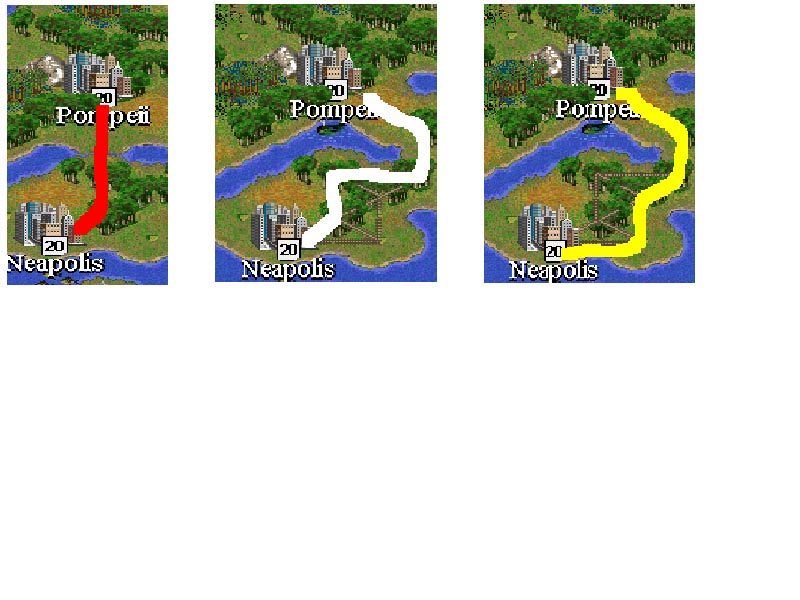
I was playing around with this for a little while today and I made some interesting observations on how the cities must be connected in order to attain the 50% road/RR bonus for trade routes. This is what I have observed...
The cities must be connected by the most direct route or else there is no bonus.
Two cities connected on the same horizontal or vertical axis
- Both get the bonus
Two cities connected on the same diagonal
- Only opponents city gets the bonus, the road/RR must leave your city on a vertical or horizontal axis and enter opponents city on a vertial or horizontal axis or else only he will get the bonus. But in furthar testing, I ran into a problem, it didn't always work out perfectly, some cities got the bonus one way but not the other way, if your city is above the city you're trading with on the map, the road/RR must leave on the vertical axis and enter on the horizontal axis, if it is below the opponents city on the map, it must leave your city on the horizontal axis and enter on the vertical axis in order for your city to have the trade route bonus. If it is built both ways both cities get the bonus.
Two cities on different axis and diagonals.
- If the road/RR leaves your city on a diagonal and enters the opponents city on a horizontal/vertical axis only your city will attain the bonus, if the opposite is true only your opponents city will have the bonus, if both are true then both cities attain the bonus.
The effect of rivers
- Rivers seem to have an interesting affect on trade routes, if two cities are on a river, both cities will receive a trade bonus. Furthar testing will be done later....
This provides some interesting conclusions, if you know which path the trade is going along, you will know how to limit your opponents trade, maximize your own and not waste time building unneccessary roads/RRs over harsh terain.
Last edited by Caesar the Great on 10-06-2001 at 02:02
|
|
| |
|
|
|
samson
|
|
Caesar the Great,
The "most direct" route is not always true.
I have seen one case where NO route provided a bonus and others where the one that does provide it seems far from direct.
The river effect on trade is news to me. What exactly do you mean by: quote:
if two cities are on a river, both cities will receive a trade bonus |
The same river? Any river?
Are you sure you're not simply seeing the extra trade caused by working bridged river squares?
I have often thought this should be true and have looked for it but have not seen it.
How would you even know if it was true, since you can't eliminate the river?
samson
P.S.
This is definitely a topic that does need to be clarified, so go for it!
|
|
| |
|
|
|
Caesar the Great
|
|
New York
Apr 1999
time: 00:14
|
|
What I meant by most direct is, the fewest number spaces possible, given the circumstances.... some of the routes I observed were in fact quite obscure, but they fulfilled the criterea and did provide a bonus.
What I meant by the statement on the river, I only did one test on this, but two cities were on the same diagonal, a river ran down that same diagonal, a railroad was built, and under these conditions the other city, as all other observations had shown, should have yielded a bonus, but didn't. Building roads/RRs in paths off of the river spaces between the two cities provided normal results, horizontal and vertical river spaces provided normal results. Your own cities/units won't interupt the trade route, enemy cities/units will. If there are water spaces in the way of the trade route no road/RR path can be established.
|
|
| |
|
|
|
Caesar the Great
|
|
New York
Apr 1999
time: 00:14
|
|
When playing with the cheat menu for a little while, I found that for open terrain the above work perfectly fine, but water complicates the situation, creating some seemingly obscure trade road/RR routes, but when looking at what happened when terrain was changed to water, there definitely seems to be a pattern to it. With water squares, the route goes normally until it hits the water square, then it goes around the water sqaure, always in the direction of the city, but when it has gone around the water square, it doesn't continue with the normal route, but instead it calculates a new route from that square to the destination city. If it runs into more water, this happens again. With multiple squares it continue until it finds another direct route to the city.
|
|
| |
|
|
|
samson
|
|
A few clarifications.
Rivers do NOT create a connection between cities or provide a trade route bonus. Neither do they form a barrier to trade routes. Both of those statements appear to be misinterpretations of other effects.
Intervening cities can have a variety of effects. They can form part of the road/rail connection, they can prevent the connection from ever being achieved, or they can create the bonus in one city (to which they are connected) even though there is NO connection at all to the destination city.
Airports (in both cities) act as a 50% road bonus. But if either a road or rail connection exists, that bonus (50% for road, 100% for rail) replaces the airport bonus.
Non-allied foreign units on the road/rail connection (even non-military units) disrupt the trade bonus. Allied foreign units do not.
Also, a terrain square changed to Ocean via the CHEAT MENU may not function the same as an original Ocean square as it effects road/rail connections. So tests conducted using that technique, may be suspect.
|
|
| |
|
|
|
arii
|
|
St-Louis MO USA
Jan 1970
time: 05:14
|
|
I posted about this about 6-8 months ago. Apparently the computer recognizes only 1 path between 2 cities. The path recognized between city A and B is different from the 1 from B and A. From my personal experience it is the same path for RR. A trick to know the recognized paths between 2 cities if you don't already have roads or no river between the 2 cities is to put a warrior in each city and order them to go to the other city.
|
|
| |
|
| |
|
| |
|
|
|
Gastrifitis
|
 |
The happy land of Engineers
Feb 2001
time: 05:14
|
|
Definite that airbases, by themselves, do not contribute to trade connections. They don't hurt, either, you just have to have roads and railroads on the square too. The Trans-Siberian Railway doesn't generally help, either. The key seems to be, as arii mentioned, the Goto command. If there is so much water in the way that the Goto command fails, the computer will never recognize a completed route.
Sometimes, when testing for the shortest route with the Goto command, I will have a railroad going in the right general direction without following the rules for the shortest route. Often the test unit will take the railroad in that occasion. (Go figure. When I want them to take the railroad, they don't.) Just after running the route, if I check back in the source city, the trade route value has increased! It's only a phantom increase, however. If I look back in the city 2 seconds later, it's gone. But it does show how closely the Goto command is tied in.
|
|
| |
|
|
|
Quantum Satis
|
|
Sweden
Aug 2000
time: 06:14
|
|
Here is a way to find out if a trade route has the road or railroad bonus. Change workers in the city to Entertainers and look at how the value of the trade route change. These values are for foreign trade routes:
No con: 0,1,2,3,4,5,6
Road: 0,1,3,4,6,7,9
Rail: 0,2,4,6,8,10,12
With Superhighways the patterns are different:
No con: 0,1,3,4,6,7,9,10,12,13,15,16
Road: 0,2,4,6,8,10,12,14,16,18,20,22
Rail: 0,2,5,7,10,12,15,17,20,22,25,27
If the routes are domestic their values increases by one regardless of whether the cities are connected or not. The exception is when a city has the Superhighways and is connected to the other city by railroad:
Rail: 0,1,2,3,5,6,7,8,10,11,12,13,15,16,17,18,20...43
(4, 9, 14, 19...39 are missing)
If the distance between two trading cities exceeds 22 squares, or the path between the two cities is too complicated then you don't get the road and railroad bonuses. Diagonal distances are the same as others.
|
|
| |
|
|
|
Quantum Satis
|
|
Sweden
Aug 2000
time: 06:14
|
|
Deleted
Last edited by Quantum Satis on 15-07-2001 at 01:15
|
|
| |
|
|
|
Quantum Satis
|
|
Sweden
Aug 2000
time: 06:14
|
|
(Trying again to attach a file)
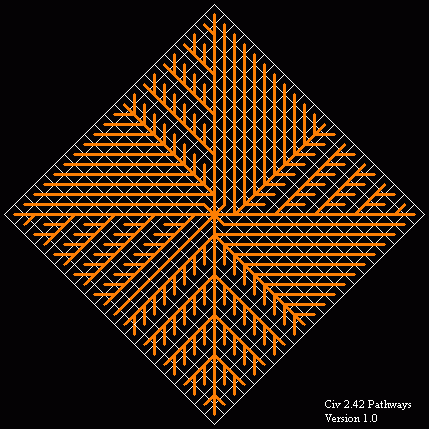
Here is a picture showing where to build roads so that the trade routes receive the road bonus. The center square is the receiving city. The picture is made with the assumptions that there is no water blocking the way, and that the date line is not crossed. Only distances up to 10 squares are shown but the road bonus can be collected for trade routes up to 22 squares long.
 Attachment: pathways10.gif Attachment: pathways10.gif
This has been downloaded 739 time(s).
|
|
| |
|
|
|
Quantum Satis
|
|
Sweden
Aug 2000
time: 06:14
|
|
La Fayette - Thank you, I'm glad someone liked the picture. Unfortunately I cannot claim any credit for it since all I did was to plot down the outcome of the GoTo-routine, so all credit goes to the person who wrote that routine.
Adam Smith - I made a map containing a continent with a size of 21 x 21 squares. A game was started and Rome was built on the center square. The Extra Land unit had been changed so that it was like an Explorer but with 16 movement points. One such unit was placed on each of the 80 outermost squares of the continent and sent to Rome, with their choice of route noted down . Some more of those units were sent from selected squares to find out the finer details of the pattern. I assume that the game checks the path of a trade route with the GoTo-routine and, as DaveV pointed out in another thread, it is likely that the programmer reused the GoTo-routine rather than writing a new for this function. So far this theory seems to be correct. The asymmetry in the pattern that you mentioned is intentional, that is, by me at least.
Rasputin - The picture shows where to build a road between two cities, the receiving city is the center square, the city sending out the caravan is any of the other squares and the road should be built following the line connecting those two squares. The picture shows only the forward route, if you want the bonus for the return route you have to place the other city in the center and see if more roads are needed. Did this make the picture any clearer?
There is another use for the picture. When a city is connected to the capital, waste (loss of shield production) in that city is reduced. A city that can produce 4 shields without waste in despotism, can then produce 6 shields without waste. This connection needs only to be built in one direction, towards the capital.
|
|
| |
All times are GMT. The time now is 05:14.
Apolyton Time is 00:14. |
top of page
|
| archivepost |
|
Forum Rules:
You may not post new threads
You may not post replies
You may not post attachments
You may not edit your posts
|
HTML code is ON
vB code is ON
Smilies are ON
[IMG] code is ON
|
|
|
|
|
|





 10-06-2001 01:50


 Attachment:







 to SlowThinker for bumping this thread. That diagram above is the most useful thing I've seen in months.............all those occasions swearing due to no bonus..........I hope it turns out to be accurate.
  |
|