|
| |
|

|
albiedamned
|
|
Ellicott City, MD
Sep 2001
time: 00:15
|
|
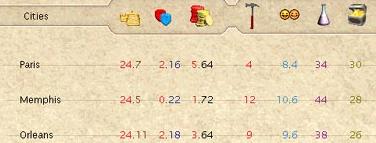
Sorry if this has been covered before. I'm trying to figure out all the details of the columns on the domestic advisor screen (I attached a snippet from the latest screenshots for reference). Here's what I think I know, and what I'm not sure about.
The first column is food, in the form of consumed.stored. Paris generates a total of 31, consumes 24, and stores 7 each turn.
The second column is shields, in the form of support.production. Paris produces 18 total shields per turn, uses 2 shields for unit support and puts 16 towards production each turn.
The third column is gold, in the form of maintenance.surplus. So Paris produces 69 total gold per turn, spends 5 for building maintenace, and has 64 for treasury, science, and luxuries.
I have no idea what the next column is. That's the one with the hammer as the column header. It's probably really obvious, but for some reason I don't get it.
The next column is luxuries. I believe the two numbers distinguish luxuries coming from city improvements vs. luxuries coming from special resources on the map. However I'm not sure what this distinction means - do the two different types of luxuries have different effects? Also, where do luxuries allocated from gold fit in? All the gold seems to be allocated to science and treasury, so gold allocated to luxuries doesn't show up on this screen.
The last two columns are obviously gold going to science and treasury.
Any insights into the stuff I'm not sure about, as well as corrections to the stuff I think I know, is much appreciated!
Also, one small suggestion - it would seem that total culture points generated per turn by each city would be a useful column on this screen.
 Attachment: domadv.jpg Attachment: domadv.jpg
This has been downloaded 261 time(s).
|
|
| |
|
|
|
albiedamned
|
|
Ellicott City, MD
Sep 2001
time: 00:15
|
|
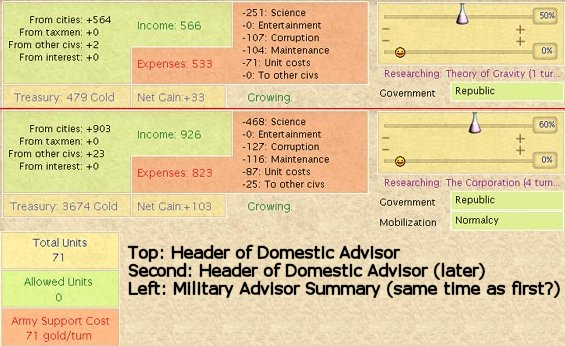
Isaac, you're probably right. Now that I think about it, I believe I remember reading somewhere in one of the previews that unit support was now in gold not shields, and that it was done at the civ level not at the city level. So the shields number is probably waste.production, not support.production.
And you're also probably right about the gold, now that I think about it. It would make sense the maintenance would also be calculated at the civ level not the city level, so the first number is probably corruption not maintenance. And thus that would explain the hammer column being maintenance. The maintenance isn't subtracted specifically from that city's gold output, it is subtracted from the civ as a whole (which is shown at the top part of the domestic advisor screen). The "hammer" column is just shown so you can know how much that city is costing you - it's not part of the calculation of the city's gold allocation.
I'm glad I asked - it makes more sense now. Any idea about the distinctions between the two types of luxuries?
|
|
| |
|
|
|
albiedamned
|
|
Ellicott City, MD
Sep 2001
time: 00:15
|
|
I'm pretty sure there are two different types of luxuries there. There are two slightly different smiley faces (one is more yellow, one is more orange), and for Paris, for example, it has 8.4. The two columns after that are science and treasury, but I don't think the 8.4 number has anything to do with them. I'm trying to understand what is the 8 and what is the 4.
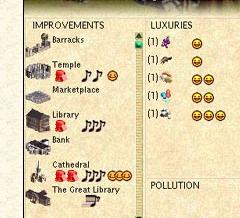
The screen shot snippet I attached below is from the Paris city view screen shot, which presumably was taken around the same time in the game as the Domestic Advisor snippet I included above. This shows 4 orange smileys being generated by improvements (1 from the Temple, 3 from the Cathedral), and 9 yellow smileys from luxuries, which I presume are the special map resources. So this is off by one from the 8.4 from the domestic advisor screen, but it's close enough to make me think there's a correlation. So I'm just wondering if the orange smileys generated by improvements are somehow different from the yellow smileys generated by luxury resources?
Attachment: domadv.jpg
This has been downloaded 237 time(s).
|
|
| |
|
|
|
Bleyn
|
|
quote:
Originally posted by MacTBone
It looks like the orangeish smilie isn't as happy, maybe they're content? |
I sort of doubt that is the case for two reasons.
1. All three cities shown in the first image have higher numbers in the first part of the smilies column than the second one. If it were a rep. of the happiness with the first number being the happy citizens and the second the content ones, that second number should be higher than the first, or maybe equal. It shouldn't be lower.
2. The second image makes it fairly clear that the two types of smilies are being generated from different sources. If you add in the smilie on the slider part of the third image, it is probably fairly safe to say that the first number is the semi-flexible production of happiness from luxuries, and the second is the more fixed generation of happiness from city improvements.
|
|
| |
|
|
|
Bleyn
|
|
quote:
Originally posted by lockstep
I agree. It is interesting, however, that the happiness from luxuries generated in each city varies slightly (from 8 to 10) according to the domestic advisor screenshot (http://www.civ3.com/images/screensh...ic_advisor2.jpg), although, judging from a map screenshot of - probably - this very game (http://www.civ3.com/images/screensh...strialages1.jpg), most of the French cities are connected by road and therefore share the same luxuries. I conclude that the effect of at least some of the luxuries is increased by specific city buildings. |
I would agree that is a reasonable conclusion. Memphis and Orleans do both have higher maintainence costs in that image than Paris. Which means more buildings, and could mean buildings that have bonuses to that sort of luxury. Of course, the question becomes what buildings might that be?
|
|
| |
|
|
|
albiedamned
|
|
Ellicott City, MD
Sep 2001
time: 00:15
|
|
My question is still this: why distinguish between the two types of luxuries on the domestic advisor screen, unless there is some difference between their effects? If luxuries from special resources and luxuries from city improvements both have the same exact effect (they make people content), then why bother breaking the number down into the two components, and why bother using two icons?
My suspicion remains that the effect of special resource luxuries is somehow different from the effect of improvement luxuries, but I'm not sure how. And I also wonder where luxiries from a gold allocation will fit in - will they go with the special resource luxuries, or the improvement luxuries. Since the screenshots provided so far don't show a gold allocation to luxuries, I can't answer that last question.
|
|
| |
|
|
|
Bleyn
|
|
quote:
Originally posted by albiedamned
My question is still this: why distinguish between the two types of luxuries on the domestic advisor screen, unless there is some difference between their effects? If luxuries from special resources and luxuries from city improvements both have the same exact effect (they make people content), then why bother breaking the number down into the two components, and why bother using two icons?
|
Actually, calling that column the Luxuries column is probably somewhat inaccurate. It is more acurately an indicator of how much Happiness is being generated in the city. What it is showing is one smily icon representing the Happiness being generated by Luxuries, and another being directly generated by City Improvements such as temples.
Its really little different in content from the Happiness Analysis subscreen in Civ2. I just looked at that screen on one of my old savegames, and it broke things down into the unaltered happiness, followed in sequence by the happiness as modified by luxuries, city improvements, troops outside the city (unhappiness), and wonders. Now they are just showing it in a different fashion.
In fact, looking over that again makes me wonder. If military units are now supported by the civilization as a whole, and not a particular city, is there any link between a military unit and any particular city that will have any effect at all? How will having units in the cities have an effect on happiness? Will your civ. explode in discontent if you decide to shift all of your forces to the outer perimeter of your area of influence and leave the center unguarded? Will there be any specific generators of unhappiness in cities other than increasing population, and the difficulty level of the game? If you have a weak culture, and there is a strong culture encroaching on your borders, will you get any indicators in form of increasing unhappiness in boarder cities?
That last one would actually be a nice touch. At least in civ/civ2, there were three ways to deal with unhappiness, increase the luxury rate, convert citizens to Elvises, or build city improvements. If, in civ3, losing the culture war in a city meant increasing unhappiness before the revolt, you would actually be getting a warning with one appropriate and two inappropriate counter-actions. Fiddling with luxury rates and entertainers would treat the symptoms but not cure the disease. Building temples and the like would not only help fix the symptoms, it would go to fixing the cultural disease in a way that I doubt the others will.
|
|
| |
|
| |
All times are GMT. The time now is 05:15.
Apolyton Time is 00:15. |
top of page
|
| archivepost |
|
Forum Rules:
You may not post new threads
You may not post replies
You may not post attachments
You may not edit your posts
|
HTML code is ON
vB code is ON
Smilies are ON
[IMG] code is ON
|
|
|
|
|
|





 22-09-2001 17:44





 |
|