|
| |
|

|
Oerdin
|
 |
of Internet Music.
Sep 2001
time: 21:15
|
|
I personally would rather have a real nation like Scotland or Ireland represent the Celts but people have voted over wellingly for the inclusion of a more broadly defined Celtic civ. So without further ado here is the first proposal for a Celtic civ.
--------------
* The Celts *
--------------
Names: Celtic Empire, Celts, Celtic
Time Period: 500B.C. and 200 A.D. (though states such as Scotland & Ireland survive to this day)
Leader: King Arthorius (Arthur)
Unique units: Woad Warrior; a swordsman that has a +1 to movement
CSAs: Commercial and either Militerist or Religious.
Historical Significance: A widely spread cultural group that dominated Europe from 500B.C. to 200A.D.; Celtic artifacts have been found in Asia Minor and as far away as the Tarim basin, Xinjiang provience, China.
Description:
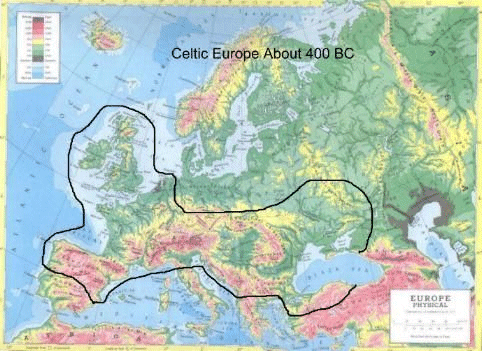
CELTS:- An ancient people who dominated much of Western , Central , Eastern Europe and Asia Minor in the 1st millennium bc, giving their language, customs, and religion to the other peoples of that area.
History:- The earliest found archaeological evidence associated with the Celts places them in what is now France and western Germany in the late Bronze Age around 1200 bc. In the early Iron Age, they are associated with the Halstatt culture (8th-6th cent. bc) named for an archaeological site in Upper Austria. They probably began to settle in the British Isles during this period. Between the 5th and 1st centuries bc , their influence extended from what is now Spain , the islands of the British Isles to the shores of the Black Sea , from the Ukraine to Turkey. This huge land/cultural region ( never an 'Empire') encompassing the areas mentioned influenced much of the continent of Europe and was greater in size then modern European Russia. Despite the shared religion/language and culture this large area was never politically united , finding only brief periods of unity when threatened by common foes. The later Iron Age phase of Celtic Culture is called La Tene, after a site in Switzerland and dates from the previously mentioned 5th to 1st centuries bc. Evidence from this period suggests that the Celts were the first peoples of Europe to actively use and work with iron. The word Celt is derived from Keltoi, the name given to these people by Herodotus and other Greek writers. To the Romans, the Continental Celts were known as Galli, or Gauls; those in Britain were called Britanni. In the 4th century bc the Celts invaded the Greco-Roman world, conquering northern Italy and sacking Rome, whilst also conquering Macedonia and Thessaly. They plundered Rome in 390, sacked Delphi in 279, and penetrated Asia Minor, where they were known as Galatians. The "Cisalpine Gauls" of northern Italy were conquered by the Romans in the 2nd century bc .Transalpine Gaul (modern France and the Rhineland) was subdued by Julius Caesar in the 1st century bc. and most of Britain came under Roman rule in the 1st century ad. In the same period. the Celts of central Europe being fragmented came under the domination by the Germanic peoples. In medieval and modern times the Celtic tradition and languages survived in Brittany ( Western France), Cornwall, Galicia ( North Western Spain) , Galatia ( Central Turkey), Wales, the Scottish Highlands, Isle of Man and Ireland, and to a lesser extent in the Norse/Celtic culture of Iceland.
Way of Life:- The various Celtic tribes were bound together by common speech, customs, and religion, rather than by any well defined central governments. There government was through the use of a feudal system with each tribe being headed by a king/chief and was divided by class into Druids (priests), warrior nobles, and commoners/freemen and slaves . Politically there was a great degree of democracy within the society with both men and women being treated equally and all important decisions being made at tribal gatherings in which women had an equal voice. Rulers were subject to removal at these gathering if found unsatisfactory or incompetent and succession was not necessarily hereditary. The absence of any large scale political unity amongst the tribes contributed substantially to the extinction of their way of life, making them vulnerable to their enemies. Their economy was pastoral and agricultural and they had no real urban life however trade played a large part in there economy . The nobles fought on foot with swords and spears and were fond of feasting and drinking. Celtic mythology, which included earth gods, various woodland spirits, and sun deities, was particularly rich in elfin demons and tutelaries, beings that still pervade the lore of peoples of Celtic ancestry.
Celtic Christianity:- The Christian faith was well established in Celtic Britain by the 4th century ad, but in the 5th century the Saxons and other Germanic peoples invaded the country, driving most of the Celtic Christians into Wales and Cornwall. At the same time. St. Patrick and other British missionaries founded a new church in Ireland, which then became the centre of Celtic Christianity. The Irish church developed a distinctive organization in which bishops were subordinate to the abbots of monasteries .The Irish monks, devoted to learning as well as religion, did much to preserve a knowledge of ancient Roman literature in early medieval Europe. Between the late 6th and the early 8th centuries, Irish missionaries were active in Christianizing the Germanic peoples that had conquered the Western Roman Empire, and they founded numerous monasteries in present-day France, Germany, Switzerland , and Italy. Celtic Christianity in Ireland was weakened by the Viking invasions of the 9th and 10th centuries, and by the 12th century its characteristic institutions, which were incompatible with those of the dominant Roman church, had largely disappeared from Europe.
Art:- Celtic art is considered the first great contribution to European art made by non Mediterranean peoples. Its roots go back to the artisans of the Urnfield culture and the Hallstatt culture (8th-6th cent. bc) at the beginning of the Iron Age. It flowered in the period of the La Tene culture. Although Celtic art was influenced by ancient Persian, Greek, Etruscan, and Roman art and by that of the nomads of the Eurasian steppes it developed distinctive characteristics. These are evident in its major artefacts-weapons, vessels, and jewelry in bronze, gold, electrum and occasionally silver. Many of these objects were made for chieftains in southern Germany and France and were recovered from their tombs. The Celtic style is marked by a preference for stylised plant motifs, usually of Greek origin, and fantastic animals, derived from the Scythians and other steppe peoples; however the human figure tended to play a secondary role. Other favourite motifs are elliptical curves and opposing curves. spirals, and chevrons, also derived from steppe art. These elements were combined in dynamic yet balanced, intricate geometrical patterns carried out in relief engraving, or red, yellow, blue, and green champleve enamel on shields, swords, sheaths, helmets, bowls, and jewelry. They also appeared on painted pottery cinerary urns, food vessels, incense bowls, and drinking cups. Examples of Celtic art include torcs, or neck rings, with the two open ends ornamented with animal heads, the silver repousse Cundestorp cauldron (c. 400 bc . National Museum, Copenhagen), a bronze lozenge-shaped shield with circular medallions and small enamel circles (1st cent. bc - 1st cent. ad ), and a bronze mirror with enamelled decoration (1st cent. bc) (both British Museum. London). Also surviving are roughly carved stone monuments and wooden objects. During the period of Roman domination of Western Europe in and after the 1st century bc the art of Celtic peoples on the Continent gradually lost its distinctive style. The Celts of Ireland continued to work with traditional motifs but as Christianity took hold, they combined them with Christian motifs and employed their skills in the service of the church.
Celts Today:- Today the people who call themselves Celts or still strongly identify with there celtic history can be found in the following areas:- Brittany France, Cornwall, Galicia Spain, Galatia Turkey, Ireland, Isle of Man, Scotland and Wales. All these areas have strong Celtic elements to there culture with some of them still speaking Celtic Languages whilst others though not speaking a Celtic language have strong Celtic cultural rootes. The modern Celts have a varied and rich history and have influenced many of the worlds current great nations with their pioneering spirit and love of adventure helping to found some of the worlds most progressive and greatest nations.
|
|
| |
|
| |
|
|
|
Alexander01

|
|
Thank you. Vercingettorix is also my personal favorite. Of course, there are plenty of famous Celtic leaders:
Vercingettorix, Cunobelin, Boadicea, Vortigern, Vortimer, Aurelius Ambrosius (Romano-Briton), Uther Pendragon, Arthur, Llewellyn, Gruffyd, Rhys, and any number of Scots, though they weren't pure-bred Celts anymore, too much Saxon and Norman mingling.
Unfortunately, though the Celts were very influential and successful for a time, even the greatest leaders had their defeats.
Vercingettorix had to surrender to Caesar, Boadicea committed suicide, Vorterigern's Saxon mercenaries turned on him, Arthur was killed at the Battle of Camlann. (or was it Mt. Badon?)
As capital city I suggest either La Tene or Tintagel. Or Camelot for the die-hards. 
|
|
| |
|
| |
|
| |
|
| |
|
| |
|
|
|
Oerdin
|
|
of Internet Music.
Sep 2001
time: 21:15
|
|
Name: Celts, Celtic
Time Period: 500BC-200AD
Leader: Vercingettorix (Celtic King who fought Julius Caeser)
Unique units: Woad Warrior; a swordsman that has a +1 to movement
CSAs: Commercial and Religious.
History: This section needs to be edited down to under 1000 words. Right now we have about two pages. As soon as I get a chance I'll reedite the text and submite it for review.
Capital: La Tene
City list: Tintagel, Llundain (London) , Caer Baddon (Bath) , Rhydychen (Oxford),
Caergrawnt (Cambridge), Caeredin (Edinbrugh), Catraeth (Catterick), Caerloyw (Gloucester), Caerdydd (Cardiff), Ty Ddewi (St Davids), Caerfyrddin (Carmarthen),
Aberteifi (Cardigan), Abertawe (Swansea), Bangor, Caernarfon, Castell Nedd (Neath), Casnewydd (Newport) ,Y Trallwng (Shrewsbury), Galatia, Numantia, Kells,
Armagh, Caernarfon, Caerphilly, Cork, Rhymney, Iona, Rhondda, Illauntanig, Durrow, Merthyr, Tara, Llangollen, Dinas Powys, Aberystwyth, Rhayader, Abergavenny, Dinas Emerys, Llanelli, Maesteg.
Great Generals/war leaders: Boadicea, Arthur, Cunobelin, Vortigern, Vortimer, Aurelius Ambrosius (Romano-Briton), Uther Pendragon, Llewellyn, Gruffyd, Rhys.
Can anyone think of anything that should be changed or added?
|
|
| |
|
|
|
Va-Toran
|
|
La Tene is a major archeological site in Switzerland, and not the same place as Tintagel.
Another city worth adding is Hallstatt, which is another very important archeological site in Austria.
|
|
| |
|
|
|
molly bloom
|
 |
Lundenwic
Oct 2001
time: 15:15
|
|
While I was pondering the subject of Celtic Wonders, I thought of the salt trade and the tin trade. The Hallstatt site/culture stems in part from salt mining/trading, and the element 'Hall' in placenames is a synonym of Celtic origin for the Germanic Salz, and thus: Hallstatt, Reichenhall, Hallein and Hall, and in Gaul, placenames beginning with 'Al', such as Alesia. Salt was a new form of wealth (hence salary, from the Latin) an essential feature for any sedentary culture, an object of long distance trade across Western and Central Europe. It enabled the preservation of foodstuffs and could be fed to cattle to strengthen them. The tin trade was with the Mediterranean, through Phoenician middlemen, and most likely in Cornwall, from, or near St. Michael's Mount, in Mount's Bay off Marazion. The island of St. Michael's Mount is accessible at low tide via a causeway.
Failing the trading option, then what about Carn Brea or Maiden Castle, or for a later Celtic golden age trigger, a scriptorium such as produced the Book of Durrow, the Book of Kells, or the Lindisfarne Gospels?
Maiden Castle:
www.gallica.co.uk/celts/maiden.htm
Carn Brea:
www.cledha.freeserve.co.uk/cbpg/
Some possibly Celtic mummies:
www.channel4.com/nextstep/mystery_mummies
The Celts of Northern Italy also wrote in Lepontic script, in characters derived from the Etruscan alphabet, and there's also Iberian inscriptions from Contrebia in Spain, and Gallo-Greek from Vaison-la-Romaine. Not just the Irish with the gift of the blarney, it seems.
Should Dublin really be on a list of 'celtic' settlements by the way? The area was known as dubh/dubb linn to the Celtic population, but the town grew up from a Viking longphort. As an Irish settlement yes, but not as a Celtic one, IMHO.
|
|
| |
|
| |
All times are GMT. The time now is 05:15.
Apolyton Time is 00:15. |
top of page
|
| archivepost |
|
Forum Rules:
You may not post new threads
You may not post replies
You may not post attachments
You may not edit your posts
|
HTML code is ON
vB code is ON
Smilies are ON
[IMG] code is ON
|
|
|
|
|
|





 19-10-2001 23:45


 Attachment:


 |
|