|
|
|
I voted "other", but I want them left in or replaced by another Native American tribe from that region... we should have at least 4 native americans, 2 for north america and 2 for central/south america. Thus Inca/Aztec/Apache(or Sioux)/Iroquois(or cherokee).
|
|
| |
|
| |
|

|
Ribannah
|
 |
The Netherlands, Embassy of the Iroquois Confederacy
Aug 2000
time: 06:15
|
|
The Iroquois - not just the League, but all Iroquois - counted 20% of all native Americans north of Mexico after European diseases reduced the total Amerind numbers there from 15 million to 500,000.
In their Golden Age they ruled a big part of the region, controlling almost all the trade with the Europeans. The League in particular also had vassal tribes that
payed tribute to them, such as the Delawares, and were the spokespeople for many of their neighbours in dealings with the colonialists. No enemy, including the Sioux and (on and off) the French, could withstand them.
In addition, the Iroquois gave mankind much agricultural and social knowledge.
I'd say this is plenty significant if you compare them to, for instance, the Algonquins or the Cherokees, or other civ3 tribes as the Persians or Egyptians.
|
|
| |
|
|
|
Ribannah
|
|
The Netherlands, Embassy of the Iroquois Confederacy
Aug 2000
time: 06:15
|
|
Wulfram: Yes, that's the same map I found.
Here is a description of Iroquois territory:
http://www.tolatsga.org/iro.html
quote:
The original homeland of the Iroquois was in upstate New York between the Adirondack Mountains and Niagara Falls. Through conquest and migration, they gained control of most of the northeastern United States and eastern Canada. At its maximum in 1680, their empire extended west from the north shore of Chesapeake Bay through Kentucky to the junction of the Ohio and Mississippi Rivers; then north following the Illinois River to the south end of Lake Michigan; east across all of lower Michigan, southern Ontario and adjacent parts of southwestern Quebec; and finally south through northern New England west of the Connecticut River through the Hudson and upper Delaware Valleys across Pennsylvania back to the Chesapeake. With two exceptions - the Mingo occupation of the upper Ohio Valley and the Caughnawaga migration to the upper St. Lawrence - the Iroquois did not, for the most part, physically occupy this vast area but remained in their upstate New York villages. |
This is all prime land for agriculture and/or hunting.
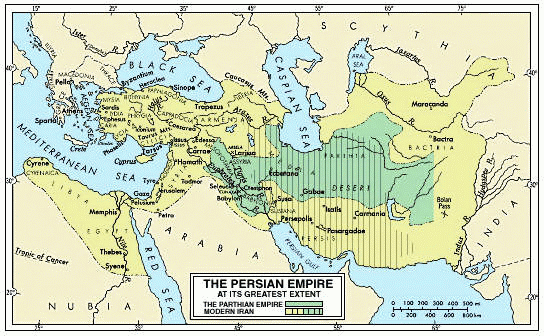
While the Iroquois did not build cities like Persepolis, they did have gardens. 
quote:
Originally posted by Locutus
As much territory as the Iroquois may have ruled over, the technological level and the impact that a a civilization had on the world at large should also be taken into account when you rank civs. In this area the Iroquois, although certainly not insignificant, are IMHO inferior to the other civs from the top 32 (excluding Zulus of course and maybe the Hebrew). It's true that at least some people on this forum seem to underestimate the importance of the Iroquois but I'm not sure if I'd place them in the top 32 of most important civilizations in human history either (they should still be in Cvi3 IMHO but only for 'political' reasons). |
I would rather say that technology is more important than size. However, in my opinion we should not compare the (static) knowledge of civs, but what new things they added. Some of these 32 may have started on a high enough level, but never discovered anything of importance.
The Iroquois gave human civilization important agricultural and social knowledge.
For instance, after contact with the Iroquois, the Dutch started to plant more
than one crop on a given field (although they used rotation rather than the Three Sisters system) instead of the old way of leaving fields fallow. This allowed them to have a merchant class of 25% of their total population, while their competitors had 95% of their people working in agriculture, and made the Dutch the wealthiest civilization in the world for more than a century, until their rivals finally grasped the concept. Human civilization would not be where it is now, had we not learned this new technique.
|
|
| |
|
|
|
oriel94
|
 |
Sydney, Australia
Oct 2001
time: 15:15
|
|
Once again, I'm sorry, but I must beg to differ. The Iroquois had no written language in any meaningful sense. Art is not the same thing as writing. Furthermore, if you want to see what an Iroquois 'city' looked like, you might visit the Royal Ontario Museum at
http://www.rom.on.ca/digs/longhouse/longvillage.html
These were temporary structures which would last a couple of seasons until the land was exhausted, whereupon the 'city' would relocate.
I'm sure the Iroquois were and are an admirable people with 'much to teach us', etc. But whatever else they were, they were not a civilisation. They were a borderline late stone-age and early agricultural people.
The Aztecs and the Incas were civilizations. They had real permanent cities made from stone. 'Civis', hence 'civilisation', is the latin word for town or city. The Aztecs also appear to have had a written language, although this is somewhat more doubtful in the case of the Incas.
Last edited by oriel94 on 08-11-2001 at 05:36
|
|
| |
|
|
|
Ribannah
|
|
The Netherlands, Embassy of the Iroquois Confederacy
Aug 2000
time: 06:15
|
|
quote:
Originally posted by oriel94
Once again, I'm sorry, but I must beg to differ. The Iroquois had no written language in any meaningful sense. Art is not the same thing as writing. |
The Iroquois (and many other native tribes in North America) used a script of glyphs. Laws, treaties and important events were recorded on wampum belts. Messengers used glyphs on less permanent surfaces in case they had business with tribes that did not speak their language.
quote:
Furthermore, if you want to see what an Iroquois 'city' looked like, you might visit the Royal Ontario Museum at ...
These were temporary structures which would last a couple of seasons until the land was exhausted, whereupon the 'city' would relocate. |
Before European contact, the Iroquois usually stayed in the same place for about 20 years, not much different from many other civs elsewhere in the world. They would move a couple of kilometers along the river and return when the soil had recovered. Quite different from setting up a tipi or wigwam and moving twice a year. They used construction techniques such as the arch to make their longhouses last. They had other things besides houses that are typical for a permanent town, such as palisades, granaries, gardens and guesthouses. Fishing lodges were nearby, and their villages were connected by permanent roads. They had long trade routes and used wampums (without writing) as currency.
quote:
I'm sure the Iroquois were and are an admirable people with 'much to teach us', etc. But whatever else they were, they were not a civilisation. They were a borderline late stone-age and early agricultural people. |
I have no idea what you mean by those qualifications. What I do know is that
Iroquois agriculture was in some ways more advanced than what Europeans had.
Furthermore, I think it is weird to deny a people who had formed a confederacy of nations, with a constitution, a participatory democracy, women's rights, etc., again long before the Europeans had any of the sort, the right to be called a civilization - for just a single reason: they didn't make their houses from stone.
Well, it may come as a surprise to you, but many civilizations didn't build stone
houses. in 1665 the great city of London, made of wood and straw, burned to the ground. So we can't really call the British a civilization either, can we? 
In general, people simply used what was readily available. The Aztecs had good stone and bad wood. The Iroquois and the British had good wood for building. Other civs used loam. So what?
|
|
| |
|
|
|
Trifna
|
 |
of anchovies
Jul 2001
time: 13:15
|
|
quote:
Originally posted by Ribannah
Err - no.
The Sioux are rather far cousins of the Iroquois and certainly not of the same civilization. You are also forgetting the Pueblo tribes (Hopi, Zuni), the Anasazi (/Navaho), the Aztecian tribes (Soschone, Comanche), to name just a few groups.
The Iroquois were not constantly at war, this is pure myth. They formed the League exactly to make sure that they weren't; other confederations in the region followed for the same reason. Only after the Europeans came was there
more warfare - but still not constant.
I am curious to hear why. |
I didn't meant constantly at war, but that war was an important thing in their culture. The warrior was valorised alot, etc.
And about Sioux and such, I may not be in the same group of tribes, but they were culturally similar. Like the case of Portugal/Spain, all the ones grouped in "Babylonian" in Civ III, or even Visigoth and Ostrogoth (that did have some differences but could be generalized as Goths)
|
|
| |
|
|
|
Ribannah
|
|
The Netherlands, Embassy of the Iroquois Confederacy
Aug 2000
time: 06:15
|
|
quote:
Originally posted by Trifna
And about Sioux and such, I may not be in the same group of tribes, but they were culturally similar. Like the case of Portugal/Spain, all the ones grouped in "Babylonian" in Civ III, or even Visigoth and Ostrogoth (that did have some differences but could be generalized as Goths) |
Let's see ...
The Sioux chiefs took their title by force, the Iroquois held elections.
The Sioux rode horses, the Iroquois had muskets.
The Sioux hunted the bison, the Iroquois planted corn.
The Sioux women had few rights, the Iroquois women had many.
The Sioux lived in tents, the Iroquois in longhouses.
.....
They aren't in the same linguistic group either.
And this is a neighbouring nation, the differences with the Zuni, Comanche and Seminole, to name a few, are even larger.
|
|
| |
|
|
|
orange
|
 |
It doesn't matter what your name is!
Feb 2000
time: 00:15
|
|
quote:
Originally posted by Ribannah
The Iroquois had both writing and permanent towns (up to 4,000 people), even before the Europeans arrived.
Did you think Firaxis just invented their city list? |
4,000 people?? Ribannah that's not a town, that's a village! My home town has 7,000 people in it, and my God it's not densely populated at all 
You also have to look at population. The Persian Empire at its height (including Tyre, Antioch, Babylon, Alexandria, etc. etc. etc.) was home to probably 10X or more the population of any time in Iroquois history, possibly even Native Americans altogether!
|
|
| |
|
|
|
Ribannah
|
|
The Netherlands, Embassy of the Iroquois Confederacy
Aug 2000
time: 06:15
|
|
quote:
Originally posted by Trifna
But for their language, are you sure? i mean, they all came from the same people.
|
Yes, I'm sure. Remember, they had thousands of years to develop their languages since they crossed over from Siberia! Sioux and Iroquois could not understand each other's tongue one bit (unless they learned to, of course).
quote:
But after your arguments, I'd stil keep my position on something: they seem to have quite the same way of doin. |
Give one single example!
quote:
By the way, are you sure Iroquois cultivated corn that much compared to Sioux?... Cuz as I know that Americans emphasized the corn culture within American tribes because of some advantage it had. And it gave dentition problems to the concerned Amerindians. As I know, Iroquois were hunting what they had in their regions. |
Yes, I'm sure. The Iroquois did some hunting and fishing to complete their meal, but agriculture was the basis since around 900 AD. Later, when the Dutch and French arrived, they hunted the beaver for trade.
quote:
For Sioux taking over Iroquois, well it's not a factor that much if we consider that interior wars between factions are always there in any culture. |
On occasion, Iroquois fought Iroquois. But war between different cultures is just as common! The Iroquois drove the Sioux from their original hunting grounds so they could trade more fur. The Sioux (better: Lakota) did not stand a chance against the superior Iroquois warfare skills. They retreated to the plains, then grew into the horseriding tribe as we now remember them.
Orange, it's like Wulfram says, 4,000 people was quite a town in those days.
The total number of natives north of Mexico is estimated to have been 15 million, which dropped to a mere 500,000 because of the diseases (and slaughter) brought by the Europeans.
|
|
| |
All times are GMT. The time now is 05:15.
Apolyton Time is 00:15. |
top of page
|
| archivepost |
|
Forum Rules:
You may not post new threads
You may not post replies
You may not post attachments
You may not edit your posts
|
HTML code is ON
vB code is ON
Smilies are ON
[IMG] code is ON
|
|
|
|
|
|







 05-11-2001 05:32


 Let's see how long we'll stay here this time




 Attachment:


 |
|